Posts by admin
On the Yoga and Mantra Siddhi
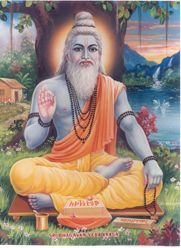
* Veda Vyasa *
>> The S’rîmad Devî Bhâgawatam <<
Translated by Swami Vijñanananda
(Sanskrit, n., देवी भागवतपुराण, DevÄ« BhÄ�gavatapurÄ�na, „the old book of the Goddess“), also known as Shrimad Devi Bhagvatam or Devi Bhagavatam, is one of the most important work in Shaktism, the veneration in Hinduism of the divine feminine, next to Devi Mahatmya.
1. Himâlayâ said :– „O Mahes’varî! Now tell me the Yoga with all its Amgas (limbs) giving the knowledge of the Supreme Consciousness so that, I may realize my Self, when I practice according to those instructions.
2-10. S’rî Devî said :– „The Yoga does not exist in the Heavens; nor does it exist on earth or in the nether regions (Pâtâla). Those who are skilled in the Yogas say that the realization of the identity between the Jivâtma and the Paramâtmâ is „Yoga.“
O Sinless One! The enemies to this Yoga are six; and they are lust, anger, greed, ignorance, vanity and jealousy. The Yogis attain the Yoga when they become able to destroy these six enemies by practicing the accompaniments to Yoga. Yama, Niyama, Âsana, Prânâyâma, Pratyâhâra, Dhâranâ, Dhyâna, and Samâdhi, these are the eight limbs of Yoga. Yama includes Ahimsâ (non-injuring; non- killing); truthfulness; Asteyam (non-stealing by mind or deed); Brahmacharya (continence); Dayâ (mercy to all beings); Uprightness; forgiveness, steadiness; eating frugally, restrictedly and cleanliness (external and internal). These are ten in number. Niyama includes also ten qualities :– (1) Tapasyâ (austerities and penances); (2) contentment; (3) Âstikya (faith in the God and the Vedas, Devas, Dharma and Adharma); (4) Charity (in good causes); worship of God; hearing the Siddhântas (established sayings) of the Vedas; Hrî or modesty (not to do any irreligious or blameable acts); S’raddhâ (faith to go do good works that are sanctioned); (9) Japam (uttering silently the mantrams, Gâyatrîs or sayings of Purânas) and (10) Homam (offering oblations daily to the Sacred Fire). There are five kinds of Asanas (Postures) that are commendable: Padmâsan, Svastikâsan, Bhadrâsan, Vajrâsan and Vîrâsan. Padmâsan consists in crossing the legs and placing the feet on the opposite thighs (the right foot on the left thigh and the left foot on the right thigh) and catching by the right hand brought round the back, the toes of the right foot and catching by the left hand brought round the back the toes of the left foot; sitting then straight and with ease. This is recommended by the Yogis (and by this one can raise oneself in the air).
Ma Ganga Retreat above Rishikesh, India

>> Ma Ganga Retreat above Rishikesh, India <<
Retreats and Tours Developed by the American Institute of Vedic Studies
We are happy to announce that our third annual Inner Tantric Yoga Experience: Ma Ganga Retreat, March 9-14, 2010 is now open for early registration. It will feature deeper teachings for serious students and sadhaks and special interaction with Vamadeva and Shambhavi by the sacred Ganga river in a quiet resort above Rishikesh. The resultant experience is transformative and life-changing.
The program will emphasize ritual, mantra, pranayama and meditation to connect one directly to the Shiva and Shakti forces of the Himalayas that represent the soul of India. Shambhavi teaches special mantras and does unique chanting programs for the students. Students are expected from all over the world including from the United States, India, Brazil, Russia and Germany. The retreat is a spiritual celebration of life and the Ganga that can both purify and energize us at a deep level.
Ayurveda Under Cultivation
Robert E. Svoboda
>> AYURVEDA SVOBODA, BOOKS & GALLERY<<
>> BRIHAD ARYANKA UPANISHAD <<
Ayurveda Under Cultivation
An aranyaka is an ancient Vedic text that was composed in, and meant to be studied in, a forest. Though the texts of classical Ayurveda were written with urbanites in mind, they are verily aranyakas in spirit, for they carry to city dwellers an urgent „back to Nature“ message. To better access that message let us for a moment remove ourselves from the metropolis, and imagine that we are seated under a spreading banyan tree that shades an Ayurvedic guru’s ashram.
The guru sits, dispensing teachings and healings, inspired by the tree’s prana, guided by its intelligence, permitting the natural curative energy of the universe to flow through into student and patient, resisting the blandishments of the ego that yearns to claim doership. Ayurveda herself is a living entity – we can call her the Ayur Vidya – who, being an innate property of the cosmos, exists mainly in the non-physical world. The Ayur Vidya, who develops and spreads in our world solely by finding suitable hosts here, sends her shakti into the substances used in healing and the healers alike, facilitating healthy relationships between those roots and fruits that are administered and the hands that administer them. The wise practitioner of Ayurveda seeks only to serve as a fit vessel for her wisdom, rather to pretend any personal capacity to accomplish anything.
Lama Jigme´s Sunday’s Reading
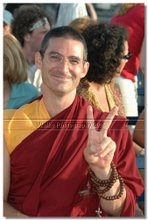
and how to feed a monk with a dollar…
May you enjoy my gifts to you in the best of happiness and health!
Lama Jigme
Who is Lama Jigme ?
Ordained as Lama Jigme Gyatso: Rime Manipa Tantrika, which translates as “Ocean of Courage Teacher; ” he is a Jewish-american born, Tibetan-buddhist: Monk, Teacher, Healer and Tantrika.
Lama Jigme was taught to be devoted to the Buddha of Compassion {Manipa} in a NON-sectarian manner {Rime} that practices Sutra’s union of compassion and insight as well as the union of Tantra’s paths of devotion, imagination and sensuality {Tantrika}.
In an age when many are content to hide behind tradition, hearsay, dogma and circular reasoning this controversial and unconventional teacher insists that a true Lama’s resume, credentials and letters of recommendation are the vastness of his Compassion, the profundity of his Insight and the power of his Effectiveness.
Lama Jigme Gyatso has had the very good fortune to receive teachings from every major Buddhist lineage of the Theravada, Mahayana and Tantric traditions.
TANTRA & VEDA: One Tradition
Vedic Light and Tantric Energy Yogas
By David Frawley
Tantra and Veda: One Tradition
A number of writers and teachers, particularly in Western academia, have tried to divide the two great traditions of India of Veda and Tantra as different or even contrary. Some Yoga teachers have uncritically taken up this view as well. They see the Vedic tradition as Aryan and patriarchal and the Tantric tradition as non-Aryan and matriarchal. They identify the Vedic tradition with invading Aryans and the Tantric tradition with indigenous Dravidians. They see the Tantric as worshipping the Mother Goddess and the Vedic as rejecting her. They imply that Vedic and Tantric ideas and practices are very different.
Now that the Aryan Invasion theory is severely in question, and the Sarasvati River of Vedic fame, discovered as the main homeland of civilization in ancient India, we should reexamine these views. In my own more than thirty years of studying Vedic and Tantric texts in the original Sanskrit, I have also found remarkable connections between the two traditions.
Vedic and Tantric traditions are one, though with different orientations. The Vedic tradition is an earlier form of the Tantric, which itself is a later development of Vedic practices. Tantric teachings abound in the use of Vedic mantras and the mysticism of the Sanskrit alphabet. They use Vedic fire altars and practices and honor Vedic deities at an inner level. Inner Tantric Yoga reflects the four main Vedic deities of Agni, Soma, Vayu and Surya (the forces of fire, moon, wind and sun).
Moderne Physik – Klang & Schwingung
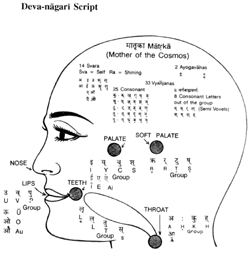
SPRACHE KLANG & SCHWINGUNG
>> THE MYTH OF QUANTUM CONSCIOUNESS <<
Nicht nur in der modernen Physik, bzw. neuesten naturwissenschaftlichen Erkenntnissen hat Masse keine materielle Substanz mehr, und man ist daher nicht mehr der Ansicht, dass Teilchen aus irgendeinem Grundstoff bestehen, sondern sie sind Energiebündel… diese dynamischen Strukturen oder Energiebündel bilden die stabilen nuklearen, atomaren und molekularen Strukturen, die die Materie aufbauen und ihr den Anschein geben, als bestünde sie aus einer festen materiellen Substanz. Doch gehen wir zurück zur Auffassung der Tantras hinsichtlich dieses Themas:
TASC – HHTDL visit to southern California
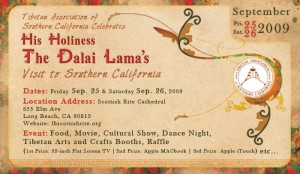
>> Visit to Southern California <<
In celebration of His Holiness the Dalai Lama’s Visit to Southern California on Fri Sept 25 and Sat Sept 26, 2009. Two Fun Filled days of Food, Movie, Cultural Show, Dance Night, Art & Crafts Booths, Donation Raffle.
The >Tibetan Association of Southern California (TASC)< was founded on September 16, 1993 at Thubten Dhargye Ling, Los Angeles, California in the presence of Kalon Tenzing N. Tethong, Dhonchod Renchen Dharlo and Special Envoy Gyari Rinpoche. Eight board members were elected. At the Beverly Wilshire Hotel in September 93, H.H.D.L. blessed and offered each of the newly elected board members khatas and wished them the best.
NAVARATRI – NINE DIVINE NIGHTS
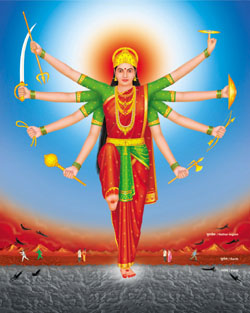
>> Navaratri Festival Campaign <<
DIE 9 NÄCHTE DER GROSSEN GÖTTIN NAVDURGA
(19.09.2009, in India and everywhere)
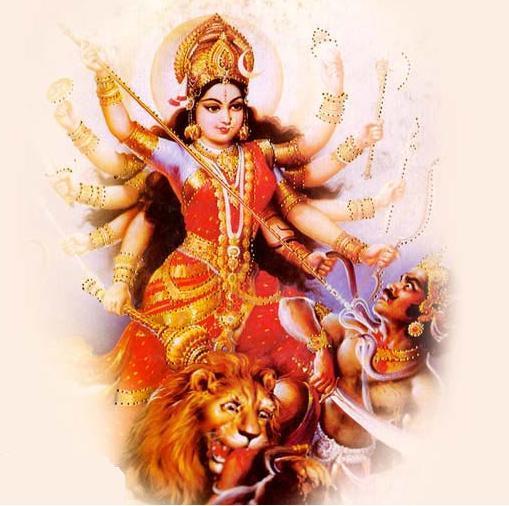
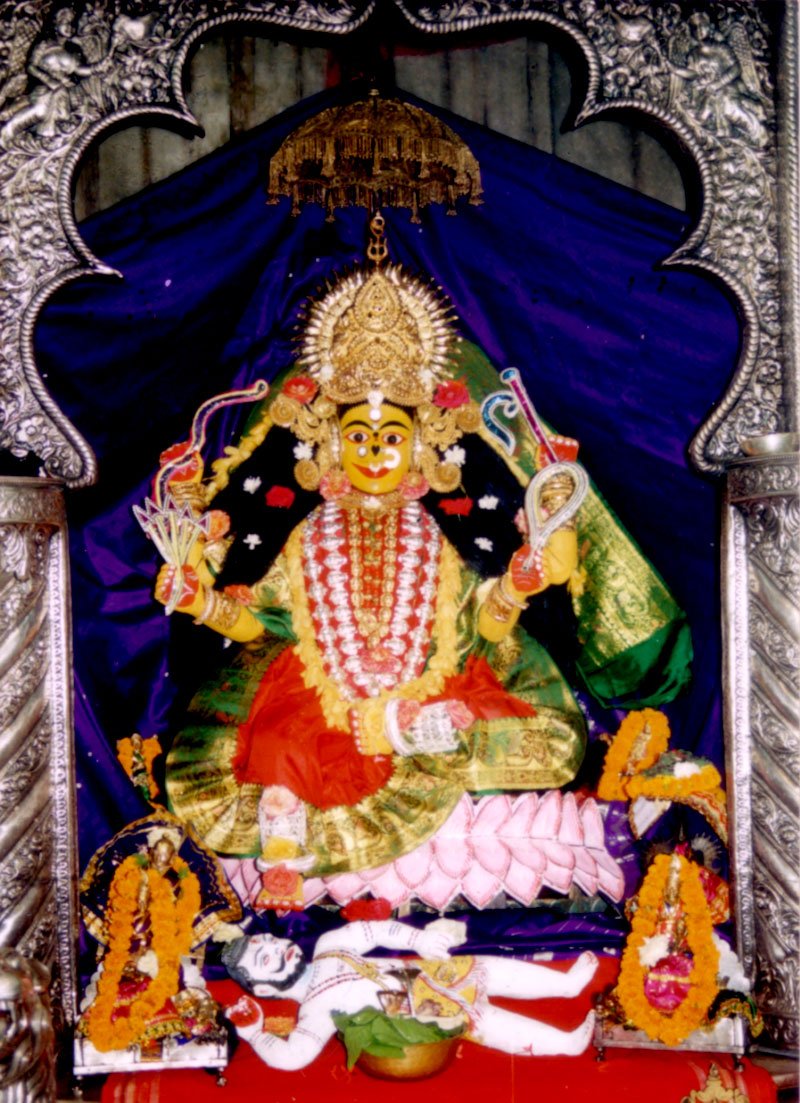
Navaratri (Marathiनवरात्रि,Sanskrit: नवरात्रि, Bengali: নবরাত্রি, Tamil: நவராத்திரி, Kannada:ನವರಾತ್ರಿ) is a Hindu festival of worship and dance. The word Navaratri literally means nine nights in Sanskrit; Nava meaning Nine and Ratri meaning nights. During these nine nights and ten days, nine forms of Shakti/Devi i.e. female divinity are worshipped.
Durga als Dreiheit der Natur – Göttliche Mutter Durga, welche in allen Geschöpfen in Form von Intelligenz, Barmherzigkeit & Schönheit existiert. Sie ist die Gemahlin von Shiva, welcher das Universum erschafft, erhält & zerstört. Ein Gruß an die Göttliche Mutter Durga, welche in allen Geschöpfen in dieser Form allgegenwärtig ist.
Durga Navaratri beginnt am ersten und endet am zehnten Tag nach Neumond des Monats Aswayuja (September/Oktober). Das Fest erinnert an den Sieg von Durga über Mahishasura, den büffelköpfigen Dämon. In Bengalen wird ihr Bild neun Tage lang verehrt und dann dem Wasser übergeben. Der zehnte Tag heißt Vijaya Dasami oder Dussera (der „zehnte Tag“). Am zehnten Tag werden in den Dörfern und Städten Prozessionen mit einem Durga-Bildnis abgehalten.
Lama Thubten Yeshe – Discovering Buddhism

>> DISCOVERING BUDDHISM <<
The Discovering Buddhism Series is designed to be viewed on its own or as supplementary material for anyone following the Discovering Buddhism at Home program. Each of the thirteen 30 minute segments is introduced by Richard Gere or Keanu Reeves.
>> Lama Thubten Yeshe << (1935–1984) was a Tibetan lama who, while exiled in Nepal, co-founded Kopan Monastery (1969) and the Foundation for the Preservation of the Mahayana Tradition (1975). He followed the Gelugpa tradition, and was considered unconventional in his teaching style.
Lama Yeshe was born near the Tibetan town of Tolung Dechen, but was sent to Sera Monastery in Lhasa at the age of six. He received full ordination at the age of 28 from Kyabje Ling Rinpoche. Jeffrey Paine reports that Lama Yeshe deliberately refused the geshe degree, despite having studied for it:
Many years later, when pressed why he had shunned this prestigious degree, he would laugh: „And be Geshe Yeshe?“[1]
Sera Monastery did award him an honorary geshe degree in the early 80s. He also used to joke that he was a Tibetan hippie: „I dropped out!“
Deepak Chopra: Jesus – Spiritual Journey

>> Deepak Chopra from JESUS: A Story of Enlightenment <<
Deepak Chopra (Hindi: दीपक चोपड़ा; born October 22, 1946) is an Indian physician and author. He has written extensively on spirituality and diverse topics in mind-body medicine. Chopra says that he has been profoundly influenced by Jiddu Krishnamurti.[1] He has also been influenced by the teachings of Vedanta and the Bhagavad Gita. Chopra has influenced the New Thought Movement in the United States.
Spiritual Journey | Spiritual Enlightenment:
“What if Jesus wanted his followers—and us—to reach the same unity with God that he had reached? My story is based on the premise that he did. By following the young seeker from Nazareth on his path to Christhood, I’ve laid out a map of enlightenment. It wasn’t necessary to invent the map. Enlightenment has existed in every age. The path from suffering and separation to bliss and unity with God is well marked. I put Jesus on this path because I believe he walked it.”
–Deepak Chopra from
JESUS: A Story of Enlightenment
Gorakshanath the Originar of Hatha-Yoga
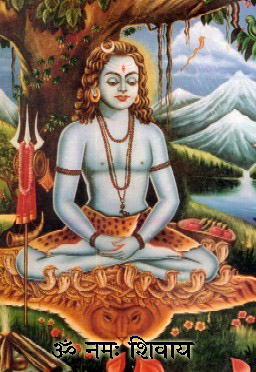
Gorakhnath or Gorakshanatha Saivism is also known as Siddha Siddhanta and Nath tradition. It was founded by Gorakshanatha (Gorakhnath) who lived about 10th century AD. He is believed to be 3rd, 4th or 5th in a line of 12 prominent teachers of this tradition, which has followers in both Buddhism and Hinduism.
He was said to be a disciple of Matsyendranatha who was from in Nepal. Followers of this tradition believe that knowledge of this tradition was received by Matsyendranath directly from Siva himself. Gorakshanatha is credited with such works as Siddha Siddhanta Paddhathi and Viveka Martanda. He composed them in Hindi. He also created 12 monastic orders across Northern India in an effort to preserve the Adinatha tradition.
Other important works of this tradition are Hatha Yoga Pradipika, Gheranda Samhita, Siva Samhita and Jnanamrita.
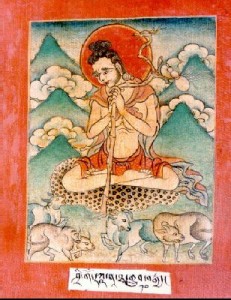
Also known as Gorakhnath – regarded as the originator of hatha yoga!
The school was predominantly ascetic and adapted many practices of the Pasupatha tradition and the Adinatha Tradition in contrast to the Nandinatha tradition followed in the south. Although it is a tantric tradition, it differs from many left-handed (vamachara) schools of tantra with its uncompromising emphasis on the practice of brahmacharya or celibacy and its stand against the use of sexual energy in yogic practices. In the past this tradition enjoyed some Muslim following in the northern India and some of them even became heads of monasteries.
The Gorakshanatha tradition brought to light many secrets of hatha yoga, kundalini yoga and samadhi and contributed to their present day popularity. Members of this tradition also dabble in occult sciences and siddhis or super natural powers.
Followers of this tradition believe that it would be possible through yogic practices to prolong human life and become immortal in the physical body (kayasiddhi). They believe that through the practice of hathayoga it is possible to channel breath energy through a web of nerves or nadis and acquire occult powers as well as achieve liberation. No one knows for sure what these practices are except those who have been initiated into them. Some followers of this tradition claim to have seen or interacted with beings who are several hundreds of years old. There are claims that Gorakshanatha, the original founder of the school, is still alive and active in our earth plane but does not appear in public.
Followers of the tradition believe that Siva is the material and efficient cause of creation and that after liberation the jivas would return to Siva, like bubbles in water. Oneness with Siva can be experienced by serious practitioners of yoga in a deep state of samadhi. Once the state of samadhi is reached, an individual would remain forever established in transcendental consciousness even while engaged in the mundane affairs of the outside world.
The tradition is still active in many parts of India and abroad and its followers range from mendicants and street magicians to the most obscure ascetics living in the Himalayas.
The popularity of hatha yoga, pranayama, kundalini yoga, holistic medicine, astrology and ayurveda in the modern world can be attributed to a great extent to this tradition.
The International Nath Order is draws its inspiration from the ancient Natha tradition, although it strives to propagate its teachings mostly outside India.
It was founded in 1978 by Guru Mahendranath in order to share the knowledge of his own spiritual awakening and also the wisdom of the ancient tantric schools of Hinduism and Buddhism.
India, Indian, video, text, culture, history, travel, art

India content, video & text from online Indian encyclopedia
India online encyclopedia, www.indiavideo.org offers Indian video and text content online. The site is a culture atlas of India with professionally created video clips or movies and text on India, Indian culture, history, travel, art, heritage, yoga, beauty, cuisine, food and health. The content on India is created for travellers and tourists besides students and academicians specialising in history, religion, culture, civilization, sociology, indology, south Asia studies, India experience programmes, Indian heritage, Indian systems of knowledge and studies in alternative or complementary medicine of India.
Invis Multimedia developed this site in association with United Nations Educational, Scientific and Cultural Organisation (UNESCO), New Delhi office .
Yoga & Ayurveda a call for full Potential
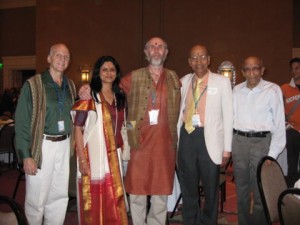
( Dr. Frawley at >> NAMA conference << with Shambhavi and Dr. Lad)
The Yoga Tradition
David Frawley, Pandit, Vedacharya
Abstract: To bring out the full healing potential of Yoga, what we need is not just Yoga therapists applying the tools of Yoga according to the guidelines of Western medical doctors. What we need in the long run are Yogic doctors who can diagnose and treat disease according to the Yogic medical system of Ayurveda. This article explores the separation of Yoga therapy and Ayurveda in the West and how they may be brought together.
>>> A Call for a Complete Yogic System of Medicine <<<
The effectiveness of a therapy depends upon the medical system according to which it is prescribed. In this regard, the question arises: What medical system is Yoga therapy depending upon for its diagnosis and treatment-and is that medical system in harmony with Yogic principles?
There is a comprehensive medical system-one of the oldest in world-that is based on Yogic principles. It has a long history of usage with Yoga and is in resurgence today. This is the Ayurvedic system of medicine of India, which remains commonly practiced in India and is now spreading worldwide.
To bring out the full healing potential of Yoga, what we need is not just Yoga therapists applying the tools of Yoga according to the guidelines of medical doctors, however helpful that can be. What we need in the long run are Yogic doctors, Yogic physicians who can diagnose and treat disease according to a medical system that is Yogic in nature. That Yogic medical system need not be invented. It is already here in the form of Ayurveda.
>> Yoga & Ayurveda, a call for a complete yogic System of Medicine
Rote Nasen Lauf 2009

>> RED NOSE DAY INTERNATIONAL <<
About Red Nose DayRed Nose Day is, quite simply, a day like no other! We take some fantastic fundraising in schools, offices and homes across the land, mix it with the nation’s favourite celebrities getting up to all kinds of mischief, sprinkle a new Red Nose (or three!) across the entire UK and add a cracking night of comedy on BBC One to make Red Nose Day the phenomenon it is.
Ganz Österreich läuft für einen guten Zweck (unten finden Sie die Gemeinden, die mit dabei sind!)
Laufen, gehen, walken, herumtollen – alles ist erlaubt, in allen Geschwindigkeiten, weil es auf die Schnelligkeit bei diesem Lauf nicht ankommt. Dieses Event ist daher für die ganze Familie bestens geeignet. Es geht darum, sich zu bewegen, sich fit zu halten, dabei Spaß zu haben und damit kranken Kindern ein Lachen ins Spital zu bringen.
JETZT HIER ANMELDEN UND ALLE INFOS:
The Hamsa Gayatri (The Sacred Swan)
![MPj04330550000[1]](http://www.deinayurveda.net/wordpress/wp-content/uploads/2009/09/MPj0433055000011-300x199.jpg "MPj04330550000[1]")
The Hamsa Gayatri (The Sacred Swan)
By Yogi Baba Prem Tom Beal Veda Visharada, CYI, C.ay, C.va.
Of the numerous Gayatri mantras that are known, one of my favorites is the Hamsa Gayatri mantra. It is longer than most one or two word mantras for beginners, but short enough for most people to easily learn and chant.
The mantra to the sacred swan is a mantra for uplifting consciousness. As hamsa literally means ‘swan’, it represents purity, but this is also symbolic for the soul. The soul, our true essence, is synonymous with the swan. The swan, or soul, in its highest state requires a different term to more clearly define it–paramahamsa, or the supreme swan is the yogic term commonly used. Parama comes from the root para–meaning higher, elevated or highest. It also means final, last and more than. Parama, itself, means most distant, highest, primary and most prominent. Therefore, paramahamsa literally means supreme swan.