
Posts by admin
REMINDER: ECCHR Office Party, 10 November 2012
| Ladies, Gentlemen and Friends, |
|
We are delighted to invite you to our
OFFICE PARTY in Zossener Str. 55-58 (Entrance D) in Berlin-Kreuzberg on
Saturday 10 November 2012
8.00 pm Opening of the Exhibition and book presentation „El Hotel“
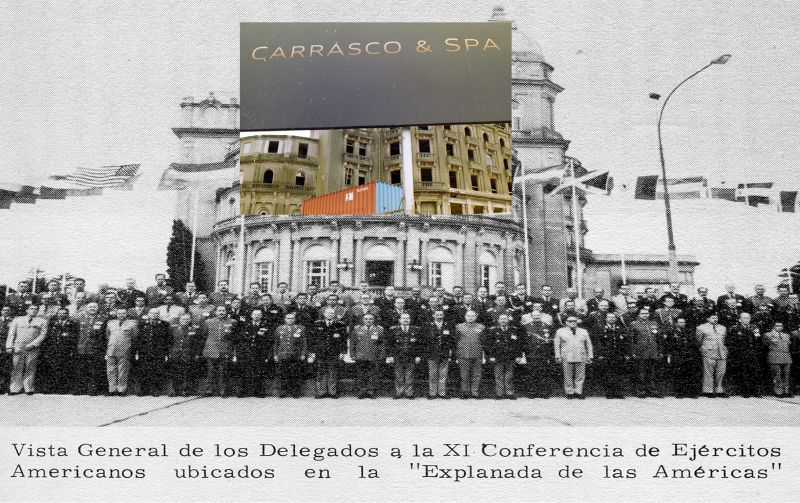
A photographic installation by Azul Blaseotto and Eduardo Molinari (Buenos Aires). In 1975, Hotel Carrasco in Montevideo, Uruguay, was the venue of the “XI. Conference of the American Armies”. During this event, which took place in a luxurious atmosphere and whose context remained obscure, strategic agreements for the future launch of “Operation Condor“ were concluded. This formed the basis of state terrorism that enabled the construction of the neoliberal net which haunts us until today.
8.30 pm PartyWe look forward to seeing you.
The ECCHR Team http://www.ecchr.de
http://de.wikipedia.org/wiki/European_Center_for_Constitutional_and_Human_Rights
Please RSVP to: party@ecchr.eu
We kindly ask you for donations to cover part of the exhibition/party costs or to support our programmatic work:
Berliner Volksbank, BLZ: 100 900 00, Account Number: 8853607011
BIC/SWIFT: BEVODEBB, IBAN: DE77100900008853607011
(If you require a receipt for your donation, please enter your address.)
|
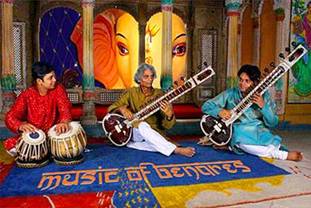
Save the date ! Musik of Benares – Musik is love
Varanasi (Hindustani pronunciation: [ʋaːˈraːɳəsi] ( listen)), also commonly known as Benares, Banaras (BanÄ�ras [bəˈnaːrəs] ( listen)) or Kashi (KÄ�śÄ« [ˈkaːʃi] ( listen)), is a city situated on the banks of the Ganges in the Indian state of Uttar Pradesh, 320 kilometres (199 mi) southeast of state capital Lucknow. It is regarded as a holy city by Hindus, Buddhists and Jains. It is one of the oldest continuously inhabited cities in the world and the oldest in India.[3][4] http://en.wikipedia./wiki/Varanasi
In Hindustani music, a ghar�n� is a system of social organization linking musicians or dancers by lineage or apprenticeship, and by adherence to a particular musical style. A gharana also indicates a comprehensive musicological ideology. This ideology sometimes changes substantially from one gharana to another. It directly affects the thinking, teaching, performance and appreciation of music.
The word gharana comes from the Hindi word ‚ghar‘, which means ‚family‘ or ‚house‘. It typically refers to the place where the musical ideology originated; for example, some of the gharanas well known for singing khyals are: Agra, Gwalior, Indore, Jaipur, Kirana, and Patiala. http://en.wikipedia.org/wiki/Gharana
www.music-of-benares.com
Pandit Shivnath Mishra
Deobrath Mishra-Prashant Mishra
Die 3 Meister bringen mit Ihrer Musik wieder den Zauber der mehr als 2000 Jahre alten Tradition der Sitar und Tabla zu uns ins NUU. Ihre Musik lebt überwiegend von der Improvisation und folgt dem Ausdrucksreichtum der menschlichen Stimme. Sie steigert sich zu höchster Erregung und Spannung, welche die Musiker, und auch die Zuhörerinnen, in eine Art Trance-zustand versinken lässt. Seit mittlerweile sieben Generation musizieren Vater und Sohn der Mishra Familie gemeinsam. Pandit Shivanth und Deobrat Mishra spielen seit über 20 Jahren Konzerte auf der ganzen Welt. Deobrat Mishra wurde mehrfach als bester Sitar Spieler Indiens ausgezeichnet. Es ist eine seltene Gelegenheit drei Musiker aus drei Generationen aus einer Familie auf einer Bühne gemeinsam zu erleben ! Ihre Konzerte berühren durch Musik auf höchstem Niveau, mitgetragen von den Bilder des Malers David Müller-Abt, im kleinem intimen Rahmen der Galerie Werkstatt NUU.
Moving pot verwöhnt uns an den drei Abenden mit indischen Köstlichkeiten, kulinarisch- vegetarisch!
Du bist wieder herzlich eingeladen, wenn du kommen magst – bitte unbedingt reservieren…max 30 Personen/Abend !
Mo.5, Mi.7. und Do.8. November 2012
9.Wilhelm Exnergasse 15
Einlass 19h Beginn 20h
Eintritt 25€
inkl. Chai und indischem Essen
Reservierung notwendig ! nuu@gmx.at oder sms/tel: 0699 19429921
p.s unsere Webseite ist leider nicht mehr aktuell, aber eine Neue ist im entstehen…
Galerie Wekstatt NUU 9. Wilhelm Exnergasse 15 nuu@gmx.at www.nuu.at 0699 19429921
http://www.oldindianphotos.in/2012/05/varanasi-benares-in-1937-vintage-video.html
http://www.sacred-destinations.com/india/index.php
http://www.facebook.com/oldindianphotos
http://www.facebook.com/mishramusic
Protecting human rights during conflict one of world’s greatest challenges, UN official tells General Assembly
Security Council Resolution 1674, adopted on 28 April 2006, „reaffirms the provisions of paragraphs 138 and 139 of the 2005 World Summit Outcome Document regarding the responsibility to protect populations from genocide, war crimes, ethnic cleansing and crimes against humanity“.[12] The resolution commits the Council to take action to protect civilians in an armed conflict. The Security Council’s role in implementing the responsibility to protect is not limited to taking collective action against mass atrocities (pillar three of the responsibility to protect), but it can also make important contributions to structural and operational prevention of genocide, war, crimes, ethnic cleansing, and crimes against humanity (pillar two of the responsibility to protect).[13] http://en.wikipedia.org/wiki/United_Nations_Security_Council
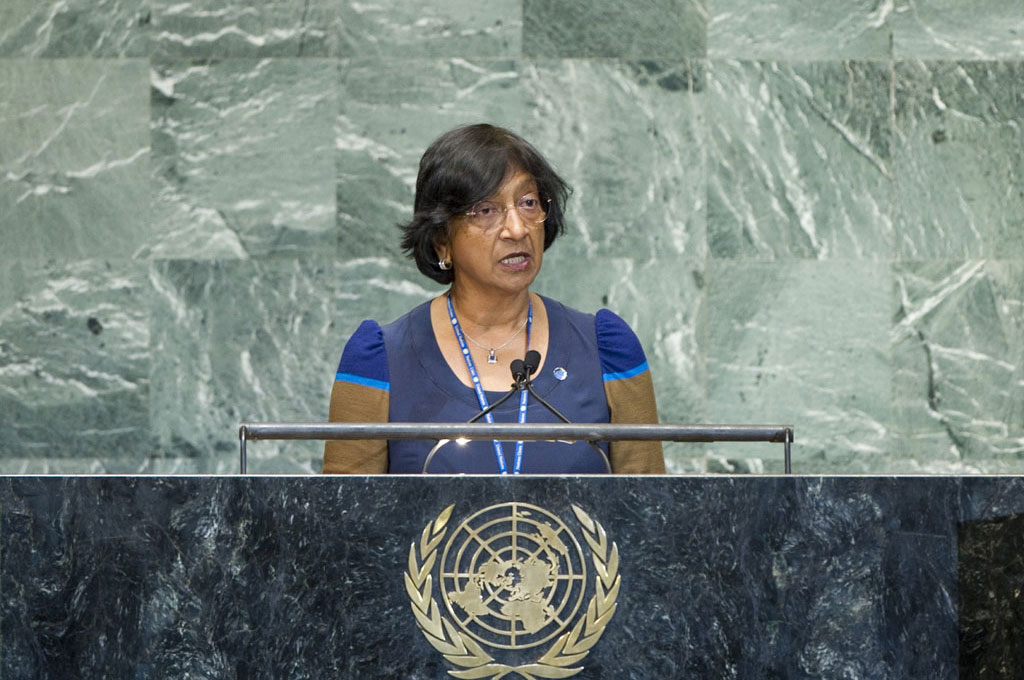
24 October 2012 – Protecting human rights during times of conflict is one of the greatest challenges that the international community faces today as evidenced by the crises in Syria, Mali and other parts of the world, a senior United Nations official said today.
“The protracted violence is an immediate reminder that the prevention of conflict and the protection of human rights in times of conflict remain among the most daunting challenges for the international community,” the UN High Commissioner for Human Rights, Navi Pillay, told the General Assembly in New York.
“Outright disrespect for international human rights and humanitarian law, let alone for human life, is an anachronism which cannot be tolerated. The UN must act to uphold the rule of law and protect human rights,” she added during her annual report on the work of the Office of the UN High Commissioner for Human Rights (OHCHR).
In particular, Ms. Pillay urged States to take urgent and effective measures to protect the Syrian people. More than 20,000 people, mostly civilians, have died in Syria since the uprising against the regime of President Bashar al-Assad began some 20 months ago. A further 2.5 million people urgently need humanitarian aid, and more than 340,000 have crossed the border to neighbouring countries, according to UN estimates.
“There is no doubt that every Security Council member wishes to see an end to the ever-deepening conflict in Syria and to the violence affecting civilians,” Ms. Pillay said. “While taking into account important political concerns, it is urgent to find ways to avert the massive loss of civilians and human rights violations.”
During her presentation, Ms. Pillay underscored that the challenge of addressing crises and protecting human rights has grown due to organized crime, terrorism, the proliferation of weapons and the exploitation of natural resources – all developing at a faster pace.
While she acknowledged that much remains to be done to ensure human rights are respected all over the world, Ms. Pillay also noted there have been developments that indicate an enhanced attention to human rights in various countries. For example, OHCHR now has a field presence in 57 countries, and human rights advisers are working with governments to mainstream human rights. OHCHR has also expanded its technical cooperation considerably.
In addition, OHCHR has consistently supported the Geneva-based Human Rights Council, which has, over the past two years, steadily addressed urgent situations and mandated commissions of inquiry and fact-finding missions to places where there have been reports of human rights violations, including Syria.
The UN human rights chief also highlighted the work of her office with respect to development, the rule of law, democracy, and against all forms of discrimination.
“The growing recognition of the centrality of human rights in the peace, security, development and humanitarian agendas, and trust in OHCHR is very rewarding,” Ms. Pillay noted. However, she warned that financial constraints are limiting the resources required to support her office’s mandated activities.
“While we continue to endeavour to fulfil such work, without sufficient resources, we are being compelled to do less with less,” the UN official said, and called on the General Assembly to renew its commitment to support OHCHR and maintain its momentum to promote and protect human rights all over the world.
News Tracker: past stories on this issue
Top UN rights body extends mandate of independent probe into Syria violence
#previous #articles #Navi Pillay #UN High Commissioner #humanrights
http://www.facebook.com/unitednationshumanrights
————————————————–
2012-10-25 Update — The Justice Campaign @thejustcampaign
2012-10-25 Update — Auschwitz Institute for Peace and Reconciliation
Our friends at the GCR2P write: „Addressing the UNGA yesterday, Navi Pillay said that protecting human rights during times of conflict is one of the greatest challenges that the international community faces today as evidenced by the crises in Syria, Mali and other parts of the world. ‚The protracted violence is an immediate reminder that the prevention of conflict and the protection of human rights in times of conflict remain among the most daunting challenges for the international community.‘ „
2013 will be the twentieth anniversary of the Vienna Declaration and Programme of Action, and of the establishment of the High Commissioner’s mandate. OHCHR has grown dramatically in size and reach as we vigorously protect and promote human rights all over the world. I earnestly seek your renewed commitment and support to enable OHCHR to maintain the momentum. http://www.ohchr.org/en/NewsEvents/Pages/DisplayNews.aspx?NewsID=12690&LangID=E

UN human rights chief Navi Pillay urging a prompt independent investigation:
2012-10-27 Update — Asia Pacific Centre for the Responsibility to Protect (R2P)
„He cited Aceh as an example, highlighting that the implementation of human rights – as is internationally understood – must adapt to the sharia implemented in
the province.
The joint ministerial decree is among the three regulations the Indonesian government has offered to set up in response to its refusal to adopt 30 „critical“ recommendations by the United Nations Human Rights Council (UNHRC) after a quadrennial human rights review in May.
In addition to the decree, the government has also announced that it will establish a law on human rights friendly districts and finalize the long-awaited truth and reconciliation bill to deal with past human rights abuses.“
Human rights must bow to religious values: Home Minister | The Jakarta Post
Citing Syria and Mali, deputy UN chief highlights impact of Security Council unity
Religious harmony is a must, but how? | The Jakarta Post
„Table of religious intolerance:
• During the era of President Susilo Bambang Yudhoyono (as of 2007) 108 churches have been closed/damaged; in the era of president Megawati Soekarnoputri, 92; in the era of president Abdurrahman Wahid, 232; in the era of president Soeharto, 456.
• Based on data from the Manado Post daily, there were 2,442 cases of church closures and demolitions in the period between 2004 and 2010
• In 2011, Setara Institute recorded 244 cases of religious intolerance in 17 regions. The largest number of cases was recorded in West Java (57 cases), followed by South Sulawesi (45), East Java (31), North Sumatra (24) and Banten (12).“
http://www.ohchr.org/EN/Issues/FreedomReligion/Pages/FreedomReligionIndex.aspx
http://en.wikipedia.org/wiki/Freedom_of_religion
http://www.thejakartapost.com/news/2012/10/20/religious-harmony-a-must-how.html
2012-10-23 Update: Asia Pacific Centre for the Responsibility to Protect (R2P)
„We need humanitarian assistance. If we reject the humanitarian assistance, the international community will not accept us,“ Thein Sein told reporters in his first domestic press conference since taking office 18 months ago.
„We have to feed the people. It costs $10,000 a day,“ he said of the Rakhine camps.
„Our government cannot afford it. We are not in a situation to feed the people in the camps with the help of ordinary citizens so we have to accept humanitarian assistance from the international community. If we do not accept the humanitarian assistance they will say we are not human.“
http://www.interaksyon.com/article/46140/myanmar-leader-says-open-to-aid-for-muslims
2012-10-12 Update — BANGLADESH: Rohingya refugees face more restrictions
DHAKA, 12 October 2012 (IRIN) – Activists warn of further restrictions on Rohingya refugees in southeastern Bangladesh following recent communal violence.
“Rohingya refugees in Bangladesh will likely face more restrictions on their movement or arrests and push-backs,” Chris Lewa, director of the Arakan Project, an advocacy organization for the Rohingya, told IRIN on 12 October.
“We are seeing examples of that already on the ground.”
“Refugees International is concerned about the talk of further restrictions being imposed on Rohingya refugees in the Cox’s Bazar District of Bangladesh,” said Melanie Teff, a senior advocate with Refugees International.
The Rohingya – an ethnic, linguistic and religious minority who fled persecution en masse from Myanmar’s neighbouring Rakhine State decades ago – have long had a tenuous relationship with the Bangladeshi authorities who view them as illegal migrants.
Under Burmese law, they are de jure stateless and face constant persecution, say activists, while in Bangladesh they are barred from employment.
According to the UN Refugee Agency (UNHCR), there are more than 200,000 Rohingya in Bangladesh today, including more than 30,000 documented refugees living in two government-run camps [Kutupalong and Nayapara] within 2km of the Burmese border.
UNHCR has not been permitted to register newly arriving Rohingya since mid-1992. The vast majority of Rohingya are living in villages and towns in the area and receive little to no assistance as UNHCR is only allowed to assist those who are documented.
Blame game
On 1 October, Bangladesh Home Minister Mohiuddin Khan Alamgir accused the Rohingya of involvement in a series of attacks on minority Buddhist temples and homes in the southeast.
The violence was reportedly triggered by a photo posted on Facebook that insulted Islam at the end of September, resulting in some of the worst sectarian violence in Bangladesh in years.
Thousands of Muslims went on the rampage in predominately Buddhist areas, setting ablaze temples and monasteries, resulting in dozens of homes burned.
„The attacks on temples and houses in Buddhist localities in Ramu and neighbouring areas in Cox’s Bazar (district) were perpetrated by radical Islamists,“ the minister told reporters.
„Rohingyas and political opponents of the government were also involved in the attack,” he added, describing the incident as a „premeditated and deliberate attempt“ to disrupt communal harmony.
Recent violence in Rakhine State has displaced thousands
Following the violence, law enforcement agencies were instructed to restrict the movement of Rohingya refugees and curb their interactions with the local community – a move confirmed by refugees on the ground.
“New check posts were established and we are facing abnormal restriction after the Ramu incident,” a 20-year-old Rohingya youth, who asked not to be identified, told IRIN by phone.
Impact in Myanmar
The impact of these events in Myanmar is also a concern. “What’s happening in Bangladesh will only exacerbate communal tension inside Rakhine State,” Lewa said.
In June 2012 violence flared in Rakhine State forcing tens of thousands of Rohingya to flee both within Myanmar and across the border.
According to Myanmar government estimates, more than 70,000 people are now living in temporary camps and shelters following inter-communal conflict.
Of particular concern is forced segregation and protracted displacement in the state capital, Sittwe, where Rohingya who lost their homes in the violence have been moved into camps, says Refugees International.
Despite repeated advocacy efforts by UNHCR, civil society and the diplomatic community, Bangladesh decided to close its borders to persons fleeing the country.
Those who managed to make it to Bangladesh were rounded up and sent back. However, there are no reliable figures on the number of arrivals and the number refouled.
2012-10-11 Update — U Ba Sein Rohingya Blogger
The European Rohingya Council formed ~ Rohingya Blogger http://bit.ly/WS8oiu
2012-10-10 Update — Burma News from Mizzima
Plight of stateless Rohingyas hinges on citizenship: US official. The lack of citizenship must be addressed for any long-term solution to the distress in the Rohingya community http://bit.ly/PmZIRJ
2012-10-06 Update — Democratic Voice of Burma
Analysis: Did the gov’t incite the racial violence targeting the Rohingya? http://bit.ly/R2GFI6
2012-10-06 Update — Asia Pacific Centre for the Responsibility to Protect (R2P)
2012-09-30 Update — “ Casualties of 5 thousand people, numerous people injured and thousands displaced and homeless after the Security Council may not take any action, then what can they ?“ ‘‘২৫ হাজার মানুষের প্রাণহানি, অসংখ্য মানুষ আহত এবং হাজার হাজার মানুষ বাস্তুহারা ও গৃহহীন হওয়ার পরও যদি নিরাপত্তা পরিষদ কোন পদক্ষেপ নিতে না পারে, তাহলে তারা আর কী করতে পারে?“
সিরিয়ার সংকট সমাধানে ব্যর্থ হওয়ায় জাতিসংঘ নিরাপত্তা পরিষদের সংস্কারের দাবি তুলেছে নিউজিল্যান্ড৷ এদিকে, রোহিঙ্গা জাতিগোষ্ঠীর সদস্যদের সংকট সমাধানে সতর্কতার সাথে পদক্ষেপ গ্রহণের আহ্বান জানালেন জাতিসংঘ মহাসচিব বান কি-মুন৷
জাতিসংঘ সাধারণ পরিষদের বৈঠকে নিউজিল্যান্ডের পক্ষ থেকে দাবি উঠেছে, নিরাপত্তা পরিষদের স্থায়ী পাঁচ সদস্যের ভেটো ক্ষমতা সীমিত করার৷ বিশেষ করে যখন গণহত্যার মতো নির্মম ঘটনা বন্ধের প্রশ্ন আসে তখন অন্তত স্থায়ী পাঁচ সদস্যের ভেটো ক্ষমতা রহিত করা উচিত বলে মনে করেন নিউজিল্যান্ডের পররাষ্ট্র মন্ত্রী মারে ম্যাকালি৷ তিনি বলেন, সিরিয়ার বিষয়ে ঐকমত্যে পৌঁছতে ব্যর্থ হওয়ায় নিরাপত্তা পরিষদ তার বিশ্বস্ততা হারাচ্ছে৷
‘‘২৫ হাজার মানুষের প্রাণহানি, অসংখ্য মানুষ আহত এবং হাজার হাজার মানুষ বাস্তুহারা ও গৃহহীন হওয়ার পরও যদি নিরাপত্তা পরিষদ কোন পদক্ষেপ নিতে না পারে, তাহলে তারা আর কী করতে পারে?“ – এমনভাবেই জাতিসংঘ সাধারণ পরিষদের বৈঠকে প্রশ্ন তুলেছেন ম্যাকালি৷ নিরাপত্তা পরিষদের এমন ব্যর্থতায় নিউজিল্যান্ডের মানুষ হতাশ উল্লেখ করে তিনি নিরাপত্তা পরিষদের সংস্কার সাধনের দাবি তুলেন৷ তবে নিরাপত্তা পরিষদে ভেটো ক্ষমতা একেবারে তুলে দেওয়ার কথা না বলে বরং এটিকে সীমিত করার পক্ষে মত দেন মারে ম্যাকালি৷
এদিকে, জাতিসংঘ মহাসচিব বান কি-মুন বিশ্বের বৃহত্তম ইসলামি সংস্থা ওআইসি’র নেতৃবৃন্দের উদ্দেশ্যে বলেছেন, মিয়ানমারের মুসলিম জনগোষ্ঠী রোহিঙ্গাদের বিষয়টি অত্যন্ত সতর্কতার সাথে বিবেচনা করতে হবে৷ নতুবা সেদেশে চলমান রাজনৈতিক সংস্কার প্রক্রিয়াকে ব্যহত করতে পারে বলে আশঙ্কা প্রকাশ করেন তিনি৷ রোহিঙ্গা জনগোষ্ঠীর সমস্যা নিয়ে ইসলামি সম্মেলন সংস্থা ওআইসি’র মহাসচিব একমেলেদ্দিন ইহসানোগলু এবং মিয়ানমারের প্রেসিডেন্ট থেন সেনের সাথে পৃথক বৈঠক করেন বান কি-মুন৷ http://www.dw.de/dw/article/0,,16274693,00.html
2012-09-30 Update — U.N. chief urges careful handling of Myanmar Rohingyas issue
(Reuters) – U.N. Secretary-General Ban Ki-moon urged the world’s largest Islamic body on Saturday to „treat carefully“ the issue of the stateless Muslim Rohingyas in Myanmar because it could affect the reform process underway in the country, also known as Burma.
Over the past year, Myanmar has introduced the most sweeping reforms in the former British colony since a 1962 military coup. A semi-civilian government, stacked with former generals, has allowed elections, eased rules on protests and freed dissidents.
Read more here ~ http://bit.ly/RqZc3f
2012-09-26 Update — Auschwitz Institute for Peace and Reconciliation
The situation of the Rohingya people in Burma remains dire. Even as President Thein Sein has launched political and economic reforms to move the country away from its authoritarian past, and even as Aung San Suu Kyi, Burma’s champion of human rights, has been freed from house arrest and is now in the middle of an historic, emotional, and heavily publicized visit to the United States, there is still a threat of genocide for the Rohingya. With this in mind, Christine Lim traveled to the campus of Columbia University on Sept. 14 for a discussion titled “Burma in Transition: Minorities, Human Rights, and Democratic Process.” http://bit.ly/UtjzuV
2012-09-20 Update Asia Pacific Centre for the Responsibility to Protect (R2P)
4th in the R2P ‚classics‘ series. As a reviewer in the Times Higher Ed put it, ‚its clear and accessible style, as well as its meticulous discussion of the R2P’s historical and political context, is well integrated into an analysis of the practical side of genocide prevention…‘. Meticulous research is right – brings the ICISS and the WS outcome debates to life. Tim http://bit.ly/OnkNv1
2012-09-18 Update — Asia Pacific Centre for the Responsibility to Protect (R2P)
“We are sending them logistical aid, treating them as though they were victims of natural disasters, when what they need most is legal status, adequate livelihoods and a stable future,” Mahendradatta, one of a team of Muslim lawyers, said in Jakarta on Saturday. http://bit.ly/UYrjHA
2012-09-16 Update — Myanmar investigates anti-Rohingya violence
Government commission makes first visit to Rakhine state to investigate violence between Buddhists and Muslims.
The government-appointed commission tasked with investigating violence in Rakhine State, Myanmar, has just completed its first visit to the area. The 27 members saw, first-hand, segregated communities following fighting that resulted in the deaths of at least 80 people and the burning of homes, businesses, Muslim mosques and Buddhist temples.
Around 60,000 Rohingya Muslims remain in camps after violence in June which followed the rape and murder of a Buddhist girl allegedly by three Muslim men. There are also thousands of Buddhists who are still displaced after their homes too were burned to the ground.
In the Muslim majority town of Maungdaw, Rakhine Buddhists are in camps, while in the capital Sittwe, where Buddhists have a slim majority, the homeless are mainly staying in monasteries where their numbers are decreasing as people slowly regain enough courage to return to their communities.
The Rohingya, however, have had their freedoms restricted. Officially, they’ve been told they can leave the camps, but with the caveat from security forces that their safety cannot be guaranteed.
‚Foreign invaders‘ http://farmlandgrab.org/
“We are not allowed to go back to our houses,” said Jakersharife, a Rohingya man whose sister and grandmother were killed in the fighting.
“We want our homes back. We want our land, our business and peace,” he said.
2012-09-13 Update — Human Rights Education Institute of Burma (HREIB)
Rohingyas ‘have the right’ to apply for Burmese citizenship: minister. Rohingyas born in Burma are eligible to apply for citizenship if at least two generations of their families have lived in the country, Immigration Minister Khin Ye told the Radio Free Asia Burmese Service on Wednesday.
He said that those who met these requirements “have the right” to apply for citizenship in Burma, where many of them have lived in Rakhine State along the Bangladesh border for generations.
“Foreigners, like the Bengalis, have the right to apply for citizenship if they want to,” Khin Ye said, citing an amendment to the country’s constitution in 1982 during the rule of the former military regime. http://bit.ly/QV8aSx
2012-09-13 Update — Human Rights Education Institute of Burma (HREIB)
Rohingya Can ‘Apply for Citizenship’An immigration official says the minority can settle in Burma if individuals meet certain requirements. http://bit.ly/QV8aSx
2012-09-12 Update — Asia Pacific Centre for the Responsibility to Protect (R2P)
„In Myanmar, tens of thousands of Rohingya refugees remain stranded in squalid camps after violence left their homes destroyed. Myanmar’s government estimated at least 70,000 people had been displaced by fighting in Rakhine state in July. The unrest began after a Buddhist Rakhine woman was raped and killed in May, allegedly by three Muslim Rohingya men. The UN says more than 100,000 Rohingya refugees are living in camps near the state capital Sittwe after their villages were destroyed.“ http://bcove.me/nd3twiit
2012-09-12 Update — Asia Pacific Centre for the Responsibility to Protect (R2P)
„Tens of thousands of displaced people continue to live in refugee camps in Myanmar’s Rakhine state after clashes between Rohingya Muslims and Rakhine Buddhists killed dozens of combatants in June.
Both sides accuse the other group of having committed atrocities during the conflict.“ http://aje.me/O4JGoC
2012-09-11 Update Muslim delegation visits Rakhine State in Burma http://bit.ly/U5Obm0
An delegation of the Organization of Islamic Cooperation (OIC) led by the group’s representative to the United Nations, Ambassador Ufuk Gokcen, arrived in Rakhine State in Burma on Sunday.
“They met the union border affairs minister and Rakhine chief minister and also visited some refugee camps and made donations,” an official said, adding that the group concluded their visit on Monday.
2012-09-11 Update Matthew F. Smith @matthewfsmith @crisisgroup
Good piece by @jimdella on the plight of Burma’s stateless Rohingya & the need for peace & reconciliation. @crisisgroup http://bit.ly/UGc31M
2012-09-07 Update — Rohinga Blogger U Ba Sei
Our View: Burmese Muslims face severe persecution | Azizah al-Hibri and Robert P. George
For Muslim Americans and other concerned citizens in Indianapolis and elsewhere in the nation, news of still more violence against the largely Muslim Rohingya of Burma highlights the plight of one of the world’s most persecuted communities and the need for a global response. The latest bloodshed, coupled with two prior months of riots and murders, has left more than 700 dead and 80,000 homeless. This violence has been compounded by the behavior of the Burmese security forces who, according to major human rights organizations, have participated in killings and rapes as well as mass arrests against the Rohingya. Read more here ~ http://bit.ly/QqWYjX
2012-09-06 Update — Asia Pacific Centre for the Responsibility to Protect (R2P)
The Rohingya crisis: ASEAN vs Red Cross | The Jakarta Post
„ASEAN as a home for all its members, ironically, has not yet offered any solution to extinguish the Rohingya fire. ASEAN therefore has to restore its credibility as a common home for all ASEAN peoples including the Rohingyas by optimizing the ASEAN Inter-governmental Commission on Human Rights (AICHR), which has a special mandate to promote and protect human rights across the region…
In the spirit of non-interference, AICHR could facilitate the Myanmar government through various capacity-building supports for their law-enforcement officials such as community policing especially in the state of Rakhine.
This approach is in line with the mandate of the Outcome Document of the 2005 United Nations World Summit (A/RES/60/1, para. 138-140) and the Secretary-General’s 2009 Report (A/63/677) on the Implementation of the Responsibility to Protect which stipulates that the state carries the primary responsibility for protecting populations from genocide, war crimes, crimes against humanity and ethnic cleansing, and their incitement.“
2012-09-04 Update — Rakhine commission schedules 9-day investigation trip
“Our main objective is to do a pre-survey to help carry out our tasks,” said commission Secretary Dr. Kyaw Yin Hlaing. The team will meet with victims from both communities, residents, government officials and other officials during the trip, he told the Myanmar Times newspaper.
Following the trip, the commission will recruit and train people to collect data that will aid its investigation. http://www.mizzima.com/news/inside-burma/7927-rakhine-commission-schedules-9-day-investigation-trip.html
2012-08-30 Update HRW report details persecution of Burma’s Rohingya Muslims
Reports from the US-based Human Rights Watch (HRW) and Amnesty International, and from Al Jazeera, have shed further light on the oppressive conditions facing the Rohingya Muslim population in Burma’s Rakhine state (also known as Arakan), as well as the communal violence that broke out in June. http://www.wsws.org/articles/2012/aug2012/burm-a30.shtml
2012-08-30 Update — China Denies UN Access to Returning Refugees | The Irrawaddy Magazine http://www.irrawaddy.org/archives
The Chinese authorities have banned officials of the UN High Commissioner for Refugees UNHCR) from accessing Kachin refugees who are being forced back home into war-torn northern Burma.
More than 2,000 refugees who took shelter in China’s southwestern Yunnan Province have been deported to Burma since last week. Aid workers, Human Rights Watch and the United States have all urged Beijing to cease the forced repatriation as hostilities between Burmese government troops and Kachin rebels are escalating.
2012-08-29 Update — The Rohingya massacre and OIC
http://www.saudigazette.com.sa/index.cfm?method=home.regcon&contentid=20120829134347 The conference, convened by King Abdullah, Custodian of the Two Holy Mosques, condemned the policy of violence meted out by the government of Myanmar to the Rohingya, describing it incompatible with the principles of human rights and international laws.
2012-03-30 Myanmar poll key test of democratic reform – UN expert
“I have consistently stressed that the next round of elections should be truly free, fair, inclusive and transparent, but the credibility of Sunday’s vote will not be determined solely on the day, but in the lead-up to and following election day,” said UN expert on human rights in Myanmar Ojea Quintana. More: http://bit.ly/HoYm3k
2012-08-26 Update — Democratic Voice of Burma DVB @DemocVoiceBurma
Watchdog slates Bangladesh over Rohingya policy | Democratic Voice of Burma http://www.dvb.no/news/watchdog-slates-bangladesh-over-rohingya-policy/23437 … #Burma #Myanmar
2012-08-25 Update — Global Centre for the Responsibility to Protect (GCR2P)
HRW says China is „flouting its international legal obligations by forcibly returning Kachin refugees to an active conflict zone rife with Burmese army abuses.“ http://www.hrw.org/news/2012/08/24/china-refugees-forcibly-returned-burma
2012-08-24 Update — Global Centre for the Responsibility to Protect (GCR2P)
HRW says Bangladesh’s policy towards Rohingya refugees is „cruel and inhumane“ and calls upon the government to do more to assist and protect the Rohingya fleeing from killings and other sectarian violence in Burma/Myanmar’s Rakhine State. http://www.hrw.org/news/2012/08/22/bangladesh-assist-protect-rohingya-refugees
2012-08-24 Update — U.S. Ambassador in Myanmar Speaks Out on Rohingya . The “Rohingya are oppressed by everybody,” Mr. Mitchell said. “These people are stateless. They have nowhere to turn. And it is not going to be lost on the international community.”
http://blogs.wsj.com/searealtime/2012/08/24/u-s-ambassador-in-myanmar-speaks-out-on-rohingya
2012-08-23 Update — HRW finds Bangladesh’s Rohingya policy ‘cruel’; urges govt to open borders
Dhaka, 23 August: New York-based Human Rights Watch (HRW) has slammed the government for its restrictions on humanitarian aid to Rohingya Muslim refugees fleeing persecution and violence in neighbouring Myanmar. http://www.bengalnewz.com/bangladesh/dhaka/082328080.html
2012-08-20 Update — International Criminal Law Bureau
Burma to Investigate Rakhine Violence http://www.internationallawbureau.com/blog/?p=5717
2012-08-20 Update — Global Centre for the Responsibility to Protect (GCR2P)
Burma/Myanmar has formed a commission to investigate the violence in Rakhine State. The commission is charged with „determining the circumstances behind the unrest and recommending short and long-term strategies to overcome the community tensions and mistrust.“ http://bit.ly/SHayxA
2012-08-18 Update — Asia Pacific Centre for the Responsibility to Protect (R2P)
Exercising responsibility or dodging international investigation? Myanmar sets up internal investigation of Buddhist-Muslim clashes to make proposals for peace http://wapo.st/NvMTUf
2012-08-18 Update — Myanmar to examine Muslim-Buddhist violence – Asia-Pacific – Al Jazeera English. Government forms 27-member commission to find causes of June clashes and suggest ways for for „peaceful coexistence“. http://aje.me/QLMeZL
2012-08-17 Update — Global Centre for the Responsibility to Protect (GCR2P) OCHA reports that the overall security situation is improving across the Rakhine State, though inter-communal tensions remain very high, with reports of sporadic conflicts in some townships.87 people dead, over 5,300 houses destroyed in Rakhine State: gov’t http://bit.ly/N4tARU
Islamic group to take Rohingya issue to the UN http://bit.ly/RU2rQI
The Organisation of Islamic Cooperation (OIC) has condemned „the continued recourse to violence by the Myanmar authorities against the members of this minority and their refusal to recognize their right to citizenship,“ and said it would bring the matter before the UNGA.
2012-08-17 Update — SBY asks Kalla to be RI’s special envoy for Rohingya issue | The Jakarta Post – President Susilo Bambang Yudhoyono has asked former vice president Jusuf Kalla, who is also the Indonesian Red Cross (PMI) chairman, to be Indonesia’s special envoy in the ongoing conflict involving ethnic Rohingya people in Myanmar. http://bit.ly/NrUenI
2012-08-15 Update — BBC News – Muslim homes razed in Burma’s Rakhine state – report http://bbc.in/NyzHdq Thousands of Rohingya Muslims are living in refugee camps outside of Sittwe.
2012-08-15 Update — International Coalition for the Responsibility to Protect (ICRtoP)
UN envoy welcomes mission to Myanmar’s state of Rakhine, the site of recent ethnic violence that has displaced thousands of people.
“This has demonstrated the willingness of the Myanmar Government to cooperate with the international community to alleviate the suffering of its people,” Mr. Nambiar said, adding that he and Secretary-General Ban Ki-moon had been in continuous contact with authorities on the matter. http://bit.ly/PcJ30U
2012-08-15 Update — Rohingya: Allegations and Refutations (Part 1) | M.S.Anwar ~ SOAS Bulletin of Burma Research, Vol. 1, No., 1, Spring 2003, ISSN 1479-8484
#UNESCO Early Article Reprint 1 http://www.soas.ac.uk/sbbr/editions/file64276.pdf #allegation #refutation The name Rohinga didn´t exist in history.
2012-08-14 Update — Thousands of Rohingya helpless after violence (Exclusive Video)
Al Jazeera gains exclusive access to Rakhine state where 70,000 people have been displaced by ethno-sectarian violence.
Tens of thousands of displaced people continue to live in refugee camps in Myanmar’s Rakhine state after clashes between Rohingya Muslims and Rakhine Buddhists killed dozens of combatants in June.
Read & watch here ~ http://bit.ly/Nn3qd3
2012-08-13 Update — Protect 1.5 million people displaced in Syria -UN expert (1 photo) http://on.fb.me/QW1RC0
“It is imperative that all parties to the conflict respect international humanitarian and human rights law http://www.un.org/en/law/index.shtml, particularly the right to life and the right to physical integrity, and ensure the protection of IDPs [internally displaced persons] as civilians,” urged UN human rights expert Chaloka Beyani. More: http://bit.ly/O6FmYP
______________________________
A WFP staffer interviews a Syrian family as part of a needs assessment mission, which found that some 1.5 million people in Syria need food assistance over the next 3 to 6 months. Credit: WFP
2012-08-13 Update — @HRmyanmar *** Where is so-called Rohinga ( or ) Bangali in the Ethnic Groups of CENTRAL INTELLIGENCE AGENCY ( C I A ) THE WORLD FACTBOOK ???? *** http://bit.ly/NtkyMj
2012-08-13 Update — Saudi King orders $50 million aid for Myanmar Muslims http://bit.ly/TxsZHj
Aung San Suu Kyi facing backlash for silence on abuses via @Telegraph http://soc.li/Msd4yRL
2012-08-13 Update — First aid in Myanmar except for Turkey to accept the UN http://bit.ly/S2nPQO
2012-08-11 Update — United Nations Human Rights
The human rights situations of Muslims in the southern provinces, particularly displaced persons from Myanmar and Bangladesh, and of other ethnic minorities, stateless people and migrant workers, as well as the issue of human trafficking were among the questions raised when the UN committee against racial discrimination examined the report (http://bit.ly/QFks58) of Thailand. Discussion summary: http://bit.ly/QlpKi6
2012-08-10 Update — International Coalition for the Responsibility to Protect (ICRtoP)
Myanmar has welcomed a visit by the Organization of Islamic Cooperation (OIC), the world’s largest Muslim grouping, which has urged a probe into violence between Buddhist Rakhine and Rohingya that has left scores dead in recent months. Myanmar invites OIC probe of sectarian violence http://bit.ly/NiZBU8
2012-08-10 Update– UN appeals to Bangladesh to allow aid groups to resume work http://bit.ly/Qh63b8
“The government has sound evidence that the three UN employees were involved in the Rakhine riots,” said Thein Htay, the border affairs minister, in the first official explanation of the arrests.
The UN continues to call for detailed information about the employees and why they are being held.
2012-08-10 Update — Iranian lawmakers call halt to ‘massacre,’ ‘genocide’ http://bit.ly/P90LDa
2012-08-10 Update — EU asks Bangladesh to rescind aid ban on NGOs http://bit.ly/RF7tBR
2012-08-10 Update — Rohingya send ‘open letter’ to international community http://bit.ly/PGt079
2012-08-10 Update — New curfew imposed after renewed attacks in Rakhine State http://bit.ly/NIWUXT
2012-08-10 Update — Burma to consider allowing Islamic group to visit Rakhine State http://bit.ly/P6SXlC
2012-08-10 Update — Turkey foreign minister travels to Rakhine State http://bit.ly/MFphWX
2012-08-09 Update — British MP Sadiq Khan highlights suffering of Rohingya http://shar.es/vk75l “We have seen positive actions from the Burmese government in recent years – such as the release of Aung San Suu Kyi from house arrest – but they need to realise that the first job of government is to secure the safety of all citizens.
It is important that the British government uses all its influence to end this savage treatment of the Rohingya community by the Burmese authorities.
2012-08-09 Update — Suu Kyi must not ignore the Rohingya – New Straits Times http://bit.ly/QObFAc
2012-08-09 Update — Rohingya send ‘open letter’ to international community http://bit.ly/PGt079
2012-08-08 Update — Rohingya Muslims: Zardari writes letter to Myanmar president http://bit.ly/MKuOwG President says Pakistani government, people were saddened to learn about the losses of Muslims.
He said that only peaceful coexistence of various communities would ensure that the democratic transition was not reversed.
2012-08-08 Update — ASEAN mulls assistance for Myanmar Rohingya http://on-msn.com/NiG8RG#scpti50„ASEAN cannot be perceived to be standing by without taking any action on such a big scale of humanitarian difficulty,“ he added. Bangladesh last week banned three international agencies from providing assistance to Rohingya refugees who had fled from neighbouring Myanmar. Decades of discrimination have left the Rohingya stateless, and they are viewed by the UN as one of the world’s most persecuted minorities.
Myanmar’s government considers the estimated 800,000 Rohingya in the country to be foreigners while many citizens see them as illegal immigrants from Bangladesh and view them with hostility.
2012-08-07 — United Nations Human Rights — Expressed concern over alleged human rights violations in Rakhine and Kachin as well as the continued detention of prisoners of conscience, UN rights expert Tomás Ojea Quintana stressed that Myanmar needs to grapple with serious human rights challenges before democracy can succeed. More: http://bit.ly/MeQBjf
2012-08-06 — Update International Coalition for the Responsibility to Protect (ICRtoP)
UN expert Tomás Ojea Quintana says challenges remain in Myanmar, and calls for an independent investigation into allegations of serious human rights abuses committed by State actors in Rakhine. http://bit.ly/OWrNxv
2012-08-06 Update — UN envoy calls for Myanmar ‚truth commission‘ http://bit.ly/OV5p7Y more detail: http://www.boston.com/news/world/asia/2012/08/04/myanmar-has-serious-human-rights-challenges/5q4BvgxhqvbtheBzySCs2K/story.html
2012-08-06 Update– Demonstrators back Rohingya resettlement proposal | Democratic Voice of Burma http://bit.ly/OFRce0 The plan was promptly rejected by the UNHCR.
“The resettlement programs organised by UNHCR are for refugees who are fleeing a country to another, in very specific circumstances. Obviously, it’s not related to this situation,” said Guterres according to an AP report.
The plan was promptly rejected by the UNHCR.
“The resettlement programs organised by UNHCR are for refugees who are fleeing a country to another, in very specific circumstances. Obviously, it’s not related to this situation,” said Guterres according to an AP report.
Last week’s order to three international aid agencies, MSF, Action Against Hunger and Muslim Aid, to stop proving aid to Rohingya refugees, in the full knowledge of the suffering and possible deaths that such an order will cause, will not solve any of the problems Bangladesh faces with Rohingya refugees.
2012-08-06 Update — Bangladesh’s lose – lose strategy on the Rohingya | Democratic Voice of Burma http://bit.ly/OGmcub.
The root cause of Rohingya refugees arriving in Bangladesh is the persecution they face, and also the long-term refusal of the government to allow international agencies full and free access to assist the Rohingya. Preventing refugees in Bangladesh from receiving aid doesn’t address this problem. Devoting significant military police and security resources to trying to turn back refugees doesn’t solve this problem. What is needed is a political solution.
Bangladesh could win significant international plaudits and favours by allowing Rohingya refugees’ entry to Bangladesh, and negotiating a fully-fledged international aid operation, funded internationally, to assist those refugees.
2012-08-05 Update — RT @KenRoth #Burma’s Arakan violence so far leaves 90 dead & 100,000 displaced, says @HRW. Govt troops join killing of #Rohingya. http://trib.al/ETmhsg In its 1982 Citizen Act, Burma denied the Rohingya community citizenship, although many have lived in Rakhine State for centuries.
Quintana will present his finding to the UN Security Council.
2012-08-01 Update — RT @KenRoth: Slideshow of violence in #Burma’s Arakan State, mostly against Muslim #Ronhingya, from @HRW. http://www.hrw.org/features/burma-violence-arakan-state
The crisis highlighted the long-standing and systemic discrimination against the Rohingya Muslim community, who are not recognised by the State and remain stateless, said the UN human rights chief. Find out more: http://bit.ly/QjGLd7
___________________
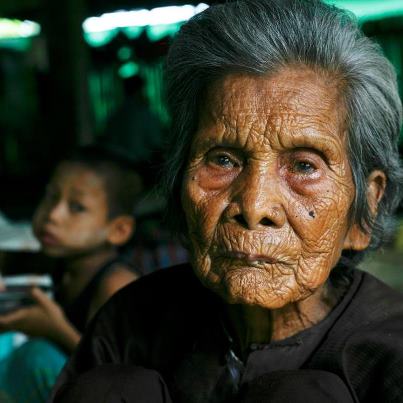
Daw Kyine Than Phyu, 96-years-old, is in a temporary camp to take refuge from recent violence in the area in Rakhine State, Myanmar, 17 June 2012. The latest instability in Rakhine state was triggered on 28 May, when an ethnic Rakhine woman was raped and murdered. This was followed by the killing of 10 Muslims by an unidentified mob on 3 June. According to official figures, over 70,000 people have been displaced in the ensuing violence. At least 78 have died, although unofficial estimates are higher. Credit: EPA/LYNN BO BO
A large number of Muslims are killed in Burma by Budisht , army and police of Burma as Muslims are in minority in Burma but silence of World Powers on this issue is a more worse crime.
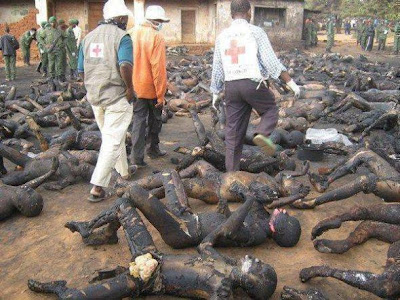
Source: http://merhrom.wordpress.com
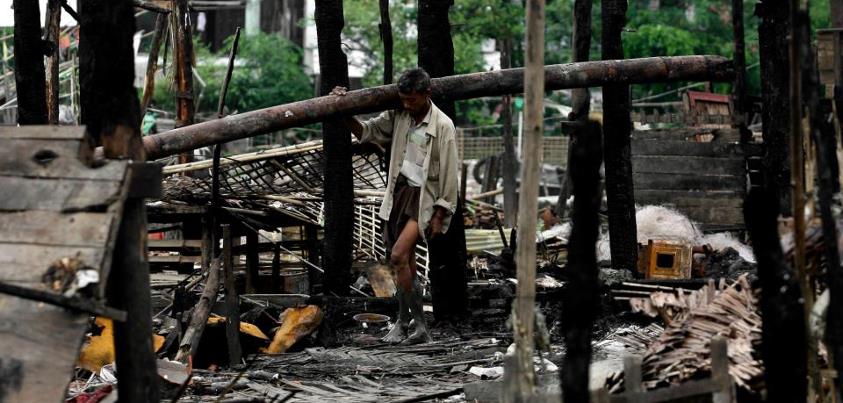
Caption: An ethnic Rakhine man carries bamboo at the burnt Myoe Thu Gyee quarter in Sittwe, Rakhine State, western Myanmar, 16 June 2012. Credit: EPA/LYNN BO BO
__________________
Muslims are compelled to remain inside the country as internal refugees. They face abuse in the forms of rape, torture, extortion, and murder.
Sexual violence and terrorizing thousands of Muslims women and their families. The situation of the Muslim minorities is more complicated because they are not recognized as citizens and any scope of any reconciliation will not give them any protection.
The longer the UN Security Council remains silent, the more people will die.
You and I can make that happen. Burma’s Noble Laureate Aung San Suu Kyi has asked the international community for help. Tell the U.N. Secretary General Ban Ki Moon to pass a resolution to stop the genocide in Burma. The clock is ticking. God have mercy on us all if we stand by and do nothing.
United Nations must to find a way to solve the suffering of the more than a million Muslims in Burma. There is an urgent need for medical supplies and food aid.
http://www.facebook.com/Damascus Center for Human Right Studies (DCHRS)
http://en.wikipedia.org/wiki/Responsibility_to_protect
http://en.wikipedia.org/wiki/Security_council#Responsibility_to_protect
http://www.hrw.org/burma
http://physiciansforhumanrights.org/places/burma
http://www.facebook.com/burmacampaign
http://www.facebook.com/democratic voice of burma
http://www.facebook.com/pages/RFA-Burmese
http://www.facebook.com/burmavjmedia
http://www.facebook.com/pages/Burma-News-from-Mizzima
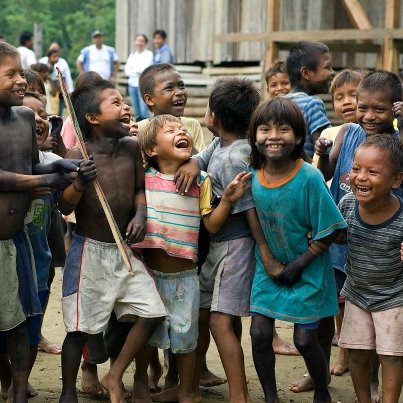
On this special day, read & share the UN Declaration on the Rights of Indigenous Peoples to celebrate: http://bit.ly/PGAy9G http://en.wikipedia.org/wiki/Declaration_on_the_Rights_of_Indigenous_Peoples
International Day of the World’s Indigenous Peoples (23 photos)
__________________
Indigenous children from the Embera people, displaced by armed conflict. Rio Suchio, Colombia. 14 June 2006. Credit: UN Photo
Find out more about our work on the rights of indigenous peoples:http://bit.ly/Nl2WAf
___________________
Global Centre for the Responsibility to Protect (GCR2P)
Asia Pacific Centre for the Responsibility to Protect (R2P)
International Coalition for the Responsibility to Protect (ICRtoP)
Mind and Life XXV Webcast
2012 – XXV
Contemplative Practice and Health:
Laboratory Findings and Real World Challenges
with His Holiness the Dalai Lama
The Rockefeller University, New York, NY – October 17 – 21, 2011

Live Webcast
Mind and Life XXV will be webcast live on Saturday, October 20 beginning at 9:00am Eastern Time.
Live Twitter Feed
Mind and Life will also be live tweeting the event. Follow us @mindandlifeorg
Session 5 The final session of ML XX began with Roshi Joan Halifax quoting His Holiness from years ago – “Compassion is not a luxury, it is a necessity for human beings to survive.” Moving on to the sole formal presentation of the session, William George of Harvard Business School spoke of compassionate, authentic leadership. […]
http://www.mindandlife.org/category/blog/compassion-in-economics
http://www.facebook.com/mindandlife
http://www.facebook.com/DalaiLama
http://www.facebook.com/joan.halifax
#previous #article Mind and Life “Ecology, Ethics & Interdependence”
SRI SRI DURGA PUJA-2012
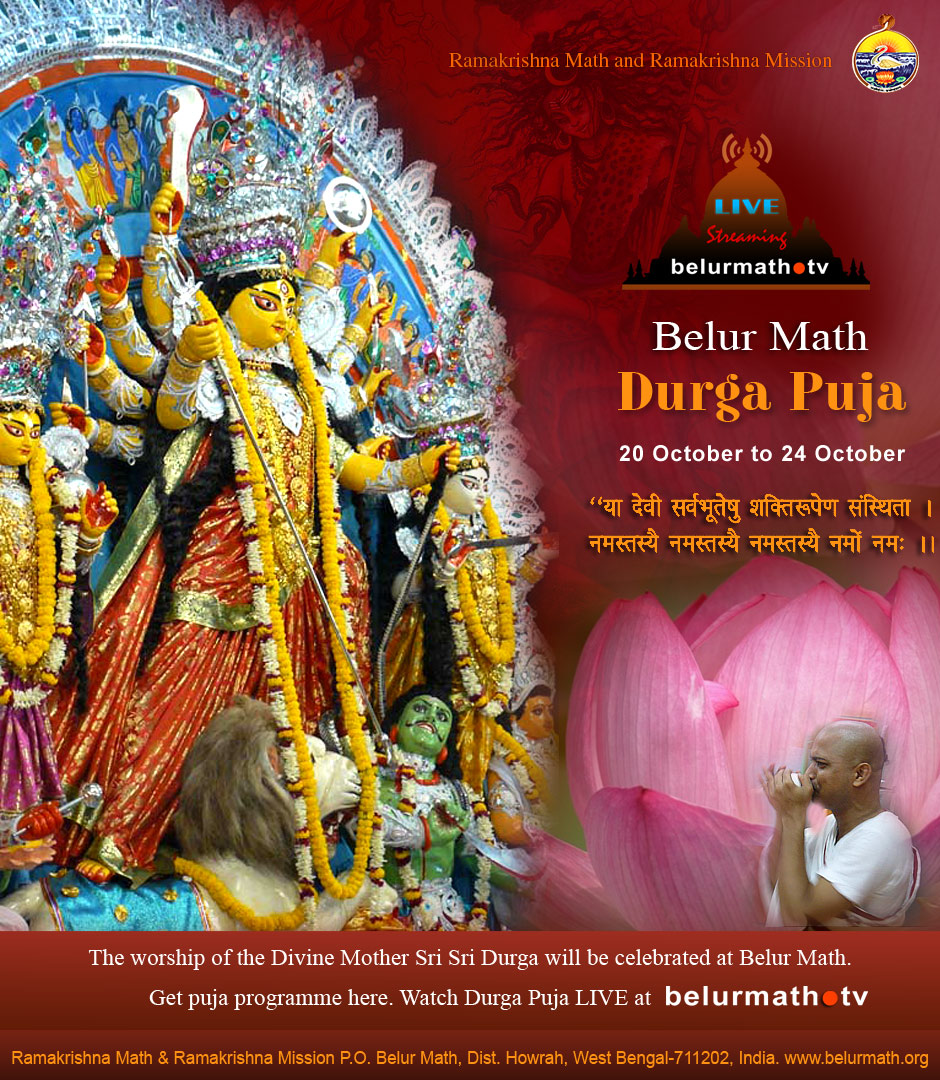
Belur Math Durga Puja LIVE at www.belurmath.tv
The worship of the Divine Mother Sri Sri Durga will be celebrated at Belur Math as per programme given below.
http://www.belurmath.org/news_archives/2012/10/14/sri-sri-durga-puja
#previous #articles #ramakrishna #vivekananda #yoga #vedanta
Sharada Navaratri Mahotsavam at Shrimatham

Sharada Navaratri Mahotsavam at Shrimatham
16 – 24 October 2012
Their Holinesses Pujyashri Jayendra Saraswathi Shankaracharya Swamiji and Pujyashri Shankara Vijayendra Saraswathi Shankaracharya Swamiji will perform Sharada Navaratri Mahotsava for Sri Mahatripurasundari Sametha Sri Chandramouleeswara Swami at Sri Kanchi Kamakoti Peetham, Kanchipuram from 16th to 24th October 2012.
Special pujas, japas, parayanam, homam etc. will be performed during this period for Lokakshema . Devotees are invited to participate in the pujas and receive the bountiful blessings of Sri Mahatripurasundari Sametha Sri Chandramouleeswara Swami and Pujyasri Acharya Swamijis.
Iranian Film Festival Australia (IFFA)
http://www.iffa.net.au 2nd Iranian Film Festival Australia coming back in Oct 2012 with a great selection of new films and retrospective titles.

Find out about the list of 2012 festival films in just one place! pic.twitter.com/n7X2IJoK
Convention on Biological Diversity (COP 11) , India Oct. 8-19
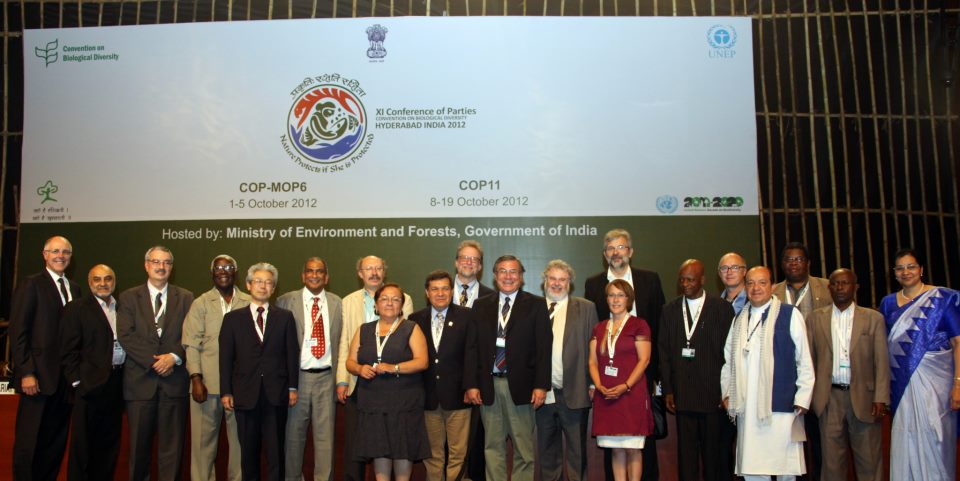
The Convention on Biological Diversity (CBD), known informally as the Biodiversity Convention, is an international legally binding treaty. The Convention has three main goals:
- conservation of biological diversity (or biodiversity);
- sustainable use of its components; and
- fair and equitable sharing of benefits arising from genetic resources
In other words, its objective is to develop national strategies for the conservation and sustainable use of biological diversity. It is often seen as the key document regarding sustainable development. http://en.wikipedia.org/wiki/Convention_on_Biological_Diversity
As 193 member states will descend on India Oct. 8-19 for high-level talks on Biodiversity (COP 11 CBD), Braulio Ferreira de Souza Dias, executive secretary of the Convention on Biological Diversity, talked to IPS' about what's at stake.
http://www.scidev.net/en/science-and-innovation-policy/science-at-rio-20
http://www.scidev.net/en/news/nagoya-biopiracy-agreement-is-unexpected-success
http://www.twnside.org.sg/title2/books/The.Road.to.an.Anti-Biopiracy.Agreement.htm
previous #articles #videos #biodiversity #sustainable development
http://www.facebook.com/ipsnews
http://www.facebook.com/ipsenvironment
Live Webcasts: Shantideva’s „A Guide to the Bodhisattva’s Way of Life

Shantideva (Sk: ŚÄ�ntideva; Zh: 寂天; Tib: ཞི་བ་ལྷ། (Shyiwa Lha, Wylie: zhi ba lha); Mn: Шантидэва гэгээн) was an 8th-century Indian Buddhist scholar at Nalanda University and an adherent of the Madhyamaka philosophy of Nagarjuna. http://en.wikipedia.org/wiki/Shantideva
There will be live webcasts of His Holiness the Dalai Lama teachings on Shantideva’s „A Guide to the Bodhisattva’s Way of Life (chodjug)“ at the request of a group of Southeast Asians at the Main Tibetan Temple in Dharamsala, India, on September 4-6, 2012. There will be live webcasts in English, Chinese, Tibetan and Russian languages. The live webcasts can be viewed at http://dalailama.com/liveweb
For times in your region: 9:30am IST on September 4th in Dharamsala, India, is the same as 5:00am BST on September 4th in London, England; and 9:00pm PDT on September 3rd in Los Angeles, California, USA
#previous #articles #videos #dalai lama #tibet
http://www.facebook.com/DalaiLama

UN Human Rights Office calls for an independent inquiry into the apparent killing by the security forces
UN Human Rights Office calls for an independent inquiry into the apparent killing by the security forces of at least 8 people during protests in Nyala, Darfur, Sudan. The office is also concerned about the persecution of bloggers, as well as violence against gay and lesbian activists in Liberia. http://bit.ly/QzBUtX
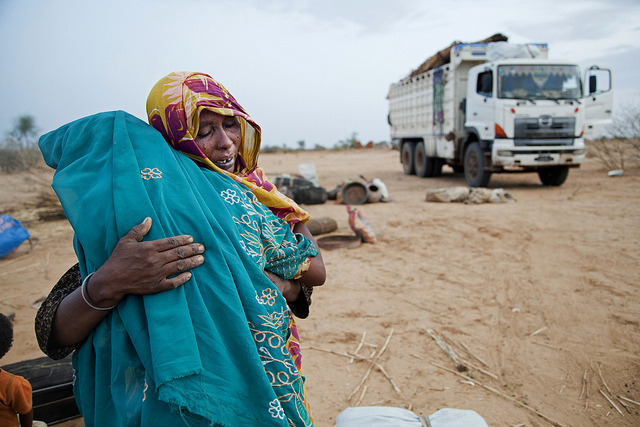
IDPs return to their village and are hugged by the villagers on Flickr by UNHCR (CC license-BY). Welcoming home returning IDPs in Sudan: Internally Displaced Persons (IDPs) returned to their original village, Sehjanna, after living seven years in an IDP camp in Aramba. They are welcomed by relatives and friends who stayed back. The voluntary repatriation program is organized by the Office of the United Nations High Commissioner for Refugees (UNHCR) and the Sudanese Humanitarian Aid Commission.
http://globalvoicesonline.org/africa-celebrating-humanity-through-photos-and-videos
http://globalvoicesonline.org/-/world/sub-saharan-africa/mali
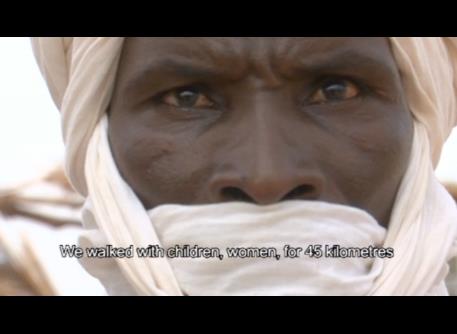
Niger-Mali refugee crisis: ‚We came with nothing … there is nothing to eat. Nothing‘ – video
http://www.hrw.org/africa/sudan
https://twitter.com/ovietnamfinance
http://www.hrw.org/asia/vietnam
http://www.facebook.com/IranLGBT
http://www.facebook.com/lgbtqnation
#previous #articles #videos #humanrights #sudan
Damascus Center for Human Right Studies (DCHRS) #Syria #Humanrights #Amnesty FSA killings probe findings ‘must go to UN inquiry’ http://bit.ly/MIKGQr http://www.facebook.com/DCHRS
IPS Inter Press Service News Agency — Check out this fantastic map and historical timeline of LGBT legal rights around the world, by our colleagues at IPS Cuba http://bit.ly/QKCl21

Statement by civil society organisations deeply concerned by violence against stateless Rohingya
UPDATE 2012-07-30
NGO warns of ‘second tragedy’ in western Burma | Democratic Voice of Burma: http://bit.ly/NR1Dtz
___________________
http://www.hrw.org/burma #economy #humanrights
http://physiciansforhumanrights.org/places/burma
http://www.burmacampaign.org.uk/news-and-reports
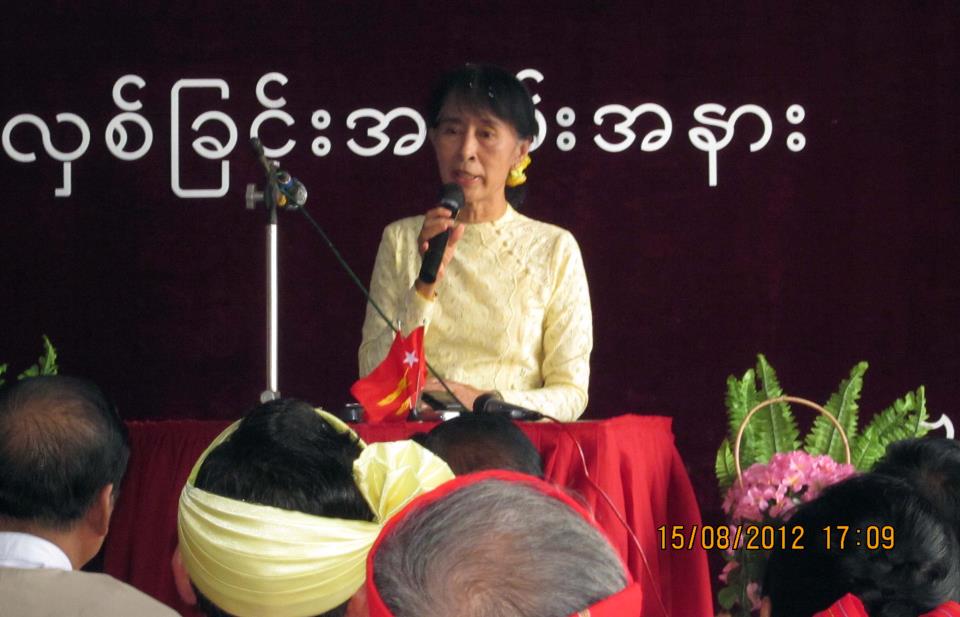
Radio Free Asia’s mission is to provide accurate and timely news and information to Asian countries whose governments prohibit access to a free press. Guided by the core principles of freedom of expression and opinion, RFA serves its listeners by providing information critical for informed decision-making. http://www.rfa.org/burmese
Radio Free Asia (RFA) is a private, nonprofit corporation that broadcasts news and information to listeners in Asian countries where full, accurate, and timely news reports are unavailable.
__________________________
United Nations Human Rights “The underlying tensions that stem from discrimination against ethnic and religious minorities pose a threat to Myanmar’s democratic transition and stability,” said UN expert on the human rights situation in Myanmar Tomás Ojea Quintana. More: http://bit.ly/LDoDep
__________________________
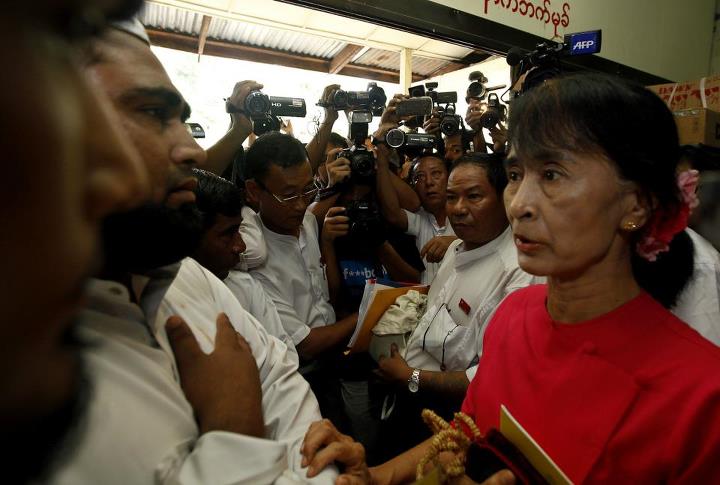
Myanmar democracy leader Aung San Suu Kyi comforts Muslim men who came and ask for help at the National League for Democracy (NLD) party headquarters, Yangon, Myanmar, 6 June 2012. Credit: EPA/NYEIN CHAN NAING
The Rohingya (Burmese: ရိုဟင်ဂျာ) are a Muslim people who live in the Arakan region. As of 2012, 800,000 Rohingya live in Myanmar. According to the UN, they are one of the most persecuted minorities in the world. http://en.wikipedia.org/wiki/Rohingya_people
Rohingya (Ruáingga) is a language spoken by the Rohingya people of Arakan (Rakhine/Rohang), Burma (Myanmar).[1][2] It is related to the Chittagonian language spoken in the neighboring southeastern Chittagong Division of Bangladesh. http://en.wikipedia.org/wiki/Rohingya_language
The Indo-Iranian language group constitutes the easternmost extant branch of the Indo-European family of languages. It consists of three language groups: the Indo-Aryan, Iranian and Nuristani. The Indo-Iranian languages occasionally go by the term „Aryan languages“.[1] The speakers of the Proto-Indo-Iranian language, the hypothetical Proto-Indo-Iranians, are usually associated with the late 3rd millennium BC Andronovo and Sintashta-Petrovka cultures of Central Asia. Their expansion is believed to have been connected with the invention of the chariot. http://en.wikipedia.org/wiki/Indo-Iranian_languages
Civil Society Organisations Deeply Concerned by On-going Violence against Stateless Rohingya in Myanmar and their Refoulement from Bangladesh
The stateless Rohingya of Myanmar have suffered from extreme persecution and discrimination for decades. They are now facing another crisis. On 3 June inter-communal violence erupted, and this has evolved into large-scale state sponsored violence against the Rohingya. Despite this, neighbouring Bangladesh is not allowing them to enter to seek refuge. The Rohingya population needs urgent measures to be taken for their protection.
In Myanmar, what began as inter-communal violence has evolved into large-scale state sponsored violence against the Rohingya. The violence began on 3 June 2012 and has mainly occurred in Sittwe and Maungdaw. On 10 June, a state of military emergency was declared, after which the military became more actively involved in committing acts of violence and other human rights abuses against the Rohingya including killings and mass scale arrests of Rohingya men and boys in North Rakhine State. Many Rohingya continue to be victims of violence and cannot leave their homes for fear of persecution, and are thus deprived of their livelihood and most basic needs. The urgent humanitarian needs of those displaced (IDPs) – including those not in IDP camps – are not being adequately met and there is concern that those displaced will not be allowed to return to their homes as soon as it is safe to do so, thus creating a situation of protracted displacement.
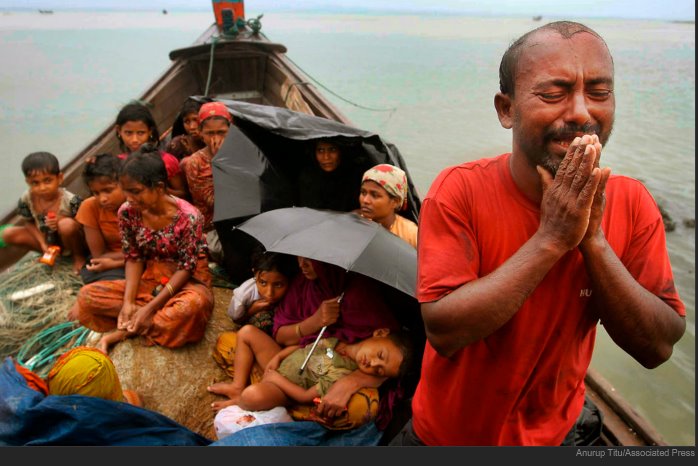
Heartbreaking photo of a Muslim refugee from Myanmar pleading with Bangladesh to let him in. Bangladesh has turned back 1,500 refugees fleeing violence between majority Rakhine Buddhists and minority Rohingya Muslims in western Myanmar. http://nyti.ms/LKzzFE
Bangladesh, in contravention of its international legal obligations, closed its border and pushed back many Rohingya fleeing the violence and persecution in Myanmar. The refoulement of these refugees by Bangladesh to Myanmar where they face a very immediate threat to life and freedom, and a danger of irreparable harm; and the manner of refoulement, by push backs into dangerous waters, including in unsafe vessels are matters of serious concern.
The legal obligations of both Myanmar and Bangladesh require them to protect all persons within their territories or subject to their jurisdictions, regardless of whether they are citizens, stateless persons or refugees. In their treatment of the Rohingya, both countries have violated the right to life, the right to be free from torture or cruel, inhuman or degrading treatment or punishment, the right to liberty and freedom from arbitrary detention, the right to food and shelter including the fundamental right to be free from hunger and the right to the highest attainable standard of health. Bangladesh has also acted in violation of the rights to seek and to enjoy asylum and not to be subjected to refoulement.
We therefore recommend that both states immediately uphold their human rights obligations in this situation.
In particular, we recommend that the Government of Myanmar and the Rakhine State authorities take immediate steps to:
1. Stop the violence.
2. Stop the arbitrary arrests of Rohingya and abuses by security forces against them.
3. Allow unhindered humanitarian access to assist all those in need as a result of the crisis, including internally-displaced people staying outside camps and those hosting them.
4. Allow the displaced to return to their homes once it is safe and they feel safe to return, and ensure that a situation of protracted displacement is avoided.
5. Allow an international inquiry into the abuses committed since June 2012 in Rakhine State.
We recommend the Government of Bangladesh take immediate steps to:
1. Open its borders to refugees and to stop refoulement of refugees.
Further, we call on the international community to:
1. Provide financial support for the humanitarian operation needed to assist people affected by the crisis in Rakhine State.
2. Support the government of Bangladesh in providing protection to Rohingya refugees.
3. Engage with the Governments of Myanmar and Bangladesh in relation to the above recommendations.
We also recommend that the reform process in Myanmar address existing policies of discrimination against the Rohingya; and that this current crisis be used as an opportunity to address the longstanding problems between the communities in Rakhine State, and to promote a constructive dialogue aiming at peace and reconciliation.
http://www.hrw.org/burma
http://physiciansforhumanrights.org/places/burma
http://www.facebook.com/burmacampaign
http://www.facebook.com/democratic voice of burma
http://www.facebook.com/pages/RFA-Burmese
http://www.facebook.com/burmavjmedia
http://www.facebook.com/pages/Burma-News-from-Mizzima
#previous #articles #videos #burma
#previous #articles #videos #refugee
Myanmar: “Sunday’s by-elections, key test of democratic reform process,” says UN expert
GENEVA (30 March 2012) – The United Nations Special Rapporteur on the human rights situation in Myanmar, Tomás Ojea Quintana, said that Myanmar’s by-elections on 1 April will be a key test of progress made by the Government in its process of reform. In the coming polls, 48 parliamentary seats will be contested. More: http://bit.ly/HoYm3k

Live Blogging on International Justice Day

www.ohchr.org/WelcomePage.aspx
http://www.10a.icc-cpi.info/index.php/en
The International Criminal Court (commonly referred to as the ICC or ICCt)[1] is a permanent tribunal to prosecute individuals for genocide, crimes against humanity, war crimes, and the crime of aggression (although it cannot, until at least 2017, exercise jurisdiction over the crime of aggression).
It came into being on 1 July 2002—the date its founding treaty, the Rome Statute of the International Criminal Court, entered into force—and it can only prosecute crimes committed on or after that date. The Court’s official seat is in The Hague, Netherlands, but its proceedings may take place anywhere. http://en.wikipedia.org/wiki/International_Criminal_Court
International Criminal Justice Day was adopted on 1 June 2010 by the States Parties to the International Criminal Court at the Review Conference to the Rome Statute. July 17th is International Criminal Justice Day. Celebrate, Reflect, Act.
In Kampala (Uganda), at the Review Conference of the Rome Statute held in 2010, States Parties to the International Criminal Court decided to start celebrating 17 July every year as the Day of International Criminal Justice. The date commemorates 17 July 1998, when the international community reached an historic milestone by adopting the Rome Statute, the legal basis for establishing the permanent International Criminal Court.
The adoption of the Rome Statute was a momentous step towards ending impunity for the perpetrators of the most serious crimes of international concern – genocide, war crimes, crimes against humanity and aggression – which threaten the peace, security and well-being of the world. http://en.wikipedia.org/wiki/World_Day_for_International_Justice
For several years civil society has commemorated this anniversary by leading International Justice Day celebrations.
Speech | May 2010 | Kampala, Uganda – Kofi Annan addresses the First Review Conference of the Assembly of States Parties to the Rome Statute of the International Criminal Court http://kofiannanfoundation.org/newsroom
On 6 July 2012, the International Criminal Court (ICC) and the Assembly of States Parties (ASP) held an event and symbolic flag-raising ceremony, calling other parties to join in celebrations of 17 July, International Criminal Justice Day.
The event began with speeches by Ambassador of Luxembourg, H.E. Mr Jean-Marc Hoscheit, representing the States parties to the Rome Statute, and the ICC President, Judge Sang-Hyun Song.

On 17 July, the world celebrates International Justice Day, commemorating the adoption of the Rome Statute http://www.iccnow.org/rome and celebrating the achievements of international criminal justice. On this occasion, the Coalition calls on all governments to firmly commit to prioritizing international justice and hold accountable those who are suspected of committing the gravest crimes against humanity.
“The tools for ending impunity exist for perhaps the first time in history; it is now a matter of galvanizing universal political will to make them fully operational,” said William R. Pace, convenor of the Coalition. Read the Coalition’s press release
Credit: AMICC
Live Blogging on International Justice Day
On 17 July, the Coalition for the International Criminal Court will host a live question & answer blogging session in commemoration of International Justice Day with Coalition Convener William Pace. The session will be held on the Coalition’s blog, In Situ: See Justice through the Eyes of Civil Society from 4:30 to 5:30 p.m. CET (10:30-11:30 a.m. EST).
2012 Ottawa Quran Festival July 28 – 29 at RA Centre

The Quran (English pronunciation: /kɔrˈɑːn/[n 1] kor-ahn; Arabic: القرآن al-qurʾÄ�n, IPA: [qurˈʔaːn],[n 2] literally meaning „the recitation“), also transliterated Qur’an, Koran, Al-Coran, Coran, Kuran, and Al-Qur’an, is the central religious text of Islam, which Muslims consider the verbatim word of God (Arabic: الله, Allah).[1] It is regarded widely as the finest piece of literature in the Arabic language. http://en.wikipedia.org/wiki/Quran
The Quran is composed of verses (Ayah) that make up 114 chapters (suras) of unequal length which are classified either as Meccan (المكية) or Medinan (المدينية) depending upon the place and time of their claimed revelation. Muslims believe the Quran to be verbally revealed through angel JibrÄ«l (Gabriel) from God to Muhammad gradually over a period of approximately 23 years beginning in 610 CE, when Muhammad was 40, and concluding in 632 CE, the year of his death.
Hereby, the Executive Committee of the Quran Festival, would like to invite you to join other Islamic Centers for holding next Quran Festival in the month of Ramadan al-Mubarak 2012.
The Executive Committee of the Quran Festival had the honour to hold the first Quran Festival, at which several Islamic centers were present, in Ottawa in 2010. The main goal of this festival is to familiarize the youth and adolescents of the Muslim as well as non-Muslim communities in Canada with the aesthetics and visual elegance of the Quran and its noble concepts.
The Festival intends to set the grounds for introduction and development of Quranic culture and education, along with the valuable and productive programs of the Islamic centers in the holy month of Ramadan, the month of the revelation of the Quran and the month of fasting.
The first Quran Festival was held in the holy month of Ramadan in 2010, participated by a group of Islamic centers in Ottawa. In the month of Ramadan 2011, the second Quran exhibition was held in Ottawa. A similar exhibition was held in Toronto, at the Ontario Science Centre, for the first time, which was received with great enthusiasm from visitors.
Second Quran Festival, Ottawa, Aug 6 – 7 2011
Since the beginning of its mission, the Committee has set its aim to invite as many interested Islamic centers as possible to participate in its annual festival. Therefore, in the upcoming month of Ramadan , with the graciousness and providence of Allah, and with the committed attendance and participation of all Islamic centers, along with the annual exhibitions in Ottawa and Toronto, we are planning to establish the first Quran Festival in Montreal, Insha’Allah.
Alongside constructing a channel of education on the beauties of the Holy Quran and the relevant Islamic arts for Muslim and non-Muslim populations, we hope to attract the younger generations’ attention to their rich Islamic/Quranic heritage.
The Quran Festival includes a variety of exhibitions and programs, of which the most important ones are
- The exhibition of exquisite Qurans
- The exhibition of Quranic Interpretations (Tafsirs)
- The exhibition of Quranic Arts (i.e. copies of the antique and elegant prints of Quran pages, beautiful artworks, Islamic Calligraphy, etc.)
- Quran in the virtual space (i.e. Internet)
- Quran and Children
- Quranic Software
- Quranic Videos/Animations
- Quranic Knowledge and Contests
- Quranic Recitation
- Speech and Answering the visitors’ questions on Quranic topics
All the participating Islamic centers can have a specific display table to introduce and present information about the programs of their own centers as well as any Quranic artworks.
As the Quran Festival aims to have the maximum participation from Islamic centers, on behalf of this committee, we would like to invite your center to take part in the 2012 Annual Quran Festival.
We look forward to hearing back from you and hope to have you as one of the contributing centers to the 2012 Quran Festival. To help us organize and coordinate sections and duties well in advance, please complete the attached form and send it back to us as soon as possible.
Executive Committee of Quran Festival in Canada
http://iranculture.ca/dev
http://www.cultureofiran.com
http://www.facebook.com/Cultural Centre of the Islamic Republic of Iran Ottawa
http://www.facebook.com/LeCentreCulturelDIranAOttawa
Celestial Hierarchy in Christianity (Gabriel)
#previous #articles #videos #lunar calendar
Österreichisches Kulturforum Teheran – ÖKFT
#previous #articles #videos #iran
http://www.iranhumanrights.org
http://www.rferl.org/section/Iran
http://www.transparency-for-iran.org
http://portal.unesco.org/en/Convention Diversity of Cultural Expressions 2005
Background Note: http://www.un.org/rights/dpi1627e.htm
Oxford Journal: http://jiel.oxfordjournals.org/content/9/3/553.abstract

Mishras 2012 Europen Musical tour
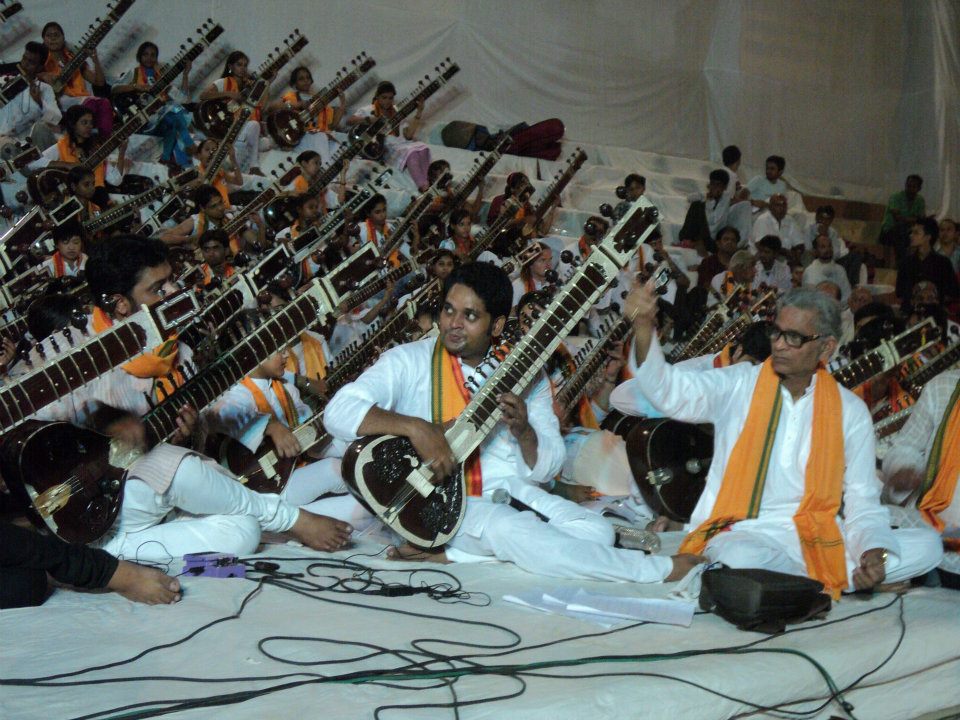
Dear Friends,
We are in Varanasi now and wish all of you. We are happy to inform you that our tour for Europe this year will be in October/ November 2012. So we are starting now for booking the Concert dates of Europe and just like to inform you that if you want to book any concert of us then please contact us soon as now we are booking the dates.
We are coming three musician Pandit Shivnath Mishra, myself Deobrat Mishra on Sitar and Prashant Mishra on Tabla. So please contact us soon for any information you need.
Hope to hear from you soon.
Yours, Deobrat Mishra
Sitar Artist.
Contact us at: mishramusic@hotmail.com
Website: www.music-of-benares.com
Cell: 0091-9451586700
Note: we are also sending you a attachment of recent concert photos and Video Link on youtube we did with 108 Sitar players in Varanasi to save holy River Ganges. Please have a look. You can see more picture of it on my facebook account: Deobrat Mishra
My father Pandit. Shivnath Mishra made a history in Varanasi-India to conduct a orchestra of 108 sitar players. Total musician where 151 including Tabla players and Flute players.
Varanasi (Sanskrit: वाराणसी ) is a city situated on the banks of the River Ganges in the Indian state of Uttar Pradesh, 320 kilometres (199 mi) southeast of state capital Lucknow. It is regarded as a holy city by Buddhists and Jains, and is the holiest place in the world in Hinduism (and center of earth in Hindu Cosmology). It is one of the oldest continuously inhabited cities in the world and probably the oldest of India. The Kashi Naresh (Maharaja of Kashi) is the chief cultural patron of Varanasi and an essential part of all religious celebrations.The culture of Varanasi is closely associated with the River Ganges and the river’s religious importance. The city has been a cultural and religious centre in North India for several thousand years.
The Benares Gharana form of Indian classical music developed in Varanasi, and many prominent Indian philosophers, poets, writers, and musicians resided or reside in Varanasi, including Kabir, Ravidas Their Guru Swami Ramanand, Trailanga Swami, Munshi Premchand, Jaishankar Prasad, Acharya Shukla, Ravi Shankar, Girija Devi, Hariprasad Chaurasia, and Bismillah Khan. Tulsidas wrote Ramacharitamanas here, and Gautama Buddha gave his first sermon at Sarnath located near Varanasi (Kashi). Varanasi is home to four universities: Banaras Hindu University, Mahatma Gandhi Kashi Vidyapeeth, Central Institute of Higher Tibetan Studies and Sampurnanand Sanskrit University. Residents mainly speak Hindi and Kashika Bhojpuri, which is closely related to the Hindi language. People often refer to Varanasi as “the city of temples”, “the holy city of India”, “the religious capital of India”, “the city of lights”, and “the city of learning.”
Mishras Press release:
Very rare to see three generation master musician’s on same stage.
11th GENERATION FATHER AND SON SITAR MASTERS of Benares Gharana
From their home city of Benares, an ancient spiritual centre of traditional music and Indian culture, “The Mishras” are bringing classical North Indian Ragas and meditative music to the world audience, gifting the audience with a fabulous performance and a spiritual experience. Join this father and son duet of two of the worlds finest Sitar Artist and Prashant Mishra on Tabla grandson of Pandit Shivnath Mishra as they inspire one another to new levels of loving interplay.
PANDIT SHIVNATH MISHRA
Pandit Shivnath Mishra was born on the 12th of October 1943, in Varanasi (North India). Also known as “Legend of the Sitar”, he is the 10th generation of the prominent Benares Gharana lineage of top class singers including Pandit Bade Ramdas Mishra and Panditji Great Grand Father. Since childhood, his highly musical family could see signs of a masterful musician in him. When Panditji was five years old, he began studying vocal music with his father, Badri Prashad Mishra, and his uncle-guru, Pandit Mahadev Prashad Mishra. However, when he was eight his musical inclination led him to study the sitar. In a family of great classical Indian vocalists, he was the first one who mastered the sitar.
Due to the vocal influence from his family as well as the Benares Gharana tradition, he is one among few artists in Contemporary India who ‘sing inside’ while playing a musical instrument. His lively, powerful and unique style has praised him with innumerous titles by the most representative authorities and institutions of music in and outside India. In 1966, when he was only twenty-three, he received a gold medal in the All India Music Conference, in Calcutta.
1979 marks the beginning of his performances abroad. Sine then, he has been constantly on tour in many foreign countries, among them Germany, Italy, France, Luxembourg, Switzerland, Austria, Japan, Holland etc. In 1999, he gave his first concert in the USA and Canada. During his tours, he has performed with several international jazz artists such as John Handy, Paul Horn, David Freezen, Ben Conrad, Berred Kworrase, George Figgler Aimester among others. Moreover, he participated in many conferences and recitals including the Condolence Metal of Late Prime Minister Mrs. Indira Gandhi, in Germany. He also took part in programs broadcast by the BBC Television and the German Radio.
Being one of India’s premiere sitar artists of all times, Pandit Shivnath Mishra was the Head of the Music Department at the Sampurnanand Sanskrit University of Benares, in Varanasi, for 36 years. At this time, in 1994, he formed the “Music of Benares” which consists of a group of North Indian (Hindustani) classical musicians whose aim is to familiarize audiences all over the world with Hindustani music in general and the Benares Gharana in particular. What is characteristic of the Benares Gharana is exactly the singing of the Thumri, a light Indian classical music that is highly ornamental and thus very emotional and expressive. At a time when many different Gharanas mix with each other, the “Music of Benares” group keeps this ancient tradition alive.
Incorporation of this style with the “Jugalbandi” presentation, in which there are two solo artists sharing the stage, has created a unique synthesis of classical and folk that appeals to audiences everywhere. But this is not just Jugalbandi, this is a duet between a Guru and his Shishya (disciple) and, in this case, between father and son. Seeing this special interaction on stage is no doubt an unforgettable and mesmerizing experience.
Deobrat Mishra – biography
Deobrat Mishra is no doubt one of the most energetic and innovative sitar artists of India. Selectivity, melody and rhythmic complexity are typical features in his lively playing style.
Born in 1976, he represents the 11th generation of the Benares Gharana tradition. As a young child he studied tabla with his mother, Pramila Mishra, who is the granddaughter of the well-known tabla player Pandit Baiju Mishra. He started by studying vocal music with his father at the age of five and began his sitar lessons a year later. That same year, after only six months of studying the sitar, he gave his first public performance on stage. Five years later, he performed for the first time on the All India Radio.
Since 1994 he has been touring throughout Europe with his father. In the same year he was chosen to receive the award of the best young sitar player of India. In 2000 he received the “Jewels of Sound Award” in Mumbai. His many projects include music workshops, solo performances for radio and television as well as world music programs with Indian and European artists. Moreover, he is the one in charge of cultural events and music lessons provided by the Academy of Indian Classical Music, the school he founded along with his father, Pandit Shivnath Mishra, in 2006.
Recently, he received a Masters degree in sitar from the Prayag Sangit Samiti in Allahabad. Among many other projects, the Mishras performed and recorded their music with the Western Symphony Orchestra of Italy in 2005. Nowadays, they fully dedicate their art to similar projects including annual tours around the world.
Above all, the Mishras (father and son) serve as two of India’s leading cultural ambassadors of our times
Prashant Mishra is one of the best young Tabla player of benares music tradition. When he was five he started to learn tabla with the family member of Biru Mishra of Varanasi also studying Tabla presently with Mr.Chakkan lal Mishra(Student of Great Tabla player Anokhelal Mishra..
Soon after few years of hard practice with his grandfather Pandit Shivanath mishra and uncle Deobrat mishra he was able to perform with Mishras His skills beautifully compliment and support the Mishras in their concerts.
http://timesofindia.indiatimes.com/topic/Aviral-and-nirmal-flow-of-the-Ganga/news
In 2004 he won first prize in Tabla competition organized by Sangeet Natak Academy Uttar Pradesh India. He received many awards for his tabla playing at many different places. The Mishras tour will help to support the Academy Of Indian Classical Music School in Varanasi, India.
Additionally, the Mishras support their Academy of Music in Benares, India where they keep alive the tradition of their music amongst young musicians. Every January and February, the Academy is open to international students of all ages and skill levels. These study tours to India are a cultural experience combining ashram style living and intensive music instruction in one of the world’s oldest cities.
Visit: www.benaresmusicacademy.co
For more information, contact Deobrat Mishra: mishramusic@hotmail.com
Visit our website: www.music-of-benares.com
http://www.gangaaction.com/
http://
http://
#Previous #articles #videos #benares #gharana
#Previous #articles #save #ganga #water #humanrights
Note: Mishra or Misra (Hindi: „मिश्र“ „मिश्रा“) is a Hindu Brahmin surname found mostly in the northern and central parts of India. It is one of the most widespread Brahmin surnames in the fertile Gangetic plain region and in the Indian states of Delhi, Bihar, Uttar Pradesh, Uttarakhand, Madhya Pradesh, Rajasthan, Orissa, Assam and West Bengal. It is also found in countries such as Guyana and Trinidad and Tobago under the anglicized version of Misir, due to migration owing to agricultural/plantation employment. The surname is also found in Nepal, Fiji and Mauritius, as well as in other Indian diaspora communities.
In Hinduism, Brahmin refers to the class of educators and preachers. It is the highest class in the caste system. There are many references in the Ramayana and Mahabharata about the importance of a Brahmin. In the Vedic period, the Brahmins preferred isolation and solely dedicated their life to propagating knowledge and Dharma. However Misras have historically been martial Brahmins and in earlier years, many were drafted into the army.
