
Posts by admin
Act4Tibet – Yogi Tsoru Dechen Foundation

Yogi Tsoru Dechen Foundation, Florida
The Yogi Tsoru Dechen Rinpoche Foundation was created to provide Westerners access to the Buddha Dharma (Path of Awakening), and to supply Compassion and Wisdom to all human beings. The founder and spiritual leader of YTDR Foundation is Tulku Karma Gyurme Sonam Rinpoche, who is recognized as a Lama – a term reserved for senior members of the Tibetan Order.
ACT is a branch of the Yogi Tsoru Dechen Rinpoche foundation that is dedicated to helping the young Tibetan refugees and monks at Lama Tulku Karma’s camp in Mainpat, India.
Acupuncturists from Sedona treat Tibetans living in exile in a Tibetan refugee camp in India, called Mainpat. Invited by buddhist lama Tulku Karma Rinpoche, the experience so moved them that they formed the Tibetans in Exile Health Project, a not for profit tax exempt organization committed to meeting the health care needs of Tibetans living in exile.
YTDR manages several charitable programs which directly benefit the people of Tibet and help ensure the survival of their culture. The Foundation’s ultimate vision is to have Dharma Centers established throughout the world devoted to cultivating wisdom and compassion for all beings.
With Dharma Centers already established in Nepal and the US, these additional centers will sustain the teachings and unique lineage of Tibetan Buddhism that was nearly extinguished in the political upheavals of the 20th century, and which have been re-established while still in exile.
YTDR Foundation is a volunteer based organization, and is a registered Florida Charitable Entity EIN 30-0458849 that has applied for Federal Non-Profit Status.
Meet YTDR Sedona Dharma Center, friends, fans at fb <
Meet Act4Tibet, friends, fans at fb <
Indo Tibetan Yogic Tradions of the 5 Rites

> The Indo-Tibetan Tibetan Yogic Tradition <
and the “Tibetan Rites of Rejuvenation”
The Five Tibetan Rites is a system of exercises reported to be more than 2,500 years old which were first publicized by Peter Kelder in a 1939 publication entitled „The Eye of Revelation“. Although practically nothing is known about Kelder, one source reports that Kelder was raised as an adopted child in the midwestern United States, and left home while still in his teens in search of adventure. In the 1930s, Kelder claims to have met, in southern California, a retired British army colonel who shared with him stories of travel and the subsequent discovery of the Rites. Originally written as a 32-page booklet, the publication is the result of Kelder’s conversations with the colonel.The Rites are said to be a form of Tibetan yoga similar to the more well-known yoga series that originated in India. However, the Five Rites and traditional Tibetan yoga both emphasize „a continuous sequence of movement“ ( Sanskrit: vinyasa ), whereas Indian forms focus on „static positions“. Although the Rites have circulated amongst yogis for decades, skeptics say that Tibetans have never recognized them as being authentic Tibetan practices.
The Five Tibetan Rites are also referred to as “ The Five Rites „, “ The Five Tibetans „, “ The Five Rites of Rejuvenation “ and most recently “ T 5 T „. Read More: > HERE <
Disputed origins – Although the origin of the Five Rites prior to the publication of The Eye of Revelation is disputed between practitioners and skeptics, a comparison of illustrations of the postures shows a remarkable similarity between the Rites and authentic Tibetan ‚phrul ‚khor exercises from a system rendered into English as ‚Vajra Body Magical Wheel Sun and Moon Union‘ (Tibetan: རྡོ་རྗེ་ལུས་ཀྱི་འཕྲུལ་འཁོར་ཉི་ཟླ་ཁ་སྦྱོར; Wylie: rdo rje lus kyi ‚phrul ‚khor nyi zla kha sbyor).
Chris Kilham, whose 1994 book The Five Tibetans helped respark the Five Rites‘ popularity, says, „As the story has it, they were shared by Tibetan lamas; beyond that I know nothing of their history.“Even though the historic lineage of the Rites prior to the publication of Kelder’s booklet remains to be ascertained, the Rites have nevertheless been affirmed by a lama and scholar of the Sa skya tradition of Tibetan Buddhism as being „a genuine form of yoga and were originally taken from an authentic Indo-Tibetan tantric lineage, namely a cycle of yantra-yoga associated with the Sadnadapadadharma.“ These techniques have been integrated into the well-known > “Six Yogas of Naropa”< (Sk. Sadnadapadadharma षड्नादपादधर्म Tib. na ro chos drug ན་རོ་ཆོས་དྲུག་).
However, it has been argued that the Five Rites predate yoga as we know it today by as much as seven hundred years or more and, therefore, could not have derived from either Tibetan or Indian forms of yoga. Moreover, it has also been suggested that the Rites are more likely to have originated from a system of Kum Nye which, like the Rites, date back 2,500 years.
Nevertheless, Chris Kilham also states that “ the issue at hand, though, is not the lineage of the Five Tibetans. The point is their immense potential value for those who will clear 10 minutes a day to practice.“
Tibetan Buddhism Trul Khor, by Tenzin Wangyal Rinpoche
Records of Teachings Received by Tibetan Masters from the Sa skya Tradition – A Project of the University of Munich in collaboration with the Tibetan Buddhist Resource Center (New York), funded by the German Research Foundation (DFG):
About the Database: The „Records of Teachings Received“ (gsan yig) from which the entries of this database originate, form part of the collected writings of the renowned Sa skya pa master and historian A mes zhabs Ngag dbang kun dga‘ bsod nams (1597-1659).
This database contains references to almost 1,800 individuals (references to some of whom were previously scarce or non-existent) listed in 746 lineage records. Read More: > HERE <
Kum Nye and sKu-mNyé refer to a wide variety of Tibetan religious and medical body practices. The two terms are different spellings in the Latin alphabet of the same Tibetan phrase (Wylie: sku mnye), which literally means „massage of the subtle body“. Some systems of sku mnye are vaguely similar to Yoga, Tai Chi, Qi Gong, or therapeutic massage. Confusingly, „Kum Nye“ and Ku Nye are also used to transcribe the Tibetan phrases dku mnye („belly massage“) and bsku mnye („oil massage“), which are pronounced identically to sku mnye. dKu mnye and bsku mnye manipulate the physical body, rather than the subtle (energetic) one.
Systems of Kum Nye are found in many Tibetan Buddhist and Bön traditions. These can be entirely different both in purpose and in methods. For instance, some forms are very slow moving; others are intensely aerobic. Some systems are based in the Tibetan Medical Tantras (scriptures), and are mainly therapeutic. Other systems are based in Dzogchen, and are mainly religious in purpose. Read More: > HERE <
N�rop� or Naropa (Prakrit; Sanskrit: N�ropad�, 956-1041) was an Indian Buddhist yogi, mystic and monk. He was the disciple of Tilopa and brother, or some sources say partner and pupil, of Niguma . Naropa was the main teacher of Marpa, the founder of the Kagyu school of Tibetan Buddhism. As an Indian tantric Buddhist, he has a place in Vajrayana Buddhism as a whole, but he is particularly renowned in Tibetan Buddhism via his name being attached to the six yogas of Naropa, a suite of advanced yogic practices for the attainment of skills relevant to the completion stage of anuttarayogatantra.
Naropa was born a high status Brahmin but from an early age showed an independent streak, hoping to follow a career of study and meditation. Succumbing to his parents wishes, he agreed to an arranged marriage with a young brahmin girl. After 8 years they both agreed to dissolve their marriage and become ordained.
At the age of 28 Naropa entered the famous > Buddhist University at Nalanda < where he studied both, Sutra and Tantra.
He gained the reputation as a great scholar and faultless debater, essential at that time as the tradition of debate was such that the loser automatically became a student of the winner. He eventually gained the title „Gatekeeper of the North“; engaged in many debates, taught and won many students. Read more: > HERE <
-
Articles:
-
Booktipp: > Eye of Revelation: (Paperback) <
-
Umbrella Association: > Die Fünf Tibeter Dachverband ® e.V. <
GPIW Summary Report, Sufi Yogi Dialogue
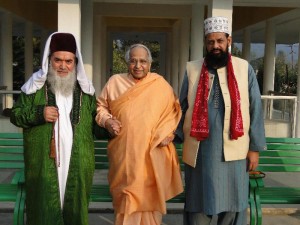
> Himalayan Yoga Tradition Rishikesh, India <
> Sufi-Yogi Dialogue Summary Report <
Sufism or taṣawwuf (Arabic: تصوّف), also spelled tasavvuf according to the Persian pronunciation, is generally understood to not be a distinct sect of Islam, but the inner, mystical dimension of Islam.A practitioner of this tradition is generally known as a ṣūfÄ« (صُوفِيّ), though some adherents of the tradition reserve this term only for those practitioners who have attained the goals of the Sufi tradition. Another name used for the Sufi seeker is Dervish. Classical Sufi scholars have defined Sufism as „a science whose objective is the reparation of the heart and turning it away from all else but God.“ Alternatively, in the words of the renowned Darqawi Sufi teacher Ahmad ibn Ajiba, „a science through which one can know how to travel into the presence of the Divine, purify one’s inner self from filth, and beautify it with a variety of praiseworthy traits. Read More: > HERE <
From January 27th to February 1st, 2010, Hindu and Muslim religious leaders from India, Pakistan and Afghanistan met to explore how they could work more closely to form a spiritual alliance to ease tensions, counter extremism, and set a new tone for the region. The Sufi-Yogi Dialogue took place in a land famous for spiritual seers and sages, Rishikesh, on the banks of the sacred Ganges River in India. Organized by the Global Peace Initiative of Women, the Dialogue was facilitated by Dena Merriam, GPIW Founder and Convener, along with Swamini Pramananda, and hosted jointly with Swami Veda Bharati of the Swami Rama Sadhaka Grama and the Association of Himalayan Yoga Meditation Societies International.
GPIW Summary Report – Sufi Yogi Dialogue
Coming to the One through the Many
From January 27th – February 1st, 2010
the Global Peace Initiative of Women brought a delegation of
Hindu and Muslim spiritual leaders from India,
Afghanistan and Pakistan to form a spiritual alliance
On the banks of the sacred river Ganga
in Rishikesh, India
During the course of the four days, leaders from the Sufi and Yogic traditions spoke in great depth about the common ground between them and expressed great interest in learning more about each other’s practices and forming a new partnership for peace. The gathering was not a typical interfaith meeting as the leaders came together to explore a much deeper engagement, to re-discover and strengthen their ancient shared spiritual roots as a means to meet the contemporary challenges of the region and begin to resolve present-day conflicts between the two great cultures of Hinduism and Islam.
The Sufis and Yogis in particular were chosen for this ground-breaking dialogue because they represent the mystical core of the Islamic and Hindu traditions respectively. As such, they are especially suited to distilling the common essence of unity, the direct experience of the Divine, at the heart of both religions – and perhaps ultimately of all religious experience. Tapping into this inner source of unity, common to all spiritual paths at their innermost level, has the potential to guide us to outer unity in our crisis-torn world. It is in this deep meeting at the essential core of our Being that we can best experience our true identity with the Divine, which can then serve as a fulcrum for global healing and harmony.
The Hindu leaders represented Yogic, Vedantic and Kashmiri Shaivite traditions from different parts of India, while the Sufi leaders represented orders in Pakistan and Afghanistan, as well as Kashmir in India.
Meet Kashmir Sufism Society, friends and Studies at fb <
Meet Support Internal Displaced Kashmirian Indigenous at fb<
SAVE A SMILE & DIE Kashmir Shivaiten im Himalaya Gebirge <
SUFI POETRY – The appeal of Sufi poetry is universal, great Sufi Poets such as Rumi, Hafiz and Omar Khayyam are appreciated by both Sufi’s and non Sufi’s alike. This is because their poetry expresses the universal aspirations of spiritual seekers .
More interesting Articles, Contacts about Islam, Medicine, Sufi Arts and Culture:
(mehr …)
Sondernewsletter Dr. Michael Ehrenberger

Kenneth Earl Wilber II (born January 31, 1949) is an American author who has written about adult development, developmental psychology, philosophy, worldcentrism, ecology, and stages of faith. His work formulates what he calls Integral Theory. In 1998, he founded the Integral Institute, for teaching and applications of Integral theory.Wilber’s philosophy has been influenced by Madhyamaka Buddhism, particularly as articulated in the philosophy of Nagarjuna. Wilber has practiced various forms of Buddhist meditation, studying with a number of teachers, including Dainin Katagiri, Taizan Maezumi, Chogyam Trungpa Rinpoche, Kalu Rinpoche, Penor Rinpoche and Chagdud Tulku Rinpoche. Advaita Vedanta, Trika (Kashmir) Shaivism, Tibetan Buddhism, Zen Buddhism, Ramana Maharshi, and Andrew Cohen can be mentioned as further influences. Read More: > HERE <
Liebe Freunde!
Liebe Kolleginnen und Kollegen!
SONDERNEWSLETTER: Entgegen unseren sonstigen Gepflogenheiten bringt dieser Sondernewsletter zwei wesentliche Unterschiede zu den bisher versandten Schriftstücken. Das erste Merkmal ist, dass er nicht von meiner Frau Doris stammt, die sich sonst in dankenswerter Weise intensiv der Verbreitung von Information annimmt und das zweite Merkmal ist, dass es sich um den ersten Newsletter der Dr. Ehrenberger Holistic Media GmbH handelt. Um Euch jedoch ein bekanntes Bild zu bieten, habe ich die Gestaltung unserer bisherigen Texte gewählt. Dies lässt mich hoffen, dass die Botschaft Gehör findet und wir in Resonanz kommen. Zukünftig werden meine Newsletter ein anderes Layout bekommen und sind über die Seite www.holimed.tv zu beziehen.
Nach dieser kurzen, erklärenden Einleitung möchte ich mit einem Zitat von Ken Wilber fortfahren, das im Vorwort zu Ervin Lazlos Buch „Die Bewusstseinsrevolution“ zu finden ist:
„Nach Auffassung von Prof. Laszlo ist die reale Welt nicht mechanistisch und fragmentiert, sondern eine verwobene, essentiell holistische, das heißt ganzheitliche Welt. Der Kosmos ist lebendig und die Menschen sind keine isolierten Einzelwesen, sondern durch das Urfeld miteinander verbundene Elemente, im Netzwerk des Lebens, die mit den Rhythmen und Energien des Universums schwingen.“ Ken Wilber, 1999
Meiner Meinung nach findet man kaum eine kürzere und prägnantere Beschreibung der Wirklichkeit um uns: wir leben in einem hoffnungslos miteinander verwobenen Universum. Dies ist die gedankliche Grundlage des sich abzeichnenden Paradigmenwandels, dessen sanfte Morgenröte bereits am Horizont des wissenschaftlichen Denkens zu erkennen ist. Die Besonderheit dabei ist, dass die nun beginnende, unaufhaltsame Veränderung nicht in einem Elfenbeinturm der Wissenschaft, gleichsam (in einer zu hinterfragenden Art) geklont wird, um sie dann stolz der Welt zu präsentieren. Nein, dieser Drang zu einer radikalen Veränderung unseres Weltbildes hat bereits viele Gruppen in allen Teilen der Bevölkerung der ganzen Erde erfasst und in jedem Moment werden es mehr Menschen, die erkennen, dass eine neue Art des Denkens den Weg in ihre Herzen findet.
Das Projekt Holimed.tv unterstützt diese Entwicklung. Ich sehe es gleichsam als ein Experiment, das klären soll, in wieweit wir bereit sind, nicht nur von einem Paradigmenwandel zu reden, sondern aktiv ein Teil davon zu sein. Holimed.tv bietet seinen Besuchern Themen, die sich mit der Ganzheit der Wirklichkeit befassen. Die Bearbeitung der Themen basiert in Form von Videos, mp3 Files oder in schriftlicher Form. Es besteht die Möglichkeit des Austausches in der Community, wo man sich registriert und ein Profil erstellt und danach verschiedenen Diskussionsforen beitritt. Holimed.tv versteht sich als eine Informationsplattform für eine holistische Denk- und Lebensweise, als ein Pool neuer Ideen, die zu einem friedlicheren Leben auf unserem Planeten führen können, wenn wir bereit sind sie umzusetzen.
Holimed.tv ist noch jung und muss, ähnlich wie ein kleines Kind, getragen werden. Getragen durch Menschen denen das Miteinander mehr am Herzen liegt als eine ständige Konfrontation. Ich ersuche daher um Eure Mithilfe, um dem Projekt die Chance zu geben, laufen zu lernen. Jede Art von Mithilfe wird gerne angenommen. Darunter fallen einfache, kostenlose Registrierung, Einsendung von Beiträgen und Erfahrungsberichten, wissenschaftliche Unterstützung oder ein Weiterleiten dieses Newsletters.
Um den Start etwas zu erleichtern bieten wir 12 Therapeutinnen oder Therapeuten die Möglichkeit, sich auf Holimed.tv in Form eines kurzen Videos zu präsentieren. Die Kosten für die Erstellung der 12 Videos übernimmt das Team von Holimed.tv . Anmeldung unter: oberreiter@holimed.tv. Für die ersten 25 Anmeldungen in der Holimed.tv-Community gibt es die DVD „Hinter dem Regenbogen“ gratis.
Ich ersuche all diejenigen, die es wert finden die Idee von Holimed.tv zu verbreiten, dies auch zu tun. Ein einfaches Weiterleiten dieses Newsletters an Freunde, Bekannte oder interessierte Gruppen genügt. Ich darf mich bereits an dieser Stelle dafür bedanken. Es sind derzeit noch nicht allzu viele Beiträge auf Holimed.tv zu sehen, wichtiger jedoch ist, dass die formgebende Idee vorhanden ist und es an uns liegt, das Gedankengebäude mit Leben zu füllen.
Michael Ehrenberger Bali, Februar 2010
Wir freuen uns, wenn Sie mit uns Kontakt aufnehmen.
Für den Inhalt verantwortlich:
Dr. Ehrenberger Holistic Media GmbH.
Mogersdorf 159, 8382 Mogersdorf, Österreich
Email: office@holimed.tv
web: www.synthese.at, www.holimed.tv, www.naturundtheraphie.at
Ali Akbhar College of Music – New CD
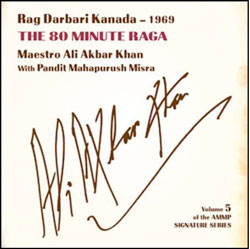
> Ali Akhbar College of Music, LAYA Project <
Ali Akbar Khan (Bengali: আলী আকবর খাঁ) (14 April 1922 – 18 June 2009), often referred to as Khansahib or by the title Ustad (master), was a Hindustani classical musician of the Maihar gharana, known for his virtuosity in playing the sarod. Khan was instrumental in popularizing Indian classical music in the West, both as a performer (often in conjunction with Sitar maestro Ravi Shankar), and as a teacher. He established a music school in Calcutta in 1956, and the Ali Akbar College of Music in 1967, which is now located in San Rafael, California and has a branch in Basel, Switzerland. Khan also composed several classical ragas and filmscores. He was a Distinguished Adjunct Professor of Music at the University of California, Santa Cruz. Read More: > HERE <
„Darbari Kanada“ is a late-evening rag played between 9:00 PM and midnight. Most classical performers treat this rag with reverence, as it is one of India’s most majestic ragas. This session took place in 1969 in a New York City church, with the natural reverberation adding a tremendous and distinct element, along with audible sounds of the city streets. No attempts were made to alter the original content of the master recordings. Ali Akbar Khan’s electrifying performance of this heroic rag adds notable weight to his stature as „a musician’s musician.“ He plays with subtlety and control along with the strength of a master.
Now Available at the Ali Akbar College of Music:
ALI AKBAR KHAN
Vol. 5 of the AMMP Signature Series
TRACK LISTING
CD 1: Alap (Solo)
CD 2: Gat (Tabla Accompaniment)
Original 80-minute concert recording
Disc Two features accompaniment
from Pandit Mahapurush Misra
Packaged with liner notes and
archival photos
Winter Session 2010 Starts Sunday, February, 14th – This session features a full lineup of Introductory Courses, Youth Courses and Online classes via Webcast. Please check our schedule or you may also register now.
Donations to the AACM are much appreciated! To date we have raised $11,000 of our $30,000 goal toward college operations. Thank you to our current members for your continued support!
MAHA KUMBH MELA IN INDIA, 2010

The Purna (complete) Kumbh takes place at four places (Prayag (Allahabad), Haridwar, Ujjain, and Nashik) after every twelve years,while the Ardh Kumbh Mela is celebrated every six years at Haridwar and Prayag. Over 45 days beginning in January 2007, more than 17 million Hindu pilgrims took part in the Ardh Kumbh Mela at Prayag, and on January 15, the most auspicious day of the festival of Makar Sankranti, more than 5 million participated. Read More: > HERE <
Prof. (Dr.) Chitralekha Singh* – Kumbh Mela is a very big festival, participated by millions of people by taking a dip in the sacred waters at Haridwar, Parayag (Allahabad), Ujjain, Nasik & Vrindavan. This festival is observed at an interval of twelve years, when there is coincidence between the moon, the sun and the planet B’rhaspati. The bath, worship, charity and Satsang (religious congregation) are all important.
Churning of the sea by combined effort of the gods and demons produced Amrit (immortal juice). Gods and demons, both wanted it. So the pot was shifted from place to place and wherever this was shifted there was some spillage and these places were Haridwar, Prayag, Divya Vrindavan (where Garuda the vehicle of Vishnu has put the Amrit juice on Kadamb tree), Nasik, Ujjain and Haridwar, Vrindavan, Kumbh Mela is held in these places. At Nasik, Ujjain and Haridwar, Kumbh Mela is held every three years, but at Parayag it is after 12 years with Arddh Kumbh Mela held every 6 years.
Kumbh Mela after 6 years or 12 years is the proportional gain in the Magh Mela held at Parayag every year during the month of Magh (January – February) when lacs of pilgrims from all over India assemble to have a dip in the holy waters, in an attempt to wash away all their sins. Magh Mela (fairs) is held every year and everyday. Thousands of people are seen bathing in this water, throughout the month. Probably it was king Harsavardhan who was the initiator of this assembly (Mela).
During Kumbh Mela (after every 12 years) Parayag and all other pilgrimageswears a festive look, decorated with bright and glittering festoons. For a few days these places transforms into a Kumbhanagar, with lacs of pilgrims from all over India. Thousands of Sadhus and Sanyasis, who come down from their isolated mountain homes, and tourists from all over the world assemble these places to participate in this auspicious fair.
During the festival, the days of Makar Sankranti, Basant Panchmi, Maha Sivaratri, Chetra Amaveseya, Ram Navami and Baisakhi are recognized as more auspicious and benevolent.
(All the sketches are done by artist /author Prof. (Dr.) Chitralekha Singh at Haridwar, Maha Kumbh 2010 festival dated 5.02.2010)
Dean: Institute of Visual & Performing Art, Mangalayatan University, Vishwamitrapuri (Beswan), Aligarh.
Visit at: www.artistchitralekha.com
e.mail: artistchitralekha@artlover.com
Mob.: 09319103482
Meet Kumbh Mela Haridwar 2010, friends, at fb <
See All Sketches:
GVT. NATIONAL INSTITUTE OF AYURVEDA

* Traditional Ayurveda: Our Strenght *
> NATIONAL INSTITUTE OF AYURVEDA <

THE CAMPUS: The main campus of Govt. Ayurveda College is at Puthiyakavu, two kilometers from Tripunithura town in the Vaikom Road. The place is named after the Durga temple (puthiya-new; kavu-temple) famous for the fire works display during the annual festival.
It was a border area in between Cochin and Travancore the erstwhile princely States before the independence of India. The old building of the toll collection centre is still seen in the roadside. On Pathamudayam (the tenth day after Vishu, April 14 or 15) free trade is allowed in the forenoon, which is still re-enacted.
Lack of infrastructure for the introduction of Degree course in Ayurveda prompted the authorities to shift the college to a land with more area. Thus in 1964 a land area of more than 11 acres was acquired for the college at Puthiyakavu and the foundation stone was laid in 1968 by the then Health Minister Sri. B.Wellington. The new college building was opened in 1973 April 9th by the former President of India, Sri.V.V.Giri followed by the complete shifting of the college to the new campus. The campus is named after Acharya Dhanwanthari.
THE COLLEGE: The course offered by Govt. Ayurveda College Tripunithura is B.A.M.S (Bachelor of Ayurvedic Medicine and Surgery) also titled as AYURVEDACHARYA. It is a degree course recognized by Central Council of Indian Medicine, New Delhi, the authorized monitoring agency for education in Indian systems of medicine. The committee appointed by CCIM visits the college periodically reviews the standard before renewing the recognition.
The college is affiliated to Mahatma Gandhi University, Kottayam. The university conducts examinations and awards degree on satisfactory completion of the course. There are concerned constituted bodies like Board of Studies and Faculty in University to implement the syllabus and curriculum in a proper way.
THE HOSPITAL: Government ayurveda college hospital came into existence in 1960 when the hospital under indigenous medicine department at East Fort Gate, Tripunithura was handed over to the college for the clinical training of the students. By providing rational treatment to suffering public, the hospital is an active presence in the public health scenario of Central Kerala. In 1982 a new two storeyed hospital building was opened in the college campus at Puthiyakavu by the then Health Minister Sri.K.G.R.Kartha. It accommodated Prasootitantra, Koumarabritya, Salyatantra and Salakyatantra wards. There was also an anorectal clinic with Ksharasootra facilities. Kayachikitsa, Rogavijnana and Agadatantra wards remained at the Old Hospital building at Tripunitura. 13 departments came into existence in 1998. A new four storied building for 500 bedded hospital was dedicated to the nation by the then President of India Dr. A.P.J. Abdul Kalam in Dec. 17, 2005. This enabled to accommodate the all the departments in a single roof. More and more facilities are added in each year updating the quality of service rendered to the suffering humanity.
PHARMACY: Pharmacy is an essential part of any ayurvedic educative institution as quality medicines are needed for rational management of diseases. A small scale pharmacy was established at the hospital compound at East Fort Gate in 1960. It was later shifted to the Puthiyakavu campus in 1974. The present building with necessary machineries started functioning in 1980.
This subsidiary of the college is under the department of Rasasastra & Bhaishajyakalpana(R&B). The separate department for the subject was established in1998 by the bifurcation of Dravyagunavijnana. R & B imparts the knowledge of preparation of medicines in sastric lines. Rasasastra an associate system of ayurveda that incorporates refined forms of metals, minerals etc. as medicines is also taught by R & B. This also needs theoretical and practical knowledge. So a rasasala to give practical training is also a part the department.
The pharmacy presently manufactures medicines worth 8.50 lakhs approximately for free distribution through the collegiate hospital. All the forms of medicines like kashayas, churnas lehyas tailas are produced with quality manufacturing practices.
Proposal to upgrade the pharmacy to attain the GMP(Good Manufacturing Practices) certificate is being considered by the Government of India.
> Meet Lord Dhanvantari, friends at facebook <
> Meet all Ayurveda, friends, studies at fb <
Guru Shishya Tradition in Yoga, Veda, Arts

http://eastmeetswestmusic.com/
The guru-shishya tradition, lineage, or parampara, denotes a succession of teachers and disciples in traditional Indian culture and Dharmic Traditions such as Sanatana Dharma, Sikha Dharma, Jaina Dharma and Buddha Dharma. It is the tradition of spiritual relationship and mentoring in traditional Hinduism where teachings are transmitted from a guru (teacher, गुरू) to a ‚śiṣya‘ (disciple, शिष्य) or chela. Such knowledge, whether it be vedic, agamic artistic, architectural, musical or spiritual, is imparted through the developing relationship between the guru and the disciple. It is considered that this relationship, based on the genuineness of the guru, and the respect, commitment, devotion and obedience of the student, is the best way for subtle or advanced knowledge to be conveyed. The student eventually masters the knowledge that the guru embodies. The word Sikh is derived from the Sanskrit word shishya. It is related to the Brahmacharya. Read More: > Here <
Rashtriya Ayurveda Vidyapeeth was established on 11th Feb., 1988 with one of the objectives of promoting knowledge of Ayurveda and started functioning since 1991. The Vidyapeeth initiated the course of Member of RAV with an effort to revive the traditional method of Gurukula system of informal education of India i.e., Guru Shishya Parampara to Ayurvedic graduates after formal education. As people are aware, the present classical texts of Ayurveda, Charaka Samhita, Sushruta Samhita, Ashtanga Hridaya etc. are believed to be the outcome of such informal education. This kind of study is lacking at present in the modern educational institutions where the courses are bound by fixed syllabus, duration of time and many subjects to learn.
Guru Shishya Parampara is the traditional method of residential form of education wherein the Shishya remains with his Guru as a family member and gets the education as a true learner. This system gradually vanished with the disappearance of Gurukuls. However, it is still a very effective means of transfer of knowledge from the Gurus (teachers) to Shishyas (students). RAV is making efforts to revive the system through two types of courses.
In colleges and institutions only a relevant portion of the Samhita (texts of Ayurveda) is being taught in the form of syllabus. Guru Shishya Parampara of RAV facilitates the students to study whole text and get adequate knowledge of Samhita and its Teeka (commentary) and traditional skill for the Ayurvedic clinical practice. The Shishyas get sufficient time for interaction and discussion on the issues taken for study.
COURSES:
- (A)acharya guru shishya parampara, (One-year course of Member of Rashtriya Ayurveda Vidyapeeth) (MRAV)
- (B)Chikitsak guru shishya parampara, (One-year/Six month’s course of Certificate of Rashtriya Ayurveda Vidyapeeth) (CRAV)
- Read More: > HERE <
„The main features of a fruitful Guru-Shishya relationship led to (1) purity of mind and body, humility, a sense of service, and a devotional and spiritual attitude; (2) a thorough grounding of technique and science of music; (3) the gradual development of the disciple as he sits behind his guru at concerts and joins in when asked, but does not perform by himself until his guru finds him fit to do so; and (4) freedom from economic worries by the disciple, living and serving his guru, as a member of his family.“
Pandit Ravi Shankar (My Music, My Life)
PUBLICATIONS: Vidyapeeth has been publishing certain books of Ayurveda, which are found suitable for general public in creating awareness, and also books for Ayurvedic professionals. The Vidyapeeth also publishes the theses of its students after necessary review and recommendation by the Expert Committee and approval by the Governing Body. Further, the Vidyapeeth brings out a Souvenir, containing selected full papers, at the time of Conference/Seminar conducted every year.
SEMINARS/CONFERENCES: Vidyapeeth conducts a Conference/Seminar/Workshop every year on a topic that requires discussion and exchange of the views and clinical experience on the diagnosis and treatment of the disease, mostly the health problems not easily managed by majority of Vaidyas without side effects. So far Conferences/Seminars have been conducted on Kshara Sutra, Heart diseases, Ayurvedic Education, Training and Development, Nadi Vigyan, Fast Acting Ayurvedic Medicines and Techniques, Cancer, Shothahara Avam Jeevanu Nashak Ayurvedic medicines, AIDS, Thyroid disorders, Rasayana, Ayurvedic management of kidney and urinary disorders , Management of Hepato-biliary & Splenic disorders through Ayurveda, Diabetes Mellitus, Mental Health and Vatavyadhis.
AWARD OF FELLOW OF R.A.V.: For achieving one of its objectives, the Vidyapeeth awards Fellowship to the eminent scholars of Ayurveda and practitioners of various traditional Ayurvedic techniques in recognition of their scholarly expertise and contribution in the field of education, research, patient care and literature. In the year 1992 the Vidyapeeth awarded 50 Foundation Fellowships to eminent Vaidyas. Thereafter, a maximum of 30 fellowships are being awarded every year. This is an honorary recognition and a felicitation with a citation, a shawl and a kalash/memento presented to each awardee in the Convocation of RAV. As per rules of the Vidyapeeth, the total number of fellows at any time shall not exceed 300. Every year the Governing Body determines these fellowships on the basis of the bio-data of scholars. So far, 224 scholars have been awarded Fellow of Rashtriya Ayurveda Vidyapeeth (FRAV) Annexure – IV.
CONVOCATION: In order to fulfill the objectives of the Vidyapeeth viz. to institute due recognition to successful candidates and to recognize and encourage merit in various branches of Ayurveda, the Vidyapeeth holds Convocation every year for awarding certificates to passed out students and to felicitate eminent scholars and Vaidyas with Fellow of Rashtriya Ayurveda Vidyapeeth (FRAV) for their significant contribution for the progress of Ayurveda in the fields of education, research, literature and health care.
A guru (Sanskrit: गुरु) is one who is regarded as having great knowledge, wisdom and authority in a certain area, and who uses it to guide others (teacher).
In sanskrit gu means darkness & ru means light. As a principle for the development of consciousness it leads the creation from unreality to reality, from the darkness of ignorance to the light of knowledge. In its purest form this principle manifests on earth as a divine incarnation (saint), a person with supreme knowledge about God and all creation. Other forms of manifestation of this principle also include parents, school teachers , non-human objects (books) and even one’s own intellectual discipline.
The syllable gu means shadows
The syllable ru, he who disperses them,
Because of the power to disperse darkness
the guru is thus named.
– Advayataraka Upanishad 14—18, verse 5
In the religious sense the term is commonly used in Hinduism and Sikhism, as well as in Buddhism and new religious movements.
Finding a true guru is often held to be a prerequisite for attaining self-realization. Guru Nanak, founder of the Sikh religion said: „Even if a thousand suns and moons rose, they would be unable to remove the darkness of ignorance within the heart. This can only be removed through the grace of the Guru.“
„Guru“ also refers in Sanskrit to Brihaspati, a divine figure in Hinduism. In Vedic astrology, guru or Brihaspati is believed to exert teaching influences.[clarification needed] Indeed, in many Indian languages such as Hindi, the occidental Thursday is called either Brihaspativaar or Guruvaar (vaar meaning day of the week).
In contemporary India, Indonesia and the Philippines, the word „guru“ is widely used with the general meaning of „teacher“. Guru in Buddhism, Hinduism, Sikh…Gurukulam System in Tradititional KALARI… Read More: > HERE <
In Western usage, the meaning of guru has been extended to cover anyone who acquires followers, though not necessarily in an established school of philosophy or religion. In a further Western extension, guru is used to refer to a person who has authority because of his or her perceived secular knowledge or skills, such as in business.
Weblinks: > yoga-vidya.de < ( no english translation avaiable) – ….Ishwara selbst ist der ursprüngliche Guru (Lehrer). Unsere Guru Parampara (Schüler-Lehrer-Tradition) beginnt bei Narayana. Narayana ist Vishnu, also eine Manifestation von Ishwara. Die Hatha Yoga Guru Parampara fängt bei Shiva an. Alle Guru Paramparas in Indien fangen letztendlich mit Gott an, indem ursprünglich ein Lehrer die Weisheit direkt von Gott empfangen hat. So ist Gott der Lehrer aller Lehrer..
- www.punarjanis.com (Dr. E. Shaji Raj)
- www.unom.ac.in
- www.hihtindia.org (Himalayan Ayurveda Hospital Trust)
- AYURVEDA, Prime Treatments in Ayurveda <
- AYURVEDA4UAll <
- Meet Yoga Vidya English, friends and Studies at fb <
- Meet Ayurveda Friends, Groups, Studies at facebook <
- Meet Ayurveda4UAll, friends, Studies at facebook <
- Meet CODEX ALIMENTARIUS friends and group at fb <
- Meet FREE Visa to India for MBA, Degree Programs , it jobs at fb <
- Meet Lord Dhanwantri, friends, studies at facebook <
Council for Parliament of the World´s Religions

> SWAMI VIVEKANANDA´s SPEECH AT THE COUNCIL 1893, Chicago <
There have been several meetings referred to as a Parliament of the World’s Religions, most notably the World’s Parliament of Religions of 1893, the first attempt to create a global dialogue of faiths. The event was celebrated by another conference on its centenary in 1993. This led to a new series of conferences under the official title „Parliament of the World’s Religions“.
In 1893, the city of Chicago hosted the World Columbian Exposition, an early world’s fair. So many people were coming to Chicago from all over the world that many smaller conferences, called Congresses and Parliaments, were scheduled to take advantage of this unprecedented gathering. A number of congresses were held in conjunction with the exposition, including those dealing with anthropology (one of the major themes of Exposition exhibits), labor, medicine, temperance, commerce and finance, literature, history, art, philosophy, and science. One of these was the World’s Parliament of Religions. The Parliament of Religions was by far the largest of the congresses held in conjunction with the Exposition. Read More: > HERE <
Our Mission – The Council for a Parliament of the World’s Religions was created to cultivate harmony among the world’s religious and spiritual communities and foster their engagement with the world and its guiding institutions in order to achieve a just, peaceful and sustainable world. To accomplish this, we invite individuals and communities who are equally invested in attaining this goal.
Our Vision – The vision of the Council for a Parliament of the World’s Religions is of a just, peaceful and sustainable world in which:
- Religious and spiritual communities live in harmony and contribute to a better world from their riches of wisdom and compassion
- Religious and cultural fears and hatreds are replaced with understanding and respect
- People everywhere come to know and care for their neighbors
- The richness of human and religious diversity is woven into the fabric of communal, civil, societal and global life
- The world’s most powerful and influential institutions move beyond narrow self-interest to realize common good
- The Earth and all life are cherished, protected, healed and restored
- All people commit to living out their highest values and aspirations.
Our Approach – The Council for a Parliament of the World’s Religions seeks to promote interreligious harmony, rather than unity. The problem with seeking unity among religions is the risk of loss of the unique and precious character of each individual religious and spiritual tradition; this understanding is key to our framework.
Interreligious harmony, on the other hand, is an attainable and highly desirable goal. Such an approach respects, and is enriched by, the particularities of each tradition. Moreover, within each tradition are the resources (philosophical, theological and spiritual teachings and perspectives) that enable each to enter into respectful, appreciative and cooperative relationships with persons and communities of other traditions.
> Parliament of World´s Religions utube Channel <
> The Dalai Lama addresses Parliament of World Religions 2009 <
Our Opportunity – We live in a world of difference. Yet, we are interdependent. Nowhere is learning to live with difference more important than religion.
Too often, religion is misused as an instrument for division and injustice, betraying the very ideals and teachings that lie at the heart of each of the world’s great traditions. At the same time, religious and spiritual traditions shape the lives of billions in wise and wonderful ways. They gather people in communities of shared beliefs and practices. When these diverse communities work in harmony for the common good, there is hope that the world can be transformed.
Over the years, the Council has initiated dialogues and nurtured relationships among people of difference. In doing so the Council has provided a framework for expressing many visions of a just, peaceful and sustainable future. In the process, religious and spiritual communities have discovered a shared commitment to ethical principles.
This shared commitment has opened the way for a new era of cooperative action among the world’s religious and spiritual communities as well as civil and political societies. The well-being of the Earth and all life depends on this collaboration.
Meet Council for a Parliament of the World’s Religions (CPWR) at fb <
Meet Declare 2010 THE YEAR OF PEACE – Make it the largest Group of fb <
HERMANN HESSE FOUNDATION – SIDDHARTHA
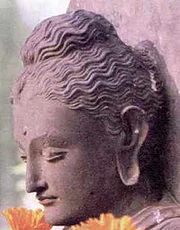
(HERMANN HESSE FOUNDATION – Film Footage, Portrait, Sound…)
> THE DIGITAL GUTENBERG PROJECT <
> JNANA YOGA, BHAKTI YOGA, ADVAITA VEDANTA <
Buddha Shakyamuni – Kopf einer Buddhastatue am Niederrhein. Hesse gab der Hauptfigur seiner „indischen Dichtung“ denselben Vornamen des historischen Buddhas Siddhartha Gautama. „Einen Buddha zu schaffen, der den allgemein anerkannten Buddha übertrifft, das ist eine unerhörte Tat, gerade für einen Deutschen.“ > Henry Miller < über Hesses Siddhartha.
Hermann Hesse (German pronunciation: [ˈhɛʀman ˈhɛsə]) (July 2, 1877 – August 9, 1962) was a German-born Swiss poet, novelist, and painter. In 1946, he received the Nobel Prize in Literature. His best-known works include Steppenwolf, Siddhartha, and The Glass Bead Game (also known as Magister Ludi), each of which explores an individual’s search for authenticity, self-knowledge and spirituality. Read More: > HERE <
Hermann Hesse was born on 2 July 1877 in the Black Forest town of Calw in Württemberg, Germany. Hesse began a bookshop apprenticeship in Esslingen am Neckar, but, after three days, he left. Then, in the early summer of 1894, he began a 14-month mechanic apprenticeship at a clock tower factory in Calw. The monotony of soldering and filing work made him resolve to turn himself toward more spiritual activities. In October 1895, he was ready to begin wholeheartedly a new apprenticeship with a bookseller in Tübingen. This experience from his youth he returns to later in his novel Beneath the Wheel.
In Gaienhofen, he wrote his second novel, Beneath the Wheel, which was published in 1906. In the following time, he composed primarily short stories and poems.
Gaienhofen was also the place where Hesse’s interest in Buddhism was re-sparked. Following a letter to Kapff in 1895 entitled Nirvana, Hesse ceased alluding to Buddhist references in his work. In 1904, however, Arthur Schopenhauer and his philosophical ideas started receiving attention again, and Hesse discovered theosophy. Schopenhauer and theosophy renewed Hesse’s interest in India. Although it was many years before the publication of Hesse’s Siddhartha (1922), this masterpiece was to be derived from these new influences.
During this time, there also was increased dissonance between him and Maria, and, in 1911, Hesse left alone for a long trip to Sri Lanka and Indonesia. Any spiritual or religious inspiration that he was looking for eluded him, but the journey made a strong impression on his literary work. Following Hesse’s return, the family moved to Bern (1912), but the change of environment could not solve the marriage problems, as he himself confessed in his novel Rosshalde from 1914.
In 1931, Hesse began planning what would become his last major work, The Glass Bead Game (aka Magister Ludi). In 1932, as a preliminary study, he released the novella Journey to the East. The Glass Bead Game was printed in 1943 in Switzerland. For this work, he was awarded the Nobel Prize in Literature in 1946.
AWARDS: * 1906 – Bauernfeld-Preis, * 1928 – Mejstrik-Preis der Wiener Schiller-Stiftung, * 1936 – Gottfried-Keller-Preis * 1946 – Goethepreis der Stadt Frankfurt, * 1946 – Nobel Prize in Literature, * 1947 – Honorary Doctorate from the University of Bern, * 1950 – Wilhelm-Raabe-Preis, * 1954 – Orden Pour le mérite für Wissenschaft und Künste, * 1955 – Peace Prize of the German Book Trade
From the end of the 1930s, German journals stopped publishing Hesse’s work, and it was eventually banned by the Nazis.
The Glass Bead Game was Hesse’s last novel. During the last twenty years of his life, Hesse wrote many short stories (chiefly recollections of his childhood) and poems (frequently with nature as their theme). Hesse wrote ironic essays about his alienation from writing (for instance, the mock autobiographies: Life Story Briefly Told and Aus den Briefwechseln eines Dichters) and spent much time pursuing his interest in watercolors.
Hesse also occupied himself with the steady stream of letters he received as a result of the prize and as a new generation of German readers explored his work. In one essay, Hesse reflected wryly on his lifelong failure to acquire a talent for idleness and speculated that his average daily correspondence was in excess of 150 pages. He died on 9 August 1962 and was buried in the cemetery at San Abbondio in Montagnola, where Hugo Ball is also buried.
The Digital Gutenberg Project – In June 2002, the Ransom Center and IImage Retrieval Inc. of Carrollton, Texas collaborated on the digitization of the Center’s Gutenberg Bible using the i2s Digibook 6000 overhead scanner. The project took less than a week to complete and resulted in nearly 1,300 digital images. For the first time, it is possible for the general public to view all of the pages from the University of Texas copy, including all of the large illuminated letters in volume I and the copious handwritten annotations, as well as other indications of the book’s use in religious services. The release of the web images coincides with the installation of the Gutenberg Bible in a new exhibition case, part of the recently remodeled main lobby of the Ransom Center.
Further reproduction of any of the Gutenberg Bible images without the written consent of the Ransom Center is prohibited. Inquiries regarding the availability of higher-resolution digital images for research or publication should be directed to the Center’s staff.
The > Project Gutenberg < Presents Siddhartha > CONTENT < :
Copyright Status: Not copyrighted in the United States. If you live elsewhere check the laws of your country before downloading this ebook.
An Indian Tale by Hermann Hesse:
…..But he, Siddhartha, was not a source of joy for himself, he found no delight in himself. Walking the rosy paths of the fig tree garden, sitting in the bluish shade of the grove of contemplation, washing his limbs daily in the bath of repentance, sacrificing in the dim shade of the mango forest, his gestures of perfect decency, everyone’s love and joy, he still lacked all joy in his heart. Dreams and restless thoughts came into his mind, flowing from the water of the river, sparkling from the stars of the night, melting from the beams of the sun, dreams came to him and a restlessness of the soul, fuming from the sacrifices, breathing forth from the verses of the Rig-Veda, being infused into him, drop by drop, from the teachings of the old Brahmans.
…..For whom else were offerings to be made, who else was to be worshipped but Him, the only one, the Atman? And where was Atman to be found, where did He reside, where did his eternal heart beat, where else but in one’s own self, in its innermost part, in its indestructible part, which everyone had in himself? But where, where was this self, this innermost part, this ultimate part? It was not flesh and bone, it was neither thought nor consciousness, thus the wisest ones taught. So, where, where was it? To reach this place, the self, myself, the Atman, there was another way, which was worthwhile looking for? Alas, and nobody showed this way, nobody knew it, not the father, and not the teachers and wise men, not the holy sacrificial songs!
They knew everything, the Brahmans and their holy books, they knew everything, they had taken care of everything and of more than everything, the creation of the world, the origin of speech, of food, of inhaling, of exhaling, the arrangement of the senses, the acts of the gods, they knew infinitely much—but was it valuable to know all of this, not knowing that one and only thing, the most important thing, the solely important thing?
Surely, many verses of the holy books, particularly in the Upanishades of Samaveda, spoke of this innermost and ultimate thing, wonderful verses. „Your soul is the whole world“, was written there, and it was written that man in his sleep, in his deep sleep, would meet with his innermost part and would reside in the Atman…… (Anm.: Advaita Vedanta).
Marvellous wisdom was in these verses, all knowledge of the wisest ones had been collected here in magic words, pure as honey collected by bees. No, not to be looked down upon was the tremendous amount of enlightenment which lay here collected and preserved by innumerable generations of wise Brahmans.— But where were the Brahmans, where the priests, where the wise men or penitents, who had succeeded in not just knowing this deepest of all knowledge but also to live it? Where was the knowledgeable one who wove his spell to bring his familiarity with the Atman out of the sleep into the state of being awake, into the life, into every step of the way, into word and deed?….
Thus were Siddhartha’s thoughts, this was his thirst, this was his suffering.
Often he spoke to himself from the Chandogya-Upanishad the words: „Truly, the name of the Brahman is satyam—verily, he who knows such a thing, will enter the heavenly world every day.“
Often, it seemed near, the heavenly world, but never he had reached it completely, never he had quenched the ultimate thirst. And among all the wise and wisest men, he knew and whose instructions he had received, among all of them there was no one, who had reached it completely, the heavenly world, who had quenched it completely, the eternal thirst.
„Govinda,“ Siddhartha spoke to his friend, „Govinda, my dear, come with me under the Banyan tree, let’s practise meditation.“
They went to the Banyan tree, they sat down, Siddhartha right here, Govinda twenty paces away. While putting himself down, ready to speak the Om, Siddhartha repeated murmuring the verse:
Om is the bow, the arrow is soul, The Brahman is the arrow’s target, That one should incessantly hit.
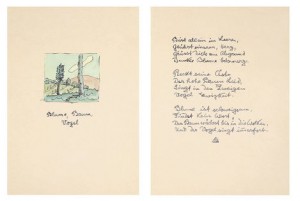
( > * Hermann Hesse Paintings:Flower, Tree, Bird * < )
SIDDHARTHA, FIRST PART
- THE SON OF THE BRAHMAN
- WITH THE SAMANAS
- GAUTAMA
- AWAKENING
SECOND PART
- KAMALA
- WITH THE CHILDLIKE PEOPLE
- SAMSARA
- BY THE RIVER
- THE FERRYMAN
- THE SON
- OM
- GOVINDA
- Related Articles on Yoga, > ADVAITA VEDANTA <
- Meet Hermann Hesse, Friends, Fans, Arts at facebook <
Evening about Tagore Culture Prize 2009
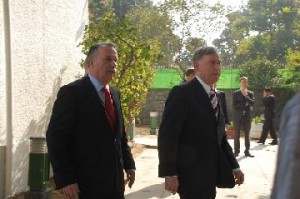
German President at Göthe Institute Dehli
> Göthe Institute in New Dehli <
> PRESSEMITTEILUNG TAGORE KULTURPREIS 2009 <
> Deutsch Indische Ges. Tagore Kulturpreis <
Rabindranath Tagore (Bengali: রবীন্দ্রনাথ ঠাকুর) (7 May 1861 – 7 August 1941),sobriquet Gurudev,was a Bengali polymath. As a poet, novelist, musician, and playwright, he reshaped Bengali literature and music in the late 19th and early 20th centuries. As author of Gitanjali and its „profoundly sensitive, fresh and beautiful verse“, being the first non-European to win the 1913 Nobel Prize in Literature, Tagore was perhaps the most important literary figure of Bengali literature and a mesmerising representative of the Indian culture whose influence and popularity internationally perhaps could only be compared to that of Gandhi whom Tagore named ‚Mahatma‘ out of his deep admiration for him.Read More: > HERE <
On 10th October 2009, the German musician and author Peter Pannke along with Dieter B. Kapp received the prestigious Rabindranath Tagore Culture Prize 2009 from the Indo-German Society in Stuttgart.
This award acknowledges over 30 years of Pannke’s commitment and dedication as an ambassador of Indian traditions in Germany and as a promoter of musical dialogues between the two countries. To mark this occasion, the Goethe-Institut has invited the renowned Indologist to a festive program at the Max Mueller Bhavan. The program will include conversations about his recently published books ‘Singers Die Twice’ and ‘Dreamtalker’ as well as readings from these books. Strains from traditional Dhrupad music will conclude the evening.
The poet, Ashok Vajpeyi, will inaugurate the program with a speech in honour of Peter Pannke. Other participants in this event: Sanjeev Gupta (Translator), Dhritabrata Bhattacharjya Tato (Publisher Daastaan), Druphad singer Prashant Kumar Mallik accompanied by his music ensemble.
Filmclip: „Obsession“ by Troubadour United
Peter Pannke studied Sinology, Indology, comparative religious studies and Musicology. He travelled for many years through the Near East, North Africa, Pakistan and India, before he made a name for himself as a radio broadcaster, sound artist and as leader of the band Troubadours United. He is a composer and musician and has produced over eighty CDs/LPs. He is also an author of reportages, illustrated books and poetry. His book „Dreamtalker – Songs, Poems, Essays“ was released in January 2010 in Delhi by Dastaan Publishers. The English translation of his highly acclaimed travelogue „ Singers Die Twice“will be published in India this autumn.
Singer, Dreamer and Storyteller:
An evening with Rabindranath Tagore Culture Prize winner Peter Pannke
Literature / Music
Thursday, 04.03.10, 7.00 p.m.
Siddhartha Hall, Goethe-Institut/Max Mueller Bhavan
Related link:
Press release announcing the Rabindranath Tagore Culture Prize winner for 2009 deutsch
Meet ALL Rabindranath Tagore, Friends, Studies, Groups at fb <
Poetry, Rabindranath Tagore in Germany
> TAGORE, GHANDI, INDIA TODAY <
> MARTIN KÄMPCHEN & TAGORE BOOK TIPS <
Rabindranath Tagore (Bengali: রবীন্দ্রনাথ ঠাকুর) ,(7 May 1861 – 7 August 1941),γsobriquet Gurudev,was a Bengali polymath. As a poet, novelist, musician, and playwright, he reshaped Bengali literature and music in the late 19th and early 20th centuries. As author of Gitanjali and its „profoundly sensitive, fresh and beautiful verse“,being the first non-European to win the 1913 Nobel Prize in Literature, Tagore was perhaps the most important literary figure of Bengali literature and a mesmerising representative of the Indian culture whose influence and popularity internationally perhaps could only be compared to that of Gandhi whom Tagore named ‚Mahatma‘ out of his deep admiration for him.Read More: > HERE <
Rabindranath Tagore (1861-1941) ist der berühmteste Dichter des modernen Indien. 1913 erhielt er als erster Asiate den > Literatur-Nobelpreis < . Sein universales Genie schuf Literatur in allen Gattungen, er gründete eine Schule und Universität, betätigte sich als Schauspieler, Sänger seiner eigenen Lieder, als Maler und Sozialreformer in den Dörfern. Kämpchen hat als erster Tagore in einer repräsentativen Sammlung von fünfzig Gedichten und Liedern, die alle Schaffensperioden umfassen, den deutschsprachigen Lesern vorgestellt.
Tagore besuchte Deutschland dreimal und wurde dort sehr gefeiert. In mehreren wissenschaftlichen Werken untersucht Kämpchen Tagores Verhältnis zum deutschen Geistesleben der zwanziger Jahre. Dieses letzterschienene Buch beschreibt Tagores Beziehungen zu dem Philosophen Hermann Keyserling, zu Kurt Wolff (seinem Verleger), zu Helene Meyer-Franck (seiner Übersetzerin) und Heinrich Meyer-Benfey (seinem profiliertesten Interpreten).
…..If I were asked who was the greatest poet India has produced, including the greatest of ancient India, Kalidasa, my firm answer would be: ‘Tagore’ … It is tragic, however, that his greatness as a poet will never be generally acknowledged, like the greatness of Goethe, Hugo or Tolstoy…..
These two sentences by the well-known writer Indian > Nirad Chaudhuri < sum up the fate of Rabindranath Tagore as a literary figure: On the one hand, they emphasise the immense importance his work receives in West Bengal and Bangladesh; on the other hand, they demonstrate the clear limits of his importance. Tagore’s influence does not transcend the confines of the Bengali language. Bengali is spoken by approximately 180 million people in West Bengal and Bangladesh. This is a larger figure than, for example, the entire German-speaking population. Yet, Bengali is considered a regional language of the Indian subcontinent (with a limited significance even within the context of the subcontinent), whereas German is accepted as a world language, as indeed most European languages are. We are all aware of the political and economic history which created such an imbalance between the languages and the cultures in the world.
Congenial translations needed!
Hence it entirely depends on the availability of congenial translations whether Rabindranath Tagore’s true worth will be appreciated beyond Bengal. Making Shakespeare, Dante or Tolstoy one’s own with the assistance of excellent translations is comparatively easy. Shakespeare has been translated into German for the last two hundred years with immense success, and is still being translated. But translating Tagore into German does not merely entail two European languages, but two languages which are divided by separate cultures, social contexts, geographical areas and religions. He who wants to translate a poem by Tagore from Bengali to German needs to bridge the gulf which separates India and Germany.
It is not easy for an Indian to admit that their national poet, Rabindranath Tagore, is hardly known in Europe. Although the Indian subcontinent entered the sphere of modern World Literature through Tagore, this has become a fact of history now. Today Tagore is no longer a vibrant, dynamic element of World Literature, he no longer influences the intellectual horizon of a large readership and inspires writers outside Bengal. For Bengalis, Rabindranath Tagore continues to have a powerful, sometimes overbearing cultural presence.
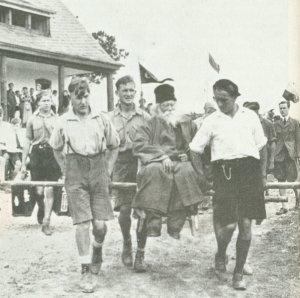
Visiting a youthgroup in Germany, 1930 (siehe oben)
It is virtually impossible to ignore him, even though one may reject him. For Europeans, Tagore represents the distant memory of a Wise Old Man from the East, of an Eastern mystic who arrived in Germany after the First World War to dispense consolation and courage to a people immersed in a deep spiritual and cultural crisis. For less than a decade, Tagore enthused German audiences and readers, after which he sank into oblivion, a process which was aided by the advent of Nazi Germany for which the Indian poet was anathema.
Many Germans may feel that Tagore would best be forgotten. The mystical vagueness of his poems and his lyrical prose may have enthralled European readers for some years, but they could not pass the test of time. These poems were rendered into English by the poet himself and then translated into German by German translators. Tagore’s own English rendering does not merit the term “translation”. These texts were at best paraphrases. He transformed his finely chiselled Bengali verses into rhythmical English prose. In the process he often simplified or even trivialised the content by leaving out some of the more complex ideas and evocations and by adding new material. It is generally agreed that, whatever be the inherent worth of these English texts, they do not echo the intricacy and vigour and musicality of Tagore’s original poetry. Hence I call the German version of Tagore’s poetry “doubly watered-down”: first watered-down by Tagore himself through his English prose texts and then again by adopting them for the German.
If we examine the kind of poems Tagore selected for translation, we realise that they were predominantly his “spiritual” or “mystical” poems. He must have presumed that they especially appeal to Western readers, and he was not mistaken. But in the bargain, Tagore sacrificed a large spectrum of his themes, styles and moods which he did not present to the non-Bengali public. Tagore’s selection of poems helped to reinforce the image of Tagore as a mystic.
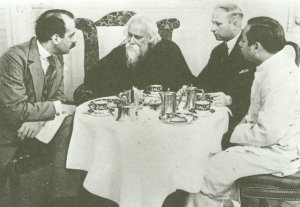
With German intellectuals in 1926
With German intellectuals in 1926
In 1921, Rabindranath Tagore visited Germany for the first time. The German people had just suffered a humiliating defeat in the First World War. Burdened with the crushing demands made by the Versaille Treaty, they longed for a “saviour” who could re-establish their self-esteem and help them find again meaning in life. Before entering Germany, Tagore expressed that he empathized with the German people in their hour of crisis and that he had come to strengthen her. So there was a clear symbiotic relationship even before Tagore began his month-long trip from city to city. Tagore mesmerized and fascinated his German audiences. Wherever he spoke, the halls were packed. Indeed, the newspapers reported scuffles and regular fights by people who were refused entry. The German press rose to the occasion by reporting Tagore’s every movement.
Tagore’s poetry had a direct appeal to Germans of that generation because his poetry (or whatever he chose to give to the West) was exotic, had a romantic flair, was imbued with spiritual idealism – and yet in all its strangeness it was still easily accessible. His poetry embodied a religious imagery, essentially Vaishnava in character, which was innovative for Western ears. To them, this culture of emotions was unfamiliar in its directness, its eroticism and involvement with nature and the cosmos – and yet, the poetry was totally comprehensible. Tagore himself, attired in his flowing, dark gown and with his white beard and serene face, radiated a certain erotic energy.
Tagore revisited Germany in 1926 and 1930. Although the early biographies of Tagore characterize Tagore’s three visits to Germany as unmitigated success stories, Tagore himself preferred to take a more detached view. In 1921, he wrote to a friend:
It has been a wonderful experience in this country for me! Such fame as I have got I cannot take at all seriously. It is too readily given, and too immediately. It has not had the perspective of time. And this is why I feel frightened and tired at it and even sad.[2]
The German-speaking press was by no means unanimous in its praise. There were three major points around which the criticism of the press revolved: (1) Tagore, a Hindu, wanted to influence Christians in their faith and ultimately convert them to Hinduism. (2) German writers deserved a slice of the Indian writer’s enormous fame, as they were no less talented and relevant in their writing. (3) Tagore’s seeming “oriental lethargy”, “bloodlessness”, “Indian mildness” was inimical to German or European “dynamism”, to its “action-oriented” mindset. At that point of history, this European mindset was deperately needed to support the reconstruction of the German nation after the First World War.
Rilke, Zweig, Thomas Mann, Hesse
The adulation Tagore received from the masses rather deterred serious German fellow writers from making an evaluation of Tagore’s literary merit. They even shied away from meeting him. Yet, there were two of Germany’s eminent contemporary writers who met Tagore and two others who took a serious interest in him and acclaimed him as a figure of consequence.
Let me first turn to Rainer Maria Rilke (1875-1926). Even a few months before Tagore was awarded the Nobel Prize, Rilke recognized Tagore’s importance which he expressed in a letter to Lou Andreas-Salomé[3]. Rilke had heard another famous writer, the Frenchman André Gide, read out his French translation of Gitanjali which had impressed Rilke considerably. Further, Rilke mentioned his praise of Tagore in a letter to the German publisher Kurt Wolff[4]. At the time, Wolff had just secured the English manuscript of Gitanjali for his publishing firm and it was already being translated. Quick to see his advantage, Wolff offered to Rilke that he translate Gitanjali into German, as Gide did into French. Rilke considered the offer deeply for some time and then rejected it. This is the explanation he gave in his letter to Kurt Wolff:
I do not find within myself that irrefutable call for the proposed assignment, from which alone could emerge a definitive and responsible work. Although much in these stanzas has a familiar ring, it seems, so to speak, to be borne towards me on a tide of unfamiliarity… This may be partly due to my meagre acquaintance with the English language.[5]
Rilke is not known to have commented on Rabindranath Tagore thereafter, not even in 1921 when the latter was in the zenith of his fame.
Stefan Zweig (1881-1941), the Austrian writer, and Thomas Mann were introduced to Rabindranath Tagore in the summer of 1921. True to their temperament, their reactions to Tagore were quite opposite to each other. Zweig, the suave cosmopolitan and altruistic humanitarian, had visited India in the winter of 1908/09. He was appalled by the poverty and misery he saw and later bemoaned the feeling of “unsurmountable unfamiliarity”[6] that overcame him when he faced India’s tumultuous life. Yet, he maintained an active interest in India’s freedom struggle and in her intellectual life. He also observed Rabindranath’s rise to fame in Europe and exchanged views on him with that other European intellectual with a keenly critical and supportive interest in India, Romain Rolland. So when Kurt Wolff informed Stefan Zweig that Tagore was to change trains in Salzburg en route to Vienna, Zweig who resided in Salzburg, jumped at the chance to meet him. The short meeting was deeply meaningful to Zweig. Returning home, he immediately penned a letter to Wolff in which he wrote:
Thank you very much for the information regarding Tagore’s travel programme. This enabled me to spend half an hour in his company today at Salzburg railway station while he changed trains. Thanks to you, I have encountered this great personality, of whom I formed a strong and profound impression.[7]
Zweig continued to observe Tagore’s impact on the European public. Zweig unequivocally appreciated Tagore’s message of humanism, while he was critical of Tagore’s ostensible penchant to seek publicity. When Tagore chose to visit the philosopher Count Hermann Keyserling in Darmstadt for a week, Zweig commented that Tagore “was unwise enough to have his visit publicly announced”[8]. And in 1926 Zweig criticised Tagore for this “new mania of travelling around Europe as a missionary of the spirit” which he calls a “contageous disease”[9].
Thomas Mann (1875-1955) was both less sympathetic and more complex in his reaction to Tagore. Initially, he even refused to meet him. In 1921, Mann was approached by Hermann Keyserling to write an essay on Tagore which was meant to publicize the “Tagore-Week” Keyserling planned in Darmstadt. Mann refused and was also unwilling to go and attend Tagore’s lectures. In a letter typical of Thomas Mann, he explained the reasons for his negative response.
Dear and Respected Count Keyserling,
I cordially thank you for your letter. It exudes so much enthusiasm that I almost packed my bags and went to Darmstadt. However this would have been easier than writing an article, particularly one canvassing for the famous Indian of whom I have, whether you believe it or not, no understanding, or almost none, until now. […] The image I have always had of him is picturesque but pallid. Surely I do him an injustice in assuming that the subjective pallor of this image reflects reality; in presuming him to be a typical Indian pacifist, animated by a somewhat anaemic humanitarian spirit and a mildness which I deemed almost hostile in the years I spent engrossed in violent emotional conflict. Surely the man is totally different. Since I understand from your letter that he has made a deep impression on you, he must be great.[10]
Thomas Mann alluded to the well-known duality between European strength and Indian “pallor”, “mildness” to which he gave a distinctly negative connotation. The letter was cleverly crafted. Mann had his say on Tagore clearly and then made a rhetorical volte-face by declaring: “Surely the man is totally different. Since […] he has made a deep impression on you, he must be great.” In this manner, he could pronounce his reservations and still hope not to offend the famous Count.
A few weeks later, however, Thomas Mann was unable to avoid coming face to face with the “pallid” Indian poet. Mann lived in Munich and Tagore arrived in that city for several lecture engagements. Tagore delivered a lecture at the University, and on the next day Kurt Wolff, Tagore’s German publisher, invited some people from the intellectual élite to a reception at his home. Thomas Mann and his wife Katja attended both the lecture and the reception. Mann noted down in his diary the impressions of this second day:
At 11 drove with K[atja] to K.Wolff’s for R.Tagore’s lecture. Select gathering. The impression of a fine old English lady gained strength. His son was brown and muscular – a masculine type. I was introduced, said ‘it was so beautiful’ and pushed K. forward: ‘my wife who speaks english better than I’. He did not seem to grasp who I was.[11]
What had happened? Tagore’s long robe and his flowing hair had reminded Mann of a “fine old English lady” which was a rather rude remark. When Mann was introduced to Tagore, he avoided a conversation by pushing his wife forward and claiming that she speaks English better than he and hence should be spoken to. After thus studiously avoiding contact with Tagore, Mann should not have been too surprised that the poet did not recognise his German colleague, the famous Thomas Mann. Yet Mann’s pride must have been bruised.
Hermann Hesse (1877-1962) never met Rabindranath Tagore although one would have expected him, more than anybody else, to seek and maintain a contact with the Indian poet. Hesse had been involved with Indian Thought since his childhood. His parents were Protestant Christian missionaries in South India. His maternal grandfather, Heinrich Gundert, had been a pioneering scholar of the Malayalam language and culture. Hesse, like others in his time, naïvely conceived of India as a country of spiritual perfection and angelic human beings. This romantic notion was bound to be shattered when Hesse set out on his one long trip outside Europe which took him to Sri Lanka and Indonesia in 1911. He was unable to set foot on mainland India as due to illness his trip had to be cut short. But he witnessed Hindu and Buddhist culture. Hesse was disillusioned with Asia, but then his expectations had not been realistic. He published his diary notes and returned to his experience again and again in letters, short stories and essays. Slowly, his disappointment transformed itself into a new vision of India which was less idealistic. Formerly, Hesse had believed in the dichotomy of the “spiritual East” and the “materialistic West”. Now he chose to perceive an undercurrent of mysticism in both East and West. He envisioned a spiritual unity encompassing both.
The best-known fruit of Hesse’s Indian experience is his “Indian novel” Siddhartha. When Rabindranath Tagore toured Europe in 1921, Hesse was deeply involved in writing this novel of an Indian spiritual aspirant’s path to fulfilment. He lived in the Ticino mountains in southern Switzerland almost like a hermit. The idea of travelling to Germany or Austria to meet Tagore must have been far from his mind. And yet, Hermann Hesse kept an eye on the intellectual developments of his time. He reviewed three books by Tagore (Gitanjali, The Gardener and The Home and the World) and expressed his views in several letters. The last letter in which Hesse referred to Tagore is from 1957. Hesse was not fascinated by Tagore to the same degree as Stefan Zweig, Romain Rolland and Hermann Keyserling were. Strangely, Hesse considered Tagore’s writing as too European and not of exceptionally high quality, although he did laud the nobility and dream-like beauty of his texts. Hesse did however fully support Tagore’s novel The Home and the World concluding his review with the words: “…the more people read this book the better.”[12]
In his last letter, Hesse commented on Tagore’s “partial eclipse in the West” after the Second World War. Hesse opined that Tagore had been “a fashion” in the 1920s and now had to pay the price for being out of fashion. Yet, in some minds and hearts the effects [of reading Tagore] have lived on and borne fruit, and this continuing influence – impersonal, silent and in no way dependent on fame and fashion – may in the final analysis be more appropriate to an Indian sage than fame or personality cults.[13]
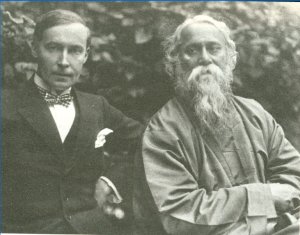
With his publisher Kurt Wolff in 1921
Rabindranath Tagore in Germany Today
We have to return to the question of translations. Translations into German started to appear from 1914 in rapid succession. No sooner did they come out in London, were they taken up by Kurt Wolff. Already in 1921, an eight-volume Collected Works could be published to coincide with Tagore’s first visit to Germany. However, when the devaluation of the German currency set in in 1923, the entire book market began to collapse. Kurt Wolff continued to publish new volumes of translation until 1925, and then he stopped. In 1929, his firm went bankrupt. There were several persons who had prepared translations of Tagore’s works for Kurt Wolff. From among them, Helene Meyer-Franck was the most dedicated and diligent. From 1918, she became the sole translator of Tagore into German. Her husband, Heinrich Meyer-Benfey, and she brought out his Collected Works.
After Kurt Wolff desisted from publishing, a new phase began for Helene Meyer-Franck: she learnt Bengali for the sole purpose of reading Tagore, her “dear Master”, in the original. It was a lonely fight in her small town near Hamburg, as she was virtually on her own. However, she learnt to read Bengali sufficiently well to translate into German three novellas and a collection of poetry. The novellas were published as early as 1930, but they left no visible trace because of the Nazi Reich emerging in 1933. Helene Meyer-Franck had to wait until after the Second World War before she was able to publish her second slim volume. Soon thereafter, first her husband and then she died. As a result, her initiative to translate Tagore directly from Bengali was not continued, and there was nobody to emulated her. In the 1950s, the old translations from English, published in the 1920s, were republished in West-Germany, and in some cases new translations of these weak and flawed English texts came out.
Communist East-Germany had a special relationship with Tagore. The latter’s internationalism endeared him to the regime, and his work was given political weight. Tagore’s books were translated into German in much larger numbers than in the West. Yet, these translations were generally of doubtful quality. Several anthologies contained translations from the English and from the Bengali side by side; other books were translated via Russian. Then there were so-called team-translation, i.e. a Bengali knowing little German and a German knowing little or no Bengali teamed up to produce a translation. None of these methods were at all satisfactory, and they did not serve to enhance Tagore’s reputation as a figure of World Literature. As far as I can see, only one person in erstwhile East-Germany mastered Bengali well enough to produce a competent translation on her own; that was Gisel Leiste, who translated one major novel, Gora.
It was not until the 1980s and 1990s that fresh direct translations were brought out, first by Alokeranjan Dasgupta (one volume) and then by Martin Kämpchen (three volumes). They were brought out by small, specialised or by theological publishers. What Tagore needs acutely, however, are mainstream literary publishers who market his works. This need is soon going to be fulfilled by a volume of love poetry, translated by Martin Kämpchen, brought out (in February 2004) by a premier literary publisher, Insel Verlag, in its series Liebesgedichte. Another publisher, Verlag Artemis & Winkler, is scheduled to bring out a larger volume of Tagore’s Selected Works, edited by Martin Kämpchen, in its series of Classics of World Literature.
I believe that in Germany Tagore’s time has now arrived. Apart from the fact that any great literature has a claim to be noticed and respected throughout the world simply because it is great literature, I wish to identify three areas in which Tagore’s ideas and ideals have a strong relevance for us today:
-
Ecology. – Rabindranath Tagore’s love of nature was inspired by the awareness that all living beings, including animals, trees and plants, are endowed with a soul. On this level of consciousness, human beings are equal with “low” creatures and plants. We are all co-creatures of God’s creation. Accordingly, Tagore’s praise and worship of nature is born of a deep spirit of togetherness and feeling of a creational bond between humans and nature. Such a sense of unity is missing in modern Western ecology. It tends to emphasise the usefulness of nature and the necessity of a natural environment for the practical survival of mankind. Thus, with his poetry and his essays, Tagore can inspire a deeper understanding of and togetherness with the natural environment.
-
Education. – Rabindranath Tagore’s ideas of education continue to be relevant. He wanted to unfold the entire personality through music, songs, dance, theatre, art, contemplation of nature, meditation and social service. The Indian subcontinent has strayed from these ideals, and in Western countries, too, the demons of “usefulness” and “efficiency” have to be tamed by the intentless, playful activity of Tagorean education.
-
International understanding. – Rabindranath Tagore’s deep yearning for harmony among men, achieved through mutual tolerance and simplicity of life, is as worthy of imitation now as it was then. It is not enough to nourish dreams and circulate hopes. Tagore has demonstrated to us how much one inspired human being is capable of achieving among men. Tagore descended from his dreams into reality and gradually worked out an understanding between human beings in his school, his university and his interaction with the wide world.

Rabindranath Tagore Street in Berlin
opened in 1961 (Photo: Christian Zeiske, Berlin)
Notes: Dr Dr Martin Kämpchen is a writer on India and a translator of Tagore from Bengali to German. He lives at Santiniketan, India. For more information visit his website www.martin-kaempchen.com.
- [1] Nirad Chaudhuri: Thy Hand, Great Anarch! India 1921-1952. Chatto & Windus, London 1987, p.596.
- [2] Rabindranath Tagore: Letters to a Friend. Edited by C.F.Andrews. Macmillan, New York 1929, p.171.
- [3] See Rainer Maria Rilke – Lou Andreas Salomé: Briefwechsel. Edited by Ernst Pfeiffer. Insel Verlag, Frankfurt 1975, p.300 (dated 20th September 1913).
- [4] See Kurt Wolff: Briefwechsel eines Verlegers 1911-1963. Edited by Bernhard Zeller and Ellen Otten. Verlag Heinrich Scheffler, Frankfurt 1966, p.136f.
- [5] Op.cit., p.138f.
- [6] Stefan Zweig: Benares: Die Stadt der tausend Tempel. In: Zweig: Begegnungen mit Menschen, Büchern, Städten. S.Fischer Verlag, Berlin/Franklfurt 1956, p.260.
- [7] Kurt Wolff: Briefwechsel eines Verlegers. p. 414.
- [8] Romain Rolland – Stefan Zweig: Ein Briefwechsel 1910-1940. 1st vol. 1910-1923. Verlag Rütten & Loening, Berlin 1987, p.640f.
- [9] Rolland – Zweig: Briefwechsel. 2nd vol. 1924-1940. p.187.
- [10] Thomas Mann: Briefe 1889-1936. Edited by Erika Mann. S.Fischer Verlag, Frankfurt 1961, p.188f.
- [11] Thomas Mann: Tagebücher 1918-1921. Edited by Peter de Mendelssohn. S.Fischer Verlag, Frankfurt 1979, p.529f.
- [12] Vivos Voco (Leipzig), vol. 1, Nov. 1920, p.817.
- [13] Hermann Hesse: Preface. In: Later Poems of Tagore. Translated and with an introduction by Aurobindo Bose. Peter Owen, London 1974, p.7.
- For more comprehensive accounts of Tagore’s impact on the German people, please refer to my books: Rabindranath Tagore and Germany: A Documentation. Max Mueller Bhavan, Calcutta 1991; Rabindranath Tagore in Germany. Four Responses to a Cultural Icon. Indian Institute of Advanved Study. Shimla 1999; My Dear Master. Correspondence of Helene Meyer-Franck / Heinrich Meyer-Benfey and Rabindranath Tagore 1920-1938. Edited by Martin Kämpchen and Prasanta Kumar Paul. Rabindra-Bhavana, Visva-Bharati, Santiniketan 1999.

- Tagore meets Einstein:
- Vishva Bharati University: > SCIENCE AND EDUCATION CENTER <
- MAHATMA GHANDI UNIVERSITY<
- GHANDI INSTITUTE FOR NONVIOLENCE
- Meet Rabindranath Tagore, Studies Friends at fb <
- Handwritten Letter in Sweet Memory of Tagore <
- Meet Vishwa Bharati School, friends at fb <
- Meet Mahatma Ghandi, friends, studies at fb <
- Meet Albert Einstein, friends, organisation at fb <
- Meet 100 Years Poetry Society, friends at facebook <
Architecture for Tibet – Manushree Orphanage
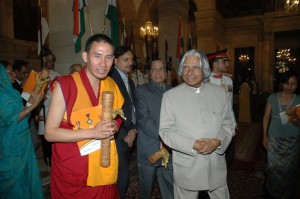
The PRESIDENT and Dalai Lama coming out after the Investiture Ceremony at> Rashtrapati Bavan<
> MANUSHREE VIDYAPITH ORPHANAGE <
> ARCHITECTURE FOR TIBET´s BLOG <
> KLIMA, ENERGIE, WOHNEN MIT UMWELTBERATUNG WIEN <
Architecture in Tibet contains Chinese and Indian influences, and reflects a deeply Buddhist approach. The Buddhist Prayer wheel, along with two deer or dragons, can be seen on nearly every Gompa in Tibet. The design of the Tibetan Chörtens can vary, from roundish walls in Kham to squarish, four-sided walls in Ladakh.
The most unusual feature of Tibetan architecture is that many of the houses and monasteries are built on elevated, sunny sites facing the south, and are often made out a mixture of rocks, wood, cement and earth. Little fuel is available for heat or lighting, so flat roofs are built to conserve heat, and multiple windows are constructed to let in sunlight. Walls are usually sloped inwards at 10 degrees as a precaution against frequent earthquakes in the mountainous area. Read More: >HERE <
INTRODUCTION – The Manjushree Orphanage free Education is one of the major projects in Arunachal Pradesh, Eastern part of Himalayan region. Whose purpose is to promote love, kindness, compassion and peace for the benefit of individuals, families, communities and the world? It will contribute to this endeavour by inspiring young people to act with a ‚good heart‘, to become leaders in their communities and to help bring peace into the world.
The name of the orphanage is called Manjushree Vidyapith, Orphanage. This orphanage was commence on 30th, October 1998 with an obvious and distinct intention of serving the deprived and disadvantaged children of the society irrespective of religion, caste, community, tribe, gender etc.
We started with 17 orphans with three teaching staffs from far-flung villages of this area in the year 1998. It is the first orphanage of its kind in whole area.
> Architecture for Tibet utube Channel <
In the beginning, one building was constructed to accommodate 17 orphans and 3 teaching staff. Army authority of the area had come forward to help the orphanage. Since then the number of orphans and destitute grow in geometric progression and the income of the orphanage in arithmetic progression. As a result, we are unable to admit many helpless orphans and neglected children.
The children who have lost their parents, the children who are destitute and dependent, and the children who have been born disabled or become disabled due to accident make up the family members of this orphanage.
Where they are provided with all the necessities of lives along with proper education and appropriate guidance to make them competent for facing various confrontations of lives.
At present, the orphanage is home to 108 children 80 orphans, 18 destitute and 10 physical disabled children from different social background. However, most of the children hail from this remote region. After coming here, they have started to relive their lives leaving their horrifying and disappointing past behind and they have begun to learn to tread forward with confidence and dignity. They live here as a different member of a single family, where every one is treated on equal terms.
We run a school inside our orphanage up to 5th grades. In the school, students are taught different subjects such as English, Math, Hindi, Tibetan, Science, Social Studies etc. 8 qualified teachers are engaged in imparting education to the orphans. Those who pass the 5th grade go to other school as day scholars but stay in the orphanage. Right now 25 students go to other school from our orphanage.
Besides, the residents are provided modern education, and equipped with moral values to help them become a better human being. The mental and physical growths of the residents and to help them possess a kind heart are given paramount importance. The orphanage has left no stone unturned to return back the smile they had lost.
So in all, the orphanage in itself has learnt to exist as very well knit family enriched with love, peace and knowledge and tranquility despite of many ups and downs. But in a way Manjushree family and I are indeed very thankful to all those great people who have been supporting us in one way or other without whose contributions we would not have reached this far. Read More: > HERE <
Our Project: Architecture for Tibet’s current project is an Academic Center for the Manjushree Orphanage in Tawang, Arucnachal Pradesh, in the high Himalaya of Northeast India. The new, light-filled Academic Center will replace the present schoolhouse, which is falling apart and not large enough to accommodate the number of children.
The proposed two-story building will contain not only classrooms, but a library, a multi-purpose space, a computer and language lab, and a large Nursery Environment, for the youngest children to learn, play and be cared for in. Within this place, the children can cultivate a true sense of friendship while gaining the knowledge they need to overcome their difficult circumstances.
The building is “green”: Temperature is regulated through a combination of geothermal and solar-based technologies, creating a warm environment during the harsh winters and a dry, airy place in summer, when the region receives heavy rains. This will enable the children to be comfortable, healthy, and active within their learning environment throughout all the seasons.
Our Organization: Architecture for Tibet has been founded by the Architectural Designer John Ullman of NYC and is composed of concerned professionals from the fields of architecture, engineering and education from around the world who are bound together by the common will to improve the built learning environ in Tawang, Arucnachal Pradesh.
- GREEN IDEAS DEIN IN DEIN AYURVEDA NET ARTICLE <
- Meet Tibet Friends, Culture, Arts, Medicine at facebook <
- Meet Himalaya Friends, Studies, Culture at facebook <
- Meet Green Architecture Groups and Studies at facebook <
- Meet Klimabündnis, KlimaschutzexpertInnen at facebook <
- Meet Architecture for Tibet, friends, fans at fb <
Kathak Academy , Shehjar, Kashmir Poetry
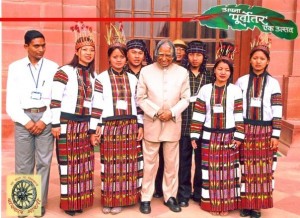
Artists from North East (Mizoram) with > Dr. APJ Abdul Kalam < at Rashtrapati Bhavan
Kathak (Hindi: कथक, Urdu: کتھک) is one of the eight forms of Indian classical dances, originated from northern India. This dance form traces its origins to the nomadic bards of ancient northern India, known as Kathaks, or storytellers. These bards, performing in village squares and temple courtyards, mostly specialized in recounting mythological and moral tales from the scriptures, and embellished their recitals with hand gestures and facial expressions. It was quintessential theatre, using instrumental and vocal music along with stylized gestures, to enliven the stories. Its form today contains traces of temple and ritual dances, and the influence of the bhakti movement. From the 16th century onwards it absorbed certain features of Persian dance and Central Asian dance which were imported by the royal courts of the Mughal era. Read More: > HERE <
Kashmiri Pandit (Hindi: कश्मीरी पण्डित) refers to a person who belongs to a sect of Hindu Pandits who originate from the Kashmir region in the Indian subcontinent. Many experts speculate that the Aryan Race originated in Kashmir and its vicinity. Kashmiri Pandits have made significant contributions to Indian thought and science. Abhinavagupta, Kalhana have been stalwarts in the fields of, philosophy and history respectively. Kashmir figures prominently in Sanskrit poet Kalidasa’s compositions but it is not known conclusively whether he hailed from that ethnicity or region. The birth place of CHARAKA one of the founders of AYURVEDA and INDIAN MEDICINE in general is also considered to be in Kashmir. Read More: > HERE <
The Pandit Shambhu Maharaj Kathak Academy was established to offer an all encompassing training in Kathak and Hindustani music. Apart from Kathak, and Hindustani Vocal, other courses being taught are Tabla, Yoga and Sanskrit. The teaching is of a uniformly high standard and the students are constantly encouraged and supported with scholarships and freeships, workshops and interactive sessions with renowned artists. The students are also provided the hostel facilities in a much secure and appropriate environment.
The school offers training at three levels.
About Vashwati Mishra – DANCE is my language, friend, identity, reflection, strength, medium and my consciousness.
Kathaks Improvisational character draws me. Every moment of the dance has its own innate beauty and enjoyment speed,rhythm,grace, expression It reflects all the colours of life.
Most people dream and then there are the few who give concrete shape to their dreams. In 1984 Vaswati Misra, an exponent of Kathak, choreographer and teacher started to give shape to her dream. With no financial support, but with the good wishes of friends and family she founded Dhwani, a center for the performing arts. She chose the name with care. Commonly taken to mean sound, for her, the meaning was definitely „In which the implied is more striking than the expressed“ The meaning reflected perfectly her approach to both choreography and performance. Read More: > Here <
Dhwani a cultural organization. Registered in 1984. Recognized by Indian Council for Cultural Relation, Department of Culture, Ministry of HRD, CID, Unesco.
About Shehjar – The idea of an e-magazine, with focus on multiple aspects of our rich cultural heritage, politics, philosophy, community news, views, people, community business promotion,networking,matrimonials,entertainment, new songs & videos and other such, originated in the middle of 2007. We are amazed at the pace the events have unfolded, converting those initial turbid perceptions into a reality.
Though we intend to have special, theme based issues as well, we endeavor to put together an interesting mix of articles, poems and event sections in each issue. Every issue attempts to have a fair representation in terms of variety of content and subjects. A web based magazine does not have limitations with regard to the publishing of high quality multimedia content, like graphics, audios and videos etc. as compared to the traditional subscription-based print magazines that inherently lack some of these feature.
Conceived and designed to be an interactive online magazine to serve the large global Internet readership, Shehjar will appear at regular intervals. Its hosting website, kashmirgroup.com, will be ever active and responsive to readers, with features like discussion forum, news and readers’ feedback. We hope that you will find these features interesting and keep us busy with your participation. With a global membership database and subscription listof about 10,000 registered users/members in our group, the possibilities of immediate readership are limitless.
*****
Shri G.L. Kaul retired as an Information officer for the J&K State. He had also been editing Kashmir Today ( English) and Tameer (Urdu) both official magazines of Information Department. As an avid theater activist he has acted in and directed many plays in Kashmiri, Urdu, Hindi and Punjabi, performing all over the country. He is the founder member of J&K cultural academy and IPTA group.
> Girdhari Ji’s Poetry VIDEO <
*Kashmirii Kavita Tehar-ta-charvan, *Urdu/Hindi Kavita Aye Mere Ghar*
One of the many talents of Girdhari Ji is his ability to write poems in several languages; that connect instantly with the reader. And what tops even that is the narration of this poetry in his lyrical voice and style. We are delighted to inform our subscribers that in this issue of Shehjar and in several forthcoming ones, we will be presenting videos of Girdhari Ji narrating several of his poems. These videos were prepared by his son Prof. Sanjay Kaul when Girdhari Ji was in the Boston area.
The two videos in this issue are in Kashmiri and in Hindi-Urdu. The Kashmiri is chaste and words flow easily, making his poetry well suited for musical compositions. We are suggesting that some of the musicians among our readers create memorable songs based on Girdhari Ji’s poetry and request you to contact us if you would like to do so. We will put you in contact with Girdhari Ji.
Our email id for all correspondence is editor.shehjar@gmail.com
Sufi Poetry and the Kashmir Sufi Society

> Dr. A. P. J. Abdul Kalam & Khwaja Farooq Renzu Shah <
> Kashmir: Sufis, Saints and Shrines <
> Kashmiri Overseas Association, Inc. <
Kashmir Sufism-History and Background
Kashmir-The Valley of Divinity – In the heart of the great Himalayas is a beautiful valley, which has been described by poets and emperors as paradise. Over the centuries, the verdant vale of Kashmir has seen the blossoming of many exquisite flowers of the philosophy of humankind. With the bountiful beauty of nature constantly around them, the people of Kashmir have always been filled by thoughts of the divinity of creation.
With the first rays of the sun, the melodious Azaan – call for the morning prayers, resonates through the mountains, a new day of life ushers into hope and joy with fresh fragrance of the Himalayan blooms and lotuses, of fir and pine trees. The purity of the mesmerizing beauty of Kashmir transforms any seeking soul into a humble being. The enchanting natural beauty of the valley with lakes and waterfalls, mountains and dales, rivers and springs, birds and butterflies and the peace loving folks all together in harmony magnify the Oneness of Allah in totality. The mystic atmosphere of Kashmir made this a suitable place for Rishis, Saints and Sages for time immemorial.
The philosophers of the valley have had a joyous belief in the manifestation of the beauty of God, in the world that we see around us. It is a deep belief that every aspect of creation is a part of the supreme consciousness. This philosophy of love and the recognition of divine beauty were the essence of the Buddhist and Hindu philosophies of the early period in Kashmir. Islam in the valley inherited these traditions and Kashmiris developed a rich Sufi culture, which continued the tradition of a deep personal love of God.
In Kashmir, visions of the lord’s glory are constantly in front of us. Kashmir Valley is an ideal refuge for a contemplative mind that gives you space to cultivate virtues towards leading a meaningful and content life. Long walks into the forests and boat cruising in the backwaters of Dal Lake during the day and quite evenings observing the stars awakens ones senses to understand the mystery of the universe .
Khwaja Farooq Renzu Shah has written eleven books and his Sufi Mankabat on Bulbul Shah has received national and international awards. Nusrat Fatheh Ali Khan and his disciple Rufi Fateh Ali have achieved fame through Bul bul Shah Mankabat on Sufism. His association with Sufi shrines of Kashmir , particularly shrine of Sheikh-ul-Alam at Chrar Sharief Budgam district, Sufi shrine of Muqam, Waterhail Budgam, Khansahib Budgam, Makhdoom Sahib Srinagar, Rahbab sahib, Drayigam shrine, Naqashband Sahib Srinagar, BulBul Shah Sahib Nawakadal Srinagar, Khankah Moula KhanKah, Fateh kadal Srinagar are very strong . After the tragic burning of Chrar Sharief shrine including Khankah Faiz, Khawaja Farooq had honour to rebuild Khankah Faiz. His Sufi seminars are attended by thousands of shrine believers. He organized international conference of Sheikh-Ul-Alam, Bul Bul Shah and Amir-I-Kabir. Khwaja Farooq Renzu was awarded Col.Qadafi award at Tripoli for his distinguished contribution on Sufism in 1988. He was awarded by the President of India, Prime minister, Governor and chief minister of J&K for his contribution to Sufism.
Kashmir: Where Sufis are Rishis and Rishis are Sufis!
By Sultan Shaheen
The most dominant influence on the Kashmiri Muslims, in terms of their Kashmiriyat, is that of the Rishi order of Sufis. While the Sufi orders like the Suharwardi, Kubravi, Naqshbandi and Quadri, arrived in Kashmir from Persia, Central Asia, and Central and North India, the Rishi order evolved in the valley itself indigenously in the beginning of the fifteenth century. The Kashmir valley was already permeated with the traditions of Hindu ascetism and Buddhist renunciation.
The term >„RISHI“< itself is clearly a derivation from Sanskrit and Indian traditions, though some Medieval Muslim scholars have tried to show that it is derived from the Persian word raish or rish meaning the feathers or wings of a bird. Baba Dawood Mishkati, for instance, gives a rather tortuous explanation. A bird whose feathers have been removed has no control over its own movements and depends entirely on the wind. And this is also the case with a Rishi; he is alienated from the world and lives alone, buffeted by fate. This and similar explanations, have, however, failed to impress the average Kashmiri Muslim and he, by and large, accepts its Sanskrit derivation and uses it loosely like his Hindus brethren as synonymous for a sage. In fact many Kashmiris do not even associate the word with any particular order of sufis, but use the word to denote any and every sufi saint.
The indigenous Rishi order of Sufis, however, does differ not only from the establishmentarian and fundamentalist Muslims but also from other Sufi orders in its philosophy and way of life. Many writers who have chronicled the life and times of Kashmiris of this period have been attracted to the unique way of life and philosophy of the Rishi order of Sufis. An important chronicler of this period, Abul Fazl, for instance, is all praise for them. He writes: „The most respected class of people in this country (Kashmir) are the Rishis. Although they have not abandoned the traditional and customary forms of worship (taqlid), but they are true in their worship. They do not denounce men belonging to different faiths. They do not have the tongue of desire, and do not seek to obtain worldly objects. They plant fruit-bearing trees in order that people may obtain benefit from these. They abstain from meat and do not marry.“
This account is corroborated by Emperor Jahangir. He writes: „Although they have not acquired learning and marifa, they live a frank and unostentatious life. They criticise nobody and ask for nothing from anyone. They neither eat meat nor marry. They always plant fruit-bearing trees in uninhabited parts, so that people may be benefited by them. But they themselves do not hope to reap any advantages from these trees.“
The Kashmiri Muslim Rishi’s ascetic and unworldly life thus bears a close resemblance to the lifestyle of the Hindu Rishis and Munis as well as Buddhist and Jain monks.
Baba Dawood Khaki describes a Rishi as one who is an ascetic and leads a disciplined life different from those of other saints. He is free from all worldly pleasures. Baba Nasib calls them gracious to the pious and describes them as men of pure heart. Their presence has turned Kashmir into heaven, he says. Cutting themselves away from all worldly relationships, they neither marry nor bother themselves with a family life. Piety is their apparel(khirqa); their nights are devoted to worship and during the day they worship incessantly. Having abandoned all worldly desires, they have succeeded in controlling their carnal lusts. Read Full Article: > HERE <
Lal Ded: The Great Kashmiri Saint-Poetess
Edited by: Dr. S. S. Toshkhani
Streifzug durch die Welt der indischen Mystiker und Dichterheiligen
– ihre Gedichte u. Gesänge –
This book represents the proceedings of a National Seminar on „Remembering Lal Ded in Modern Times“ conducted by Kashmir Education, Culture and Science Society in New Delhi on 12 November, 2000. Lalleshwari or Lal Ded, according to late Prof. Jayalal Kaul, has been the greatest genius of Kashmir of all times. This book has many eminent writers of modern period who have recollected the genius of Lal Ded for the modern world. Lal Ded was living in the 14th century in Kashmir. In spite of long interval of history, Lal Ded is remembered in every home even in modern period. Her Vaaks, or sayings, represent the best teachings for human kind today to seek unity and harmony between people of all religion and races. Her poetry is all inspiring. Her philosophy of life represents the highest science of life. She can be the leader to combine science and humanism world over, and once again establish a peaceful and melodious world of joy and happiness. Kashmiris in general and Indians and the people of the world are inspired by Lalleshwari’s teachings. This book and the seminar by KECSS cannot possibly touch all aspects of life and times of Lal Ded. However, a laudable attempt is made to recall Lal Ded for creating a joyful and harmonious world in Kashmir and the rest of India and the world. Hindus, Muslims and people of all faith remember Lal Ded with great reverence. This book should be of world-wide interest.
About Kashmir Sufism Society: Khwaja Farooq Renzu Shah believes in “Love as Revolution” which can engulf our power on all forms of terror, hate, communalism and regionalism. He is making efforts to restore the highest position of Sufism in Kashmir and make the world aware of its importance. He has practiced so far one lakh times Darood Khawani and attended Sufism Mehfils throughout the state. Read More: > Here <
- Founder Chairman of Kashmir Sufism Society
- Distinguished personality of Kashmir
- Founder of Kashmir Sufism society – Direct decedent of 1st Muslim king of Kashmir Renzu shah who was also known as Rinchen Shah (Foundation of Sufism under direct patronage of Hazrat Sharaf-u-din Bul bul Shah was laid by him in 1318 AD.)
- Meet Kashmir Sufism Society, friends and Studies at fb <
- Meet Support Internal Displaced Kashmirian Indigenous Peoples at fb<
- SAVE A SMILE & DIE Kashmir Shivaiten im Himalaya Gebirge <
