Posts by admin
VEDIC ASTROLOGY – Introduction
VEDIC ASTROLOGY
AN INTRODUCTION
The traditional Vedic horoscope is based on ancient wisdom rooted in the Veda, the oldest source of spiritual knowledge in the legacy of our humanity. Veda means knowledge, from the Sanskrit root Vid, to know. This verb-root has given rise to such modern words as ‚video‘, the Dutch ‚weten‘ or the German ‚wissen‘, both meaning ‚to know‘. This Veda. or knowledge, has been revealed in the remote past from the Divine Consciousness to Rishis or Seers, who ‚heard‘ or ’saw‘ the Veda and shaped it into hymns and chants for the benefit of the humanity.
SHAMBHALA … ein Geschmack von Weisheit

>> TAI CHI VEREIN SHAMBHALA <<
25 Jahre Shambhala… ein Geschmack von Weisheit
17.-20. September, Fest, Kurzworkshops, Vorträge, Rituale…
Wir feiern mit Euch!
Wie es so geht im Leben – man reibt sich die Augen und schaut verwundert auf 25 Jahre gemeinsames Tun und Verwirklichen einer Vision zurück.
Und wir – der Vorstand, alle unsere Shambhala Lehrerinnen und Lehrer, Mitarbeiter und Mitarbeiterinnen des Büros, unsere Gastlehrer und Gastlehrerinnen, Ausbildner und Ausbildnerinnen sind einen langen, intensiven, oft auch turbulenten Weg miteinander gegangen – mit Euch – unseren Schülerinnen und Schülern, Begleiterinnen und Begleitern über die Jahre – DANKE!
Wir wollen mit diesem Festwochenende eine Brücke schlagen in die Zukunft. Wie wird unsere Welt, dieser Planet Erde, unser aller Alltag in 25 Jahren – 2034 sein?
Wie können wir unseren Platz als Erwachsene jetzt verantwortlich einnehmen? Dreistündige Spezialworkshops werden uns von Freitag Nachmittag an durch das Wochenende führen. Spezielle Themen, die manchmal im Alltag des Praktizierens und Wachsens zu wenig Aufmerksamkeit bekommen – in diesen Tagen wollen wir das alles mit viel Spaß nähren.
25 Jahre bedeuten für uns Feiern, gemeinsam das Leben genießen und voller Zuversicht uns in die Zukunft hinein entfalten. JA!!!!!
MEENA CHOPRA – Fine Arts

>> MEENA CHOPRA, Poetry & Fine Arts <<
I soared the heights in the Milky Way sailing a vast panoramic emptiness…….वह सभी क्षण जो मुझमें बसते थे उड़कर आकाश गंगा में बह गए……-Meena Chopra.
I write verse, I paint and sculpt. I am associated with media and education. I am associated with CROSS CURRENTS Indo Canadian International Arts, where we have art events to bring communities together on a common platform through arts.
Art Statement/Message:
My art is my search for the moments beyond the ones of self knowledge.
It is the rhythmic fantasy which is so very elusive.
A restless streak which looks for its own fulfillment.
A stillness that moves within.
An intense search for my origin and ultimate identity.
Serene surroundings of my birth place „Nainital“ a hill resort in India have been a source of inspiration to me always. Strangely enough the beauty of Canada reminds me of my birth place a lot. Significantly the immenseness of the sky, the glory of the setting sun with its ever-changing colors and the unlimited wide expanse of the earth stills my nature within.
Grüne Apotheke – Standardwerk

Dr. Jörg Grünwald / Christoph Jänicke
„Gegen (fast) jede Krankheit ist ein Kraut gewachsen“ – man muss nur wissen welches.“
Das aktuelle Standardwerk für alle, die die Heilkraft der Pflanzen nutzen möchten. Die Grüne Apotheke führt moderne Phytotherapie und traditionelle Pflanzenheilkunde zusammen, beleuchtet alles Wissenswerte zu den einzelnen Heilmitteln und macht es dank des übersichtlichen Farbleitsystems leicht, schnell und sicher für jede Beschwerde das beste Mittel zu finden.
Der erste Teil des Buches beschreibt die lange Tradition und die unterschiedlichen Formen der Phytotherapie in verschiedenen Medizinsystemen. Darüber hinaus erfährt der Leser, welchen rechtlichen Ansprüchen ein pflanzliches Präparat heute genügen muss, um auf den Markt zu kommen.
-
Selbstbehandlung mit pflanzlichen Heilmitteln und -tees
-
Ausführliches Beschwerdekapitel, über 100 Pflanzensteckbriefe
-
Mit wissenschaftlichen abgesicherten Empfehlungen.
Das Herzstück des Buches bilden das ausführliche Beschwerdenkapitel mit wissenschaftlich abgesicherten Empfehlungen und die 100 daran anschließenden Heilpflanzenporträts in alphabetischer Reihenfolge. Der Beschwerdenteil ist in zwölf Bereiche untergliedert von Herz-Kreislauf-Beschwerden über Hautkrankheiten und gynäkologische Beschwerden bis Kinderkrankheiten.
In Info-Kästen geben der „Arzt“ und der „Herbalist“ fachliche Ratschläge zu Diagnose, Verlauf und Behandlung.
NÖ Heckentag 2009

Der NÖ Heckentag bietet auch 2009 wieder eine große Auswahl an einheimischen, regional angepassten Laubgehölzen und zahlreichen Sortenraritäten bei den Obstbäumchen. Ob Dirndl oder Liguster, Holler oder Schneeball, Elsbeere oder Pimpernuss, Freunde heimischer Wildgehölze werden garantiert fündig und dürfen sich über hohe Qualität und günstige Preise freuen.
Die Pflanzen für diese Aktion stammen ausschließlich aus Niederösterreich und wurden von den Mitarbeitern des Vereines Regionale Gehölzvermehrung (RGV) händisch besammelt, professionell als wertvolles Saatgut aufbereitet und in den Partnerbaumschulen zu kräftigen Jungpflanzen herangezogen.
YOGALEHRER IM HINDUISMUS
YOGALEHRER IN INDIEN
oder: “ YOGI in INDIEN „
Mit insgesamt 390 Versen stellt die Yoga-Shikha („Krone des Yoga“)-Upanishad die umfassendste Yoga-Upanishad dar. Sie besteht aus sechs Kapiteln, deren letztes einmal eine selbstständige Abhandlung gewesen zu sein scheint. Dieses > Shaiva-Werk < soll, ähnlich wie die > TANTRAS <, den spirituellen Suchern dienen, die mit den Schwierigkeiten des dunklen Zeitalters (kali-yuga) zu kämpfen haben.
The twelve Seats of Lord Shiva
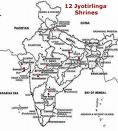
Spiritual Journey to the:
> The twelve Seats of Lord Shiva <
( or the Jyotirlingas )
> The Shiva Linga – Images of Cosmic Manhood in Art and Mythology <
> VEDEN, PURANAS, UNESCO Publishing, Cultural Heritage <
It is mentioned in the Shiv-Purana that Lord Shiva has twelve important places all over Bharatavarsha where He dwells in his linga form. Althought there are uncountable Shiv Mandirs not only in India but aboard also, these twelve places have special significance for the devotees of Lord Shiv. These places and how they came to be recognized as the Seat of Shiv have been described below:-
1. SHREE SOMNATH: (Kathiawad), Gujarat
Chandra Devan worshipped Siva at this spot to rid himself of the curse of Daksha.
The story :
Chandra Devan is considered to have built this temple & hence the name Somanathar to the Lord. Chandran fell in love with Rohini, one of the daughters of Dakshan. But Dakshan wanted to give all his daughters in marraige to one able & loving person, who would treat all his daughters equally. Chandran got married to all, but his love for Rohini was too great & the other daughters complained to their father. Dakshan cursed Chandran to dwindle in power & beauty. When Chandran begged forgiveness, Dakshan said that only prayers to Lord Siva, could free him of the curse. Chandran came to Somanath & prayed to Lord Siva, doing penance for about 4,000 years. Lord Siva appeared & said that he could not fully absolve him of the curse. Instead, he would wane in 15 days, but would grow again. This is the story said for the waxing & waning of the moon, producing new moon & full moon.
„Die Mittleren Stufen der Meditation“
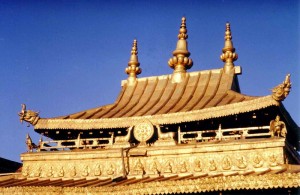
>> Acharya Kamalashila <<
und
„Die Mittleren Stufen der Meditation“
Kamalashila war ein indischer Pandita. Er lebte im 8. Jahrhundert und war Schüler des Acharya Shantarakshita. „Pandita“ (Skr.) bedeutet „Gelehrter“, „Acharya“ (Skr.) bedeutet „Leiter des Studiums, Lehrer“.
Der tibetische König Trison Detsen (742-496) hatte Padmasambhava eingeladen, damit er in Tibet den Buddhismus verbreite. Als sie entschieden, auch ein Kloster zu gründen – das Kloster Samye südlich von Lhasa – luden sie den Mönch Shantarakshita ein. Dieser gab die Mönchsgelübde und erteilte für längere Zeit Unterweisungen.
Shantarakshita sagte: „Wenn Ihr künftig einen maßgeblichen Meister bei Euch haben wollt, solltet Ihr meinen Schüler Kamalashila einladen.“
Als ein großer chinesischer Meister nach Tibet kam und seine Lehrmeinung verbreitete, lud Trison Detsen Kamalashila ein. Es kam zu einer großen Disputation zwischen den beiden Meistern. Shantarakshitas Lehrmeinung konnte aufrechterhalten werden, die chinesische Lehre wurde nach China zurück geschickt.
YOGA IM BUDDHISMUS
*
> The Eight-Fold Path Of Bhagwan Buddha <
Compiled by: Prabhat Tiwari
Lord Buddha was a contemporary of Maharshi Patanjali, the propagator of the ‘Yoga Darshana’. Just as Patanjali suggested that yoga has eight steps (ashtanga yoga) with a final goal as ‘samadhi’, Buddha too has suggested eight steps to ‘samadhi’. – Editor
Buddha says, “Wrongs are many, right is one, so how can the right be against the wrong? Right is that which is not your invention. It is already there. If you go away from it you are wrong, if you come close to it you are right. The closer you are, the more right you are. One day, when you are exactly home, you are perfectly right.”
Samyak and samadhi both start with the same root sam (equal). Samyak is the step towards samadhi. So seven steps ultimately lead to the final step ‘samadhi’. ‘Samadhi’ means – now everything has fallen in tune with existence.
These eight steps are just indicators of how to come to that ultimate courage where you take the quantum leap and you simply disappear. When the self disappears, the Universal Self arises.
> The Noble Eightfold Path < describes the way to the end of suffering, as it was laid out by > Siddhartha Gautama < . SiddhÄ�rtha Gautama (Sanskrit, m., सिद्धार्थ गौतम, SiddhÄ�rtha Gautama; Pali: Siddhattha Gotama) was a spiritual teacher in the north eastern region of the Indian subcontinent who founded Buddhism.
It is a practical guideline to ethical and mental development with the goal of freeing the individual from attachments and delusions; and it finally leads to understanding the truth about all things. Together with the Four Noble Truths it constitutes the gist of Buddhism. Great emphasis is put on the practical aspect, because it is only through practice that one can attain a higher level of existence and finally reach Nirvana. The eight aspects of the path are not to be understood as a sequence of single steps, instead they are highly interdependent principles that have to be seen in relationship with each other.
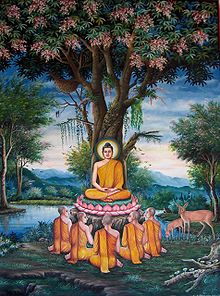
* Buddha mit seinen ersten 5 Schülern unter dem Bodhi Baum, Pappel-Feige (Ficus religiosa), auch Buddhabaum, Bobaum oder Pepul-, Pepal-, Pipul- oder Peepalbaum.
Buchtipp: Ringu Tulku, Ri-Me Philosophy

> The Ri-me Philosophy of Jamgon Kongtrul the Great: <
A Study of the Buddhist Lineages of Tibet
This compelling study of the Ri-me movement and of the major Buddhist lineages of Tibet is comprehensive and accessible. It includes an introduction to the history and philosophy of the Ri-me movement; a biography of the movement’s leader, the meditation master and philosopher known as Jamgön Kongtrul the Great; helpful summaries of the eight lineages‘ practice-and-study systems, which point out the different emphases of the schools; an explanation of the most hotly disputed concepts; and an overview of the old and new tantras.
Rimé is a Tibetan word which means „no sides“, „non-partisan“ or „non-sectarian“. In a religious context, the word ri-mé is usually used to refer to the „Eclectic Movement“ between the Buddhist Nyingma, Sakya, and Kagyu traditions, along with the non-Buddhist Bön religion, wherein practitioners „follow multiple lineages of practice.“ The movement was founded in Eastern Tibet during the late 19th century largely by Jamyang Khyentse Wangpo and Jamgon Kongtrul Lodro Thaye, the latter of whom is often respected as the founder proper. The Rimé movement is responsible for a large number of scriptural compilations, such as the Rinchen Terdzod and the Sheja Dzö. Read more: > HERE <
* Jamgön Kongtrul the Great (1813–1899) * is a giant in Tibetan history, renowned for his scholarly and meditative achievements, but also for his energetic yet evenhanded work to unify and strengthen the different lineages of Buddhism. The Ri-me movement, led by Kongtrul and several other leading scholars of the time, was a unifying effort to cut through interscholastic divisions and disputes that were occurring between the different lineages. These leaders sought appreciation of the differences and acknowledgment of the importance of variety in benefiting practitioners with different needs. The Ri-me teachers also took great care that the teachings and practices of the different schools and lineages, and their unique styles, did not become confused with one another. This lucid survey of the Ri-me movement will be of interest to serious scholars and practitioners of Tibetan Buddhism.
What is „Rimé“? Ris or Phyog-ris in Tibetan means „one-sided“, „partisan“ or „sectarian“. Med means „No“. Ris-med (Wylie), or Rimé, therefore means „no sides“, „non-partisan“ or „non-sectarian“…..
Ri-Mé_Approach, Ringu Tulku, Brussels June 2006, The Ri-Me Philosophy of Jamgon Kongtrul the Great: A Study of the Buddhist Lineages of Tibet by Ringu Tulku, ISBN 1-59030-286-9, Shambhala Publications
…..It does not mean „non-conformist“ or „non-committal“; nor does it mean forming a new School or system that is different from the existing ones. A person who believes the Rimé way almost certainly follows one lineage as his or her main practice. He or she would not dissociate from the School in which he or she was raised. Kongtrul was raised in the Nyingma and Kagyu traditions; Khentse was reared in a strong Sakyapa tradition. They never failed to acknowledge their affiliation to their own Schools.
In the 1970’s I was doing research work on the Rimé (Wylie, Ris-Med ) Movement. This gave me the opportunity to meet and interview a number of prominent Tibetan Lamas, including His Holiness, the Dalai Lama, and the heads of the four main Schools of Tibetan Buddhism. I prepared a questionnaire. One of the questions I asked was whether they believed that other Schools of Buddhism showed the way to attain Buddhahood. I have never been so rebuked in my life as when I asked that question! All of them, without exception, were shocked and felt insulted, deeply saddened that I, a monk, could ever have such doubts. They would not speak with me until I persuaded them to believe that this was one of those unimportant, procedural questions that are part of the modern University system.
„How can you say such a thing?“ they rebuked me. „All Schools of Buddhism practise the teachings of the Lord Buddha. Moreover, the Schools of Buddhism in Tibet have even more common ground. They all base their main practice on Anuttara Tantra of Vajrayana. Madhyamika is their philosophy; they all base their monastic rules on the Sarvastivadin school of Vinaya.
One of the unique features of Buddhism has always been the acceptance that different paths are necessary for different types of people. Just as one medicine cannot cure all diseases, so one set of teachings cannot help all beings – this is the basic principle of Buddhism.
His Holiness, XIV Dalai Lama, has been strongly influenced by some great Rimé teachers such as Khunu Lama Tenzin Gyatso, Dilgo Khentse Rinpoche and the 3rd Dodrupchen Tenpe Nyima. Due to their efforts in recent years, there has been more interchange of teachings amongst different Schools of Tibetan Buddhism than ever before. Following the traditions of Rimé, the Dalai Lama has been receiving and giving teachings of all Schools in their respective traditions and lineages.
Buchtipp: Swamy Swarna

> Metalle im traditionellen Ayurveda <
> Edelsteinheilkunde Hildegard von Bingen <
I am a Physicist, a Metallurgist, a Quality Management and General Management expert, a Holistic Healer with interests in Homeopathy, Tissue Remedies, Bach Flower Remedies, Reiki etc., an avid book reader, Reviewer, Author and Editor. Please visit http://svswamy.blogspot.com/ & Swamy´s World to see my detailed profile.
This blog will hold all the book reviews, including those which were earlier posted at www.blether.com That site has been closed and so I am keeping all those reviews here so that a prospective author/publisher and a publicist can decide whether I am a suitable reviewer for the book they are trying to promote. My latest reviews are also being uploaded here.
Buchtipp – Yoga in America

by Deborah S. Bernstein & Bob Weisenberg
This is the story of Yoga in America, as told by 46 ardent teachers and devotees from every part of the Yoga spectrum. 46 unique and compelling essays on what Yoga is in America representing the major yoga traditions, Bikram, Kundalini, Ashtanga, Kripalu, Iyengar and some that are much less widely known.
The 46 writers assembled in this book show both the great diversity of Yoga and its unifying principles.
Tantra & Landwirtschaft, Tantra in Agriculture
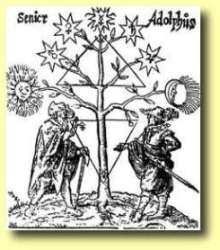
* Internationales Jahr der Astronomie 2009 *
>Immerwährender Bauernkalender< > Los & Schwendttage <
COSMOVISIONS IN HEALTH AND AGRICULTURE IN INDIA
Prabha Mahale and Hay Sore
There are two major cosmovision traditions in India. The ‘Great Tradition‘, which represents the Sanskrit or classical tradition described in the Vedas and the ‘Folk Tradition‘, representing popular Hindu tradition and the tradition of the tribal peoples.
The rituals and practices of the Hindu tradition, both classical and folk, is a continuing history. They both represent a living cult that is deeply ingrained in social, religious and cultural traditions, both in the orthodox and the popular sense. Generally they converge, occasionally they diverge. There is also the indigenous system of the original inhabitants, the tribal people who have another history and knowledge base.
The Vedas are a collection of hymns, mantras and prayers written in Sanskrit, that communicate the sacred knowledge of the cosmic order visioned by the rishis or seers.
Thus, rishis are exalted beings who manifest divine wisdom and include the visionary sages of ancient India to whom the Vedas were intuitively revealed.
A rishi or seer has a perfectly subjective and objective mind, because it is free from the six prejudices: lust,anger, greed, intoxication, delusion, jealousy. Because of this he is able to make full use of the five senses and his mental capacity.
The senses naturally move out to see, hear, touch, smell and taste, where as the mind can move outward with the senses and move inward and experience an inner non-sensory world. For a seer, the way to understanding nature is to become one with it.
Vedas cover diverse branches of learning, such as astrology, medicine, law, economics, agriculture and government. The Vedic tradition is the root of cosmology and knowledge for the vastu majority of Indians, Hindus and Jains.
In India’s traditional thought, there is no distinction between the sacred and the profane: everything is sacred. The essence of this tradition is to live in partnership with, rather than to exploit nature. The most complete holistic perspective of the universe was evolved by Vedic culture about 6000 to 8000 years ago, and has been sustained by Indian civilisation throughout the millennia.
The Vedas have played a major role in bringing together mankind and faith in nature and have guided man through Rta, the cosmic morality. The cosmology, the total worldview, had the relationship between the Human and Nature as its core. All life is believed to be interrelated and interwoven.
According to Hindu mythology Brahma is the creator, Vishnu the conserver and Shiva the destroyer of the universe.
The basic theory of cosmovision is known as Siddhanta. The Sarva Tantra Siddhantas cut across all areas of traditional Indian science.
The following elements are important for health and agriculture:
· Understanding the composition of all material, animate as well as inanimate, in terms of the five primordial elements, the Pancha Mahabhutas: vayu (air), jala (water), prithvi (earth), agni (fire) and akasha (ether, sky or space).
· Understanding the properties and action of human beings, animals and plants, in terms of three biological factors: vaata, pitta and kapha. Vaata: slender, light and averse to sunlight. Pitta: medium size, abundancy and fond of sunlight. Kapha: stout and bulky, abundant flowers and fr uits, housing many creepers.
· Understanding the fundamental existential principles of dravya (matter), guna (quality) and karma (action).
· All living beings are born and evolve from the five Mahabhutas earth, water, fire, air and space.
In death they go back to them. The Mahabhutas are the primary natural resources essential for all life forms. Through myths and rituals mankind is ever reminded of his duty (dharma) to sustain these elements.
Gods and Goddesses from the Great Tradition
The cosmovision of ancient India can be illustrated by a quotation from an Ayurvedic text:
‘The basic aim of the concepts and fundamental principles of all the sciences is to establish happiness in all living beings. But a correct and thorough knowledge of the basic principles of the universe and the (human) body leads to the correct path to happiness, while deceptive knowledge leads to the wrong path.‘
The cosmic forces were personified in the form of various gods and goddesses, whose influence or failure to maintain cosmic morality was considered the main cause of an imbalance in health. They play a role in healing and thus it was the responsibility of every individual to observe the prescribed rules.
Most of the Vedic rituals are institutionalised in Hindu Dharma and are a part of the day-to-day life of the people.
Varuna is the God of waters and all the rivers. Ganga, Yamuna, Saraswati and Kaveri are deities of the vast water cosmogony. No ceremony of birth, death or marriage is complete without the ritual purification of water. Vegetative and animal life forms such as lotus, coconut, mango, snake, tiger and cow are central in Hindu myths. Cows, which are a symbolical representation of the earth, have traditionally been objects of great worship and reverence. The killing of the cow is listed as one of the major sins in Hinduism: ‘All that kill, eat and permit the slaughter of the cow will rot in hell for as
many years as there were hairs on the body of the cow.‘ [Artha Shastra of Kautilya].
The teachings in ancient scripts such as the Upanishads, emphasise the importance of trees. Reverence for trees is expressed in the various tree worships related to the Ficus species. Trees have also been linked with penance, education and religious activities.
Prithvi, the Mother Earth, is the divine mother who sustains plant and animal life. She is perceived to be a powerful Goddess for the world as a whole.
The cosmos itself is seen as a great being, a cosmic organism. Different parts of the world are identified as parts of her body. The earth is called her loins, the oceans her bowels, the mountains her
bones, the rivers her veins, the trees her body hair, the Sun and Moon her eyes and the lower worlds her hips, legs and feet. Vayu (air) in the Vedic pantheon is associated with Indra, the God of the firmament, the personified atmosphere.
He is prana, the pure breath of life. Finally the sun, the great ball of fire is the energiser, the life giver.
The Goddesses too illustrate important ideas in Hindu philosophy. For example, Prakriti denotes physical reality. It is nature in all its complexity, orderliness and intensity. The Goddess Sri, or Lakshmi, is today one of the most popular and widely venerated deities.
In early Vedic literature she was invoked to bring prosperity and abundance. In the Sri- Sukta (an appendix to the Rig Veda dating from pre-Buddhist times) she is described as moist in cow dung. Clearly, Sri is associated with growth and the fecundity of moist, rich soil. Villagers, particularly women, worship Sri in the form of cow dung on certain occasions. Lakshmi is associated with the lotus (symbolising vegetative growth) and the elephant (whose power brings fertilising rains). Together they represent the blossoming of life. Durga is one of the most formidable Goddesses of the Hin du Pantheon. Her primary mythological function is to combat the demons who threaten the stability of the
cosmos.
Deities of villagers
In the villages, these goddesses are worshipped by upper caste Hindus. The ‘Great Gods and Goddesses‘, though acknowledge d to be in charge of distant, cosmic rhythms, are only of limited interest to most village people. Every village has its own village deities.
They often share the names or epithets of deities in the Sanskrit pantheon but they do not necessarily have any similarity with ‘the Great Tradition‘ Goddesses. Unlike the ‘Great Gods‘ whose worship is often restricted to certain castes, these deities are the goddesses of the whole village. All over southern India, these village deities are almost exclusively female. They are not usually represented by anthropomorphic images but by uncarved natural stones, trees or small shrines. The village and its immediate surroundings, therefore, represent for the villagers a more or less complete cosmos.
The central divine power impinging on, or underlying this cosmos is the village goddess. The extent to which order and fertility dominate the village cosmos is determined by the relationship between the goddess and the villagers.
Their relationship is localised and aims not so much at individual welfare but at securing the welfare of the village as a whole. In return for their worship, the goddess ensures that the villagers have good crops, timely rain, fertility and protection from diseases, spirits and untimely death.
The entire ritual complex built around agricultural operations involves protective, prohibitive and promotional values. For example, the villagers in Pachara (West Bengal) propitiate Lakshmi and Manasa a number of times each year. While Manasa is worshipped generally during the cultivation season, Lakshmi is worshipped during preharvest or post-harvest periods.
Furthermore, many of the rituals performed for living human are also being extended to Mother Earth. The Adi Perukku agricultural festival is celebrated in Tamil Nadu. On the eighteenth day of the Tamil month of Adi (between mid-July and mid-August) this festival hails the arrival of the monsoon. Reverence is paid to the River Goddess and farmers are encouraged to sow seeds.
An important aspect of this festival is the sowing of nine varieties of seeds: wheat, paddy, toordal, green gram, groundnut, bean, sesame, black gram and horse gram (Navadanya) in a pot.
It is called Mulaipari and is a forerunner of the present germination test. Apart from the festivals of the village goddess, there are a number of ritual performances that directly or indirectly relate to the various stages of managing agriculture production and consumption. These are observed by individual families and by particular caste communities. These rituals vary from region to region and from community to community.
But the ultimate goal is the same: the worship of deities,implements, bullocks, and spirits in the fields to ensure a good harvest. (Erntedankfest) http://de.wikipedia.org/wiki/Erntedankfest
Classical Indian Agricultural Science – In the Vedas, particularly Rig Veda and Atharva Veda a great deal of attention is paid to agriculture, implements, cattle and other animals, and the rains and harvests.
Ancient texts relating to agriculture are the Vrkshayurveda (Ayurveda of plants) and the Krshisastra (science of agriculture) and Mrgayurveda (animal science).
They provide a wealth of knowledge on such subjects as the collection and selection of seeds, germination, seed treatment, soil testing and preparation, methods of cultivating plants, pest control and crop protection, the rearing of cows and the care of draught cattle, for example.
Outbreaks of disease and pest attacks on plants are viewed as being based on the same principles as the epidemics that affect the human and animal species. The basic understanding is that epidemics occur because of imbalances in the ecosystem. One of the major causes of such inbalance is human error or living in the wrong way which leads to an incorrect intervention in natural processes. The main protection against epide mics is a thorough knowledge of nature which makes it possible to avoid causing serious imbalances in the ecosystem.
Vrkshayurveda – the science of plant health – was accorded a prime position in the history of agriculture in India. The three major ancie nt texts that provide the basis for Vrkshayurveda were compiled by Varahamihira, Chavundarya and Sarangadhara. These texts provide indications of an integrated approach to controlling crop pests and diseases through soil, seed, plant and environmental treatment.
These different methods have several characteristics in common and can be used to launch a multi-pronged attack on pests and diseases; to improve plant health and increase resistance; to enrich the soil with nutrients and increase useful microbial activity, and finally to ensure a broad spectrum effect on pests and diseases.
Folk knowledge – Farmers‘ perception and understanding of ecology, crops, land, labour, livestock and agricultural implements has a profound bearing on the strategy they adopt in their day to day agricultural operations.
Their ideas about climate, crops, the optimum climatic conditions required for cultivation and beliefs relating to crops and fruits are the results of the knowledge they received from their ancestors and their own long experiences in the natural laboratory of their fields. Farmers have the ability to identify various types of seeds and seedlings and this is often based on morphological characteristics. By looking at the nature of the flowers on a plant, an estimation of the yield can be made (Bauernkalender).
The technically useful items of indigenous agricultural practices are often documented without reference to the symbolic or ritual matrix in which they occur. It is a debatable point whether, by looking at these practices from a mere scientific and rational perspective does not devalue them. Despite the fact that farmers have been subject to external influences, they still continue to experiment and make innovations, sometimes adapting external knowledge to indigenous knowledge and sometimes revitalising their own knowledge.
There are indigenous institutions that regulate community administration, decisionmaking, elements of farming and the rites and rituals related to cosmovison. In the villages, religious functionaries such as Brahmin priests, and in the tribal communities of the Eastern Ghats traditional functionaries such as the Naiks and Disaris play an important role.
The functioning and strength of the institutions that kept the environment protected, depends on how successfully future citizens are introduced to the heritage that generates respect for these institutions. Knowledge systems cannot grow if traditional cultural anchors are not properly located.
Culture provides a ‘grammar‘, while technology provides new words. The meaning of life can only be discovered if both are blended together.
AYURVEDA: Complementary Global Medicine

> 7th Annual NAMA Conference <
NAMA’s annual conference is an opportunity to come together as a community, and for practitioners to enrich their knowledge by participating in continuing education programs and case study presentations. The weekend provides a valuable networking experience for attendees to connect or reconnect with friends and colleagues.