HILDEGARD OF BINGEN´s MEDICINE

HILDEGARD OF BINGEN´s MEDICINE
Hildegard of Bingen – a legendary healer, visionary, musician, artist, poet, and saint. Her works include seventy-seven symphonic compositions; Scivias, a compilation of her visions; and her two major medical works, Causae et Curae, the first christian medical compendium, and Physica – nine volumes on natural healing.
Hildegard‘s wisdom and healing art is not just a story for Germany or Europe, but since God is the creator of the entire universe, it relates to all of humanity. Therefore you will find here medicinal and nutritional informations in as many languages, as you can help me to translate. Please send translations to praxis@.st-hildegard.com
About Hildegard of Bingen’s Medicine
This ground-breaking contribution to medicine and healing contains translations of Hildegard text which reflect the high point of medieval, alchemical, and healing science. Commentary by the authors who have worked clinically with Hildegard’s wisdom for over thirty years includes information on ways to treat nervous disorders, indigestion, heart problems, and cancer.
About the Author(s) of Hildegard of Bingen’s Medicine
Dr. Gottfried Hertzka is a medical doctor in Germany, and author of the bestselling book on Hildegard medicine, So heilt Gott. He has worked clinically with Hildegard’s theories for thirty years. Dr. Wighard Strehlow was a research chemist in the pharmaceutical industry in West Germany, and now works with Dr. Hertzka in the Hildegard Practice at Konstanz, West Germany.
PROJECTS:
Plans for a New Foundation
Abbey of St. Hildegard owe the plan to found a new convent, which would revive the old religious house at Eibingen and also be a link to the one destroyed by the Swedes at Rupertsberg in 1632 (founded by Hildegard herself), to Bishop Peter Josef Blum of Limburg (1842-1883)
INFORMATION:
-
http:// > www.regionalgeschichte.at <
INTERNATIONALER FRIEDENSLAUF

Mae Sot Peace Walk 2009
INTERNATIONALER FRIEDENSLAUF FÜR DIE WELT UND BURMA
“My life is for peace and justice nothing more.”
„Peace inside is Peace outside“
Ashin Sopaka wurde 1977 in Burma geboren. Als er 12 Jahre alt war wurden durch die Militärregierung alle Schulen geschlossen. Er wurde mit 13 Jahren Novize in dem buddhistischen Kloster KabarAye (Weltfrieden). Nach seiner Ausbildung begab er sich auf eine Wanderschaft durch Burma, Thailand, Singapur, Malaysia, Laos und Japan. Seit 2003 lebt Ashin Sopaka im Exil in Köln.
Alle Informationen über den Internationalen Friedenslauf für die Welt und Burma, und die schönen Friedensmeditationen seit dem Jahre 2006 nach Christus finden Sie im Peace March Archiv * hier *
Ausserdem gibt es auch noch in anderen Ländern auf dieser Erde auch die schöne und gesunde Gelegenheit für einen Friedensmarsch. Alle Informationen dazu gibt es auf der Homepage: www.theworldmarch.org
A bridge to the future: Welcome, to the international site of the first ever World March that will travel the world asking for the end of wars, the dismantling of nuclear weapons and for an end to all forms of violence.
Be one of the brave and help us to create a new, non-violent global consciousness!
Help monks & nuns Bat Nha Monastery
>>>>> Bat Nha is Now a Legend <<<<<
>> Help monks & nuns in Bat Nha Monastery <<
Monastery in tradition of Thich Nhat Hanh needs urgent help-please write to government leaders Monastery inhabited by disciples of Thich Nhat Hanh in Vietnam are being asked to leave by Sept. 2. The locals have used force in the past. Please help by writing letters.
Old Report from A University Dean May Shed Light on Bat Nha Situation:
Sightings 11/17/05, Religious Rights in Vietnam,– Alison L. Boden
I recently returned from a trip to Vietnam with a group of University of Chicago faculty and students to study first-hand the state of human rights there. Concerning religious rights and freedoms, our conversations with representatives from the government’s Department of Religion in Hanoi and with several religious communities were illuminating, as was a meeting with researchers at the Vietnamese Institute for Human Rights at the Ho Chi Minh National Political Academy.
Both the U.S. Department of State and the non-governmental organization Human Rights Watch have strongly criticized the Vietnamese government’s policies toward — and participation in — the internal workings of that country’s religious communities.
My visit convinced me that their concerns are indeed warranted.
MIND & LIFE, Meditation und Forschung

>> Educating World Citizens <<
>> Meditation verändert Gehirnströme im ORF <<
>> MIND & LIFE Institute, Vision & Purpose <<
Mind and Life XIX brings together world-renowned educators, scientists, and contemplatives, with the Dalai Lama presiding, to explore new avenues for science and educational practice related to the cultivation of these positive human qualities —mindful awareness, self-control, social responsibility and concern for the welfare of others –among children, youth, and the adults who educate them. This interdisciplinary dialogue will honor insights from various perspectives on this issue, including those from educational theory and practice, philosophy, psychology, neuroscience, and the wisdom of contemplative traditions.
Nutzen von Meditation: Neueste Forschung
Inhalt
-
1. Meditation verändert Hirnfunktionen: Erfahrung & Forschung
-
2. Moderne Methoden der Achtsamkeitsschulung
-
3. Das Cultivating Emotional Balance, Challenging Times-Projekt
-
4. Studien zur klassischen tibetischen Meditation
-
5. Weiterführende Literatur und Links
1. Meditation verändert die Hirnfunktionen: Erfahrung und Forschung:
„Die Meditation verändert Körper und Geist“, behaupten diejenigen, die sie ausüben. In welcher Weise diese Veränderungen auftreten und welchen Nutzen sie für die Medizin haben könnten, ist mehr und mehr Forschungsthema.
Natya Mandir – Carnatica Brothers

Association for Classical Indian Dance
Die beiden Musiker K.N.Shashikran und P. Ganesh, die als „Carnatica Brothers“ in der indischen Musik bekannt sind, sind tatsächlich Cousins und entstammen einer hoch angesehenen, traditionellen indischen Musikerfamilie. Die beiden Künstler treten auch als Gesangduo auf.
Der erste Teil des Konzertes wird von P. Ganesh als Solist auf der Chitravina bestritten. Der zweite Konzertteil wird ein Vocal-Konzert des Sängers K.N. Sashikiran sein, der von der Chitravina begleitet wird. Beide Künstler werden von dem Mridangamspieler K. Murugaboopathi und dem Kanjiraspieler Herbert Lang begleitet.
Unter den außereuropäischen Musikkulturen nimmt die indische Musik eine Sonderstellung ein. Mit mehreren hundert technisch und namentlich verschiedenen Ragas bildet sie das größte modale Musiksystem der Welt. Kein geringerer als Olivier Messiaen hat daher im Vorwort zu seiner Kompositionslehre (Technique de mon langage musical) der indischen Tonkunst seinen Respekt gezollt und sie zu seinen Lehrmeistern gezählt.
Zeit: 2. Oktober 2009, 19.30 Uhr
Ort: Natya Mandir Studio, 1010 Wien, Börseplatz 3 , www.natyamandir.at
Eintritt: 15 € /12 € ermässigt
Anmeldung: Bitte um Anmeldung für einen Sesselplatz . Tel. 01/532 14 94 oder 0676 312 57 36, E-Mail: austro-indian@hotmail.com
Vayu Rahasya: The Secret of Vayu

Vayu Rahasya: The Secret of Vayu
Written by Dr. David Frawley,Sept. 2009
The magazine of > Sringeri Shankaracharya Math < , the oldest and most respected of the Shankara monastic centers in India, representing the great tradition of Advaita Vedanta. Dr. Frawley has written many articles for the magazine over the years and been closely connected to the Math.
Vayu, the Cosmic Power
Vayu is one of the key concepts of Vedic thought that has great importance in Yoga, Ayurveda and Vedanta. It has many profound implications both at a cosmic level and relative to our own individual lives. Indeed if one understands Vayu, one understands everything, including time, space and karma, life and death and one’s own deeper Self.
Vayu is usually regarded as the element of air at a material level. This is a good place to begin a study of Vayu, but only the beginning of many correspondences. In Vedic thought, Vayu includes the concept of space or Akasha. Space in motion is air, while air at rest is ether. These are the two sides of Vayu, which is the unity of air and ether. Ether is the field in which Vayu as a force operates.
Modern science recognizes that the universe consists of a fabric of space filled with various types of channels, currents or wormholes that are filled with dynamic interchanges. This is a picture of the cosmic Vayu, which is not only space but the energy within it both potential and actual. One could say that potential energy is space while activated space is air. The universe itself is Vayu in its ethereal vibration.
However, Vayu is much more than the material or even subtle elements. Vayu is the power through which everything comes into manifestation and into which everything eventually returns. Vayu is not just the material element of air and space but the cosmic principle of energy and space that pervades body, life, mind and consciousness. The entire manifest universe arises from space and energy which is Vayu at an outer level. At an inner level, Vayu stands for the formless principle of air and space, the invisible Spirit or Brahman behind the visible world of the earth, water and fire elements, the realm of name and form. The famous Shantipath of the Taittiriya Upanishad declares this:
Namaste Vayo, tvam eva pratyaksham Brahmasi.
`O, Vayu, you are the directly perceivable Brahman.‘
Vayu often symbolizes the supreme deity, the spirit that is formless in nature yet full of power like the wind or air. Vayu as the creative or causal power is the power of Ishvara or the Cosmic Lord. Yet Vayu as the receptacle of all power and the ground of all existence can symbolize the Supreme Brahman as well. Vayu can indicate both Saguna and Nirguna Brahman. Vayu thus often means Spirit, not just the air as an element but the presence of being and consciousness that exists everywhere but cannot be seen anywhere. We find this idea of Spirit or air in many spiritual traditions throughout the world, and in the very term `spiritual‘.
Geschichte des Ayurveda; Ursprung Ashtanga

>> Ayurveda a system of traditional Medicine <<
Was verstehen wir heutzutage unter Ayurveda ?
Betrachtet man den gegenwärtigen Gebrauch des Begriffes Ayurveda, so kann man vier Bedeutungen unterscheiden:
1. Ä€yurveda bezeichnet eine traditionelle gelehrte medizinische Wissenschaft im Indischen Kulturbereich. Auch heute noch wird Ä€yurveda gelegentlich im traditionellen Kontext gelernt. Eine solche Ausbildung erfolgt meist in engem persönlichen Kontakt zu einem Lehrer und ist eingebettet in eine umfassende traditionelle Bildung. Beispielsweise werden eine solide Kenntnis der klassischen grammatischen Wissenschaft des Sanskrit und der klassischen indischen Philosophie als Voraussetzungen für diese Art der traditionellen Ausbildung angesehen. Grundlage für diese Ausbildung sind die klassischen Texte der Ä�yurvedischen Wissenschaft, die in Sanskrit verfasst sind.
2. Ä€yurveda ist heute ein eigenständiges professionalisiertes Medizinsystem in Indien. Im 19. und 20. Jahrhundert hat der Ä€yurveda in Indien einen tiefgreifenden Wandel erfahren, der äußerlich dadurch gekennzeichnet ist, daß die Ä�yurvedische Ausbildung und Berufsausübung nach dem Vorbild der Biomedizin professionalisiert wurde. So wird Ä€yurveda heutzutage an Hochschulen gelehrt und nach einem fünfeinhalbjährigen Studium kann die Approbation als Ä�yurvedischer Arzt (B. A. M. S., d. h. „Bachelor of Ayurvedic Medicine and Surgery“) erlangt werden. Zudem existieren auch eigene Ä�yurvedische Ärztekammern und Forschungsräte.
3. In Europa und Nordamerika ist in den letzten zwei Jahrzehnten eine besondere Form des Ä€yurveda verbreitet worden, die man in Anlehnung an Kenneth G. Zysk (Zysk 2001) „New Age Ayurveda“ nennen kann. Diese Spielart des Ä€yurveda ist gekennzeichnet durch eine übermäßige Betonung von Spiritualität. Die klassische Ä�yurvedische Tradition hat im Gegensatz dazu die religiös-spirituellen Aspekte immer von der ayurvedischen Heilkunde unterschieden.
„Der klassische Ä€yurveda in Indien hat die medizinische Ausbildung des Ä€yurveda bewusst getrennt von der spirituellen und religiösen Disziplin der yogischen Askese.“
4Kenneth Zysk, Indologe (2001, p.24)
4. Ebenfalls in Europa und Nordamerika wird Ä€yurveda in den letzten Jahren oft in den Bereich von „wellness“, d. h. Maßnahmen zur Erhaltung und Steigerung von Wohlbefinden, eingeordnet. Dabei wird die heilkundliche und therapeutische Dimension des Ä€yurveda vollkommen außer Acht gelassen.
4 Quelle: Kenneth Zysk,Kenneth G.Zysk: Medicine in the Veda. Religious Healing in the Veda
EWAC – European World Ayurveda Congress

> EWAC – European Ayurveda Congress <
> EUAA – Ayurveda Association <
( Hier entsteht die neue Internet-Seite v. EuAA – Europ. Ayurv. Ass.)
Die > European Ayurveda Association (EUAA) < vertritt als europäische Dachorganisation die Interessen des Ayurveda aus 27 Ländern. Ziele und Aufgaben sind die Förderung des Ayurveda als ganzheitliches medizinisches System mit 5.000-jähriger Tradition, die Gestaltung einheitlicher Standards zur Ausbildung und Anerkennung durch die Gesundheitsbehörden, die Definition und Sicherung der Qualitätsstandards für ayurvedische Produkte europaweit.
Press Release European Ayurveda Association (EUAA) Nigel Hubbers – General Secretary – EUAA
On 10th and 11th October Baden-Baden Congress House in Germany will be host the largest and most significant Ayurvedic event ever to have been staged outside India.
The two day event in the intimate and up to date Conference and exhibition Centre is an invitation to all those who want to experience Ayurveda for the first time or those who want to learn and experience another aspect of this ancient system of Indian medicine to come and enjoy the European World Ayurveda Congress EWAC 2009 ….. Read the full information by: > Ayurveda-Portal <
DAVID HELFGOTT – SHINE ON

>> DAVID HELFGOTT & Biography <<
Veranstalterinformation: David Helfgott Tour 2009 *Shine on* David Helfgott begeistert sein Publikum und seine Musikerkollegen als Mensch und als Musiker.
David Helfgott Tour 2009 *Shine on*
Samstag, 24. Oktober 2009, 19:30 Uhr Mozart-Saal
- Frédéric Chopin: Walzer e-moll op. posth. BI 56, Walzer cis-moll op. 64/2, Scherzo Nr. 1 h-moll op. 20
- Ludwig van Beethoven: Sonate d-moll op. 31/2 «Der Sturm»
- Franz Liszt: Mephisto-Walzer Nr. 2 S 515, Dantes Sonett G-Dur S 479, Etude Des-Dur S 144/3 «Un sospiro / Waldesrauschen»
DAOISM – Traditional Meditation

>> White Cloud Monastery- Qi Gong <<
(FIVE CENTERS FACING HEAVEN)
> ITCCA International Tai Chi Chuan Association <
Tai Chi and Qi Gong schools Austria, Belgium, France, Germany, Italy, Netherland, Switzerland, Finnland
taoist meditation means to be in the center of our spirit. Deep inside our consciousness far beyond the movements of our daily mind, which is full of thoughts and feelings is peace and calmness and happy contentment. The spirit can drown in itself.
concentration needs the crossed leg sitting position or the sitting on the heels. During that positions the energy centers of the sole of foot are very close to the dantien. The life energy will become stronger and the bloodcirculation in the belly will increase. Sitting on the ground increases the alertness and vitalises the whole human.
A good concentration needs a sitting form which is like a tight bow. By this the body helps to concentrate the mind.
After this internal posture of concentrated alertness like a tight spring, the relaxed floating in the meditation can happen. Here too the Yin and Yang principle is fullfilled. The Yang of the concentrated mind finds it fullfilment in the relaxation and widening of the spirit.
The focusing of the mind in one point requires a strong and healthy energy system with no fluctuations and disharmonies. Otherways it is not possible to keep on in the concentration. Concentration awakes psychic energies, which floating freely become a warm and lifely stream and expand the spirit.
We feel safe, snugged and intact, as a part of the whole. But when the energy channels are blocked and weak and cannot become a part of the concentration, we start to dream or to sleep.
the significance of Tai Chi for the meditation: Body and soul become calm and peaceful when we follow the slow and floating movements of Tai Chi. We breath deeply and constantly. The chi cleans the energy channels. They open and come into balance. Body and soul will be concentrated, listening to the stream of the floating chi.
If the alertness stays by the internal principles, the dantien, and the floating chi meditation happens and the absent mindedness within the stram of the life energy.
The same internal attitude will continue in the sitting position. The body which has calmed down during the the movements of the form is absolutely still now. But the breath and the floating of the chi stay in their interaction.
SARGFABRIK – Girls, Girls, Girls

> Attachment: Girls, Girls, Girls <
(Badenachmittag für die Mädchen)
Mädchen aus der Sargfabrik, Mädchen aus Penzing, Wien und aus aller Welt, Mädchen aus den WG’s “Refugio“ & “Caravan“ den Wohngemeinschaften für jugendliche Flüchtlinge.
Ab Oktober 2009 startet das neue Badejahr 2009/2010! Aus diesem Anlass möchten wir euch dieses Jahr zum „Saison-Opening“ zu einem Badefest am Freitag, 2.10.2009 herzlich einladen.
Ab 18 Uhr ist Einlass für die Public Friday-Gäste – Badeclubmitglieder können natürlich auch schon früher kommen (Bitte ganz normal in die Listen eintragen).
Ab ca. 18.45 Uhr begrüssen wir alle Badeclubmitglieder mit einem Glas Sekt. Um ca. 19.15 Uhr gibt es Life Musik im Badehaus mit zwei hochkarätigen Life-Acts – lasst euch überraschen!
Nach diesem Festakt geht es weiter mit Baden, Saunieren, Relaxen bei Kerzenlicht und leiser Musik oder plaudern an der Sekt- und Saftbar im Clubraum.
Ab 20 Uhr findet parallel zum Fest die Einschulung für neue Badegesellinnen und Badegesellen statt.
Um 24 Uhr ist dann „Badeschluss“ für die Public Friday-Gäste, doch Badeclubmitglieder bleiben so lange sie wollen …
Neu: ab Oktober gibt es einen neuen Mädchen-Event im Badehaus: „Girls, Girls, Girls – der Badenachmittag für Mädchen“
Endlich können die Mädchen ab 10 Jahre einmal im Monat ohne Eltern und mit Freundinnen ins Badehaus! Bitte informiert alle Mädchen, Flyer mit Terminen und weitere Details gibt es im Attachment.
Vielen herzlichen Dank allen SpenderInnen, die es ermöglicht haben, dass der Eintritt beim Badenachmittag für Flüchlingsmädchen- und Frauen wieder gratis sein kann!!!
Den Badehaus Terminplan für Oktober 2009 senden wir ebenfalls im Attachment. Wir freuen uns auf deinen Besuch beim Badefest und wünschen ein entspanntes Badejahr 2009/2010
Das Badehaus-Team
Haus Braunspergengasse und Wohngemeinschaften Refugio, Caritas der Erzdiözese Wien für AsylwerberInnen und anerkannte Konventionsflüchtlinge.
HEADOFFICE: http://www.caritas-wien.at/
RAYA YOGA – The Royal Yoga

> RAYA YOGA, the Royal Yoga <
> Raya Yoga, der köngliche Yoga <
Der Ausdruck Raja Yoga stammt aus der Hatha Yoga Pradipika. Dort heißt es: „Wir üben Hatha Yoga, um Raja Yoga zu erlangen.“ Denn es ist sehr schwer, nur durch geistig-psychologische Techniken Kontrolle über den Geist zu bekommen. Asanas und Pranayama können uns dabei helfen. So haben eigentlich die Hatha Yoga-Schriften den Ausdruck Raja Yoga für die Sutras von Patanjali populär gemacht. Raja heißt wörtlich „Herrscher“; durch Raja Yoga werden wir zum Herrscher über unseren Geist und unser Leben.
Das Raja-Yoga besteht in der direkten Vereinigung von Manas (also wörtlich übersetzt der Seele) mit Atma. Mit anderen Wort in der Vereinigung des Einzelbewusstseins mit dem Allbewusstsein.
Es ist begreiflich, dass durch das Aufgeben der Individualität der somnambule Zustand (Samadhi) eintritt, aber ist auch klar, dass dieser Weg der schwierigste ist. Nachdem aber das Samadhi seine Unterabteilungen hat, von denen die hauptsächlichsten Samprajnata, d.h. bewusstes und Asamprajnata Samadhi d.h. unter Aufhörung des Bewusstseins sind, so ist es, nach unserer Ansicht klar, das Raja-Yoga sozusagen die Suggestion zu dem selbstinduzierten somnambulen Zustand liefert, welcher dann, da das suggerierte Objekt.
TRADITIONAL YOGA STUDIES (T.Y.S.)
> Y.R.E.F. -Yoga Research and Education Foundation <
> THE YOGA TRADITION < > YOGA IM BUDDHISMUS <
PDF: >> „108 Things You Can Do To Help the Environment„<< – Please take the time to read the amazing document and send it to those you feel could benefit from it.
Green Dharma by Georg and Brenda Feuerstein >>FREE PDF DOWNLOAD <<: It brings us joy to make Green Dharma a free download for two simple reasons:
First, the environmental crisis is extremely severe, and green action is of the utmost urgency. We are hoping that our book might stimulate its readers into appropriate attitudinal change and responsible action. Publishing this book through regular channels would take too long to reach the public, as well as destroy a large number of trees and add to pollution.
Second, we feel it is more appropriate to not charge for a book that shares the Buddha Dharma.
If you wish to donate to TYS, please click on the button below. Your gift will be used to further our work on the environmental and social crisis. Alternatively, you may send a cheque to TYS, P.O. Box 661, Eastend, SK S0N 0T0, Canada.
WORDS OF SRI ANANDAMAYI MA

Benares, August 12 th , 1948.
QUESTION: What are the benefits to be derived from hatha yoga, and what are its drawbacks?
SRI MA: What does ‘hatha’ mean? To do something by force.
‘Being’ is one thing, and ‘doing’ quite another.
When there is ‘being’, there will be the spontaneous manifestation of what is due to be manifested, owing to the prana functioning in a particular centre of the body.
On the other hand, if one practises hatha yoga merely as a physical exercise, the mind will not be transformed in the very least. By physical exercise bodily fitness is developed. One hears quite often of cases where the giving up of the practice of yogic postures and the like, has resulted in physical disorders. Just as the body grows weak from lack of adequate nourishment, so the mind has need of suitable food. When the mind receives proper sustenance, man moves towards God, whereas by catering to the body, he only increases his worldliness.
Mere gymnastics is nutrition for the body.
> Meet Ananda Ma Filmprojekt at facebook <
Homepage of Bhagavan Sri Ramana Maharshi
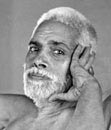
>> Bhagavan Sri Ramana Maharshi <<
December 1879 – April 1950
On very rare occasions throughout the history of mankind, Spiritual giants have appeared to exemplify the Highest Truth, guiding followers by their conduct in every moment of their lives; Bhagavan Sri Ramana Maharshi was such a giant. Unique in our time, He perfectly embodied the ultimate truth of Self-realisation, or complete absorption in the Supreme Itself.
Those who set out upon this quest are fulfilling the true purpose of life itself. This is not an easy path to follow, but be assured that every step taken in pursuit of Self-realisation, accumulates merit that is carried from birth to birth, until that final step is accomplished. This is the testimony of the Sages and doubt should never be allowed to divert you from your course.
Welcome to arunachala-ramana.org, a non-profit website created for the benefit of those who are seriously interested in Advaita and the paths to Self-realisation. This is the more comprehensive sister site to www.ramana-maharshi.org. Please do not forget to bookmark it.
This website is dedicated to Arunachala and the great saints and sages who were attracted by it thoughout the ages, including that of Bhagavan Sri Ramana Maharshi. Visitors to this site are invited to add their own news and comment via the Interactive section of the site.

