SPIRITUAL JOURNEYS, NEWS
Human Rights Day 10 December 2010

Human rights are „rights and freedoms to which all humans are entitled“.Proponents of the concept usually assert that everyone is endowed with certain entitlements merely by reason of being human.Human rights are thus conceived in a universalist and egalitarian fashion. Such entitlements can exist as shared norms of actual human moralities, as justified moral norms or natural rights supported by strong reasons, or as legal rights either at a national level or within international law. Read More: > HERE <
The United Nations Human Rights Council (UNHRC) is an inter-governmental body within the United Nations System. The UNHRC is the successor to the United Nations Commission on Human Rights (UNCHR, herein CHR), and is a subsidiary body of the United Nations General Assembly. The council works closely with the Office of the High Commissioner for Human Rights (OHCHR) and engages the United Nations‘ Special Procedures. Read More > HERE <
The Human Rights Council is an inter-governmental body within the UN system made up of 47 States responsible for strengthening the promotion and protection of human rights around the globe. The Council was created by the UN General Assembly on 15 March 2006 with the main purpose of addressing situations of human rights violations and make recommendations on them.
One year after holding its first meeting, on 18 June 2007, the Council adopted its “Institution-building package” [Word file] providing elements to guide it in its future work. Among the elements is the new Universal Periodic Review mechanism which will assess the human rights situations in all 192 UN Member States. Other features include a new Advisory Committee which serves as the Council’s “think tank” providing it with expertise and advice on thematic human rights issues and the revised Complaints Procedure mechanism which allows individuals and organizations to bring complaints about human rights violations to the attention of the Council. The Human Rights Council also continues to work closely with the UN Special Procedures established by the former Commission on Human Rights and assumed by the Council.
The High Commissioner’s statement is available as a video which will be of special interest to broadcasters and for use at particular events / Video about ordinary human rights defenders from various parts of the world. Human Rights Day, marked annually, is this year dedicated to human rights defenders who battle against discrimination.
Human Rights Day is celebrated annually across the world on 10 December.The date was chosen to honor the United Nations General Assembly’s adoption and proclamation, on 10 December 1948, of the Universal Declaration of Human Rights (UDHR), the first global enunciation of human rights. The formal establishment of Human Rights Day occurred at the 317th Plenary Meeting of the General Assembly on 4 December 1950, when the General Assembly declared resolution 423(V), inviting all member states and any other interested organizations to celebrate the day as they saw fit. Read More: > HERE <
The theme for Human Rights Day 10 December 2010 is human rights defenders who act to end discrimination.
Human rights defenders acting against discrimination, often at great personal risk to both themselves and their families, are being recognized and acclaimed on this day.
Human rights defenders speak out against abuse and violations including discrimination, exclusion, oppression and violence. They advocate justice and seek to protect the victims of human rights violations. They demand accountability for perpetrators and transparency in government action. In so doing, they are often putting at risk their own safety, and that of their families.
Some human rights defenders are famous, but most are not. They are active in every part of the world, working alone and in groups, in local communities, in national politics and internationally.
Human Rights Day 2010 will highlight and promote the achievements of human rights defenders and it will again emphasize the primary role Governments must play in enabling and protecting their role. The Day is also intended to inspire a new generation of defenders to speak up and take action to end discrimination in all of its forms whenever and wherever it is manifested.
The story does not end after 10 December 2010. The focus on the work of human rights defenders will continue through all of 2011.
Visual Designs – We would like to invite you to develop your own initiatives and make use of the visual designs. Read our “Users’ guidelines” (PDF), complete the Form and Waiver of Liability (PDF) and send it to us at: human rightsday@ohchr.org.
International Year of Forests 2011
http://www.un.org/en/events/iyof2011/
http://www.illegal-logging.info
The year 2011 was declared the International Year of Forests by the United Nations to raise awareness and strengthen the sustainable forest management, conservation and sustainable development of all types of forests for the benefit of current and future generations. Forests are an integral part of global sustainable development. According to World Bank estimates, more than 1.6 billion people depend on forests for their livelihoods. The forest product industry is a source of economic growth and employment, with global forest products traded internationally in the order of $270 billion. The UN’s Food and Agriculture Organization (FAO) estimates that every year 130,000 km² of the world’s forests are lost due to deforestation. Conversion to agricultural land, unsustainable harvesting of timber, unsound land management practices, and creation of human settlements are the most common reasons for this loss of forested areas. Read More: >HERE<
Indigenous rights are those rights that exist in recognition of the specific condition of the indigenous peoples. This includes not only the most basic human rights of physical survival and integrity, but also the preservation of their land, language, religion and other elements of cultural heritage that are a part of their existence as a people. This can be used as an expression for advocacy of social organizations or form a part of the national law in establishing the relation between a government and the right of self-determination among the indigenous people living within its borders, or in international law as a protection against violation by actions of governments or groups of private interests. Read More: > HERE <
Welcome to the International Year of Forests, 2011 (Forests 2011) Web site, a global platform to celebrate people’s action to sustainably manage the world’s forests. The United Nations General Assembly declared 2011 as the International Year of Forests to raise awareness on sustainable management, conservation and sustainable development of all types of forests.
Here, you will find information regarding events being organised throughout the International Year as well as interactive web tools and resources to promote dialogue on forests. Tell us how you plan to celebrate “forests for people” during 2011, so that we may showcase your stories and initiatives through this website. www.un.org/en/events/iyof2011
United Nations, New York, 2 November 2010 – Member States of the United Nations have adopted a new 10-year global strategy designed to halt the loss of the world biological diversity, with countries agreeing to draft national implementation plans to safeguard genetic resources within two years. / This video shows how palm oil is threatening Southeast Asia’s tropical peatlands. Due to drainage of the swamps, the peat oxidates and releases huge amounts of CO2 into the atmosphere. For more information, see www.ckpp.org
United Nations Forum on Forests (UNFF) –In October 2000, the Economic and Social Council of the United Nations (ECOSOC), in its Resolution 2000/35 established the United Nations Forum on Forests (UNFF), a subsidiary body with the main objective to promote “… the management, conservation and sustainable development of all types of forests and to strengthen long-term political commitment to this end…”based on the Rio Declaration, the Forest Principles, Chapter 11 of Agenda 21 and the outcome of the IPF/IFF Processes and other key milestones of international forest policy. The Forum has universal membership, and is composed of all Member States of the United Nations and specialized agencies. www.un.org/esa/forests/index.html
The International Indigenous Forum on Biodiversity (IIFB) was formed During the III Conference of the Parties to the Convention on Biological Diversity (COP III) in Buenos Aires, Argentina, in November 1996. The IIFB is a collection of representatives from indigenous governments, indigenous non-governmental organizations and indigenous scholars and activists that rganize around the Convention on Biological Diversity (CBD) and other important international environmental meetings to help coordinate indigenous strategies at these meetings, provide advice to the government parties, and influence the interpretations of government obligations to recognize and respect indigenous rights to the knowledge and resources.
http://iifb.indigenousportal.com/2010/11/01/closing-statement cbd
The CBD is an important international environmental convention, because it contains numerous passages that recognize traditional resource and knowledge rights, the most important of which is Article 8(j).
CBD – UN Convention on Biological Diversity
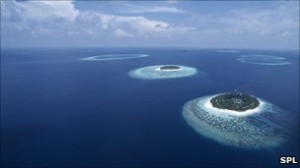
* Small island states are looking at ways to evacuate their entire populations, says UN chief
Biodiversity is the variation of life forms within a given ecosystem, biome, or for the entire Earth. Biodiversity is often used as a measure of the health of biological systems. The biodiversity found on Earth today consists of many millions of distinct biological species, which is the product of nearly 3.5 billion years of evolution. 2010 is the International Year of Biodiversity. READ MORE: > HERE <
The Convention on Biological Diversity (CBD), known informally as the Biodiversity Convention, is an international legally binding treaty. The Convention has three main goals: 1. conservation of biological diversity (or biodiversity);2. sustainable use of its components; and 3. fair and equitable sharing of benefits arising from genetic resources. In other words, its objective is to develop national strategies for the conservation and sustainable use of biological diversity. It is often seen as the key document regarding sustainable development. Read More: >HERE<
The Millennium Development Goals (MDGs) are eight international development goals that all 192 United Nations member states and at least 23 international organizations have agreed to achieve by the year 2015. They include eradicating extreme poverty, reducing child mortality rates, fighting disease epidemics such as AIDS, and developing a global partnership for development. Read More: > HERE <
Bio Diversity, preventing Deadline Life http://www.cbd.int/ – After suffering decades of obscurity, biodiversity, and the importance of saving it, is finally rising to the top of the international agenda. But will political declarations translate into the resources and action that are so urgently needed?
The United Nations General Assembly dedicated a high level summit to biodiversity which gave much-needed political impetus for a sustained global response to the crisis facing the natural world.
IUCN Director General Julia Marton-Lefèvre explains why the meeting of the Convention on Biological Diversity, in Nagoya on 18 October, is so important for the future of our planet. / Millenium Development Goals for 2015 -In the year 2000, 189 leaders from around the world met at the historic Millenium Summit in New York.According to the then Secretary-General of the UN, Kofi Annan, the UNs role for the next millenium will be crucial; making it a focal point for joint efforts in a world that presents worrisome statistics that endanger the perpetuation of generations to come.
The International Union for Conservation of Nature (IUCN) is an international organization dedicated to natural resource conservation. The stated goal of the organization is to help the world find pragmatic solutions to the most pressing environment and development challenges. Read More: > HERE <
IUCN, which helped develop the Convention and plays a key role in its implementation, will be present at the conference, trying to ensure that the latest biodiversity science underpins the decisions taken there and that governments commit to an ambitious, yet realistic plan to halt the loss of biodiversity.
Environmental migrants are people forced to migrate away from their homeland due to sudden or long-term changes to their local environment. When the migration is considered to be forced and not a matter of choice, the term environmental refugee is also used. Additionally, if the causes for the migration are believed to be due to global warming related environmental disasters, the term climate refugee is sometimes used. Read More: > HERE <
The Office of the United Nations High Commissioner for Refugees (UNHCR; www.unhcr.org), also known as The UN Refugee Agency is a United Nations agency mandated to protect and support refugees at the request of a government or the UN itself and assists in their voluntary repatriation, local integration or resettlement to a third country. Its headquarters are in Geneva, Switzerland. The UNHCR has won two Nobel Peace Prizes in 1954 and 1981. Read More: >HERE<
COP 16 Climate Change and Agrar Solutions
Kofi Atta Annan (born 8 April 1938) is a Ghanaian diplomat who served as the seventh Secretary-General of the United Nations from 1 January 1997 to 31 December 2006. Annan and the United Nations were the co-recipients of the 2001 Nobel Peace Prize for his founding the Global AIDS and Health Fund to support developing countries in their struggle to care for their people. Read More: > HERE <
The 2010 United Nations Climate Change Conference is being held in Cancún, Mexico, from 29 November to 10 December 2010.[1] The conference is officially referred to as the 16th session of the Conference of the Parties (COP 16) to the United Nations Framework Convention on Climate Change (UNFCCC) and the 6th session of the Conference of the Parties serving as the meeting of the Parties (CMP 6) to the Kyoto Protocol.In August 2010, Ban Ki-moon stated that he doubts member states will reach a new global agreement to address global warming, but after the Tianjin talks in October Christiana Figueres, executive secretary of the UN Framework Convention on Climate Change (UNFCCC), said, „This week has got us closer to a structured set of decisions that can be agreed in Cancun … This is the greatest societal and economic transformation that the world has ever seen.“ Read More: > HERE <
AGRA www.agra-alliance.org works to achieve a food secure and prosperous Africa through the promotion of rapid, sustainable agricultural growth based on smallholder farmers. Smallholders–the majority women–produce most of Africa’s food, and do so with minimal resources and little government support. AGRA aims to ensure that smallholders have what they need to succeed: good seeds and healthy soils; access to markets, information, financing, storage and transport; and policies that provide them with comprehensive support.
Through developing Africa’s high-potential breadbasket areas, while also boosting farm productivity across more challenging environments, AGRA works to transform smallholder agriculture into a highly productive, efficient, sustainable and competitive system, and do so while protecting the environment.
www.google.com/cop15 Learn about the impacts of our changing climate, and how groups are working to cope with them.
http://www.ienearth.org Established in 1990 within the United States, IEN was formed by grassroots Indigenous peoples and individuals to address environmental and economic justice issues (EJ). IEN’s activities include building the capacity of Indigenous communities and tribal governments to develop mechanisms to protect our sacred sites, land, water, air, natural resources, health of both our people and all living things, and to build economically sustainable communities.IEN accomplishes this by maintaining an… (read more)Mission:In 1991, near the sacred Bear Butte in South Dakota, near 500 Native people came together at the outdoor 2nd Annual IEN Protecting Mother Earth gathering. At this gathering, this Unifying Principle and the Environmental Code of Ethics were written.
Mission Statement – The Indigenous Peoples of the Americas have lived for over 500 years in confrontation with an immigrant society that holds an opposing world view. As a result we are now facing an environmental crisis which threatens the survival of all natural life. In 1991, near the sacred Bear Butte in South Dakota, near 500 Native people came together at the outdoor 2nd Annual IEN Protecting Mother Earth gathering. At this gathering, this Unifying Principle and the Environmental Code of Ethics were written.
Unifying Principles – The Indigenous Peoples of the Americas have lived for over 500 years in confrontation with an immigrant society that holds an opposing world view. As a result we are now facing an environmental crisis which threatens the survival of all natural life. We believe in unified action, sharing of information, and working together with mutual respect. We recognize we must assert our sovereignty and jurisdictional rights through the application of our traditional laws and recognizing our traditional forms of leadership of our indigenous nations. We stand on principles of empowering and supporting each other to take direct, informed action and affect our ability to protect our lands from contamination and exploitation. By attempting to fulfill our responsibility to defend our mother earth we are assuring the survival of our unborn generations.The members of IEN are unified in our recognition that the traditional teachings, lifestyles, spirituality, cultures and leadership of our people as well as the survival of our future generations, are entirely dependent upon our respectful relationship with the natural world and our responsibility to the sacred principles given to us by the creator.
„SNAP-SHOT“ of environmental and economic justice issues in indigenous lands (US-CANADA): 1. Toxic contaminants, agricultural pesticides and other industrial chemicals that disproportionately impact Indigenous peoples, especially subsistence and livestock cultures.2. Inadequate governmental environment and health standards and regulations.3. Clean up of contaminated lands from mining, military, and other industry activities.4. Toxic incinerators and landfills on and near Indigenous lands.5. Inadequate solid and hazardous waste and wastewater management capacity of Indigenous communities and tribes.6. Unsustainable mining and oil development on and near Indigenous lands.7. National energy policies at the expense of the rights of Indigenous peoples.8. Climate change and global warming.9. Coal mining and coal-fired power plants resulting in mercury contamination, water depletion, destruction of sacred sites and environmental degradation.10. Uranium mining developments and struggles to obtain victim compensation to Indigenous uranium miners, millers, processors and Downwinders of past nuclear testing experiments.11. Nuclear waste dumping in Indigenous lands.12. Deforestation.13. Water rights, water quantity and privatization of water.14. Economic globalization putting stress on Indigenous peoples and local ecosystems.15. Border justice, trade agreements and transboundary waste and contamination along the US/Mexico/Canada borders and other Indigenous lands worldwide.16. Failure of the US government to fulfill its mandated responsibility to provide funding to tribes and Alaska villages to develop and implement environmental protection infrastructures.17. Backlash from US state governments giving in to the lobbying pressures of industry and corporations against the right of tribes to implement their own water and air quality standards.18. Protection of sacred, historical and cultural significant areas.19. Biological diversity and endangered species.20. Genetically modified organisms impacting the environment, traditional plants and seeds and intellectual rights of Indigenous peoples – bio-colonialism.21. Economic blackmail and lack of sustainable economic and community development resources.22. Just transition of workers and communities impacted by industry on and near Indigenous lands.23. Urban sprawl and growth on and near Indigenous lands.24. Failure of colonial governments and their programs to adequately consult with or address environmental protection, natural resource conservation, environmental health, and sacred/historical site issues affecting traditional Indigenous lands and its Indigenous peoples.25. De-colonization and symptoms of internalized oppression/racism/tribalism.26. And many others ..
Compiled by the INDIGENOUS ENVIRONMENTAL NETWORK
http://en.wikipedia.org/wiki/Kyoto_Protocol
http://en.wikipedia.org/wiki/350.org , www.350.org
- Watch the UN Climate Talks in Cancun, Mexico – LIVE www.oneclimate.net
- http://timesofindia.indiatimes.com/home/environment/global-warming
- http://www.environmentallawresource.com , http://earthjournalism.net
- http://www.indigenousclimate.org , http://www.hecac.org
- http://www.earthpeoples.org/CLIMATECHANGE/Ind.PeoplesGuide .pdf
- Articles on CLIMATE CHANGE
- Meet Indigenous Environmental Network, friends, fans at fb
- Meet Eco Walk the Talk, friends, fans at fb
- Meet International Forum on Globalization, studies, friends, fans at fb
- Meet COP 16, Cancun, studies, friends, fans at fb
- Meet 100 Million Voices for a Real Climate Deal in Mexico 2010 at fb
- Peace, Paix, 和平, Salam, Shalom, Pace, Mir, Friede, Paz, Shanti, Heiwa…
Monks lead march to save Himalayas
The Drukpa Kargyu school (Dzongkha: or simply Drukpa school, is a branch of the Kagyu school of Tibetan Buddhism. It is considered to be one of the Sarma or „new“ schools of Tibetan Buddhism. Within the Drukpa Lineage, there are further sub-schools, most notably the eastern Kham tradition and middle Drukpa school which prospered in Ladakh and surrounding areas. In Bhutan the Drukpa Lineage is the dominant school and state religion. Read More: > HERE <
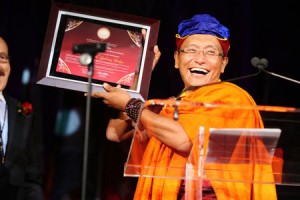
www.live2love.org On 19th September 2010, His Holiness the Gyalwang Drukpa, founder of Live To Love, a new world-wide charity specializing in building the world’s most advanced eco-friendly schools and teaching young women leadership skills, received the United Nations‘ Millennium Development Goal (MDG) Award for those efforts.At a star-studded event headlined by American actress Christie Brinkley, Ghanian-American hip-hop artist, Blitz the Ambassador American saxophonist, Dave Koz and joined by heads of state and leading dignitaries gathered to honor governments and individuals making substantial contributions toward fulfilling the UN’s Millennium Development Goals, His Holiness the Gyalwang Drukpa was feted for Live To Love’s efforts to “create compassion into action.”The annual MDG Awards provide a platform to raise awareness about the critical work of the United Nations and honor and celebrate the exceptional work of select national governments and individuals contributing to the achievement of the MDGs around the world.
Guru Rinpoche highlighted many times in his teachings and biography that so long as the descendents of the famous and great Tibetan King Trisong Deutsan is there, his blessing will always be there. As we all know Trisong Deutsan is the direct emanation of Manjushri, the Bodhisattva of Great Wisdom. These days, our beloved king of Ladakh, Trinlay Namgyal, has not been well, and he is definitely a genuine descendent of Trisong Deutsan. This is the reason why I went to Ladakh for a day trip and stayed there only for an hour.
Out of respect and care, I went to Ladakh to visit the king who has been my good friend for a very long time. I had never been to Ladakh for such a short trip. Even if I wanted to stay, I had no choice, there is already the Sikkim Eco Pad Yatra program starting soon. I am very happy that I saw him, I hope he was happy to see him. He was very seriously sick inside, but he has no pain. I am writing not only because he is a dear friend of mine, but I believe in Guru Rinpoche’s words and I know for sure that the king definitely carries the blood of Trisong Deutsan and therefore the blessing of Guru Rinpoche.
A short video showing the walking pilgrimage journey from Lahaul to Ladakh (from 23rd May to 1st July 2009) undertaken by His Holiness the Gyalwang Drukpa, His Eminence Kyabje Khamtrul Rinpoche, several Rinpoches, monks and nuns and lay followers – about 750 humans and 320 mules. /Join His Holiness the Gyalwang Drukpa and 750 nuns, monks, & friends of the Drukpa Lineage as they trek 400 kilometers across the Himalayas in a grassroots movement to elevate environmental awareness, promote education for women, and celebrate the heritage of a culture in peril. www.walking.drukpa.com OPTION C (22nd-28th December 2010) & OPTION D (24th-28th December 2010) ARE NOW AVAILABLE.
Now, I am on the way preparing for the Sikkim Eco Pad Yatra and catching up with my busy schedule. Let’s see how it will go. It seems that it’s being arranged quite well, due to help from my friends and students, especially Drukpa Publications whom I asked to arrange this through my own office. Just as our last pad yatra in Ladakh last year, this time also I took the opportunity to ask Rigzin Namgyal to arrange this for us. I know that Rigzin Namgyal along with Lotus’s help is trying his best to make all of us very comfortable and successful. Maybe next time I should be fair enough not to demand him that badly in making these difficult arrangements, such as in locations unfamiliar for him, but this time I have to apologise that I did that.
For the forthcoming Sikkim Eco Pad Yatra, I have 2 very special guests who will be joining with us, that is Gyalwa Lorepa and Drukpa Yongdzin Rinpoche. I am sure that all of you will see all the updates at the Drukpa Facebook or from different channels. I will leave you here until I return from the Pad Yatra. Take care and let’s move on and get ready for the Pad Yatra and a new year.
- http://www.khoryug.com
- http://ladakh.drukpa.com/monasteries.htm
- http://economictimes.indiatimes.com/environment/
- Article on UN Millenium Goals
- Meet Drukpa Order, studies, friends, fans at fb
- Meet Mind & Life Institute, studies, friends, fans at fb
- Meet Ecotourism, studies, friends, fans at fb
- Meet Ecobuddhism, studies, friends, fans at fb
Traditional Food, Medicine & Biodiversity
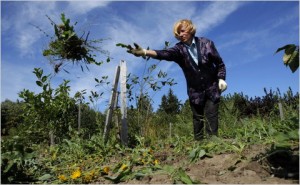
The N.I. Vavilov Institute of Plant Industry
Nikolai Ivanovich Vavilov (Russian: Николай Иванович Вавилов) was a prominent Russian and Soviet botanist and geneticist best known for having identified the centres of origin of cultivated plants. He devoted his life to the study and improvement of wheat, corn, and other cereal crops that sustain the global population. While developing his theory on the centres of origin of cultivated plants, Vavilov organized a series of botanical-agronomic expeditions, collected seeds from every corner of the globe, and created in Leningrad the world’s largest collection of plant seeds. Read More: > HERE <
The Convention on Biological Diversity (CBD), known informally as the Biodiversity Convention, is an international legally binding treaty. The Convention has three main goals: 1. conservation of biological diversity (or biodiversity);2. sustainable use of its components; and 3. fair and equitable sharing of benefits arising from genetic resources. In other words, its objective is to develop national strategies for the conservation and sustainable use of biological diversity. It is often seen as the key document regarding sustainable development. Read More: >HERE<
Ensuring that the genetic diversity of the world’s food crops is preserved for future generations is an important contribution toward the reduction of hunger and poverty in developing countries. This is where the greatest plant diversity originates and where the need for food security and the further development of agriculture is most urgent.
About VIR: “The scientific network of VIR includes the institute’s headquarters with 9 plant resources departments, 13 fundamental research laboratories, and 12 experiment stations in different geographic zones of Russia. Its chief activities are Plant Genetics Resources (PGR) collections, conservation and study.”
This recent news item was originally reported on Science Magazine’s Science Insider news feed. Earlier reportage on this story came from The Scientist blog. Top Photo: Alaska wild “berries” from the Innoko National Wildlife Refuge; U.S. Fish and Wildlife Service employee (public domain). Bottom Photo: VIR, Pavlosk Exp. Station http://www.greendump.net
Last week, we described the plight of the Russian Pavlovsk Experimental Station: Plans for a housing complex threaten some 5,000 rare plants, including varieties found nowhere else on the planet. A court judgment last week meant that only the president or prime minister could save the plants, which scientists said would take years to relocate. Now government telegrams and a presidential tweet hint that the plants might have a chance. http://blogs.discovermagazine.com
Russia Defers Razing of Seed Repository – modest reprieve for a seed bank that is home to the world’s largest collection of European fruits and berries. http://green.blogs.nytimes.com
The Vavilov Institute in Russia is the oldest seed bank in the world with a collection of over 325,000 samples of seed. Video from The Vavilov Institute from The Seed Hunter on National Geographic Channel http://natgeotv.com
Vavilov Institut Alblinse, Russian Housing Plan Threatens Seed Bank
The Institute of Plant Industry http://www.vir.nw.ru/ was established in 1921. Nikolai Vavilov was the head of this institute from 1924 to 1936 and had, and still has, the world’s largest collection of plant seeds. During the early 1930s, he became the target of the Lysenkoist debate and was exiled. In 2010 the plant collection at the Pavlovsk Experimental Station was to be destroyed to make way for luxury housing
IRRI http://irri.org Rice Research is a nonprofit research and education center established to reduce poverty and hunger, improve the health of rice farmers and consumers, and ensure environmental sustainability
Navdanya http://www.navdanya.org is a network of seed keepers and organic producers spread across 16 states in India.Navdanya has helped set up 54 community seed banks across the country, trained over 500,000 farmers in seed sovereignty, food sovereignty and sustainable agriculture over the past two decades, and helped setup the largest direct marketing, fair trade organic network in the country.
ARCHE NOAH: http://www.arche-noah.at Wir sehen unsere Arbeit als Antwort auf die restriktive globale Saatgutpolitik. Die Vielfalt an Kulturpflanzen ist Lebensgrundlage für kommenden Generationen. Und Lebensqualität für uns alle ! Wir sind ein Verein, der sich seit fast 20 Jahren für den Erhalt alter Kulturpflanzen einsetzt, mit über 8.000 Mitgliedern, Förderern und aktiven ErhalterInnen.
Svalbard Global Seed Vault – Cultural plants for the future. http://www.regjeringen.no Since the climate conditions change so rapidly, it is extremely important to ensure the genetic diversity of all the cultural plants of the world. In these genes, we will find the necessary qualities to make effective cultural plants in the future. This is absolutely necessary to secure a satisfactory food supply for the global population. Within the next 40 years, the world’s food production must be doubled, says the Norwegian minister of agriculture and food, Lars Peder Brekk.
Was wären die Schwaben ohne ihre Linsen? Trotzdem stellten Ende der 50er Jahre die letzten Landwirte “auf der Alb” den Anbau von Linsen ein, da die Importe zu billig waren und den Verbrauchern egal war, woher ihre Linsen kamen. Im Pflanzenbau herrschte damals der Zeitgeist “höher, schneller und immer mehr”. Hauptsache, der Ertrag von Weizen, Mais und Kartoffeln stieg. Egal, wie viel “Chemie” dazu auf den Acker kam. Diese Ideologie war den hiesigen Bio-Bauern schon immer ein Dorn im Auge.
Außerdem vermissten sie ihre Heimatfrucht aus der Kindheit: “Die alten Bauern bei uns in der Gegend haben uns erzählt, wie sie noch Linsen angebaut haben, zusammen mit Gerste ( GERSTE IM AYURVEDA ) und Hafer, als Stützfrucht für die zarten Pflanzen. Beim Linsen essen haben wir davon geträumt, wieder Alb-Linsen auszusäen”, erinnert sich Woldemar Mammel. Der Bioland-Bauer aus Lauterach auf der Alb baut bereits seit den 80er Jahren wieder Linsen an und begeisterte auch andere für seine Idee. Mittlerweile machen elf Bäuerinnen und Bauern in der “Öko-Erzeugergemeinschaft «Alb-Leisa»” mit und bewirtschaften 30 Hektar mit Albleisen.
Unterstützung bekommen sie von anderen Verfechtern guter Esskultur: Vor zwei Jahren hat Slow Food Deutschland die Alb-Linse in die “Arche des Geschmacks” aufgenommen, um dieses traditionelle landwirtschaftliche Erzeugnis der Schwäbischen Alb vor dem Vergessen zu retten. Die Sache hat nur einen Haken: Die original schwäbischen Alb-Linsen waren bis vor kurzem unauffindbar und so mussten sich die Bio-Bauern mit französischen und italienischen Sorten behelfen. “Niemand hatte es für nötig gehalten, diese einzigartigen, im Bundessortenregister eingetragenen Linsensorten aufzubewahren”, beklagt Mammel.
Doch die verschollenen Linsen berührten auch andere schwäbische Herzen: 2006 machten sich unabhängig voneinander der private Pflanzenzüchter Klaus Lang und Klaus Amler von der Stuttgarter Agentur Ökonsult auf die Suche. Beide werden ein Jahr später in Russland fündig! Das Wawilow-Institut in St. Petersburg, das seit 1925 für die Genvielfalt der Nutzpflanzen kämpft, hat die zwei Sorten aufbewahrt.
RICE: Rice is first mentioned in the Yajur Veda (c. 1500-800 BC) and then is frequently referred to in Sanskrit texts. Today, the majority of all rice produced comes from India, China, Japan, Indonesia, Thailand, Burma, and Bangladesh.
Asian farmers still account for 92-percent of the world’s total rice production. Rice is grown in all parts of India. Genetics shows that rice was first domesticated in the region of the Yangtze River Valley. Read More: > HERE <
- www.pranapositive.com/shm/Save Herbal Medicine
- Articles on Biodiversity
- IRRI Rice Research/Climate Change /Bioversity/Eco Crises
- www.intlcss.org International Crop Science Society
- ARCHE NOAH, Erhaltung/Verbreitung Kulturpflanzenvielfalt
- Meet UN International Day 2010 of Biodiversity at fb
- Meet Global Biodiversity Protection at fb
- www.ienearth.org Indigenous Environmental Network at fb
- www.navdanya.org studies friends fans at fb
- www.ecobuddhism, friends and studies at fb
- Greenpeace China 绿色和平 綠色和平 at fb
- Meet SLOW FOOD , friends, pages at fb
- Meet TIBETAN TSAMPA Group and Friends at fb
- http://en.wikipedia.org/wiki/Farmers’_suicides_in_India
- http://en.wikipedia.org/wiki/Europ.Directive Trad.Herbal_Med.Products
- Meet COP 16 UN Conference, friends, studies, fans at fb
- Meet International Year of Biodiversity, friends, fans at fb
- Meet NaturalNews.com at facebook
NaturalNews.com is an independent news resource that covers the natural health and wellness topics that empower individuals to make positive changes in their personal health. NaturalNews offers uncensored news that allows for healthier choice.
New York College & World Found. of TCM
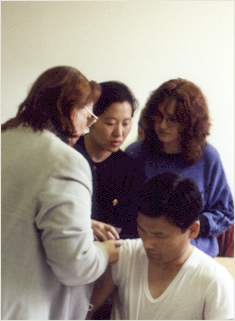
Traditional Chinese Medicine, also known as TCM, includes a range of traditional medicine practices originating in China. Although well accepted in the mainstream of medical care throughout East Asia, it is considered an alternative medical system in much of the Western world. TCM practices include such treatments as Chinese herbal medicine, acupuncture, dietary therapy, and both Tui na and Shiatsu massage. Qigong and Taijiquan are also closely associated with TCM.
Much of the philosophy of traditional Chinese medicine derives from the same philosophy that informs Taoist and Buddhist thought, and reflects the classical Chinese belief that the life and activity of individual human beings have an intimate relationship with the environment on all levels. Read More: > HERE <
New York College of Traditional Chinese Medicine (NYCTCM) by Dr. Chi Chow was started in 1996. Dr. Chow felt that the New York City area had need for a school which taught Traditional Chinese Medicine (TCM) much as it is taught in China, and which at the same time could help students relate this approach to Western medical practice. Her vision included small classes, master-apprentice type teaching relationships in clinic, and the flexibility to accommodate students’ schedules by offering classes mostly on weekends. From its first trimester in Spring of 1996, NYCTCM has embodied this approach.
The mission of the New York College of Traditional Chinese Medicine is to prepare compassionate practitioners who are solidly grounded in the tradition of Chinese medicine, who are able to integrate this tradition within the Western health care system, and who have a spirit of innovation that enables them to adapt a 4000-year-old medicine to 21st-century needs.
NYCTCM Core Values: COMPASSION – In addition to knowledge of TCM theory and mastery of techniques necessary to apply that theory, NYCTCM graduates will bring the emotional qualities of empathy, respect and compassion to all their treatment sessions. TRADITION – NYCTCM graduates will have a thorough understanding of and deep respect for traditional Chinese principles of treatment, including their cultural and philosophical context. INTEGRATION – NYCTCM graduates will have a fundamental understanding of the Western medical approach, and will be able to integrate their practice of TCM within the Western health care system. INNOVATION – NYCTCM graduates will have a spirit of innovation that enables them to adapt a 4000-year-old medicine to 21st-century needs.
The Traditional Chinese Medicine World Foundation is a not-for-profit organization dedicated to educating the public and health-care practitioners about classical traditional Chinese medicine (TCM) and natural self-healing. Through our educational programs, publications, and practitioner resources, we hope to advance the practice and integration of authentic traditional Chinese medicine in Western society.
The TCM World Foundation’s objectives include:* To serve as a source of information on the philosophy, principles, theories, modalities, and practice of authentic TCM and the classical Chinese internal martial arts, such as Qigong and Taiji.* To support the practice of authentic TCM to widen health-care options for the public.* To support an expanded concept of health and healing in contemporary medicine.* To educate individuals on the steps they can take in prevention and self-healing.* To foster a dialogue between Western and Eastern medical schools and communities in the US to improve the quality of training for practitioners of TCM.* To facilitate forums for interdisciplinary collaborations.* To foster balance and harmony in the individual, the community, society, and the world as a whole.
The Foundation’s educational efforts focus on the full system of TCM, which includes: herbal therapy, acupuncture, acupressure, internal martial arts, the prescription of foods for healing, and Chinese psychology. The educational components of the Foundation are geared toward the general public and health-care professionals as well as organizations from both the mainstream and complementary and alternative medicine communities.
Nan Lu, OMD, LAc, is the founding director of the Traditional Chinese Medicine World Foundation and its sister organization, the Tao of Healing. Dr. Lu holds a doctorate from Hubei College of Traditional Chinese Medcine, Hubei, China, and is a New York State-licensed acupuncturist. Classically and university-trained, Dr. Lu is a master herbalist as well as an internationally recognized Taiji expert and Qigong master and the best-selling author of three TCM books published by Harper Collins.
His continuing educational efforts also include the following web sites: www.tcmworld.org, www.tcmconference.org, www.breastcancer.com. http://www.youtube.com/user/masternanlu
Possessing a gift of cross-cultural communication, Dr. Lu lectures internationally and frequently partners with doctors of Western medicine using a preventive and complementary approach. His specialties include women’s health, cancer and immune system disorders and stress management.
Build Hope – Sivananda Sevashram
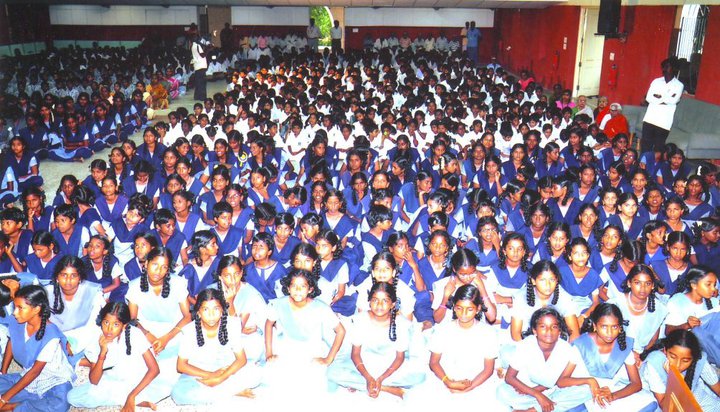
SERVE, LOVE, GIVE, PURIFY, MEDITATE, REALISE. So Says Sri Swami Sivananda Saraswati Maharaj
Swami Sivananda Saraswati (September 8, 1887—July 14, 1963) was a Hindu spiritual teacher and a well known proponent of Yoga and Vedanta. Sivananda was born Kuppuswami in Pattamadai, in the Tirunelveli district of Tamil Nadu. He studied medicine and served in Malaya as a physician for several years before taking up monasticism. He lived most of the later part of his life near Muni Ki Reti, Rishikesh. He is the founder of The Divine Life Society (1936), Yoga-Vedanta Forest Academy (1948) and author of over 200 books on yoga, vedanta and a variety of other subjects. He established Sivananda Ashram, the location of the headquarters of The Divine Life Society (DLS), on the bank of the Ganges at Shivanandanagar, at a distance of 3 kilometres from Rishikesh.
Sivananda Yoga, the yoga form propagated by him, are now spread in many parts of the world through Sivananda Yoga Vedanta Centres, but these centres are not affiliated with Swami Sivananda’s original ashrams which are run by the Divine Life Society. Read More: > HERE <
His Holiness Swami Sivananda was born in Pathamadai in Thirunelveli district, South India. Ever since his childhood, His Holiness was totally devoted to serving others. He worked very hard and graduated in Medicine. As a doctor he earned money but could not obtain peace of mind. He realized that earning a lot of money does not mean earning peace and happiness. Instead, spiritualism alone can help one attain MUKTHI or MOKSHA. His mind was in search of peace and was in a quest for the ultimate purpose of being born in this world. He felt that everyone must have a goal in life and one must lead one’s life with purpose and meaning.
Swami Sivananda proceeded to Rishikesh in North India, where he realized his goal while sitting on the banks of Ganges. He advocated non-violence, truth and worship. Many were impressed by his simplicity and teachings. He gathered a lot of followers and in due course, a mission was started in a small hut which today proudly stands as SWAMI SIVANANDA SARASWATHI SEVASHRAM at Rishikesh. His teachings were simple and he saw God as Omnipotent. He advocated the principle that „ONE CAN FIND GOD IN HIS/HER OWN HEART BY BEING HONEST AND LEADING A SIMPLE LIFE“. He believed the teachings of the Quran, Bhagavath Gita and Bible to be the same. He also believed that there was no need for one to go in search of God, as one can find God in their own hearts by not being selfish, but by making sacrifices for others. Many devotees all around the world were fascinated by his teachings and started several missions in Yoga, Siddha and other spiritual awakenings.The late founders of Sivananda Ashram, Sri S. V. Iyer and Dr. V. Mangalam, started this organization after being enlightened by Swamiji that the only real happiness a human being could find was by serving others.
We hope Swamiji’s teachings inspire and motivate all of us to do what we can to help others lead a better life.
Shri. S. V. Iyer and Dr. V. Mangalam, an elderly couple, started Sivananda Saraswathi Sevashram in 1945 with just 3 kids and with the blessings of Swami Sivananda of Rishikesh. More popularly known as „Sivananda Ashram/Orphanage/Gurukulam“, the organization has grown to be a very well known and well recognized social institution in the country today.
We are a „National Awardee“ institution recognized by the Government of India in 1983.
Sivananda Saraswathi Sevashram is a non-profit organization with the primary objective of protecting orphans, destitute women, the physically handicapped, AIDS-affected children, and the elderly.
With the experience of more than 60 years of recorded services to thousands of poor orphans, Sivananda Orphanage effectively helps transform/grow these orphans to productive citizens. We not only provide food, education and shelter, but also instill character and morals to help them grow, learn and eventually become independent.
Many, including former Prime Minister of India, Shri Pandit Jawaharlal Nehru have visited our ashram and witnessed our committed work. We currently look after 300 children and 80 elderly, all of whom are accepted and cared for with love and affection.
Burma Schools, Medicine, Sound & Travel
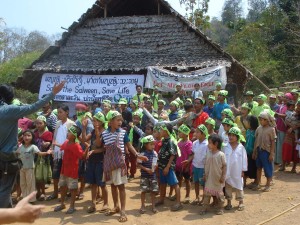
Karen children sing in honor of rivers: www.internationalrivers.org
BURMESE MIGRANT EDUCATION COMITEE
Burma, officially the Union of Myanmar, is the largest country by geographical area in Indochina (mainland Southeast Asia). The country is bordered by China on the north-east, Laos on the east, Thailand on the south-east, Bangladesh on the west, India on the north-west and the Bay of Bengal to the south-west with the Andaman Sea defining its southern periphery. One-third of Burma’s total perimeter, 1,930 kilometres (1,199 mi), forms an uninterrupted coastline. Read More: > HERE <
PRISONED NOBEL LAUREATES: Aung San Suu Kyi , born 19 June 1945) is a Burmese opposition politician and a former General Secretary of the National League for Democracy. She has remained under house arrest in Myanmar for almost 14 out of the past 20 years. Aung San Suu Kyi was the recipient of the Rafto Prize and the Sakharov Prize for Freedom of Thought in 1990 and the Nobel Peace Prize in 1991. In 1992 she was awarded the Jawaharlal Nehru Award for International Understanding by the Government of India. Read More: > Here <
Liu Xiaobo (pronunciation: [ljǒʊ̯ ɕjɑ̀ʊ̯pɔ́]; born 28 December 1955) is a Chinese literary critic, professor, and human rights activist who called for democratic reforms and the end of one-party rule in China. He is currently incarcerated as a political prisoner in China. During his 4th prison term, he was awarded the 2010 Nobel Peace Prize, for „his long and non-violent struggle for fundamental human rights in China. Read More: > HERE <
The Karen Teacher Working Group (KTWG) is a local Karen organization attempting to promote education throughout Karen State, Burma despite almost 60 years of Burma Army oppression.
You can find regularly updated news about Karen communities in refugee camps in Thailand and in internally displaced communities throughout Karen State, Burma – as well as news about schools in those communities. You can also find reports, newsletters, Karen fonts, and other resources on our site. Donations for Karen State schools may also be made online or by contacting us. For over half a century, civil war in Burma has uprooted many Ethnic, Indigenous communities. The Burmese military regime (SPDC) have focused their military offensives upon Ethnic groups living in the border areas of Burma . Numerous Ethnic Peoples have fled Burma to escape forced labour, re-location, rape, murder, theft and many other human rights abuses.
The Karen are one of the Ethnic groups from Burma . There are over 120,000 Karen living in refugee camps in Thailand . The majority of Karen live in Karen State, Burma where they continue to suffer greatly at the hands of the Burmese military regime (SPDC). There are over 100,000 internally displaced Karen persons living in Karen State, Burma.
AUNG SAN SUU KYI – Nobel Peace Prize Winner on Non Violence
Nobel Peace prize winners (Archbishop Desmond Tutu, The Dalai Lama, Shirin Ebadi, Adolfo Pérez Esquivel, Mairead Corrigan, Rigoberta Menchú, Prof. Elie Wiesel, U.S. President Barack Obama, Betty Williams, Jody Williams and former U.S. President Jimmy Carter) have called for the rulers of Burma to release Suu Kyi „create the necessary conditions for a genuine dialogue with Daw Aung San Suu Kyi and all concerned parties and ethnic groups in order to achieve an inclusive national reconciliation with the direct support of the United Nations.“
The Mae Tao Clinic (MTC), founded and directed by Dr. Cynthia Maung, provides free health care for refugees, migrant workers, and other individuals who cross the border from Burma to Thailand. People of all ethnicities and religions are welcome at the Clinic. Its origins go back to the student pro-democracy movement in Burma in 1988 and the brutal repression by the Burmese regime of that movement. The fleeing students who needed medical attention were attended in a small house in Mae Sot. Located on the border in Mae Sot, people of all ethnicities and religions are welcome at the Clinic.
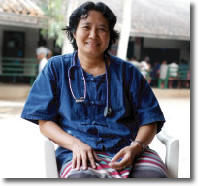
Since 1989 the Mae Tao Clinic has grown, from that one small house to a large complex of simple buildings that provide a wide variety of health services to different groups of people. Today it serves a target population of approximately 150,000 on the Thai-Burma border. Exact numbers are hard to calculate because of the fluidity of the population. About 50% of those who come to MTC for medical attention are migrant workers in the Mae Sot area; the other 50% travel cross-border from Burma for care.
Mae Tao Clinic Objectives: To provide health services for displaced Burmese populations along the Thailand-Burma border, initial training of health workers and subsequent corollary medical education, strengthen health information systems along the border, improve health, knowledge, attitudes, and practices within local Burmese populations, promote collaboration among local ethnic health organizations, strengthen networking and partnering with international health professionals and institutions.
The Nobel Women’s Initiative was established in 2006 by sister Nobel Peace Laureates Jody Williams, Shirin Ebadi, Wangari Maathai, Rigoberta Menchú Tum, Betty Williams and Mairead Corrigan Maguire. We six women — representing North and South America, Europe, the Middle East and Africa — decided to bring together our extraordinary experiences in a united effort for peace with justice and equality. Only 12 women in its more than 100 year history have been recognized with the Nobel Peace Prize. The Nobel Peace Prize is a great honor, but it is also a great responsibility. It is this sense of responsibility that compelled us to create the Nobel Women’s Initiative to help strengthen work being done in support of women’s rights around the world – work often carried out in the shadows with little recognition.
www.tutu.org Archbishop Tutu´s Birthday wishes to Aung San Suu Kyi
We believe peace is much more than the absence of armed conflict. Peace is the commitment to equality and justice; a democratic world free of physical, economic, cultural, political, religious, sexual and environmental violence and the constant threat of these forms of violence against women indeed against all of humanity.
The Vision of the Nobel Women’s Initiative is a world transformed, a nonviolent world of security, equality and well-being for all. It is the heartfelt mission of the Nobel Women’s Initiative to work together as women Nobel Peace Prize Laureates to use the visibility and prestige of the Nobel prize to promote, spotlight, and amplify the work of women’s rights activists, researchers, and organizations worldwide addressing the root causes of violence, in a way that strengthens and expands the global movement to advance nonviolence, peace, justice and equality. We accomplish this mission through three main strategies: convening, shaping the conversation, and spotlighting and promoting.
- www.nobelwomensinitiative.org
- Meet Free Liu Xiaobo, friends, fans at facebook <
- Meet International Rivers, friends, fans at facebook <
- Meet COP16, friends, fans, at facebook <
3rd Annual Atlanta Tibetan Festival
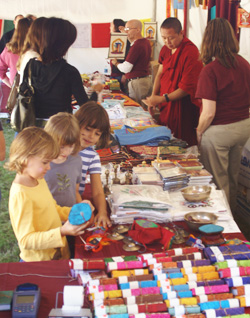
Drepung Monastery (wylie: ‚bras spungs dgon),(literally “Rice Heap” monastery), located at the foot of Mount Gephel, is one of the „great three“ Gelukpa university monasteries of Tibet. The other two are Ganden and Sera. Drepung is the largest of all Tibetan monasteries and is located on the Gambo Utse mountain, 5 kilometers from the western suburb of Lhasa. Freddie Spencer Chapman reported, after his 1936-37 trip to Tibet, that Drepung was at that time the largest monastery in the world, and housed 7,700 monks, „but sometimes as many as 10,000 monks.“ Read More: > Here <
The Gelug or Gelug-pa (or dGe Lugs Pa, dge-lugs-pa, or Dgelugspa), also known as the Yellow Hat sect, is a school of Buddhism founded by Tsongkhapa (1357–1419), a philosopher and Tibetan religious leader. The first monastery he established was at Ganden, and to this day the Ganden Tripa is the nominal head of the school, though its most influential figure is the Dalai Lama. Read more: > HERE <
Emory University is a private research university located in the metropolitan Atlanta area of Druid Hills, Georgia. The university was founded as Emory College in 1836 in Oxford, Georgia by a small group of Methodists and was named in honor of John Emory, a well-known Methodist bishop. Read More: > HERE <
Since His Holiness the Dalai Lama blessed our center in 2007, Drepung Loseling has been working towards completing its vision of creating a “Little Tibet” in Atlanta. Last year’s Tibetan Festival was voted by the Atlanta Journal Constitution as “The Top Thing to do”. Hundreds of visitors have enjoyed the last two festivals and we promise this year’s program will be just as fun.
Bring your family and friends to this special celebration of Tibetan culture. Activities include meditation, Tibetan food, music, dance, games, a Tibetan Bazaar, children’s arts and crafts, door prizes, a raffle and a live performance and workshop presented by the monks of the Mystical Arts of Tibet.
3rd Annual Atlanta Tibetan Festival
Saturday, November 6, 2010 – 10 am to 4 pm
Come and join us for our annual Tibetan Festival. There will be Tibetan food, music and dance, a Tibetan market along with guided meditation and games for the children.
The Mission of Drepung Loseling – Following the legacy of Drepung Loseling Monastery, India, and with the patronage of His Holiness the Dalai Lama, Drepung Loseling is dedicated to the study and preservation of the Tibetan Buddhist tradition of wisdom and compassion. A center for the cultivation of both heart and intellect, it provides a sanctuary for the nurturance of inner peace and kindness, community understanding, and global healing.
In implementing this vision, Drepung Loseling has two main objectives: To contribute to North American culture by providing theoretical knowledge and practical training in Tibetan Buddhist scholarly traditions for Western students, scholars and the general public; and To help preserve the endangered Tibetan culture, which today leads a fragile existence in the exiled refugee communities in India and Nepal.
Sponsor A Monk – The Drepung Loseling Educational Fund was established in 1988 to preserve traditional Tibetan culture by sponsoring a monk in training at Drepung Loseling.
Over half of our population is comprised of recent refugees whose parents remain in Chinese occupied Tibet; therefore, they cannot provide them with support. We also have a number of young monks who are orphans.
The Drepung Loseling Educational Fund was established in 1988 to preserve traditional Tibetan culture by sponsoring a monk in training at Drepung Loseling. Conditions in the Tibetan refugee camps in India are basic, and the average family is poor.
Young monks born in India have little parental support, and depend almost entirely upon the production of our small farm. Over half of our population is comprised of recent refugees whose parents remain in Chinese occupied Tibet; therefore, they cannot provide them with support. We also have a number of young monks who are orphans.
The Monastery accepts all sincere candidates regardless of their financial situation and must support them by means of the proceeds of the same small parcel of land provided to the original 216 Loseling refugee monks. The Fund helps provide for the basic needs of food, health care and education for these monks.
His Holiness formally accepts professorship: His Holiness the XIV Dalai Lama serves as Presidential Distinguished Professor, the first university appointment accepted by the 1989 Nobel Peace Laureate and leader of the Tibetan people. This appointment gives students unique access to His Holiness, his teachings and his insights. The Emory-Tibet Partnership raises awareness of Emory University as a leading center of study of Tibetan philosophy and religion in the West with both Western-trained and traditionally trained scholars.
The Affiliation with Emory University – The May 1998 visit of His Holiness the Dalai Lama marked the historic culmination of three years of dialogue and planning. While visiting Emory University in 1995, he was approached by a faculty delegation to discuss the prospects of an affiliation between Drepung Loseling Monastery and Emory University. In response to his positive interest, the affiliation process was initiated. During these discussions it was decided that the best infrastructure for this arrangement would be a direct affiliation of Emory University with Drepung Loseling Monastery in India, as well as with Drepung Loseling, Drepung’s North American seat. This would allow Drepung Loseling to design various programs both in North America and in India for academic accreditation through Emory. With this precedent-setting partnership, Drepung Loseling provides a unique link between the resources and faculty of a major American university and principal scholastic Tibetan monastery-in-exile in India.
Benares Gharana Music Concerts Austria
Varanasi (Sanskrit: वाराणसी VÄ�rÄ�ṇasÄ«)is a city situated on the banks of the River Ganges in the Indian state of Uttar Pradesh, 320 kilometres (199 mi) southeast of state capital Lucknow. It is regarded as a holy city by Buddhists and Jains, and is the holiest place in the world in Hinduism (and center of earth in Hindu Cosmology). It is one of the oldest continuously inhabited cities in the world and probably the oldest of India. The Kashi Naresh (Maharaja of Kashi) is the chief cultural patron of Varanasi and an essential part of all religious celebrations.The culture of Varanasi is closely associated with the River Ganges and the river’s religious importance. The city has been a cultural and religious centre in North India for several thousand years.
The Benares Gharana form of Indian classical music developed in Varanasi, and many prominent Indian philosophers, poets, writers, and musicians resided or reside in Varanasi, including Kabir, Ravidas Their Guru Swami Ramanand, Trailanga Swami, Munshi Premchand, Jaishankar Prasad, Acharya Shukla, Ravi Shankar, Girija Devi, Hariprasad Chaurasia, and Bismillah Khan. Tulsidas wrote Ramacharitamanas here, and Gautama Buddha gave his first sermon at Sarnath located near Varanasi (Kashi). Varanasi is home to four universities: Banaras Hindu University, Mahatma Gandhi Kashi Vidyapeeth, Central Institute of Higher Tibetan Studies and Sampurnanand Sanskrit University. Residents mainly speak Hindi and Kashika Bhojpuri, which is closely related to the Hindi language. People often refer to Varanasi as „the city of temples“, „the holy city of India“, „the religious capital of India“, „the city of lights“, and „the city of learning.“ Read More: > HERE <
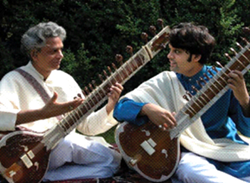
Seit mittlerweile sieben Generation musizieren Vater und Sohn der Mishra Familie – Pandit Shivanth und Deobrat Mishra – gemeinsam. Music of Benares bringen mit Ihrer Musik den Zauber der mehr als 2000 Jahre alten Tradition der Sitar und Tabla zu uns.Ihre Musik lebt überwiegend von der Improvisation und folgt dem Ausdrucksreichtum der menschlichen Stimme. Deobrath Mishra wurde mehrmals als bester Sitarspieler Indiens ausgezeichnet.
Freitag 29.10.2010, Galerie Werkstatt NUU, www.nuu.at , Gesangs/Sitar oder Tabla Workshop mit Deobrath Mishra nach tel. Vereinbarung am 1, 2 und 3. November unter 0699 19429921 möglich!
Samstag 30.10.2010, 19 Uhr: Minoriten Kloster Tulln www.minoriten.at The Sound of India – Music from Benares, Shivnath & Deobrath Mishra, Sithar, Meister der klassischen indischen Musik, Festsaal/Klubräume – Eingang Nibelungenplatz. http://weltladen-tulln.at Weltladen Tulln: Wir feiern! Der Weltladen Tulln ist 5 Jahre alt geworden! Wir feiern gemeinsam mit den Vereinen Rainbowtrust (10 Jahre alt) und Miteinander leben (20 Jahre alt).
Gharana is a traditional style and way of teaching and performing Indian classical music. This style is many hundreds of years old and has been passed from master to student, from generation to generation. There are many Gharanas or styles, one of the most prominent ones being the Benaras Gharana. It is also called Varanasi Gharana. Over the years, the Benaras Gharana has produced many outstanding vocal, instrumental and dance performers.Like many traditions, this method of performing music and the great Indian cultural heritage, in general, have been threatened due to the lack of dedicated teachers and students.
A very rare Video clip of three generation’s of master musicians performing on same stage. Concert in Tulln-Austria 2009. Pandit Shivnath Mishra & Deobrat Mishra Sitar Artist from India, Prashant Mishra Tabla player. A paṇḍit (Hindi; Devanagari: पण्डित, Sanskrit: paṇḍita) is a scholar, a teacher, particularly one skilled in Sanskrit and Hindu law, religion, music or philosophy. The English loan word pundit is derived from it. Info Click here
The Guru (teacher)-Shishya (student) relationship which was the hallmark of this system is breaking down. If this tradition is not maintained, very soon it might exist only in textbooks. Pandit Shivnath Mishra and his family have descended from a highly talented musical lineage of Benaras Gharana going back several generations. In order to preserve this heritage, so precious to India, and make it accessible to children, Pt. Mishra and his family decided to create the Benaras Gharana Baccha ( The Children’s Project).
The aim of the Academy is to: Establish a school for the teaching of Indian Classical music in the traditional Benaras Gharana style; Provide scholarships to children to assist them in their learning of this musical style; Create opportunities for students and young artists to develop their potential through study and performance; Provide right livelihood for qualified and dedicated teachers.
For this purpose, the Mishra family purchased land in Benares on which to build a residential music school. The construction of the building took around three years to be completed and now the Academy is a well-structured place to receive students from all over the world.
For foreign students, who are committed to studying seriously, the Academy opens its doors providing them with all facilities needed such as a proper music hall, nice rooms with or without toilet attached, spacious kitchen, mineral water filter and dining room, apart from a safe and peaceful atmosphere. Moreover, it is located five minutes walk from the Ganga River.
The Benares Academy is a long-term and ongoing project. Your financial assistance and creative participation is most welcomed and appreciated.The Academy is registered as a charitable non-profit society under number V23536-2000.
-
www.swara.at Indische Musik und Tanz in Österreich
-
Benares www.back-to-life.com
Omkar Spiritual Tours – Ticket for a Cause
http://www.teach-india.com/index.htm
www.srianandamayima.org/new_projects
The Narmada (Devanagari: नर्मदा, Gujarati: નર્મદા) ,also called Rewa is a river in central India and the fifth largest river in the Indian subcontinent. It forms the traditional boundary between North India and South India and flows westwards over a length of 1,312 km (815.2 mi) before draining through the Gulf of Cambey (Khambat) into the Arabian Sea, 30 km (18.6 mi) west of Bharuch city of Gujarat. Read More > Here <
The Narmada Dam Project is a large hydraulic engineering project involving the construction of a series of large irrigation and hydroelectric multi purpose dams on the Narmada River in India. The project was first conceived of in the 1940s by the country’s first prime minister, Jawaharlal Nehru. The project only took form in 1979 as part of a development scheme to increase irrigation and produce hydroelectricity. Of the thirty large dams planned on river Narmada, Sardar Sarovar Dam (SSD) is the largest structure to be built. It has a proposed final height of 136.5 m (448 ft). The project will irrigate more than 18,000 km2 (6,900 sq mi), most of it in drought prone areas of Kutch and Saurashtra. Critics maintain that its negative environmental impacts outweigh its benefits. Read More: > HERE <
A COMMERICAL AIR TICKETING SERVICE WITH A SOCIAL MOTIVE BY OMKAR SPIRITUAL TOURS – Ever thought that four flight ticket can elevate somebody´s hopes? Ever thaught that every time you fly, somebody´s future prospects could also take wings? Now this can happen by simply booking your air tickets with Omkar Spiritual Tours, a vital and innovative tours and travel service concern.
ALL PROCEEDS FROM THIS COMMERICAL SERVICE WILL GO TOWARDS THE RUNNING OF THE OMKARESHWAR SCHOOL.
Omkar Spiritual Tours is a business venture run by entepreneurs who have begun this work out of a spirit of charity to fund a very active NGO (noncommercial Organization) — a free school for local village children in Omkareshwar, India. Omkar Tours is a commerical project specifically begun for supporting an important social project.
At Omkar Tours, you are our guests and our fellow workers for a noble project, and not mere customers. All our guests receive unparalleled attention and care. Come and experience the spiritual side of India, and at the same time contribute to a worthy cause!
Omkar Tours is not a cold business venture run by entrepreneur, but a vibrant group of dedicated devotees who have begun this work out of a spirit of charity to fund the ashram free school. All the proceeds go for the running of the Omkareshwar School for the local village children, and all the workers connected with this venture are devotees of Ma Anandamayi Ashram and are spiritual people in their own right.
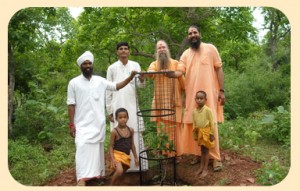
The Wonder of Omkareshwar – In Cooperation with Israelian Agriculture Students a System has found where 98 % of the thousend planted trees survived on this rocky and difficult soil on the island above the Narmada River. The Indian Forest Minister stunned and reported about the many tree planting projects where the trees only on paper exist, because only a few trees surviving in lack of water or difficult soil the first years.
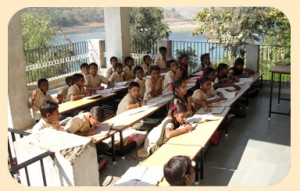
THE SCHOOL ABOVE THE NARMADA RIVER – On the hill above the Ashram (The word ashram comes from “ah—without” and “shram—stress”. An ashram is a spiritual center, meant to be a place of quiet and peace and a place for spiritual discipline and meditation practice.) Swami Kedarnath and Dr. Swami Gurusharanan founded Mata Anandmayi Tripura Vidyapeeth, a thriving school for the local village children. The school is invaluable to the local community in offering free education to children from the poorest living conditions. Without it, the children would almost certainly have no chance for essential development in life.
The school offers a unique style of education: while all the traditional subjects are extensively covered, emphasis is also placed on Dharma (the Eternal Path of Righteousness), moral values and character development, service to society and religious studies.
400 children between the ages of 6-18 currently attend Mata Anandmayi Tripura Vidyapeeth. Demand for places is high and the school is eager to respond, although finding teachers in such a remote part of India is a constant struggle.
The school initiates projects to help their local community and the school, such as litter-picking of the island or removing rubbish from the Narmada River on which it sits. Anyone who’s been to India will recognise the cultural unawareness of litter and it’s impact on the environment. Mata Anandmayi Tripura Vidyapeeth’s shaping of young hearts and minds to appreciate the need to care for their local environment is truly commendable.
Hands-on work to help their community is known as Sewa and instils a sense of respect and responsibility for their local community. This shines through upon meeting the children and is deeply missing in modern societies.
Projects range from small to large in size and continue throughout the school year.
-
FOR AIR TICKET BOOKING; PLEASE CONTACT OMKAR SPIRITUAL TOURS:
-
24-A, Sangam Nagar, Tel: 0731-4208267, Mob.: 9926902690 (Shivam Thakker)
Medha Patkar – Water and Enviroment

www.rightlivelihood.org/narmada.html
www.citizen-news.org/Articles Medha Patkar
Medha Patkar (Marathi: मेधा पाटकर, born December 1, 1954) is an Indian social activist. She is known for her role in Narmada Bachao Andolan. Author Jacques Leslie devoted a third of his book, Deep Water: The Epic Struggle Over Dams, Displaced People, and the Environment (Farrar, Straus & Giroux, 2005), to a portrait of Patkar as she planned to drown herself in rising reservoir waters behind the Sardar Sarovar Dam, whose construction she fought for two decades. Read More: > HERE <
World Water Day is observed on March 22 since 1993 when the United Nations General Assembly declared March 22 as World Day for Water. This day was first formally proposed in Agenda 21 of the 1992 United Nations Conference on Environment and Development (UNCED) in Rio de Janeiro, Brazil. Observance began in 1993 and has grown significantly ever since. The UN and its member nations devote this day to implementing UN recommendations and promoting concrete activities within their countries regarding the world’s water resources. Each year, one of various UN agencies involved in water issues takes the lead in promoting and coordinating international activities for World Water Day. Since its inception in 2003, UN-Water has been responsible for selecting the theme, messages and lead UN agency for the World Day for Water.
In addition to the UN member states, a number of NGOs promoting clean water and sustainable aquatic habitats have used World Day for Water as a time to focus public attention on the critical water issues of our era. Read More: > HERE <
The construction of large dams on the River Narmada in central India and its impact on millions of people living in the river valley has become one of the most important social issues in contemporary India. Through this website, we the friends of the Narmada valley and its people hope to present the perspective of grassroots people’s organisations on the issue. Read an introduction to the issue.
The Friends of River Narmada is an international coalition of organisations and individuals (mostly of Indian descent). The coalition is a solidarity network for the Narmada Bachao Andolan (Save the Narmada Movement) and other similar grassroots struggles in India. More info about us.
www.worldwaterforum5.org 2nd World Water Forum in The Hague, Netherlands, in 2000. Speech by Medha Patkar against privatization of water. John Briscoe (WorldBank) held his speech just before Patkar.
www.unwater.org/worldwaterday International World Water Day is held annually on 22 March as a means of focusing attention on the importance of freshwater and advocating for the sustainable management of freshwater resources.
An international day to celebrate freshwater was recommended at the 1992 United Nations Conference on Environment and Development (UNCED). The United Nations General Assembly responded by designating 22 March 1993 as the first World Water Day.
Each year, World Water Day highlights a specific aspect of freshwater. On this page, we present a brief overview of the different themes that have been the focus of World Water Day celebrations.
Nature Conservancy – Biodiversity Projects

Conservation International (CI) is a nonprofit organization headquartered in the Washington, D.C. metropolitan area, that seeks to protect Earth’s biodiversity „hotspots,“ high-biodiversity wilderness areas as well as important marine regions around the globe. The group is also known for its partnerships with local non-governmental organizations and indigenous peoples. CI was founded in 1987 by Spencer Beebe and Peter Seligmann and now has a staff of more than 900 employees. Its work occurs in more than 45 countries, primarily in developing nations in Africa, Asia, Oceania, and the Central and South American rainforests. Building upon a strong foundation of science, partnership, and field demonstration, Conservation International empowers societies to responsibly and sustainably care for nature for the well-being of humanity. Read More: > HERE <
Hans Rosling (born July 27, 1948 in Uppsala, Sweden) is Professor of International Health at Karolinska Institute and Director of the Gapminder Foundation, which developed the Trendalyzer software system. From 1967 to 1974 he studied statistics and medicine at Uppsala University, and in 1972 he studied public health at St John’s Medical College, Bangalore. He became a licenced physician in 1976 and from 1979 to 1981 he served as District Medical Officer in Nacala in northern Mozambique. Rosling’s research has also focused on other links between economic development, agriculture, poverty and health in Africa, Asia and Latin America. He has been health adviser to WHO, UNICEF and several aid agencies. In 1993 he was one of the initiators of Médecins sans frontières in Sweden. Read More > Here <
Conservancy Yunnan The alpine ecosystems mountain areas that lie above the treeline – of northwestern Yunnan are some of the most biologically rich systems in the world. Home to such endangered species such as the snow leopard and blue sheep, this unique area provides important ecosystem services such as water storage, medicinal plants, and grazing for livestock. For example the rare snow lotus, which grows in the rocky upper slopes at elevations over 4,000 meters, is used by Tibetans to treat high blood pressure.
Unfortunately, these ecosystems are currently under siege by incompatible land uses and climate change. The Nature Conservancy has joined together with the Center for Biodiversity and Indigenous Knowledge (CBIK) and academic researchers to initiate a project focused on protecting these treasured and threatened ecosystems.
Goals • Gain a clear understanding of northwest Yunnan’s alpine ecosystem and identify immediate threats • Develop and implement climate adaptive conservation strategies based scientific, social, cultural, political, and economic factors • Maintain a healthy alpine ecosystem
What the Conservancy is Doing – During October 2003, the Conservancy and its partners traversed the mountain ranges of northwestern Yunnan collecting mapping data and investigating the ecological, political, and economic status of alpine areas across the project area. We interviewed local villagers, gathered information on ecological health, and set up initial photo monitoring sites to serve as the baseline for annual monitoring of these systems. During the course of 2004, we will work with partners and communities to continue research as well as begin to implement “no-regret” conservation strategies.
http://carlsafina.org , www.gapminder.org
http://www.ted.com The Gulf oil spill dwarfs comprehension, but we know this much: it’s bad. Carl Safina scrapes out the facts in this blood-boiling cross-examination, arguing that the consequences will stretch far beyond the Gulf — and many so-called solutions are making the situation worse.
Blue Ocean Institute – From Arctic Alaskan fishing villages to Zanzibar’s shores, the staff of Blue Ocean Institute studies and articulates how the ocean is changing and how everything humans do—both on land and at sea—affects the waters, wildlife, and people of our world. But gloomy environmental warnings and predictions don’t move people to make changes that can help our shared ocean. MacArthur Prize-winning scientist/author Dr. Carl Safina and Mercédès Lee created Blue Ocean Institute in 2003 as a unique voice of hope, guidance, and encouragement.
Blue Ocean Institute is the only conservation organization that uses science, art, and literature to inspire a closer bond with nature, especially the sea. We translate scientific information into language people can understand and use to make better choices on behalf of the sea. Whether you’re a fisherman, seafood lover, student, faith leader, parent, artist, or chef, our programs help you learn how and why you should protect our planet’s life-giving ocean.
Ocean Climate Change – This project is dedicated to turning the science of climate change effects on ocean life into stories that are accessible to policy, public, and scientific communities. We seek to identify those areas of research that are lacking attention, or are particularly complicated, and write articles in both academic and popular media formats about these underrepresented or important subjects.
“Climate change” is really “carbon change” and is not just about warming. We currently focus on how climate change alters ocean chemistry, and how that can affect every creature in the sea by forcing them to devote more energy to coping with excess carbon dioxide in the ocean. Since January, this initiative has already produced several articles, ranging from online journals to environmental faith-based magazines. Our published articles call for a wider appreciation and reporting of climate change effects on marine life. Please see our staff publications page to see articles on this issue.
Grameen Shakti Solar Renewable Power
www.sourcewatch.org/Renewable_energy
www.rightlivelihood.org/grameen_shakti.html
www.gshakti.org Solar
Muhammad Yunus (Bangla: মুহাম্মদ ইউনুস, pronounced Muhammôd Iunus) (born 28 June 1940) is a Bangladeshi banker, economist and Nobel Peace Prize recipient. He previously was a professor of economics where he developed the concepts of microcredit and microfinance. These loans are given to entrepreneurs too poor to qualify for traditional bank loans. Yunus is also the founder of Grameen Bank. In 2006, Yunus and the bank were jointly awarded the Nobel Peace Prize, „for their efforts to create economic and social development from below.“Yunus himself has received several other national and international honors. He is the author of Banker to the Poor and a founding board member of Grameen America and Grameen Foundation. > HERE < The Grameen Bank is a microfinance organization and community development bank started in Bangladesh that makes small loans (known as microcredit) to the impoverished without requiring collateral. The system is based on the idea that the poor have skills that are under-utilized. The bank also accepts deposits, provides other services, and runs several development-oriented businesses including fabric, telephone and energy companies. The organization and its founder, Muhammad Yunus, were jointly awarded the Nobel Peace Prize in 2006. Read More: > HERE <
Grameen Shakti (GS) has developed one of the most successful market based program with a social objective for popularizing Solar Home Systems (SHSs) including other renewable energy technologies to millions of rural villagers.
Currently GS is one of the largest and fastest growing rural based renewable energy companies in the world. And Bangladesh, a country with one of the most successful renewable energy program in the world. As of December 2009, GS has installed more than 3,20,000 SHSs in rural areas with more than 12,000 SHSs installed per month. This success especially was the result of unique approach, blending market and social forces together to take world’s most up to date technology to the rural people.
„It is a fact that the future belongs to Renewable Energy Technologies. But unless this technology can reach the millions of rural people who suffer most from the energy crisis, it will not reach its full potential, and neither will the economic and social problems of the world be solved. — Dipal Barua
GS used its Grameen Bank’s experience to evolve a financial package based on installment payment which reduced costs and helped it to reach economy of scale. GS had to earn the good will of the rural people and especially provide excellent after sales services to ensure the success of its program. GS engineers are also called social engineers. GS engineers train women technicians and provide them with employment, they administer a scholarship program for school children, they collect damaged batteries to ensure that these do not hurt the environment. GS engineers pay monthly visits to households during installment payment and ready to offer their services for a small fee, afterwards, if a client signs an annual maintenance agreement with GS.
„It is a fact that the future belongs to Renewable Energy Technologies. But unless this technology can reach the millions of rural people who suffer most from the energy crisis, it will not reach its full potential, and neither will the economic and social problems of the world be solved. — Dipal Barua
GS solar PV program really took off the ground when rural clients realized SHSs are more cost effective than other conventional sources of energy such as kerosene and provide more utilities.
GS started its biogas program in 2005 and Improved Cook Stoves Program in 2006. GS’s biogas program is the first market based program in Bangladesh. Both programs have become popular with the rural people and show an accelerating trend.
Rural electrification through solar PV technology is becoming more popular, day by day in Bangladesh. Solar Home Systems (SHSs) are highly decentralized and particularly suitable for remote, inaccessible areas. GS’s solar program mainly targets those areas, which have no access to conventional electricity and little chance of getting connected to the grid within 5 to 10 years. It is one of its most successful programs. Currently, GS is one of the largest and fastest growing rural based renewable energy companies in the world. GS is also promoting Small Solar Home System to reach low income rural households.
SHSs can be used to light up homes, shops, fishing boats etc. It can also be used to charge cellular phones, run televisions, radios and cassette players. SHSs have become increasingly popular among users because they present an attractive alternative to conventional electricity such as no monthly bills, no fuel cost, very little repair, maintenance costs, easy to install any where etc.
GS installed SHSs have made a positive impact on the rural people. GS has introduced micro-utility model in order to reach the poorer people who cannot afford a SHS individually. Another successful GS venture is Polli Phone which allows people is off grid areas the facilities of telecommunication through SHS powered mobile phones.
