SPIRITUAL JOURNEYS, NEWS
MIND AND LIFE – COMPASSION IN ECONOMICS
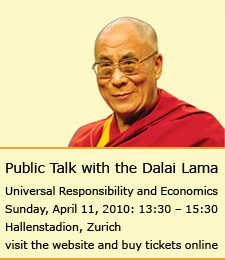
Der Dalai Lama in Zürich 2010:
Universelle Verantwortung und Wirtschaft – Die weltweite Finanzkrise und deren verheerende Folgen für Millionen Menschen unterstreichen die Bedeutung der ethischen Dimensionen von Wirtschaftssystemen. Die globale Finanzkrise, die 2008 begann, ist ein Zeichen dafür, dass konkurrenzierende Wirtschaftssysteme für Korruption und menschliche Gier anfällig sind.
Der Dalai Lama wird in seinem öffentlichen Vortrag die Frage eruieren, inwieweit die persönliche und universelle Verantwortung sowohl in der Wirtschaft wie im eigenen Leben von Bedeutung sind, und ob wir produktive Wirtschafts- und Gesellschaftssysteme entwickeln können, die gleichzeitig Mitgefühl und Altruismus belohnen und aktuelle Probleme im Bereich der Armut und der Umwelt lösen.
Der Vortrag wird auf Englisch gehalten, mit deutscher Übersetzung.
Öffentlicher Vortrag, Sonntag, 11. April 2010; 13:30 – 15:30
Hallenstadion, Zürich
> Meet Buddhism, friends, studies, Medicine at facebook <
> Meet Dalai Lama, friends, studies at facebook <
> Paramahansa´s Guidence for these times of economic crises <
> Meet Paramahansa Yogananda friends, groups, studies at fb <
> Meet Mind and Life, friends, studies at facebook <
KABIR – Yoga and the Bhakti Movement
> IRCICA Islamic History, Arts, Culture Research <
> Appendix:The 99 names of Allah <
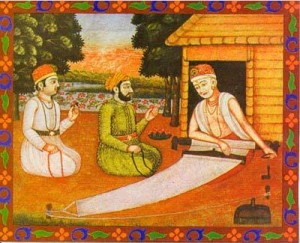
KabÄ«r (also KabÄ«ra) (Hindi: कबीर, Punjabi: ਕਬੀਰ, Urdu: کبير(1440—1518)was a mystic composer and saint of India, whose writings have greatly influenced the Bhakti movement of India. Kabir was influenced by the prevailing religious mood of his times, such as old BRHAMANIC HINDUISM , HINDU and BUDDHIST TANTRISM, the teachings of NATH YOGIS and the personal devotionalism of South India mixed with the imageless God of Islam. The influence of these various doctrines is clearly evident in Kabir’s verses. Eminent historians like R.C. Majumdar, P.N. Chopra, B.N. Puri and M.N. Das have held that Kabir is the first Indian saint to have harmonised Hinduism and Islam by preaching a universal path which both Hindus and Muslims could tread together. Read More: > HERE <
-
Asma al-Husna: > www.sufism.org <
-
The Most Beautiful Names of Allah
-
The Qur’an on the Divine Names
-
Mevlâna Jalâluddîn Rumi on the Divine Names
Shabnam Virmani is director of the Kabir Project. Started in 2003, the Kabir project brings together the experiences of a series of journeys in quest of this 15th century mystic poet in our contemporary worlds.It consists of 4 documentary films, 2 folk music videos and 10 music CDs accompanied by books of the poetry in translation.The films journey into contemporary spaces touched by his music and poetry.“The films journey into contemporary spaces touched by his music and poetry,” says Shabnam. In her films, Shabnam juxtaposes the urban and the rural, the Indian and the foreign, the classical and the folk, and the secular and the fundamentalist, in their many approaches to Kabir and the search for a universal voice. “Had-Anhad” was a joint prize winner at the recent documentary film festival, One Billion Eyes,organised by Prakriti Foundation in Chennai. Read More: >HERE <
The Kabir Project – Welcome to the home of the Kabir Project.
The Kabir project brings together the experiences of a series of ongoing journeys in quest of this 15th century North Indian mystic poet in our contemporary worlds. Started in 2003, these journeys inquire into the spiritual and socio-political resonances of Kabir’s poetry through songs, images and conversations.
We journey through a stunning diversity of social, religious and musical traditions which Kabir inhabits, exploring how his poetry intersects with ideas of cultural identity, secularism, nationalism, religion, death, impermanence, folk and oral knowledge systems. The core inspiration of the project is music, and Kabir comes alive in 4 documentary films, 10 audio CDs and poetry books through the power of song.
This is a 6-year initiative undertaken by filmmaker Shabnam Virmani as an artist-in-residency project at the Srishti School of Art, Design and Technology in Bangalore, India. The project is supported by the Ford Foundation, New Delhi.
Apart from the films, CDs and books, the true spirit of the Kabir Project lies in the taana-baana (warp & weft) of social networks and friendships built over these years between the singers, scholars, activists, artists, illustrators, students, music lovers and lay persons who have been woven together through student labs, festivals, workshops and other exchanges. Folk singers Prahlad Tipanya, Mukhtiyar Ali and others have become deep friends, giving the project its soul force. Our advisors include scholars Linda Hess and Purushottam Agrawal, poet Ashok Vajpeyi, and singer Vidya Rao.
The project is growing rapidly in many ways, with cultural groups, educational, social and community-based institutions and individuals are taking the initiative to organize festivals, workshops and interactive events that include the films, folk singers, live music concerts and discussions, reaching out to very diverse audiences.
In the next phase of the project, work has begun towards constructing a multi-media web-space to browse the music, poetry and ideas of Kabir. This web-space will be co-created with the involvement of folk singers, along with innovative social experiments to vitalize the Kabir oral traditions at the village level. We are also holding exploratory workshops with teachers and educators to brainstorm ways of bringing the ideas and values of Kabir into the classroom.
> MIRABAI- Poet, Saint & Bhakti-Tradition <
> THE SONGS OF KABIR – Sacred Text´s <
> Meet the Kabir Festival, friends at facebook <
> Meet Sufism, friends, studies at facebook <
> Meet Rumi, friends, studies at facebook <
THE EAST MEETS WEST MUSIC INC.

http://eastmeetswestmusic.com/
> Ali Akhbar College of Music, LAYA Project <
> GHARANA – Benares Music Academy <
„There is something beautiful about the stage. There is a performer and there is an audience. Nothing is in the way. The sound remains pure and unburdened by things like marketing and distribution. My hope is for this label to be more like a stage and less like the music business as I have experienced it.”
–Ravi Shankar
Ravi Shankar (Bengali: রবি শংকর; born 7 April 1920), often referred to by the title Pandit, is an Indian sitarist and composer. He has been described as the most well known contemporary Indian musician by Musik in Geschichte und Gegenwart.Shankar was born in Varanasi and spent his youth touring Europe and India with the dance group of his brother Uday Shankar. He gave up dancing in 1938 to study sitar playing under court musician Allauddin Khan. After finishing his studies in 1944, Shankar worked as a composer, creating the music for the Apu Trilogy by Satyajit Ray, and was music director of All India Radio, New Delhi, from 1949 to 1956. Read more: > HERE <
WELCOME – The Ravi Shankar Foundation proudly announces the launch of East Meets West Music. EMW Music is a listener’s passport to the sitar master’s personal archive of thousands of hours of live performance audio, film footage, interviews, and studio masters. By making personally selected source material from this collection available, Ravi Shankar hopes to bridge any divide between his recorded music and his audience. EMWMusic also provides a vibrant space for new artists, projects, and collaborations. We are thrilled to begin this journey with our long time supporters and new fans alike.
The aim of the Benares Academy is to:
- Establish a school for the teaching of Indian Classical music in the traditional Benaras Gharana style;
- Provide scholarships to children to assist them in their learning of this musical style;
- Create opportunities for students and young artists to develop their potential through study and performance;
- Provide right livelihood for qualified and dedicated teachers.
For this purpose, the Mishra family purchased land in Benares on which to build a residential music school. The construction of the building took around three years to be completed and now the Academy is a well-structured place to receive students from all over the world.
For foreign students, who are committed to studying seriously, the Academy opens its doors providing them with all facilities needed such as a proper music hall, nice rooms with or without toilet attached, spacious kitchen, mineral water filter and dining room, apart from a safe and peaceful atmosphere. Moreover, it is located five minutes walk from the Ganga River.
The mission of the Ali Akbar College of Music is to teach, perform and preserve the classical music of North India, specifically the Seni Baba Allauddin Gharana (tradition), and to offer this great musical legacy to all who wish to learn. The Ali Akbar College of Music offers education in the classical music of North India at the highest professional level. Our primary instructors are the internationally recognized sarode Maestro Ali Akbar Khan and the master of percussion Pandit Swapan Chaudhuri, from whom our students learn the necessary musical skills, knowledge and understanding to contribute significantly to musical life.
At a dargah (Islamic shrine) situated in the south-east part of India, the singers sing devotional songs in the Qawwali style, with percussion accompaniment. The lyrics are a mix of the local south Indian language, Tamil and Arabic, while the music style is that of northwestern India.
These artists are featured in the award-winning music documentary LAYA PROJECT (www.layaproject.com), and have also released a full album called NAGORE SESSIONS, available at www.earthsync.com
A tribute to the resilience of the human spirit, LAYA PROJECT is a documentary about the lives and music culture of coastal and surrounding communities inthe 2004 tsunami-affected regions. Some of these performances are rare, and documented for the first time.
Sree Debasish Dass (Pintoo) Born in a very tradtional musical familly on May day, Sree Debasish Dass has carved a special niche for himself in the world of Tabla, the king of Indian percussion instruments. He was initiated into Tabla at the tender age of five by his beloved father Late Dilip Kumar Pandit a highly acclaimed Tabla player of Farukkabad Gharana.
True to his date of birth, which symbolises sincere labour, > Debasish < (popularly known as Pintoo) put in years of relentless effort and unfailing dedication to master the art of playing Tabla. He completed his graduation from the world famous Visva-Bharati University founded by the great > Rabindra Nath Tagore < . Thereafter he plunged fully into the subtle complexities Tabla and completed his Diploma in music, Bachelor and Master degree in Tabla.
http://swara.at/ (Plattform f. Indische Musik und Tanz in Österreich)
http://www.alankara.com/ (Ver. z. Förd. d. Ind. Musik ,Kunst in Wien)
http://www.indigenouspeople.net/taino.htm (Ind. Friends, Haiti)
BALI Inst., Global Healing, Youth in Action
> Articles about Africa´s Trad. Med. <
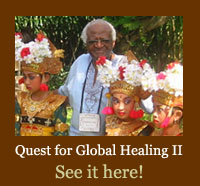
You Are Invited to Bali….., to join an extraordinary gathering of concerned global citizens, business leaders, academics and other innovative thinkers in a quest towards a more collaborative, peaceful and sustainable future for humankind and the planet. This unique gathering is designed for individuals concerned about where the world is heading, and who want to be part of the solution. QUEST FOR GLOBAL HEALING is an opportunity to step forward and define your own commitment to help change the world.
DESMOND MPILO TUTU (born 7 October 1931) is a South African cleric and activist who rose to worldwide fame during the 1980s as an opponent of apartheid. In 1984, Tutu became the second South African to be awarded the Nobel Peace Prize. Tutu was the first black South African Anglican Archbishop of Cape Town, South Africa, and primate of the Church of the Province of Southern Africa (now the Anglican Church of Southern Africa). Tutu chaired the Truth and Reconciliation Commission and is currently the chairman of The Elders. Tutu is vocal in his defence of human rights and uses his high profile to campaign for the oppressed. Tutu also campaigns to fight AIDS, tuberculosis, homophobia, poverty and racism. He received the Nobel Peace Prize in 1984, the Albert Schweitzer Prize for Humanitarianism, the Gandhi Peace Prize in 2005 and the Presidential Medal of Freedom in 2009. Tutu has also compiled several books of his speeches and sayings. Read More: > HERE <
Bali Institute for Global Renewal (BIGR) is the first world learning center that engages multicultural leadership and facilitation training, deep dialogue, indigenous wisdom, global consciousness, intergenerational activism and other action-oriented skills and training that empowers individuals, groups and organizations in their quest to make a difference in the world. BIGR includes a consortium of international organizations, corporations, NGOs, universities, thought leaders and consultants who are invested in advancing new forms of leadership training, intergenerational collaboration, nonviolent conflict resolution and social activism as part of a worldview that promotes a sustainable, humane and culturally-diverse life for all.
BIGR will be offering an array of programs created and produced by the Institute as well as education and trainings offered by its partners.
What is Global Youth in Action? Global Youth in Action (GYIA) is a series of gatherings and programs that provide multicultural, intergenerational community building, leadership training, deep dialgoue, indigenous practices and experiential field work, all focused on helping empower individuals around the world to be more engaged in their own quest to become more socially active in healing our planet.
GYIA focuses on empowering emerging leaders to gain confidence, skills, resources and support to launch their own initiatives around sustainable social and transformational action. Our goal is for individuals to establish a committed action plan through collaborative efforts, along with a follow-up support network that will allow the necessary infrastructure to continue their work.
The program design is crafted by an international coalition of thought leaders and consultants who focus on dialogic processes and authentic leadership practices for results-oriented outcomes. Programs are hosted in indigenous cultures to enhance learning and growing from a deeper perspective.
How did we get here ? The first GYIA program originated as part of the Quest for Global Healing (QGH) Conferences held in Bali in 2004 and 2006. With Nobel Peace Laureate Desmond Tutu as the honorary chairman, over 1000 participants from 40 countries have come together over the two years with the desire to step forward and define their own individual commitments to help change the world.
GYIA was specifically designed as a pre-program to QGH that offered young leaders (ages 17 to 30) an opportunity to engage in multi-cultural dialogue and collaborative learning about social activism for the new century. More than 90 youth from 16 countries brought their unique perspectives, energies, insights and deep passion to commit to a more global vision for change.
Countries represented included Peru, Thailand, Indonesia, China, France, Tunisia, South Africa, Norway, Canada, Australia, India, Laos, and the US.
Experience the Balinese Culture GYIA offers the opportunity to be immersed into the indigenous realm of Bali, to build a stronger link between the East-West perspectives on shifting world views. Highlights include Balinese performances and rituals throughout the gathering as well as spending time with local Balinese village leaders and youth.
When attending GYIA programs, participants live in homestays with Balinese families, allowing a glimpse of true community living.
Why Bali? The island and culture of Bali serves as the integral component of these programs. The foundation of this work has been based on the belief that Bali, unlike any other cultural environment in the world, will grow to be the hub for important dialogues, action-oriented multicultural/intergenerational experiences, and transformative social change.
Bali is one of the most peaceful, beautiful places on earth. It’s an ideal location for people from every part of the planet to explore new roles they can play in addressing major global issues. This rich culture has much to share with citizens of our shared planet about learning to heal, forgive and live harmoniously with one another and our beloved earth. Balinese rituals and arts all play a role in this new kind of learning. Delegates attending our sessions will encounter the unusual way Balinese ceremony and performance converge with deepening dialogue and action-orient planning. All of the BIGR programs incorporate Balinese experiences, both linear and non-linear, into the transformative curriculum.
Highlights of these conferences included:
- More than 1,300 people from 40 countries have attended
- Deep, thoughtful dialogue
- Personal dialogue with world leaders and visionaries
- Spiritual awareness beyond the religious divide
- Intergeneration, multicultural dialogue and wisdom sharing
- Personal commitments to do something when returning home
- Insights and personal growth
- Shifting of values
- Immersion of culture, spiritual connection and social activism
- Global insights
- Networking with a global community
- Post-conference gatherings
- Numerous actions including fundraising for schools, donations to families and health clinics, ongoing global networking, job openings, and more
PODS – Personalized Leadership Training:
Transformative Education, Social & Political Leadership – „World-mindedness“ is no longer a luxury, but a necessity for survival in this new century. Diverse viewpoints and perspectives are critical for this generation of constructive change on a global scale. Pioneering global facilitators in this pod will connect around their shared commitment to making a difference in education, social services and political agendas and thereby initiate the transformation of perspectives and worldviews toward a sustainable, compassionate world.
Language of the Soul: Spirituality, Healing, Medicine, and Indigenous Wisdom. – The majority of religions and cultural traditions consider disease and illness to be a fundamental part of the human condition. Spiritual factors associated with healing are increasingly being acknowledged. Illness is beginning to be deeply understood as unique language to awakening or consciousness. This pod will explore healing, medicine, spirituality and indigenous wisdom as doorways to global healing as well as a tool for activism.
Media as Activism: Media, Film, Journalism, Performance and Visual Arts – Culture is often defined by its media and art. Challenging mainstream media and building independent cultural voices are equally important components of media activism. This pod will explore how current and future art, performances and the use of media technology affect our world-view, sense and global cultural values.
Global World of Business and Nonprofits– Citizens and non-profit organizations can play an active role in shaping the future of our global economy. The emergence of a global civil society based upon partnership principles is now considered one of the real hopes to democratize the global political economy. In this pod we will work together to re-imagine global trade rules, how to inspire corporations to be accountable to people’s needs, exchange shared ideas for building strong and free labor, and how to promote fair and environmentally sustainable alternatives.
Deep Ecology, Environment and Sustainability Advocacy – The flourishing of human and nonhuman life on Earth has intrinsic value that should be shaping our environmental policies. Those who work for social change based on this recognition are motivated by love of nature as well as humanity. The Balinese emphasis on the relationship between humanity, the environment and spirituality is a model for our deep inquiry. In this pod we will explore how the needs of humanity can be balanced with environmental sustainability and survival of our shared planet.
> Meet BALI INSITUTE for Global Renewal, friends, studies at fb <
> Meet GOPIO Global Organization of People of Indian Origin at fb <
> Meet MIND and LIFE Institute, friends, studies at fb <
> Miriam Makeba, friends, fans, group at fb <
* South Africa’s Legendary Musical Sensation, Grammy Award Winner and United Nations Ambassador. On the continent, we simply call her Mama Africa.
TECHUNG – Tibetan Music, Dance, Arts
> Tibetan Institute of Performing Arts (TIPA) <
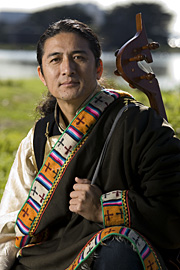
Techung is a Tibetan folk and freedom singer/songwriter living in exile in the San Francisco Bay Area. He is best known for his performances of traditional Tibetan music, dance, and opera under the name Tashi Dhondup Sharzur. He uses his childhood nickname, Techung, when performing as a solo artist. Whether performing in traditional or contemporary styles, Techung’s dual goals are to revive Tibetan music in the Tibetan community and to expose the rich performing cultural tradition of his homeland to the world community.
Techung grew up in Dharamshala, India, where his family and tens of thousands of other Tibetans resettled from their native Tibet. At the age of 9 he was enrolled in the newly formed Tibetan Dance and Drama School now known as the Tibetan Institute of Performing Arts (TIPA). In his 17 years of residency at the Institute, he studied all aspects of the Tibetan performing arts folk, court, and opera – through the oral teaching tradition used by the venerated Tibetan elders with whom he was honored to study. He toured with TIPA in its first international tour as a leading child actor in 1975-76 and for many years afterwards. After emigrating to the U.S., he co-founded the San Francisco-based Chaksampa Tibetan Dance and Opera Company in 1989. From 1995-97 Techung worked for the Milarepa Fund in San Francisco who organized the Tibetan Freedom Concerts world wide.
In addition to being looked up to as one of the key keepers of traditional Tibetan musical traditions, Techung is also respected for the original solo and collaborative music he creates by drawing on both his own heritage and his familiarity with other world music traditions. He collaborated on his first solo album, „Yarlung: Tibetan Songs of Love and Freedom“ (1997) with composer/performer Miguel Frasconi, followed by „Sky Treasure“ (2001) with Windham Hill jazz keyboardist Kit Walker. His other two solo albums were „Changhay: Traditional Tibetan drinking songs, Vol. 1“ (1999) and „Nyingtop-Courage“ (2002). His song „Losar“ was chosen as the 2003 best modern traditional Tibetan song at the first annual Tibetan Music Awards held in Dharamshala. His album Techung A Compilation of Tibetan Folk and Freedom Songs won the 2006 Best Asian Album at Just Plain Folks Music Festival www.jpfolks.com – one of America’s largest grass root music festivals.
Techung’s voice and music have been featured on the soundtracks of the IMAX film „Everest,“ the feature films: „Windhorse,“ (1998) Dreaming Lhasa, (2006) www.whitecranefilms.com),. His music is prominently featured on documentary films such as: „Blind Sight,“ (2007), www.blindsightthemovie.com, „Dalai Lama Renaissance,“ (2008) www.dalailamafilm.com, „Fire Under the Snow,“(2008) www.fireunderthesnow.com. His music has also been used in a DVD titled LIVING WISDOM WITH HIS HOLINESS THE DALAI LAMA (2008) www.soundstrue.com.
In recent years, Techung has had the honor to open for His Holiness the Dalai Lama’s public speech in Costa Rica, Japan and USA. On February 3, 2009 Techung and his band Lhasa Spirits performed at the Carnegie Hall with prominent artists such as Philip Glass, Patti Smith and others.
Song by Techung – Ser Gi Tung Pho-Sacred Offering
Beautiful people and sceneries from the „Roof of the World“
ABOUT CHAKSAMPA: Now in San Francisco, a small group of master performers have joined together to form Chaksampa, offering this unique art to a world audience in hopes of keeping it alive for another generation.
OUR GOALS…
Offering performances of Tibetan drama, music and dance, of the highest standard and the widest possible audience. Fostering the appreciation of Tibetan culture and drawing attention to its threatened survival. Continuing the traditions by providing material support, training, summer camps and encouragement to young Tibetans.
Recording and documenting performances in the Tibeatn refugee communites for preservation and study. Initiating cultural exchange programs to explore the common language of performance with artists of other traditions.
Our plan is to establish a Tibetan Performing Arts and Cultural Center as a focus for our activities in San Francisco.
- Meet Tibet Friends, Arts, Studies at facebook <
- Meet Dalai Lama Groups and Friends at facebook <
- Meet Buddhism, Studies, Friends at facebook <
ÖSTERR. AYURVEDA WOHLFÜHLPRAKTIKER
> EUROPÄISCHE AKADEMIE FÜR AYURVEDA <
> Ayurveda-Wohlfühl-Praktiker <
Wellness . Massage . Gesundheit . Beratung
Inhalte (gemäß Ausbildungsprofil des Bundesministeriums für Wirtschaft u. Familie BGBl. II) § 18 Abs. 1 der Gewerbeordnung 1994 . Berufsbegleitende Ausbildung über 3 Jahre. Entspricht der gesetzlichen Regelung gemäß Erlass des Bundesministerium für Arbeit u. Wirtschaft (MMWA-30.599/ 0243-l/7/2006) / Ayurveda-Wohlfühl-Praktiker
Aus- und Fortbildungen auch in Deutschland und in der Schweiz. Alle Termine auch online ! Fordern Sie unser Infomaterial an und abonnieren Sie den > Newsletter < mit Tipps & Spezialangeboten !
Ayurveda-Praktiker (Österreich) – Gesamtausbildung / AWPW2:
Das dreijährige Studium zum anerkannten Ayurveda-Praktiker bietet die fachliche und rechtliche Grundlage, um Ayurveda als hochwertiges Wellnessangebot in Österreich erfolgreich anzubieten.
Die fundierte Praxis-Ausbildung wird von langjährig erfahrenen und international bekannten Ayurveda-Ärzten und Therapeuten geleitet und vermittelt die Ayurveda-Massage, -Ernährung, -Psychologie und -Schönheitspflege nach ausgezeichneten Unterrichtskonzepten und mit umfangreichem Begleitmaterial. Neben vielen praktischen Techniken und Behandlungsverfahren werden auch neue Wege aufgezeigt, um Ayurveda mit einem innovativen Marketing erfolgreich in der eigenen gewerblichen Praxis oder im gehobenen Spa-Segment umzusetzen.
> Meet Pentavox Herbals, Ayurveda (Biggest Ayurveda Group on fb) <
> Meet FREE Visa to India for MBA, Degree Programms & it jobs at fb<
> Meet all Ayurveda Groups and Friends at facebook <
> Meet Dhanvanthari Groups and Friends at facebook <
> Meet NaturalNews.com at facebook <
NaturalNews.com is an independent news resource that covers the natural health and wellness topics that empower individuals to make positive changes in their personal health. NaturalNews offers uncensored news that allows for healthier choice.
KUMBHA MELA 2010, GANGA, HOLY RIVERS

Kumbh Mela (Devanagari: कुम्भ मेला) is a mass Hindu pilgrimage. It occurs after every twelve years and rotates among four locations: Prayag (Allahabad) at the confluence of the Ganga and Yamuna and mythical Saraswati river, Haridwar along the Ganga river, Ujjain along the Kshipra river and Nashik along the Godavari river. The Ardh Kumbh Mela is celebrated every six years at Haridwar and Prayag, while the Purna (complete) Kumbh takes place at four places Prayag (Allahabad),Haridwar,Ujjain,and Nashik after every twelve years. Over 45 days beginning in January 2007, more than 17 million Hindu pilgrims took part in the Ardh Kumbh Mela at Prayag, and on January 15, the most auspicious day of the festival of Makar Sankranti, more than 5 million participated. The Maha Kumbh Mela (‚Great‘ Kumbh Mela) which comes after 12 ‚Purna Kumbh Melas‘ which is after every 144 years is also held at Allahabad. The 2001, Maha Kumbh Mela was attended by around 60 million people, making it the largest gathering anywhere in the world. Read More > HERE <
The observance of Kumbh Mela dates back many centuries in Ancient India, to the Vedic period, where the river festivals first started getting organised.
* The Dalai Lama at the Kumbh Mela *
In Hindu mythology, its origin is found the one of the popular creation myths and the Hindu theories on evolution, the Samudra manthan episode (Churning of the ocean of milk), which finds mention in the Bhagavata Purana, Vishnu Purana, the Mahabharata and the Ramayana.
The pilgrimage occurs four times every twelve years, once at each of the four locations. Each twelve-year cycle includes the Maha (great) Kumbha Mela at Prayag, attended by millions of people, making it the largest pilgrimage gathering around the world.
- ABOUT KUMBH: http://www.kumbh2010haridwar.gov.in/
- History Of KUMBH
- About GANGA
- About YOGA
- About HIMALAYAS
- AYURVEDA & PANCHAKARMA
- About Akhara
- Bathing Ghats
- Bathing Dates
- Facilities
- Infrastructure
- Security
- Other Imp. Links
- …and more….
- > Meet Kumbh Mela friends, groups, fans at fb <
KASHMIRI OVERSEAS ASSOCIATION, INC.
> SAVE A SMILE, Sponsor a Child <
> KASHMIR SHIVAITEN IM HIMALAYA <
> Kashmiri Overseas Association USA <
The KOA organization has its origins in the early meetings of several Kashmiri > Pandit < families in the Washington D.C. and Maryland areas. These families soon came to realize the importance of building a community structure which could include other families too in a bond for mutual preservation and growth. As more families and members joined the founding group, the organization evolved to become a national outfit with regional chapters, documented bye-laws, systems and procedures as well as a non-profit status to better seek donations and pursue community actions.
The KOA Community: > * H E R E *<
Shriya Bhat Mission Hospital and Research Center: Since then the hospital is working as a multi-disciplinary clinic. Over the years some amenities have been added like an air conditioner, refrigerator, ECG machines, glucometers, nebulizers, traction apparatus etc. A medical van has been kept at the disposal of the sick patients. The Center is open to every body irrespective of cast or creed, region or religion.
There is a work force of consultants in internal medicine, neurology, general surgery, urology, orthopedics and dermatology in regular attendance. Patients are registered for examination and treatment round the week. The mission hospital has so far rendered its services to more than 35 thousand patients. All the patients receive a free 3-4 week supply of available medicines. A mini laboratory helps with some basic investigations, again conducted free on the patients.
Sharda Peeth Rishi Model School, Udhampur, J&K: In 1990, terrorism and sectarian violence caused nearly 500,000 Kashmiri Hindus to flee the land of their ancestors, the fabled valley of Kashmir in the Indian state of Jammu and Kashmir. These victims of terrorism, refugees in their own country, left behind virtually all of their worldly possessions as they had to flee under threat to life and honor.
As in most situations, the worst sufferers of this violence were the children of this displaced people. With their parents consumed with, yet often unable to, provide the basics of living to their families these unfortunate children were often left without the only hope for a better life – a healthy education.
The Rishi Memorial School was started in the mid-1990s with contributions from a group of US-based Indian-Americans concerned for the future of these indigent children. This remarkable experiment in social self-service began with only about a dozen students and one teacher.
Save a Smile – Sponsor a Child: The refugee camps in Jammu and Kashmir house hundreds of thousands of Kashmiri Pandits displaced from their homes as a direct result of the Islamic militancy in the valley. This tragedy has resulted in children being denied the opportunities that we take for granted. Since 1995, the Kashmiri Overseas Association, USA has implemented the Sponsor-A-Child Program for the age group 5 year olds to 17 year olds. This program aims to provide educational opportunities to the children directly affected by the tragedy. While individuals worldwide have contributed to these programs more children are in need of our financial support than currently available funds can support, there are many more that deserve our assistance. Goal: To provide tuition, school supplies and living expenses to school children who are currently living in refugee camps.
Religion – The religious practices of Hindus of Kashmir (popularly known as Kashmiri Pandits) revolve around the worship of Shiva and Shakti. All other deities (gods and goddesses) of the traditional Hindu pantheon are worshipped as various manifestations of Shiva and Shakti. Shiva is the Supreme Lord of the universe and Shakti, the Universal Mother Goddess, is his eternal companion.
Region Kashmir: Poetry of Nature – Set like a jewelled crown on the map of India, Kashmir is a many-faceted diamond, changing its character with the seasons always extravagantly beautiful. Three Himalayan ranges – Karakoram, Zanskar and Pir Panjal – snow-capped, majestic, frame the landscape from northwest to northeast. They are the birthplace of great rivers which flow down into the valleys below, forested with wild orchards and lily laden lakes.
BYO, Yogaverband Österreich: www.yoga.at : > ”Eintreten in das göttliche Bewusstsein” < , Ref.: Bettina Bäumer, Ort: St. Virgil Salzburg, 23.07.10 – 25.07.10
- Programs: http://koausa.org/koa/
- Sponsor-A-Child
- Educational Assistance Program
- Rishi Memorial School
- Medical Funds
- Shriya Bhatt Mission Hospital
- Achievement Awards
- Awards & Recognitions
- Success Stories
- Projects
- Downloads
- Official Records
- Applications & Brochures
- Publications
- Newsletters
- and more…
DIPLOMA COURSES IN TIBETAN STUDIES

Tibet (Tibetan: བོད་; Wylie: bod, Chinese: 西藏; pinyin: XÄ« Zàng) is a plateau region in Asia and disputed territory, north of the Himalayas. It is home to the indigenous Tibetan people, and to some other ethnic groups such as Monpas and Lhobas, and is now also inhabited by considerable numbers of Han Chinese people. Tibet is the highest region on earth, with an average elevation of 4,900 metres (16,000 ft). It is sometimes referred to as the roof of the world. Read More: > HERE <
Tibet Center – I.I.H.T.S.
International Institute of Higher Tibetan Studies is a non-profit association and recognized by the Austrian law.
Tibet Center – I.I.H.T.S. is under the patronage of His Holiness the Dalai Lama and supported by the Carinthian Government.
Tibet Center – I.I.H.T.S. offers authentic Tibetan Studies and knowledge through seminars, lectures, workshops, short- and longterm courses, cultural events and exhibitions. Its aim is to benefit the mental and physical well-being of society as well as the development of happiness and peace in the world. Furthermore I.I.H.T.S. promotes human values and the preservation of the precious Tibetan cultural heritage.
Tibet Center – I.I.H.T.S. aims to bring together different cultures and fosters the dialogue among religions. It is an academic institution that is specialized in providing authentic knowledge of different subject areas in the Tibetan culture. I.I.H.T.S. is unique in the West: it is the only institution that offers Tibetan Medicine and Buddhist Science & Philosophy. Only the Tibetan University in Varanasi, India is alike.
I.I.H.T.S. is open to everyone who is interested and wants to explore the Tibetan culture.
Future project plans are:
- Therapy Center of mental and physical well-being will start in Autumn 2009
- Private University of Higher Tibetan Studies is planned to be realized in 2010
Our mission is:
- the promotion and strengthening of human values and universal responsibility
- the preservation and further development of the precious Tibetan cultural heritage
- to benefit others by sharing this knowledge
- the promotion of mutual understanding between different cultures, religions & thoughts through dialogue
- Meet Tibet Friends, Arts, Studies at facebook <
- Meet Dalai Lama Groups and Friends at facebook <
- Meet Buddhism, Studies, Friends at facebook <
JAISIYARAM: YOGA, AYURVEDA, SOZIALES
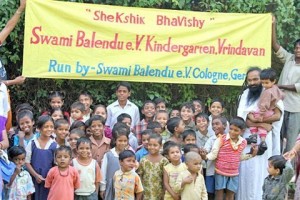
WILLKOMMEN AUF JAISIYARAM.COM!
Man kann in Workshops zu den Chakras, über Yoga oder Ayurveda teilnehmen oder auch zu einer individuellen Heilsitzung, einer Meditation oder einer Chakra Tanz Party kommen.
Auf dieser Internetseite findet ihr Information zu all diesen Aktivitäten sowie verschiedene Möglichkeiten, wie ihr von dieser wundervollen Energie profitieren könnt.
Alle Aktivitäten und Spenden unterstützen Swami Balendus Wohltätigkeitsprojekte für arme Kinder in Indien.
Wir wünschen euch viel Spaß beim Entdecken der Seite!
> Meet Swami Balendu, friends, socialprojects studies at facebook <
ART OF LIVING, MEDITATION, YOGA
His Holiness Sri Sri Ravi Shankar is a universally revered spiritual, and humanitarian leader. His vision of a violence-free, stress-free society through the reawakening of human values has inspired millions to broaden their spheres of responsibility and work towards the betterment of the world. HH Sri Sri Ravi Shankar is a multi-faceted social activist whose initiatives include conflict resolution, disaster and trauma relief, poverty alleviation, empowerment of women, prisoner rehabilitation, education for all, and campaigns against female foeticide and child labor. He is engaged in peace negotiations and counseling in conflict zones around the world. His expertise in bringing opposing parties to the negotiating table in areas such as Sri Lanka, Iraq, the Ivory Coast, Cameroon, Kashmir, and Bihar is widely acknowledged. Read More: > HERE <
The Art of Living is a multi-faceted, not-for-profit educational and humanitarian NGO with a presence in over 140 countries. Founded in 1982 by His Holiness Sri Sri Ravi Shankar, the Art of Living, today, is one of the largest voluntary organisations in the world.
Inspired by its founder’s vision of making the world a violence-free, stress-free global family, the organisation is engaged in various initiatives that uplift humanity and enhance the quality of life. The goal of the organisation is to bring peace at the level of the individual, society, nation and the world as a whole. Its areas of work covers conflict resolution, disaster and trauma relief, poverty alleviation, empowerment of women, prisoner rehabilitation, education for all, campaigns against female foeticide and child labour and environment sustainability.
Guided by Sri Sri’s philosophy of peace, “Unless we have a stress-free mind and a violence-free society, we cannot achieve world peace,” the Art of Living offers several stress-elimination and self-development programmes based mainly on breathing techniques, meditation and yoga. These programmes have helped thousands around the world to overcome depression and violent and suicidal tendencies.
The Art of Living has several sister organisations which are dedicated to realising its vision. International Association for Human Values, Ved Vignan Maha Vidya Peeth, Sri Sri Ravishankar Vidya Mandir, Vyakti Vikas Kendra India, among others, formulate and implement social projects of the Art of Living.
Professional Affiliations
The Art of Living works in special consultative status with the Economic and Social Council (ECOSOC) of the United Nations participating in a variety of committees and activities relating to health, education, sustainable development and conflict resolution. It also carries our several joint initiatives with UN organizations such as United Nations Millennium Campaign (UNMC), United Nations Children’s Fund (UNICEF), etc.
Memberships:
-
CONGO (Conference of NGOs in Consultative Status with ECOSOC of the United Nations), Geneva and New York
-
UN Mental Health Committee,UN Committee on Aging, New York
-
International Union for Health Promotion and Education, Paris
-
NGO Forum for Health, Geneva
-
National Association of Women’s Organisations, Uganda
DIVYA YOGA MANDIR TRUST, HEALTHCARE
> Patanajali Yog Peeth (UK) Trust <
> Yoga for Cure, Publications <
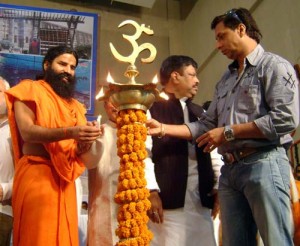
Swami Ramdev (Hindi: स्वामी रामदेव), also known as Baba Ramdev, is an Indian Hindu swami. He is particularly well-known for his efforts in popularizing Yoga as it is enunciated in Patanjali’s Yoga Sutras. He is also one of the founders of the Divya Yog Mandir Trust that aims to popularize Yoga and offer Ayurvedic treatments. His camps are attended by a large number of people. Over 85 million people follow his yoga camps via TV channels, and video. His yoga teaching sessions are for the masses and free for all. His stated principle in life is to be of help to all. Read More: > Here <
Divya Yog Mandir (Trust): Illustrious Past – A Promising Future:
The Kripalu Bagh Ashram on the blessed land next to the holy Ganges, was built in 1932 by the scholarly erudite and God realized Param Pujya Swami Kripalu Dev Ji Maharaj.
Concomitant with this noble struggle, Swami Kripalu Dev Ji along with another great spiritualist Swami Shraddhanand, who was the founder of the pure and chaste Hindus traditions of the “GURUKUL KANGRI”, organized a movement of rejuvenation of pristine Indian ancient traditions and renaissance of its glorious and hoary past where by the country, its religion and all related aspects, covered by the gathering dust of centuries neglect, were rediscovered and extolled.
Saint Shri Kripalu Dev Ji Maharaj was succeeded by his illustrious disciple Pujya Swami Shri Shankar Dev Ji Maharaj, well conversant with Vedic knowledge and an ardent advocate of noble human values. Swami ji founded the Trust in 1995 along with his group of disciples; yet another Philanthropist Pujya Swami Ram Dev Ji Maharaj who has dedicated his presence to augument the haloed traditions of the trust based on selfless service and dedicated quest for excellence in education, vedic learning and promotion of nationalism; he is joined by an energetic soul with an intense spirit of service. Acharya Shri Balkrishan Ji, also a great spiritualist & great scholar of Ayurved and an established name in Vedic philosophy Acharya Shri Muktanand ji (B.Sc. Vyakrancharya and other disciples and a few families continue to exalt the traditions and enrich the future with what the trust had enshrined and achieved in its glorious preceding years.
NATURWESEN UND ANDERSWELTREISEN

„Dana Mudra“ ist die „Geste des Gebens“, mit der in der indischen und tibetischen Kunst manche Gottheiten und Buddhas dargestellt werden.
Margot Ruis und Gerhard Kogoj haben bei längeren Aufenthalten in Indien viel Wunderbares und auch viel Erschütterndes gesehen, haben Menschen und Organisationen kennengelernt, die großartige Arbeit leisten, um den Ärmsten zu helfen. Aus dem Bedürfnis heraus, diese Arbeit mitzutragen – und zwar effizienter als es Privatpersonen möglich ist – haben sie gemeinsam mit Giorgio Nirvanananda Kriegsch und einigen engagierten Freunden den gemeinnützigen Verein „DANA MUDRA — Die Gebende Hand“ gegründet.
Wir freuen uns, Euch/Ihnen den Termin für das Naturwesenseminar 2010 mitteilen zu dürfen.
8.7. bis 11.7.2010: Naturwesen und Andersweltreisen
Ort: Biohaus Walsberg, Niederösterreich
Alle Informationen gibt es wie immer auch auf unserer Homepage: http://www.danamudra.org/calendar.php. Dort finden sich auch Hinweise auf weitere Vorträge und Veranstaltungen.
Klassischer Indischer Tanz Bharatanatyam
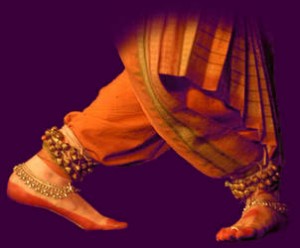
Wir laden Sie herzlich ein zur Veranstaltung:
Bhakti Devi tanzt
klassischer Indischer Tanz Bharatanatyam
Eröffnung durch Studentinnen der Indischen Tanzschule
Blaues Theater
Franz Schubert Konservatorium
Mariahilferstraße 51, 1060 Wien
Online Kartenreservierung: www.blauestheater.at
Eintritt 15,- / Ermäßigt 12,-
Kartenreservierung-Vorverkauf:
OM Shiva Esoterik Reinprechtsdorferstr. 54, 1050 Wien, Tel.: 01/9610632
DKA – CAROL SINGING CAMPAIGN
> CAROL SINGING CAMPAIGN <
> The three kings, Carol Singing <
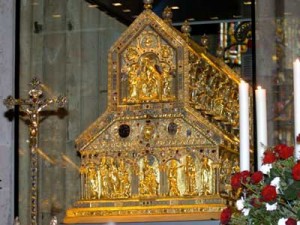
A tradition in most of Central Europe involves writing the initials of the three kings‘ names above the main door of the home to confer blessings on the occupants for the New Year. For example, 20 + C + M + B + 08.
The initials may also represent „Christus mansionem benedicat“ (Christ bless this house). In Catholic parts of Germany and in Austria, this is done by so called Sternsinger (star singers), children, dressed up as the Magi, carrying the star. In exchange for writing the initials, they collect money for charity projects in the third world.
Project work of DKA – Development includes every aspect of human life. Development cooperation intends to overcome injustice and oppression. DKA supports projects in the following fields:
-
Education enables people to look at their own life situation, and take steps to bring about positive change.Social projects work with communities to find sustainable methods of meeting peoples‘ basic needs whilst also striving for long term peace and social improvement in the community.
-
Pastoral programmes contribute to the establishment and promotion of active churches and their commitment to human concerns.
-
Protection and promotion of human rights and of indigenous people as well as particular commitment to women issues are also important priorities of the project work.
The projects of DKA have to be planned and implemented together with the persons affected in order to achieve a long-term improvement. Moreover, the projects must target a broad spectrum of people, provide holistic support and focus on pastoral and social awareness.
For more information on project policies and project support criteria please consult the relevant websites.
Decisions on the support of projects are taken by an inter-diocesan allocation committee consisting of members of Jungschar from the nine Austrian dioceses.
