MAHA KUMBH MELA IN INDIA, 2010

The Purna (complete) Kumbh takes place at four places (Prayag (Allahabad), Haridwar, Ujjain, and Nashik) after every twelve years,while the Ardh Kumbh Mela is celebrated every six years at Haridwar and Prayag. Over 45 days beginning in January 2007, more than 17 million Hindu pilgrims took part in the Ardh Kumbh Mela at Prayag, and on January 15, the most auspicious day of the festival of Makar Sankranti, more than 5 million participated. Read More: > HERE <
Prof. (Dr.) Chitralekha Singh* – Kumbh Mela is a very big festival, participated by millions of people by taking a dip in the sacred waters at Haridwar, Parayag (Allahabad), Ujjain, Nasik & Vrindavan. This festival is observed at an interval of twelve years, when there is coincidence between the moon, the sun and the planet B’rhaspati. The bath, worship, charity and Satsang (religious congregation) are all important.
Churning of the sea by combined effort of the gods and demons produced Amrit (immortal juice). Gods and demons, both wanted it. So the pot was shifted from place to place and wherever this was shifted there was some spillage and these places were Haridwar, Prayag, Divya Vrindavan (where Garuda the vehicle of Vishnu has put the Amrit juice on Kadamb tree), Nasik, Ujjain and Haridwar, Vrindavan, Kumbh Mela is held in these places. At Nasik, Ujjain and Haridwar, Kumbh Mela is held every three years, but at Parayag it is after 12 years with Arddh Kumbh Mela held every 6 years.
Kumbh Mela after 6 years or 12 years is the proportional gain in the Magh Mela held at Parayag every year during the month of Magh (January – February) when lacs of pilgrims from all over India assemble to have a dip in the holy waters, in an attempt to wash away all their sins. Magh Mela (fairs) is held every year and everyday. Thousands of people are seen bathing in this water, throughout the month. Probably it was king Harsavardhan who was the initiator of this assembly (Mela).
During Kumbh Mela (after every 12 years) Parayag and all other pilgrimageswears a festive look, decorated with bright and glittering festoons. For a few days these places transforms into a Kumbhanagar, with lacs of pilgrims from all over India. Thousands of Sadhus and Sanyasis, who come down from their isolated mountain homes, and tourists from all over the world assemble these places to participate in this auspicious fair.
During the festival, the days of Makar Sankranti, Basant Panchmi, Maha Sivaratri, Chetra Amaveseya, Ram Navami and Baisakhi are recognized as more auspicious and benevolent.
(All the sketches are done by artist /author Prof. (Dr.) Chitralekha Singh at Haridwar, Maha Kumbh 2010 festival dated 5.02.2010)
Dean: Institute of Visual & Performing Art, Mangalayatan University, Vishwamitrapuri (Beswan), Aligarh.
Visit at: www.artistchitralekha.com
e.mail: artistchitralekha@artlover.com
Mob.: 09319103482
Meet Kumbh Mela Haridwar 2010, friends, at fb <
See All Sketches:
GVT. NATIONAL INSTITUTE OF AYURVEDA

* Traditional Ayurveda: Our Strenght *
> NATIONAL INSTITUTE OF AYURVEDA <

THE CAMPUS: The main campus of Govt. Ayurveda College is at Puthiyakavu, two kilometers from Tripunithura town in the Vaikom Road. The place is named after the Durga temple (puthiya-new; kavu-temple) famous for the fire works display during the annual festival.
It was a border area in between Cochin and Travancore the erstwhile princely States before the independence of India. The old building of the toll collection centre is still seen in the roadside. On Pathamudayam (the tenth day after Vishu, April 14 or 15) free trade is allowed in the forenoon, which is still re-enacted.
Lack of infrastructure for the introduction of Degree course in Ayurveda prompted the authorities to shift the college to a land with more area. Thus in 1964 a land area of more than 11 acres was acquired for the college at Puthiyakavu and the foundation stone was laid in 1968 by the then Health Minister Sri. B.Wellington. The new college building was opened in 1973 April 9th by the former President of India, Sri.V.V.Giri followed by the complete shifting of the college to the new campus. The campus is named after Acharya Dhanwanthari.
THE COLLEGE: The course offered by Govt. Ayurveda College Tripunithura is B.A.M.S (Bachelor of Ayurvedic Medicine and Surgery) also titled as AYURVEDACHARYA. It is a degree course recognized by Central Council of Indian Medicine, New Delhi, the authorized monitoring agency for education in Indian systems of medicine. The committee appointed by CCIM visits the college periodically reviews the standard before renewing the recognition.
The college is affiliated to Mahatma Gandhi University, Kottayam. The university conducts examinations and awards degree on satisfactory completion of the course. There are concerned constituted bodies like Board of Studies and Faculty in University to implement the syllabus and curriculum in a proper way.
THE HOSPITAL: Government ayurveda college hospital came into existence in 1960 when the hospital under indigenous medicine department at East Fort Gate, Tripunithura was handed over to the college for the clinical training of the students. By providing rational treatment to suffering public, the hospital is an active presence in the public health scenario of Central Kerala. In 1982 a new two storeyed hospital building was opened in the college campus at Puthiyakavu by the then Health Minister Sri.K.G.R.Kartha. It accommodated Prasootitantra, Koumarabritya, Salyatantra and Salakyatantra wards. There was also an anorectal clinic with Ksharasootra facilities. Kayachikitsa, Rogavijnana and Agadatantra wards remained at the Old Hospital building at Tripunitura. 13 departments came into existence in 1998. A new four storied building for 500 bedded hospital was dedicated to the nation by the then President of India Dr. A.P.J. Abdul Kalam in Dec. 17, 2005. This enabled to accommodate the all the departments in a single roof. More and more facilities are added in each year updating the quality of service rendered to the suffering humanity.
PHARMACY: Pharmacy is an essential part of any ayurvedic educative institution as quality medicines are needed for rational management of diseases. A small scale pharmacy was established at the hospital compound at East Fort Gate in 1960. It was later shifted to the Puthiyakavu campus in 1974. The present building with necessary machineries started functioning in 1980.
This subsidiary of the college is under the department of Rasasastra & Bhaishajyakalpana(R&B). The separate department for the subject was established in1998 by the bifurcation of Dravyagunavijnana. R & B imparts the knowledge of preparation of medicines in sastric lines. Rasasastra an associate system of ayurveda that incorporates refined forms of metals, minerals etc. as medicines is also taught by R & B. This also needs theoretical and practical knowledge. So a rasasala to give practical training is also a part the department.
The pharmacy presently manufactures medicines worth 8.50 lakhs approximately for free distribution through the collegiate hospital. All the forms of medicines like kashayas, churnas lehyas tailas are produced with quality manufacturing practices.
Proposal to upgrade the pharmacy to attain the GMP(Good Manufacturing Practices) certificate is being considered by the Government of India.
> Meet Lord Dhanvantari, friends at facebook <
> Meet all Ayurveda, friends, studies at fb <
Guru Shishya Tradition in Yoga, Veda, Arts
http://eastmeetswestmusic.com/
The guru-shishya tradition, lineage, or parampara, denotes a succession of teachers and disciples in traditional Indian culture and Dharmic Traditions such as Sanatana Dharma, Sikha Dharma, Jaina Dharma and Buddha Dharma. It is the tradition of spiritual relationship and mentoring in traditional Hinduism where teachings are transmitted from a guru (teacher, गुरू) to a ‚śiṣya‘ (disciple, शिष्य) or chela. Such knowledge, whether it be vedic, agamic artistic, architectural, musical or spiritual, is imparted through the developing relationship between the guru and the disciple. It is considered that this relationship, based on the genuineness of the guru, and the respect, commitment, devotion and obedience of the student, is the best way for subtle or advanced knowledge to be conveyed. The student eventually masters the knowledge that the guru embodies. The word Sikh is derived from the Sanskrit word shishya. It is related to the Brahmacharya. Read More: > Here <
Rashtriya Ayurveda Vidyapeeth was established on 11th Feb., 1988 with one of the objectives of promoting knowledge of Ayurveda and started functioning since 1991. The Vidyapeeth initiated the course of Member of RAV with an effort to revive the traditional method of Gurukula system of informal education of India i.e., Guru Shishya Parampara to Ayurvedic graduates after formal education. As people are aware, the present classical texts of Ayurveda, Charaka Samhita, Sushruta Samhita, Ashtanga Hridaya etc. are believed to be the outcome of such informal education. This kind of study is lacking at present in the modern educational institutions where the courses are bound by fixed syllabus, duration of time and many subjects to learn.
Guru Shishya Parampara is the traditional method of residential form of education wherein the Shishya remains with his Guru as a family member and gets the education as a true learner. This system gradually vanished with the disappearance of Gurukuls. However, it is still a very effective means of transfer of knowledge from the Gurus (teachers) to Shishyas (students). RAV is making efforts to revive the system through two types of courses.
In colleges and institutions only a relevant portion of the Samhita (texts of Ayurveda) is being taught in the form of syllabus. Guru Shishya Parampara of RAV facilitates the students to study whole text and get adequate knowledge of Samhita and its Teeka (commentary) and traditional skill for the Ayurvedic clinical practice. The Shishyas get sufficient time for interaction and discussion on the issues taken for study.
COURSES:
- (A)acharya guru shishya parampara, (One-year course of Member of Rashtriya Ayurveda Vidyapeeth) (MRAV)
- (B)Chikitsak guru shishya parampara, (One-year/Six month’s course of Certificate of Rashtriya Ayurveda Vidyapeeth) (CRAV)
- Read More: > HERE <
„The main features of a fruitful Guru-Shishya relationship led to (1) purity of mind and body, humility, a sense of service, and a devotional and spiritual attitude; (2) a thorough grounding of technique and science of music; (3) the gradual development of the disciple as he sits behind his guru at concerts and joins in when asked, but does not perform by himself until his guru finds him fit to do so; and (4) freedom from economic worries by the disciple, living and serving his guru, as a member of his family.“
Pandit Ravi Shankar (My Music, My Life)
PUBLICATIONS: Vidyapeeth has been publishing certain books of Ayurveda, which are found suitable for general public in creating awareness, and also books for Ayurvedic professionals. The Vidyapeeth also publishes the theses of its students after necessary review and recommendation by the Expert Committee and approval by the Governing Body. Further, the Vidyapeeth brings out a Souvenir, containing selected full papers, at the time of Conference/Seminar conducted every year.
SEMINARS/CONFERENCES: Vidyapeeth conducts a Conference/Seminar/Workshop every year on a topic that requires discussion and exchange of the views and clinical experience on the diagnosis and treatment of the disease, mostly the health problems not easily managed by majority of Vaidyas without side effects. So far Conferences/Seminars have been conducted on Kshara Sutra, Heart diseases, Ayurvedic Education, Training and Development, Nadi Vigyan, Fast Acting Ayurvedic Medicines and Techniques, Cancer, Shothahara Avam Jeevanu Nashak Ayurvedic medicines, AIDS, Thyroid disorders, Rasayana, Ayurvedic management of kidney and urinary disorders , Management of Hepato-biliary & Splenic disorders through Ayurveda, Diabetes Mellitus, Mental Health and Vatavyadhis.
AWARD OF FELLOW OF R.A.V.: For achieving one of its objectives, the Vidyapeeth awards Fellowship to the eminent scholars of Ayurveda and practitioners of various traditional Ayurvedic techniques in recognition of their scholarly expertise and contribution in the field of education, research, patient care and literature. In the year 1992 the Vidyapeeth awarded 50 Foundation Fellowships to eminent Vaidyas. Thereafter, a maximum of 30 fellowships are being awarded every year. This is an honorary recognition and a felicitation with a citation, a shawl and a kalash/memento presented to each awardee in the Convocation of RAV. As per rules of the Vidyapeeth, the total number of fellows at any time shall not exceed 300. Every year the Governing Body determines these fellowships on the basis of the bio-data of scholars. So far, 224 scholars have been awarded Fellow of Rashtriya Ayurveda Vidyapeeth (FRAV) Annexure – IV.
CONVOCATION: In order to fulfill the objectives of the Vidyapeeth viz. to institute due recognition to successful candidates and to recognize and encourage merit in various branches of Ayurveda, the Vidyapeeth holds Convocation every year for awarding certificates to passed out students and to felicitate eminent scholars and Vaidyas with Fellow of Rashtriya Ayurveda Vidyapeeth (FRAV) for their significant contribution for the progress of Ayurveda in the fields of education, research, literature and health care.
A guru (Sanskrit: गुरु) is one who is regarded as having great knowledge, wisdom and authority in a certain area, and who uses it to guide others (teacher).
In sanskrit gu means darkness & ru means light. As a principle for the development of consciousness it leads the creation from unreality to reality, from the darkness of ignorance to the light of knowledge. In its purest form this principle manifests on earth as a divine incarnation (saint), a person with supreme knowledge about God and all creation. Other forms of manifestation of this principle also include parents, school teachers , non-human objects (books) and even one’s own intellectual discipline.
The syllable gu means shadows
The syllable ru, he who disperses them,
Because of the power to disperse darkness
the guru is thus named.
– Advayataraka Upanishad 14—18, verse 5
In the religious sense the term is commonly used in Hinduism and Sikhism, as well as in Buddhism and new religious movements.
Finding a true guru is often held to be a prerequisite for attaining self-realization. Guru Nanak, founder of the Sikh religion said: „Even if a thousand suns and moons rose, they would be unable to remove the darkness of ignorance within the heart. This can only be removed through the grace of the Guru.“
„Guru“ also refers in Sanskrit to Brihaspati, a divine figure in Hinduism. In Vedic astrology, guru or Brihaspati is believed to exert teaching influences.[clarification needed] Indeed, in many Indian languages such as Hindi, the occidental Thursday is called either Brihaspativaar or Guruvaar (vaar meaning day of the week).
In contemporary India, Indonesia and the Philippines, the word „guru“ is widely used with the general meaning of „teacher“. Guru in Buddhism, Hinduism, Sikh…Gurukulam System in Tradititional KALARI… Read More: > HERE <
In Western usage, the meaning of guru has been extended to cover anyone who acquires followers, though not necessarily in an established school of philosophy or religion. In a further Western extension, guru is used to refer to a person who has authority because of his or her perceived secular knowledge or skills, such as in business.
Weblinks: > yoga-vidya.de < ( no english translation avaiable) – ….Ishwara selbst ist der ursprüngliche Guru (Lehrer). Unsere Guru Parampara (Schüler-Lehrer-Tradition) beginnt bei Narayana. Narayana ist Vishnu, also eine Manifestation von Ishwara. Die Hatha Yoga Guru Parampara fängt bei Shiva an. Alle Guru Paramparas in Indien fangen letztendlich mit Gott an, indem ursprünglich ein Lehrer die Weisheit direkt von Gott empfangen hat. So ist Gott der Lehrer aller Lehrer..
- www.punarjanis.com (Dr. E. Shaji Raj)
- www.unom.ac.in
- www.hihtindia.org (Himalayan Ayurveda Hospital Trust)
- AYURVEDA, Prime Treatments in Ayurveda <
- AYURVEDA4UAll <
- Meet Yoga Vidya English, friends and Studies at fb <
- Meet Ayurveda Friends, Groups, Studies at facebook <
- Meet Ayurveda4UAll, friends, Studies at facebook <
- Meet CODEX ALIMENTARIUS friends and group at fb <
- Meet FREE Visa to India for MBA, Degree Programs , it jobs at fb <
- Meet Lord Dhanwantri, friends, studies at facebook <
Council for Parliament of the World´s Religions

> SWAMI VIVEKANANDA´s SPEECH AT THE COUNCIL 1893, Chicago <
There have been several meetings referred to as a Parliament of the World’s Religions, most notably the World’s Parliament of Religions of 1893, the first attempt to create a global dialogue of faiths. The event was celebrated by another conference on its centenary in 1993. This led to a new series of conferences under the official title „Parliament of the World’s Religions“.
In 1893, the city of Chicago hosted the World Columbian Exposition, an early world’s fair. So many people were coming to Chicago from all over the world that many smaller conferences, called Congresses and Parliaments, were scheduled to take advantage of this unprecedented gathering. A number of congresses were held in conjunction with the exposition, including those dealing with anthropology (one of the major themes of Exposition exhibits), labor, medicine, temperance, commerce and finance, literature, history, art, philosophy, and science. One of these was the World’s Parliament of Religions. The Parliament of Religions was by far the largest of the congresses held in conjunction with the Exposition. Read More: > HERE <
Our Mission – The Council for a Parliament of the World’s Religions was created to cultivate harmony among the world’s religious and spiritual communities and foster their engagement with the world and its guiding institutions in order to achieve a just, peaceful and sustainable world. To accomplish this, we invite individuals and communities who are equally invested in attaining this goal.
Our Vision – The vision of the Council for a Parliament of the World’s Religions is of a just, peaceful and sustainable world in which:
- Religious and spiritual communities live in harmony and contribute to a better world from their riches of wisdom and compassion
- Religious and cultural fears and hatreds are replaced with understanding and respect
- People everywhere come to know and care for their neighbors
- The richness of human and religious diversity is woven into the fabric of communal, civil, societal and global life
- The world’s most powerful and influential institutions move beyond narrow self-interest to realize common good
- The Earth and all life are cherished, protected, healed and restored
- All people commit to living out their highest values and aspirations.
Our Approach – The Council for a Parliament of the World’s Religions seeks to promote interreligious harmony, rather than unity. The problem with seeking unity among religions is the risk of loss of the unique and precious character of each individual religious and spiritual tradition; this understanding is key to our framework.
Interreligious harmony, on the other hand, is an attainable and highly desirable goal. Such an approach respects, and is enriched by, the particularities of each tradition. Moreover, within each tradition are the resources (philosophical, theological and spiritual teachings and perspectives) that enable each to enter into respectful, appreciative and cooperative relationships with persons and communities of other traditions.
> Parliament of World´s Religions utube Channel <
> The Dalai Lama addresses Parliament of World Religions 2009 <
Our Opportunity – We live in a world of difference. Yet, we are interdependent. Nowhere is learning to live with difference more important than religion.
Too often, religion is misused as an instrument for division and injustice, betraying the very ideals and teachings that lie at the heart of each of the world’s great traditions. At the same time, religious and spiritual traditions shape the lives of billions in wise and wonderful ways. They gather people in communities of shared beliefs and practices. When these diverse communities work in harmony for the common good, there is hope that the world can be transformed.
Over the years, the Council has initiated dialogues and nurtured relationships among people of difference. In doing so the Council has provided a framework for expressing many visions of a just, peaceful and sustainable future. In the process, religious and spiritual communities have discovered a shared commitment to ethical principles.
This shared commitment has opened the way for a new era of cooperative action among the world’s religious and spiritual communities as well as civil and political societies. The well-being of the Earth and all life depends on this collaboration.
Meet Council for a Parliament of the World’s Religions (CPWR) at fb <
Meet Declare 2010 THE YEAR OF PEACE – Make it the largest Group of fb <
HERMANN HESSE FOUNDATION – SIDDHARTHA
(HERMANN HESSE FOUNDATION – Film Footage, Portrait, Sound…)
> THE DIGITAL GUTENBERG PROJECT <
> JNANA YOGA, BHAKTI YOGA, ADVAITA VEDANTA <
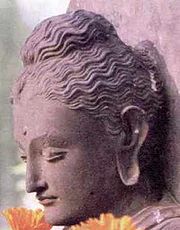
Buddha Shakyamuni – Kopf einer Buddhastatue am Niederrhein. Hesse gab der Hauptfigur seiner „indischen Dichtung“ denselben Vornamen des historischen Buddhas Siddhartha Gautama. „Einen Buddha zu schaffen, der den allgemein anerkannten Buddha übertrifft, das ist eine unerhörte Tat, gerade für einen Deutschen.“ > Henry Miller < über Hesses Siddhartha.
Hermann Hesse (German pronunciation: [ˈhɛʀman ˈhɛsə]) (July 2, 1877 – August 9, 1962) was a German-born Swiss poet, novelist, and painter. In 1946, he received the Nobel Prize in Literature. His best-known works include Steppenwolf, Siddhartha, and The Glass Bead Game (also known as Magister Ludi), each of which explores an individual’s search for authenticity, self-knowledge and spirituality. Read More: > HERE <
Hermann Hesse was born on 2 July 1877 in the Black Forest town of Calw in Württemberg, Germany. Hesse began a bookshop apprenticeship in Esslingen am Neckar, but, after three days, he left. Then, in the early summer of 1894, he began a 14-month mechanic apprenticeship at a clock tower factory in Calw. The monotony of soldering and filing work made him resolve to turn himself toward more spiritual activities. In October 1895, he was ready to begin wholeheartedly a new apprenticeship with a bookseller in Tübingen. This experience from his youth he returns to later in his novel Beneath the Wheel.
In Gaienhofen, he wrote his second novel, Beneath the Wheel, which was published in 1906. In the following time, he composed primarily short stories and poems.
Gaienhofen was also the place where Hesse’s interest in Buddhism was re-sparked. Following a letter to Kapff in 1895 entitled Nirvana, Hesse ceased alluding to Buddhist references in his work. In 1904, however, Arthur Schopenhauer and his philosophical ideas started receiving attention again, and Hesse discovered theosophy. Schopenhauer and theosophy renewed Hesse’s interest in India. Although it was many years before the publication of Hesse’s Siddhartha (1922), this masterpiece was to be derived from these new influences.
During this time, there also was increased dissonance between him and Maria, and, in 1911, Hesse left alone for a long trip to Sri Lanka and Indonesia. Any spiritual or religious inspiration that he was looking for eluded him, but the journey made a strong impression on his literary work. Following Hesse’s return, the family moved to Bern (1912), but the change of environment could not solve the marriage problems, as he himself confessed in his novel Rosshalde from 1914.
In 1931, Hesse began planning what would become his last major work, The Glass Bead Game (aka Magister Ludi). In 1932, as a preliminary study, he released the novella Journey to the East. The Glass Bead Game was printed in 1943 in Switzerland. For this work, he was awarded the Nobel Prize in Literature in 1946.
AWARDS: * 1906 – Bauernfeld-Preis, * 1928 – Mejstrik-Preis der Wiener Schiller-Stiftung, * 1936 – Gottfried-Keller-Preis * 1946 – Goethepreis der Stadt Frankfurt, * 1946 – Nobel Prize in Literature, * 1947 – Honorary Doctorate from the University of Bern, * 1950 – Wilhelm-Raabe-Preis, * 1954 – Orden Pour le mérite für Wissenschaft und Künste, * 1955 – Peace Prize of the German Book Trade
From the end of the 1930s, German journals stopped publishing Hesse’s work, and it was eventually banned by the Nazis.
The Glass Bead Game was Hesse’s last novel. During the last twenty years of his life, Hesse wrote many short stories (chiefly recollections of his childhood) and poems (frequently with nature as their theme). Hesse wrote ironic essays about his alienation from writing (for instance, the mock autobiographies: Life Story Briefly Told and Aus den Briefwechseln eines Dichters) and spent much time pursuing his interest in watercolors.
Hesse also occupied himself with the steady stream of letters he received as a result of the prize and as a new generation of German readers explored his work. In one essay, Hesse reflected wryly on his lifelong failure to acquire a talent for idleness and speculated that his average daily correspondence was in excess of 150 pages. He died on 9 August 1962 and was buried in the cemetery at San Abbondio in Montagnola, where Hugo Ball is also buried.
The Digital Gutenberg Project – In June 2002, the Ransom Center and IImage Retrieval Inc. of Carrollton, Texas collaborated on the digitization of the Center’s Gutenberg Bible using the i2s Digibook 6000 overhead scanner. The project took less than a week to complete and resulted in nearly 1,300 digital images. For the first time, it is possible for the general public to view all of the pages from the University of Texas copy, including all of the large illuminated letters in volume I and the copious handwritten annotations, as well as other indications of the book’s use in religious services. The release of the web images coincides with the installation of the Gutenberg Bible in a new exhibition case, part of the recently remodeled main lobby of the Ransom Center.
Further reproduction of any of the Gutenberg Bible images without the written consent of the Ransom Center is prohibited. Inquiries regarding the availability of higher-resolution digital images for research or publication should be directed to the Center’s staff.
The > Project Gutenberg < Presents Siddhartha > CONTENT < :
Copyright Status: Not copyrighted in the United States. If you live elsewhere check the laws of your country before downloading this ebook.
An Indian Tale by Hermann Hesse:
…..But he, Siddhartha, was not a source of joy for himself, he found no delight in himself. Walking the rosy paths of the fig tree garden, sitting in the bluish shade of the grove of contemplation, washing his limbs daily in the bath of repentance, sacrificing in the dim shade of the mango forest, his gestures of perfect decency, everyone’s love and joy, he still lacked all joy in his heart. Dreams and restless thoughts came into his mind, flowing from the water of the river, sparkling from the stars of the night, melting from the beams of the sun, dreams came to him and a restlessness of the soul, fuming from the sacrifices, breathing forth from the verses of the Rig-Veda, being infused into him, drop by drop, from the teachings of the old Brahmans.
…..For whom else were offerings to be made, who else was to be worshipped but Him, the only one, the Atman? And where was Atman to be found, where did He reside, where did his eternal heart beat, where else but in one’s own self, in its innermost part, in its indestructible part, which everyone had in himself? But where, where was this self, this innermost part, this ultimate part? It was not flesh and bone, it was neither thought nor consciousness, thus the wisest ones taught. So, where, where was it? To reach this place, the self, myself, the Atman, there was another way, which was worthwhile looking for? Alas, and nobody showed this way, nobody knew it, not the father, and not the teachers and wise men, not the holy sacrificial songs!
They knew everything, the Brahmans and their holy books, they knew everything, they had taken care of everything and of more than everything, the creation of the world, the origin of speech, of food, of inhaling, of exhaling, the arrangement of the senses, the acts of the gods, they knew infinitely much—but was it valuable to know all of this, not knowing that one and only thing, the most important thing, the solely important thing?
Surely, many verses of the holy books, particularly in the Upanishades of Samaveda, spoke of this innermost and ultimate thing, wonderful verses. „Your soul is the whole world“, was written there, and it was written that man in his sleep, in his deep sleep, would meet with his innermost part and would reside in the Atman…… (Anm.: Advaita Vedanta).
Marvellous wisdom was in these verses, all knowledge of the wisest ones had been collected here in magic words, pure as honey collected by bees. No, not to be looked down upon was the tremendous amount of enlightenment which lay here collected and preserved by innumerable generations of wise Brahmans.— But where were the Brahmans, where the priests, where the wise men or penitents, who had succeeded in not just knowing this deepest of all knowledge but also to live it? Where was the knowledgeable one who wove his spell to bring his familiarity with the Atman out of the sleep into the state of being awake, into the life, into every step of the way, into word and deed?….
Thus were Siddhartha’s thoughts, this was his thirst, this was his suffering.
Often he spoke to himself from the Chandogya-Upanishad the words: „Truly, the name of the Brahman is satyam—verily, he who knows such a thing, will enter the heavenly world every day.“
Often, it seemed near, the heavenly world, but never he had reached it completely, never he had quenched the ultimate thirst. And among all the wise and wisest men, he knew and whose instructions he had received, among all of them there was no one, who had reached it completely, the heavenly world, who had quenched it completely, the eternal thirst.
„Govinda,“ Siddhartha spoke to his friend, „Govinda, my dear, come with me under the Banyan tree, let’s practise meditation.“
They went to the Banyan tree, they sat down, Siddhartha right here, Govinda twenty paces away. While putting himself down, ready to speak the Om, Siddhartha repeated murmuring the verse:
Om is the bow, the arrow is soul, The Brahman is the arrow’s target, That one should incessantly hit.

( > * Hermann Hesse Paintings:Flower, Tree, Bird * < )
SIDDHARTHA, FIRST PART
- THE SON OF THE BRAHMAN
- WITH THE SAMANAS
- GAUTAMA
- AWAKENING
SECOND PART
- KAMALA
- WITH THE CHILDLIKE PEOPLE
- SAMSARA
- BY THE RIVER
- THE FERRYMAN
- THE SON
- OM
- GOVINDA
- Related Articles on Yoga, > ADVAITA VEDANTA <
- Meet Hermann Hesse, Friends, Fans, Arts at facebook <
Evening about Tagore Culture Prize 2009
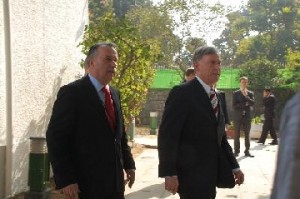
German President at Göthe Institute Dehli
> Göthe Institute in New Dehli <
> PRESSEMITTEILUNG TAGORE KULTURPREIS 2009 <
> Deutsch Indische Ges. Tagore Kulturpreis <
Rabindranath Tagore (Bengali: রবীন্দ্রনাথ ঠাকুর) (7 May 1861 – 7 August 1941),sobriquet Gurudev,was a Bengali polymath. As a poet, novelist, musician, and playwright, he reshaped Bengali literature and music in the late 19th and early 20th centuries. As author of Gitanjali and its „profoundly sensitive, fresh and beautiful verse“, being the first non-European to win the 1913 Nobel Prize in Literature, Tagore was perhaps the most important literary figure of Bengali literature and a mesmerising representative of the Indian culture whose influence and popularity internationally perhaps could only be compared to that of Gandhi whom Tagore named ‚Mahatma‘ out of his deep admiration for him.Read More: > HERE <
On 10th October 2009, the German musician and author Peter Pannke along with Dieter B. Kapp received the prestigious Rabindranath Tagore Culture Prize 2009 from the Indo-German Society in Stuttgart.
This award acknowledges over 30 years of Pannke’s commitment and dedication as an ambassador of Indian traditions in Germany and as a promoter of musical dialogues between the two countries. To mark this occasion, the Goethe-Institut has invited the renowned Indologist to a festive program at the Max Mueller Bhavan. The program will include conversations about his recently published books ‘Singers Die Twice’ and ‘Dreamtalker’ as well as readings from these books. Strains from traditional Dhrupad music will conclude the evening.
The poet, Ashok Vajpeyi, will inaugurate the program with a speech in honour of Peter Pannke. Other participants in this event: Sanjeev Gupta (Translator), Dhritabrata Bhattacharjya Tato (Publisher Daastaan), Druphad singer Prashant Kumar Mallik accompanied by his music ensemble.
Filmclip: „Obsession“ by Troubadour United
Peter Pannke studied Sinology, Indology, comparative religious studies and Musicology. He travelled for many years through the Near East, North Africa, Pakistan and India, before he made a name for himself as a radio broadcaster, sound artist and as leader of the band Troubadours United. He is a composer and musician and has produced over eighty CDs/LPs. He is also an author of reportages, illustrated books and poetry. His book „Dreamtalker – Songs, Poems, Essays“ was released in January 2010 in Delhi by Dastaan Publishers. The English translation of his highly acclaimed travelogue „ Singers Die Twice“will be published in India this autumn.
Singer, Dreamer and Storyteller:
An evening with Rabindranath Tagore Culture Prize winner Peter Pannke
Literature / Music
Thursday, 04.03.10, 7.00 p.m.
Siddhartha Hall, Goethe-Institut/Max Mueller Bhavan
Related link:
Press release announcing the Rabindranath Tagore Culture Prize winner for 2009 deutsch
Meet ALL Rabindranath Tagore, Friends, Studies, Groups at fb <
Poetry, Rabindranath Tagore in Germany
> TAGORE, GHANDI, INDIA TODAY <
> MARTIN KÄMPCHEN & TAGORE BOOK TIPS <
Rabindranath Tagore (Bengali: রবীন্দ্রনাথ ঠাকুর) ,(7 May 1861 – 7 August 1941),γsobriquet Gurudev,was a Bengali polymath. As a poet, novelist, musician, and playwright, he reshaped Bengali literature and music in the late 19th and early 20th centuries. As author of Gitanjali and its „profoundly sensitive, fresh and beautiful verse“,being the first non-European to win the 1913 Nobel Prize in Literature, Tagore was perhaps the most important literary figure of Bengali literature and a mesmerising representative of the Indian culture whose influence and popularity internationally perhaps could only be compared to that of Gandhi whom Tagore named ‚Mahatma‘ out of his deep admiration for him.Read More: > HERE <
Rabindranath Tagore (1861-1941) ist der berühmteste Dichter des modernen Indien. 1913 erhielt er als erster Asiate den > Literatur-Nobelpreis < . Sein universales Genie schuf Literatur in allen Gattungen, er gründete eine Schule und Universität, betätigte sich als Schauspieler, Sänger seiner eigenen Lieder, als Maler und Sozialreformer in den Dörfern. Kämpchen hat als erster Tagore in einer repräsentativen Sammlung von fünfzig Gedichten und Liedern, die alle Schaffensperioden umfassen, den deutschsprachigen Lesern vorgestellt.
Tagore besuchte Deutschland dreimal und wurde dort sehr gefeiert. In mehreren wissenschaftlichen Werken untersucht Kämpchen Tagores Verhältnis zum deutschen Geistesleben der zwanziger Jahre. Dieses letzterschienene Buch beschreibt Tagores Beziehungen zu dem Philosophen Hermann Keyserling, zu Kurt Wolff (seinem Verleger), zu Helene Meyer-Franck (seiner Übersetzerin) und Heinrich Meyer-Benfey (seinem profiliertesten Interpreten).
…..If I were asked who was the greatest poet India has produced, including the greatest of ancient India, Kalidasa, my firm answer would be: ‘Tagore’ … It is tragic, however, that his greatness as a poet will never be generally acknowledged, like the greatness of Goethe, Hugo or Tolstoy…..
These two sentences by the well-known writer Indian > Nirad Chaudhuri < sum up the fate of Rabindranath Tagore as a literary figure: On the one hand, they emphasise the immense importance his work receives in West Bengal and Bangladesh; on the other hand, they demonstrate the clear limits of his importance. Tagore’s influence does not transcend the confines of the Bengali language. Bengali is spoken by approximately 180 million people in West Bengal and Bangladesh. This is a larger figure than, for example, the entire German-speaking population. Yet, Bengali is considered a regional language of the Indian subcontinent (with a limited significance even within the context of the subcontinent), whereas German is accepted as a world language, as indeed most European languages are. We are all aware of the political and economic history which created such an imbalance between the languages and the cultures in the world.
Congenial translations needed!
Hence it entirely depends on the availability of congenial translations whether Rabindranath Tagore’s true worth will be appreciated beyond Bengal. Making Shakespeare, Dante or Tolstoy one’s own with the assistance of excellent translations is comparatively easy. Shakespeare has been translated into German for the last two hundred years with immense success, and is still being translated. But translating Tagore into German does not merely entail two European languages, but two languages which are divided by separate cultures, social contexts, geographical areas and religions. He who wants to translate a poem by Tagore from Bengali to German needs to bridge the gulf which separates India and Germany.
It is not easy for an Indian to admit that their national poet, Rabindranath Tagore, is hardly known in Europe. Although the Indian subcontinent entered the sphere of modern World Literature through Tagore, this has become a fact of history now. Today Tagore is no longer a vibrant, dynamic element of World Literature, he no longer influences the intellectual horizon of a large readership and inspires writers outside Bengal. For Bengalis, Rabindranath Tagore continues to have a powerful, sometimes overbearing cultural presence.
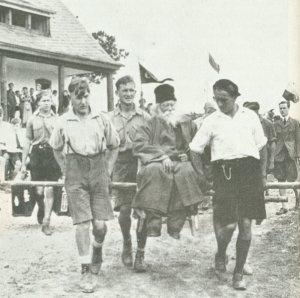
Visiting a youthgroup in Germany, 1930 (siehe oben)
It is virtually impossible to ignore him, even though one may reject him. For Europeans, Tagore represents the distant memory of a Wise Old Man from the East, of an Eastern mystic who arrived in Germany after the First World War to dispense consolation and courage to a people immersed in a deep spiritual and cultural crisis. For less than a decade, Tagore enthused German audiences and readers, after which he sank into oblivion, a process which was aided by the advent of Nazi Germany for which the Indian poet was anathema.
Many Germans may feel that Tagore would best be forgotten. The mystical vagueness of his poems and his lyrical prose may have enthralled European readers for some years, but they could not pass the test of time. These poems were rendered into English by the poet himself and then translated into German by German translators. Tagore’s own English rendering does not merit the term “translation”. These texts were at best paraphrases. He transformed his finely chiselled Bengali verses into rhythmical English prose. In the process he often simplified or even trivialised the content by leaving out some of the more complex ideas and evocations and by adding new material. It is generally agreed that, whatever be the inherent worth of these English texts, they do not echo the intricacy and vigour and musicality of Tagore’s original poetry. Hence I call the German version of Tagore’s poetry “doubly watered-down”: first watered-down by Tagore himself through his English prose texts and then again by adopting them for the German.
If we examine the kind of poems Tagore selected for translation, we realise that they were predominantly his “spiritual” or “mystical” poems. He must have presumed that they especially appeal to Western readers, and he was not mistaken. But in the bargain, Tagore sacrificed a large spectrum of his themes, styles and moods which he did not present to the non-Bengali public. Tagore’s selection of poems helped to reinforce the image of Tagore as a mystic.
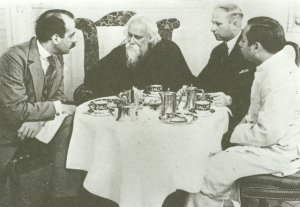
With German intellectuals in 1926
With German intellectuals in 1926
In 1921, Rabindranath Tagore visited Germany for the first time. The German people had just suffered a humiliating defeat in the First World War. Burdened with the crushing demands made by the Versaille Treaty, they longed for a “saviour” who could re-establish their self-esteem and help them find again meaning in life. Before entering Germany, Tagore expressed that he empathized with the German people in their hour of crisis and that he had come to strengthen her. So there was a clear symbiotic relationship even before Tagore began his month-long trip from city to city. Tagore mesmerized and fascinated his German audiences. Wherever he spoke, the halls were packed. Indeed, the newspapers reported scuffles and regular fights by people who were refused entry. The German press rose to the occasion by reporting Tagore’s every movement.
Tagore’s poetry had a direct appeal to Germans of that generation because his poetry (or whatever he chose to give to the West) was exotic, had a romantic flair, was imbued with spiritual idealism – and yet in all its strangeness it was still easily accessible. His poetry embodied a religious imagery, essentially Vaishnava in character, which was innovative for Western ears. To them, this culture of emotions was unfamiliar in its directness, its eroticism and involvement with nature and the cosmos – and yet, the poetry was totally comprehensible. Tagore himself, attired in his flowing, dark gown and with his white beard and serene face, radiated a certain erotic energy.
Tagore revisited Germany in 1926 and 1930. Although the early biographies of Tagore characterize Tagore’s three visits to Germany as unmitigated success stories, Tagore himself preferred to take a more detached view. In 1921, he wrote to a friend:
It has been a wonderful experience in this country for me! Such fame as I have got I cannot take at all seriously. It is too readily given, and too immediately. It has not had the perspective of time. And this is why I feel frightened and tired at it and even sad.[2]
The German-speaking press was by no means unanimous in its praise. There were three major points around which the criticism of the press revolved: (1) Tagore, a Hindu, wanted to influence Christians in their faith and ultimately convert them to Hinduism. (2) German writers deserved a slice of the Indian writer’s enormous fame, as they were no less talented and relevant in their writing. (3) Tagore’s seeming “oriental lethargy”, “bloodlessness”, “Indian mildness” was inimical to German or European “dynamism”, to its “action-oriented” mindset. At that point of history, this European mindset was deperately needed to support the reconstruction of the German nation after the First World War.
Rilke, Zweig, Thomas Mann, Hesse
The adulation Tagore received from the masses rather deterred serious German fellow writers from making an evaluation of Tagore’s literary merit. They even shied away from meeting him. Yet, there were two of Germany’s eminent contemporary writers who met Tagore and two others who took a serious interest in him and acclaimed him as a figure of consequence.
Let me first turn to Rainer Maria Rilke (1875-1926). Even a few months before Tagore was awarded the Nobel Prize, Rilke recognized Tagore’s importance which he expressed in a letter to Lou Andreas-Salomé[3]. Rilke had heard another famous writer, the Frenchman André Gide, read out his French translation of Gitanjali which had impressed Rilke considerably. Further, Rilke mentioned his praise of Tagore in a letter to the German publisher Kurt Wolff[4]. At the time, Wolff had just secured the English manuscript of Gitanjali for his publishing firm and it was already being translated. Quick to see his advantage, Wolff offered to Rilke that he translate Gitanjali into German, as Gide did into French. Rilke considered the offer deeply for some time and then rejected it. This is the explanation he gave in his letter to Kurt Wolff:
I do not find within myself that irrefutable call for the proposed assignment, from which alone could emerge a definitive and responsible work. Although much in these stanzas has a familiar ring, it seems, so to speak, to be borne towards me on a tide of unfamiliarity… This may be partly due to my meagre acquaintance with the English language.[5]
Rilke is not known to have commented on Rabindranath Tagore thereafter, not even in 1921 when the latter was in the zenith of his fame.
Stefan Zweig (1881-1941), the Austrian writer, and Thomas Mann were introduced to Rabindranath Tagore in the summer of 1921. True to their temperament, their reactions to Tagore were quite opposite to each other. Zweig, the suave cosmopolitan and altruistic humanitarian, had visited India in the winter of 1908/09. He was appalled by the poverty and misery he saw and later bemoaned the feeling of “unsurmountable unfamiliarity”[6] that overcame him when he faced India’s tumultuous life. Yet, he maintained an active interest in India’s freedom struggle and in her intellectual life. He also observed Rabindranath’s rise to fame in Europe and exchanged views on him with that other European intellectual with a keenly critical and supportive interest in India, Romain Rolland. So when Kurt Wolff informed Stefan Zweig that Tagore was to change trains in Salzburg en route to Vienna, Zweig who resided in Salzburg, jumped at the chance to meet him. The short meeting was deeply meaningful to Zweig. Returning home, he immediately penned a letter to Wolff in which he wrote:
Thank you very much for the information regarding Tagore’s travel programme. This enabled me to spend half an hour in his company today at Salzburg railway station while he changed trains. Thanks to you, I have encountered this great personality, of whom I formed a strong and profound impression.[7]
Zweig continued to observe Tagore’s impact on the European public. Zweig unequivocally appreciated Tagore’s message of humanism, while he was critical of Tagore’s ostensible penchant to seek publicity. When Tagore chose to visit the philosopher Count Hermann Keyserling in Darmstadt for a week, Zweig commented that Tagore “was unwise enough to have his visit publicly announced”[8]. And in 1926 Zweig criticised Tagore for this “new mania of travelling around Europe as a missionary of the spirit” which he calls a “contageous disease”[9].
Thomas Mann (1875-1955) was both less sympathetic and more complex in his reaction to Tagore. Initially, he even refused to meet him. In 1921, Mann was approached by Hermann Keyserling to write an essay on Tagore which was meant to publicize the “Tagore-Week” Keyserling planned in Darmstadt. Mann refused and was also unwilling to go and attend Tagore’s lectures. In a letter typical of Thomas Mann, he explained the reasons for his negative response.
Dear and Respected Count Keyserling,
I cordially thank you for your letter. It exudes so much enthusiasm that I almost packed my bags and went to Darmstadt. However this would have been easier than writing an article, particularly one canvassing for the famous Indian of whom I have, whether you believe it or not, no understanding, or almost none, until now. […] The image I have always had of him is picturesque but pallid. Surely I do him an injustice in assuming that the subjective pallor of this image reflects reality; in presuming him to be a typical Indian pacifist, animated by a somewhat anaemic humanitarian spirit and a mildness which I deemed almost hostile in the years I spent engrossed in violent emotional conflict. Surely the man is totally different. Since I understand from your letter that he has made a deep impression on you, he must be great.[10]
Thomas Mann alluded to the well-known duality between European strength and Indian “pallor”, “mildness” to which he gave a distinctly negative connotation. The letter was cleverly crafted. Mann had his say on Tagore clearly and then made a rhetorical volte-face by declaring: “Surely the man is totally different. Since […] he has made a deep impression on you, he must be great.” In this manner, he could pronounce his reservations and still hope not to offend the famous Count.
A few weeks later, however, Thomas Mann was unable to avoid coming face to face with the “pallid” Indian poet. Mann lived in Munich and Tagore arrived in that city for several lecture engagements. Tagore delivered a lecture at the University, and on the next day Kurt Wolff, Tagore’s German publisher, invited some people from the intellectual élite to a reception at his home. Thomas Mann and his wife Katja attended both the lecture and the reception. Mann noted down in his diary the impressions of this second day:
At 11 drove with K[atja] to K.Wolff’s for R.Tagore’s lecture. Select gathering. The impression of a fine old English lady gained strength. His son was brown and muscular – a masculine type. I was introduced, said ‘it was so beautiful’ and pushed K. forward: ‘my wife who speaks english better than I’. He did not seem to grasp who I was.[11]
What had happened? Tagore’s long robe and his flowing hair had reminded Mann of a “fine old English lady” which was a rather rude remark. When Mann was introduced to Tagore, he avoided a conversation by pushing his wife forward and claiming that she speaks English better than he and hence should be spoken to. After thus studiously avoiding contact with Tagore, Mann should not have been too surprised that the poet did not recognise his German colleague, the famous Thomas Mann. Yet Mann’s pride must have been bruised.
Hermann Hesse (1877-1962) never met Rabindranath Tagore although one would have expected him, more than anybody else, to seek and maintain a contact with the Indian poet. Hesse had been involved with Indian Thought since his childhood. His parents were Protestant Christian missionaries in South India. His maternal grandfather, Heinrich Gundert, had been a pioneering scholar of the Malayalam language and culture. Hesse, like others in his time, naïvely conceived of India as a country of spiritual perfection and angelic human beings. This romantic notion was bound to be shattered when Hesse set out on his one long trip outside Europe which took him to Sri Lanka and Indonesia in 1911. He was unable to set foot on mainland India as due to illness his trip had to be cut short. But he witnessed Hindu and Buddhist culture. Hesse was disillusioned with Asia, but then his expectations had not been realistic. He published his diary notes and returned to his experience again and again in letters, short stories and essays. Slowly, his disappointment transformed itself into a new vision of India which was less idealistic. Formerly, Hesse had believed in the dichotomy of the “spiritual East” and the “materialistic West”. Now he chose to perceive an undercurrent of mysticism in both East and West. He envisioned a spiritual unity encompassing both.
The best-known fruit of Hesse’s Indian experience is his “Indian novel” Siddhartha. When Rabindranath Tagore toured Europe in 1921, Hesse was deeply involved in writing this novel of an Indian spiritual aspirant’s path to fulfilment. He lived in the Ticino mountains in southern Switzerland almost like a hermit. The idea of travelling to Germany or Austria to meet Tagore must have been far from his mind. And yet, Hermann Hesse kept an eye on the intellectual developments of his time. He reviewed three books by Tagore (Gitanjali, The Gardener and The Home and the World) and expressed his views in several letters. The last letter in which Hesse referred to Tagore is from 1957. Hesse was not fascinated by Tagore to the same degree as Stefan Zweig, Romain Rolland and Hermann Keyserling were. Strangely, Hesse considered Tagore’s writing as too European and not of exceptionally high quality, although he did laud the nobility and dream-like beauty of his texts. Hesse did however fully support Tagore’s novel The Home and the World concluding his review with the words: “…the more people read this book the better.”[12]
In his last letter, Hesse commented on Tagore’s “partial eclipse in the West” after the Second World War. Hesse opined that Tagore had been “a fashion” in the 1920s and now had to pay the price for being out of fashion. Yet, in some minds and hearts the effects [of reading Tagore] have lived on and borne fruit, and this continuing influence – impersonal, silent and in no way dependent on fame and fashion – may in the final analysis be more appropriate to an Indian sage than fame or personality cults.[13]
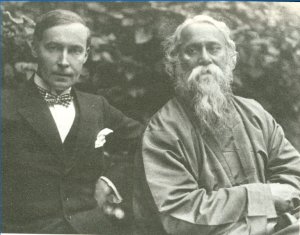
With his publisher Kurt Wolff in 1921
Rabindranath Tagore in Germany Today
We have to return to the question of translations. Translations into German started to appear from 1914 in rapid succession. No sooner did they come out in London, were they taken up by Kurt Wolff. Already in 1921, an eight-volume Collected Works could be published to coincide with Tagore’s first visit to Germany. However, when the devaluation of the German currency set in in 1923, the entire book market began to collapse. Kurt Wolff continued to publish new volumes of translation until 1925, and then he stopped. In 1929, his firm went bankrupt. There were several persons who had prepared translations of Tagore’s works for Kurt Wolff. From among them, Helene Meyer-Franck was the most dedicated and diligent. From 1918, she became the sole translator of Tagore into German. Her husband, Heinrich Meyer-Benfey, and she brought out his Collected Works.
After Kurt Wolff desisted from publishing, a new phase began for Helene Meyer-Franck: she learnt Bengali for the sole purpose of reading Tagore, her “dear Master”, in the original. It was a lonely fight in her small town near Hamburg, as she was virtually on her own. However, she learnt to read Bengali sufficiently well to translate into German three novellas and a collection of poetry. The novellas were published as early as 1930, but they left no visible trace because of the Nazi Reich emerging in 1933. Helene Meyer-Franck had to wait until after the Second World War before she was able to publish her second slim volume. Soon thereafter, first her husband and then she died. As a result, her initiative to translate Tagore directly from Bengali was not continued, and there was nobody to emulated her. In the 1950s, the old translations from English, published in the 1920s, were republished in West-Germany, and in some cases new translations of these weak and flawed English texts came out.
Communist East-Germany had a special relationship with Tagore. The latter’s internationalism endeared him to the regime, and his work was given political weight. Tagore’s books were translated into German in much larger numbers than in the West. Yet, these translations were generally of doubtful quality. Several anthologies contained translations from the English and from the Bengali side by side; other books were translated via Russian. Then there were so-called team-translation, i.e. a Bengali knowing little German and a German knowing little or no Bengali teamed up to produce a translation. None of these methods were at all satisfactory, and they did not serve to enhance Tagore’s reputation as a figure of World Literature. As far as I can see, only one person in erstwhile East-Germany mastered Bengali well enough to produce a competent translation on her own; that was Gisel Leiste, who translated one major novel, Gora.
It was not until the 1980s and 1990s that fresh direct translations were brought out, first by Alokeranjan Dasgupta (one volume) and then by Martin Kämpchen (three volumes). They were brought out by small, specialised or by theological publishers. What Tagore needs acutely, however, are mainstream literary publishers who market his works. This need is soon going to be fulfilled by a volume of love poetry, translated by Martin Kämpchen, brought out (in February 2004) by a premier literary publisher, Insel Verlag, in its series Liebesgedichte. Another publisher, Verlag Artemis & Winkler, is scheduled to bring out a larger volume of Tagore’s Selected Works, edited by Martin Kämpchen, in its series of Classics of World Literature.
I believe that in Germany Tagore’s time has now arrived. Apart from the fact that any great literature has a claim to be noticed and respected throughout the world simply because it is great literature, I wish to identify three areas in which Tagore’s ideas and ideals have a strong relevance for us today:
-
Ecology. – Rabindranath Tagore’s love of nature was inspired by the awareness that all living beings, including animals, trees and plants, are endowed with a soul. On this level of consciousness, human beings are equal with “low” creatures and plants. We are all co-creatures of God’s creation. Accordingly, Tagore’s praise and worship of nature is born of a deep spirit of togetherness and feeling of a creational bond between humans and nature. Such a sense of unity is missing in modern Western ecology. It tends to emphasise the usefulness of nature and the necessity of a natural environment for the practical survival of mankind. Thus, with his poetry and his essays, Tagore can inspire a deeper understanding of and togetherness with the natural environment.
-
Education. – Rabindranath Tagore’s ideas of education continue to be relevant. He wanted to unfold the entire personality through music, songs, dance, theatre, art, contemplation of nature, meditation and social service. The Indian subcontinent has strayed from these ideals, and in Western countries, too, the demons of “usefulness” and “efficiency” have to be tamed by the intentless, playful activity of Tagorean education.
-
International understanding. – Rabindranath Tagore’s deep yearning for harmony among men, achieved through mutual tolerance and simplicity of life, is as worthy of imitation now as it was then. It is not enough to nourish dreams and circulate hopes. Tagore has demonstrated to us how much one inspired human being is capable of achieving among men. Tagore descended from his dreams into reality and gradually worked out an understanding between human beings in his school, his university and his interaction with the wide world.

Rabindranath Tagore Street in Berlin
opened in 1961 (Photo: Christian Zeiske, Berlin)
Notes: Dr Dr Martin Kämpchen is a writer on India and a translator of Tagore from Bengali to German. He lives at Santiniketan, India. For more information visit his website www.martin-kaempchen.com.
- [1] Nirad Chaudhuri: Thy Hand, Great Anarch! India 1921-1952. Chatto & Windus, London 1987, p.596.
- [2] Rabindranath Tagore: Letters to a Friend. Edited by C.F.Andrews. Macmillan, New York 1929, p.171.
- [3] See Rainer Maria Rilke – Lou Andreas Salomé: Briefwechsel. Edited by Ernst Pfeiffer. Insel Verlag, Frankfurt 1975, p.300 (dated 20th September 1913).
- [4] See Kurt Wolff: Briefwechsel eines Verlegers 1911-1963. Edited by Bernhard Zeller and Ellen Otten. Verlag Heinrich Scheffler, Frankfurt 1966, p.136f.
- [5] Op.cit., p.138f.
- [6] Stefan Zweig: Benares: Die Stadt der tausend Tempel. In: Zweig: Begegnungen mit Menschen, Büchern, Städten. S.Fischer Verlag, Berlin/Franklfurt 1956, p.260.
- [7] Kurt Wolff: Briefwechsel eines Verlegers. p. 414.
- [8] Romain Rolland – Stefan Zweig: Ein Briefwechsel 1910-1940. 1st vol. 1910-1923. Verlag Rütten & Loening, Berlin 1987, p.640f.
- [9] Rolland – Zweig: Briefwechsel. 2nd vol. 1924-1940. p.187.
- [10] Thomas Mann: Briefe 1889-1936. Edited by Erika Mann. S.Fischer Verlag, Frankfurt 1961, p.188f.
- [11] Thomas Mann: Tagebücher 1918-1921. Edited by Peter de Mendelssohn. S.Fischer Verlag, Frankfurt 1979, p.529f.
- [12] Vivos Voco (Leipzig), vol. 1, Nov. 1920, p.817.
- [13] Hermann Hesse: Preface. In: Later Poems of Tagore. Translated and with an introduction by Aurobindo Bose. Peter Owen, London 1974, p.7.
- For more comprehensive accounts of Tagore’s impact on the German people, please refer to my books: Rabindranath Tagore and Germany: A Documentation. Max Mueller Bhavan, Calcutta 1991; Rabindranath Tagore in Germany. Four Responses to a Cultural Icon. Indian Institute of Advanved Study. Shimla 1999; My Dear Master. Correspondence of Helene Meyer-Franck / Heinrich Meyer-Benfey and Rabindranath Tagore 1920-1938. Edited by Martin Kämpchen and Prasanta Kumar Paul. Rabindra-Bhavana, Visva-Bharati, Santiniketan 1999.

- Tagore meets Einstein:
- Vishva Bharati University: > SCIENCE AND EDUCATION CENTER <
- MAHATMA GHANDI UNIVERSITY<
- GHANDI INSTITUTE FOR NONVIOLENCE
- Meet Rabindranath Tagore, Studies Friends at fb <
- Handwritten Letter in Sweet Memory of Tagore <
- Meet Vishwa Bharati School, friends at fb <
- Meet Mahatma Ghandi, friends, studies at fb <
- Meet Albert Einstein, friends, organisation at fb <
- Meet 100 Years Poetry Society, friends at facebook <
Architecture for Tibet – Manushree Orphanage
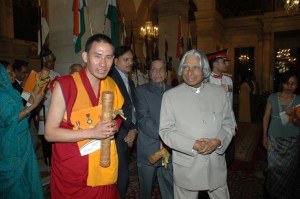
The PRESIDENT and Dalai Lama coming out after the Investiture Ceremony at> Rashtrapati Bavan<
> MANUSHREE VIDYAPITH ORPHANAGE <
> ARCHITECTURE FOR TIBET´s BLOG <
> KLIMA, ENERGIE, WOHNEN MIT UMWELTBERATUNG WIEN <
Architecture in Tibet contains Chinese and Indian influences, and reflects a deeply Buddhist approach. The Buddhist Prayer wheel, along with two deer or dragons, can be seen on nearly every Gompa in Tibet. The design of the Tibetan Chörtens can vary, from roundish walls in Kham to squarish, four-sided walls in Ladakh.
The most unusual feature of Tibetan architecture is that many of the houses and monasteries are built on elevated, sunny sites facing the south, and are often made out a mixture of rocks, wood, cement and earth. Little fuel is available for heat or lighting, so flat roofs are built to conserve heat, and multiple windows are constructed to let in sunlight. Walls are usually sloped inwards at 10 degrees as a precaution against frequent earthquakes in the mountainous area. Read More: >HERE <
INTRODUCTION – The Manjushree Orphanage free Education is one of the major projects in Arunachal Pradesh, Eastern part of Himalayan region. Whose purpose is to promote love, kindness, compassion and peace for the benefit of individuals, families, communities and the world? It will contribute to this endeavour by inspiring young people to act with a ‚good heart‘, to become leaders in their communities and to help bring peace into the world.
The name of the orphanage is called Manjushree Vidyapith, Orphanage. This orphanage was commence on 30th, October 1998 with an obvious and distinct intention of serving the deprived and disadvantaged children of the society irrespective of religion, caste, community, tribe, gender etc.
We started with 17 orphans with three teaching staffs from far-flung villages of this area in the year 1998. It is the first orphanage of its kind in whole area.
> Architecture for Tibet utube Channel <
In the beginning, one building was constructed to accommodate 17 orphans and 3 teaching staff. Army authority of the area had come forward to help the orphanage. Since then the number of orphans and destitute grow in geometric progression and the income of the orphanage in arithmetic progression. As a result, we are unable to admit many helpless orphans and neglected children.
The children who have lost their parents, the children who are destitute and dependent, and the children who have been born disabled or become disabled due to accident make up the family members of this orphanage.
Where they are provided with all the necessities of lives along with proper education and appropriate guidance to make them competent for facing various confrontations of lives.
At present, the orphanage is home to 108 children 80 orphans, 18 destitute and 10 physical disabled children from different social background. However, most of the children hail from this remote region. After coming here, they have started to relive their lives leaving their horrifying and disappointing past behind and they have begun to learn to tread forward with confidence and dignity. They live here as a different member of a single family, where every one is treated on equal terms.
We run a school inside our orphanage up to 5th grades. In the school, students are taught different subjects such as English, Math, Hindi, Tibetan, Science, Social Studies etc. 8 qualified teachers are engaged in imparting education to the orphans. Those who pass the 5th grade go to other school as day scholars but stay in the orphanage. Right now 25 students go to other school from our orphanage.
Besides, the residents are provided modern education, and equipped with moral values to help them become a better human being. The mental and physical growths of the residents and to help them possess a kind heart are given paramount importance. The orphanage has left no stone unturned to return back the smile they had lost.
So in all, the orphanage in itself has learnt to exist as very well knit family enriched with love, peace and knowledge and tranquility despite of many ups and downs. But in a way Manjushree family and I are indeed very thankful to all those great people who have been supporting us in one way or other without whose contributions we would not have reached this far. Read More: > HERE <
Our Project: Architecture for Tibet’s current project is an Academic Center for the Manjushree Orphanage in Tawang, Arucnachal Pradesh, in the high Himalaya of Northeast India. The new, light-filled Academic Center will replace the present schoolhouse, which is falling apart and not large enough to accommodate the number of children.
The proposed two-story building will contain not only classrooms, but a library, a multi-purpose space, a computer and language lab, and a large Nursery Environment, for the youngest children to learn, play and be cared for in. Within this place, the children can cultivate a true sense of friendship while gaining the knowledge they need to overcome their difficult circumstances.
The building is “green”: Temperature is regulated through a combination of geothermal and solar-based technologies, creating a warm environment during the harsh winters and a dry, airy place in summer, when the region receives heavy rains. This will enable the children to be comfortable, healthy, and active within their learning environment throughout all the seasons.
Our Organization: Architecture for Tibet has been founded by the Architectural Designer John Ullman of NYC and is composed of concerned professionals from the fields of architecture, engineering and education from around the world who are bound together by the common will to improve the built learning environ in Tawang, Arucnachal Pradesh.
- GREEN IDEAS DEIN IN DEIN AYURVEDA NET ARTICLE <
- Meet Tibet Friends, Culture, Arts, Medicine at facebook <
- Meet Himalaya Friends, Studies, Culture at facebook <
- Meet Green Architecture Groups and Studies at facebook <
- Meet Klimabündnis, KlimaschutzexpertInnen at facebook <
- Meet Architecture for Tibet, friends, fans at fb <
Kathak Academy , Shehjar, Kashmir Poetry
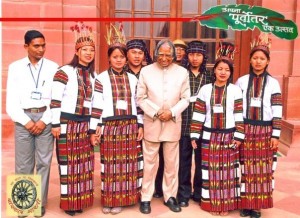
Artists from North East (Mizoram) with > Dr. APJ Abdul Kalam < at Rashtrapati Bhavan
Kathak (Hindi: कथक, Urdu: کتھک) is one of the eight forms of Indian classical dances, originated from northern India. This dance form traces its origins to the nomadic bards of ancient northern India, known as Kathaks, or storytellers. These bards, performing in village squares and temple courtyards, mostly specialized in recounting mythological and moral tales from the scriptures, and embellished their recitals with hand gestures and facial expressions. It was quintessential theatre, using instrumental and vocal music along with stylized gestures, to enliven the stories. Its form today contains traces of temple and ritual dances, and the influence of the bhakti movement. From the 16th century onwards it absorbed certain features of Persian dance and Central Asian dance which were imported by the royal courts of the Mughal era. Read More: > HERE <
Kashmiri Pandit (Hindi: कश्मीरी पण्डित) refers to a person who belongs to a sect of Hindu Pandits who originate from the Kashmir region in the Indian subcontinent. Many experts speculate that the Aryan Race originated in Kashmir and its vicinity. Kashmiri Pandits have made significant contributions to Indian thought and science. Abhinavagupta, Kalhana have been stalwarts in the fields of, philosophy and history respectively. Kashmir figures prominently in Sanskrit poet Kalidasa’s compositions but it is not known conclusively whether he hailed from that ethnicity or region. The birth place of CHARAKA one of the founders of AYURVEDA and INDIAN MEDICINE in general is also considered to be in Kashmir. Read More: > HERE <
The Pandit Shambhu Maharaj Kathak Academy was established to offer an all encompassing training in Kathak and Hindustani music. Apart from Kathak, and Hindustani Vocal, other courses being taught are Tabla, Yoga and Sanskrit. The teaching is of a uniformly high standard and the students are constantly encouraged and supported with scholarships and freeships, workshops and interactive sessions with renowned artists. The students are also provided the hostel facilities in a much secure and appropriate environment.
The school offers training at three levels.
About Vashwati Mishra – DANCE is my language, friend, identity, reflection, strength, medium and my consciousness.
Kathaks Improvisational character draws me. Every moment of the dance has its own innate beauty and enjoyment speed,rhythm,grace, expression It reflects all the colours of life.
Most people dream and then there are the few who give concrete shape to their dreams. In 1984 Vaswati Misra, an exponent of Kathak, choreographer and teacher started to give shape to her dream. With no financial support, but with the good wishes of friends and family she founded Dhwani, a center for the performing arts. She chose the name with care. Commonly taken to mean sound, for her, the meaning was definitely „In which the implied is more striking than the expressed“ The meaning reflected perfectly her approach to both choreography and performance. Read More: > Here <
Dhwani a cultural organization. Registered in 1984. Recognized by Indian Council for Cultural Relation, Department of Culture, Ministry of HRD, CID, Unesco.
About Shehjar – The idea of an e-magazine, with focus on multiple aspects of our rich cultural heritage, politics, philosophy, community news, views, people, community business promotion,networking,matrimonials,entertainment, new songs & videos and other such, originated in the middle of 2007. We are amazed at the pace the events have unfolded, converting those initial turbid perceptions into a reality.
Though we intend to have special, theme based issues as well, we endeavor to put together an interesting mix of articles, poems and event sections in each issue. Every issue attempts to have a fair representation in terms of variety of content and subjects. A web based magazine does not have limitations with regard to the publishing of high quality multimedia content, like graphics, audios and videos etc. as compared to the traditional subscription-based print magazines that inherently lack some of these feature.
Conceived and designed to be an interactive online magazine to serve the large global Internet readership, Shehjar will appear at regular intervals. Its hosting website, kashmirgroup.com, will be ever active and responsive to readers, with features like discussion forum, news and readers’ feedback. We hope that you will find these features interesting and keep us busy with your participation. With a global membership database and subscription listof about 10,000 registered users/members in our group, the possibilities of immediate readership are limitless.
*****
Shri G.L. Kaul retired as an Information officer for the J&K State. He had also been editing Kashmir Today ( English) and Tameer (Urdu) both official magazines of Information Department. As an avid theater activist he has acted in and directed many plays in Kashmiri, Urdu, Hindi and Punjabi, performing all over the country. He is the founder member of J&K cultural academy and IPTA group.
> Girdhari Ji’s Poetry VIDEO <
*Kashmirii Kavita Tehar-ta-charvan, *Urdu/Hindi Kavita Aye Mere Ghar*
One of the many talents of Girdhari Ji is his ability to write poems in several languages; that connect instantly with the reader. And what tops even that is the narration of this poetry in his lyrical voice and style. We are delighted to inform our subscribers that in this issue of Shehjar and in several forthcoming ones, we will be presenting videos of Girdhari Ji narrating several of his poems. These videos were prepared by his son Prof. Sanjay Kaul when Girdhari Ji was in the Boston area.
The two videos in this issue are in Kashmiri and in Hindi-Urdu. The Kashmiri is chaste and words flow easily, making his poetry well suited for musical compositions. We are suggesting that some of the musicians among our readers create memorable songs based on Girdhari Ji’s poetry and request you to contact us if you would like to do so. We will put you in contact with Girdhari Ji.
Our email id for all correspondence is editor.shehjar@gmail.com
Sufi Poetry and the Kashmir Sufi Society

> Dr. A. P. J. Abdul Kalam & Khwaja Farooq Renzu Shah <
> Kashmir: Sufis, Saints and Shrines <
> Kashmiri Overseas Association, Inc. <
Kashmir Sufism-History and Background
Kashmir-The Valley of Divinity – In the heart of the great Himalayas is a beautiful valley, which has been described by poets and emperors as paradise. Over the centuries, the verdant vale of Kashmir has seen the blossoming of many exquisite flowers of the philosophy of humankind. With the bountiful beauty of nature constantly around them, the people of Kashmir have always been filled by thoughts of the divinity of creation.
With the first rays of the sun, the melodious Azaan – call for the morning prayers, resonates through the mountains, a new day of life ushers into hope and joy with fresh fragrance of the Himalayan blooms and lotuses, of fir and pine trees. The purity of the mesmerizing beauty of Kashmir transforms any seeking soul into a humble being. The enchanting natural beauty of the valley with lakes and waterfalls, mountains and dales, rivers and springs, birds and butterflies and the peace loving folks all together in harmony magnify the Oneness of Allah in totality. The mystic atmosphere of Kashmir made this a suitable place for Rishis, Saints and Sages for time immemorial.
The philosophers of the valley have had a joyous belief in the manifestation of the beauty of God, in the world that we see around us. It is a deep belief that every aspect of creation is a part of the supreme consciousness. This philosophy of love and the recognition of divine beauty were the essence of the Buddhist and Hindu philosophies of the early period in Kashmir. Islam in the valley inherited these traditions and Kashmiris developed a rich Sufi culture, which continued the tradition of a deep personal love of God.
In Kashmir, visions of the lord’s glory are constantly in front of us. Kashmir Valley is an ideal refuge for a contemplative mind that gives you space to cultivate virtues towards leading a meaningful and content life. Long walks into the forests and boat cruising in the backwaters of Dal Lake during the day and quite evenings observing the stars awakens ones senses to understand the mystery of the universe .
Khwaja Farooq Renzu Shah has written eleven books and his Sufi Mankabat on Bulbul Shah has received national and international awards. Nusrat Fatheh Ali Khan and his disciple Rufi Fateh Ali have achieved fame through Bul bul Shah Mankabat on Sufism. His association with Sufi shrines of Kashmir , particularly shrine of Sheikh-ul-Alam at Chrar Sharief Budgam district, Sufi shrine of Muqam, Waterhail Budgam, Khansahib Budgam, Makhdoom Sahib Srinagar, Rahbab sahib, Drayigam shrine, Naqashband Sahib Srinagar, BulBul Shah Sahib Nawakadal Srinagar, Khankah Moula KhanKah, Fateh kadal Srinagar are very strong . After the tragic burning of Chrar Sharief shrine including Khankah Faiz, Khawaja Farooq had honour to rebuild Khankah Faiz. His Sufi seminars are attended by thousands of shrine believers. He organized international conference of Sheikh-Ul-Alam, Bul Bul Shah and Amir-I-Kabir. Khwaja Farooq Renzu was awarded Col.Qadafi award at Tripoli for his distinguished contribution on Sufism in 1988. He was awarded by the President of India, Prime minister, Governor and chief minister of J&K for his contribution to Sufism.
Kashmir: Where Sufis are Rishis and Rishis are Sufis!
By Sultan Shaheen
The most dominant influence on the Kashmiri Muslims, in terms of their Kashmiriyat, is that of the Rishi order of Sufis. While the Sufi orders like the Suharwardi, Kubravi, Naqshbandi and Quadri, arrived in Kashmir from Persia, Central Asia, and Central and North India, the Rishi order evolved in the valley itself indigenously in the beginning of the fifteenth century. The Kashmir valley was already permeated with the traditions of Hindu ascetism and Buddhist renunciation.
The term >„RISHI“< itself is clearly a derivation from Sanskrit and Indian traditions, though some Medieval Muslim scholars have tried to show that it is derived from the Persian word raish or rish meaning the feathers or wings of a bird. Baba Dawood Mishkati, for instance, gives a rather tortuous explanation. A bird whose feathers have been removed has no control over its own movements and depends entirely on the wind. And this is also the case with a Rishi; he is alienated from the world and lives alone, buffeted by fate. This and similar explanations, have, however, failed to impress the average Kashmiri Muslim and he, by and large, accepts its Sanskrit derivation and uses it loosely like his Hindus brethren as synonymous for a sage. In fact many Kashmiris do not even associate the word with any particular order of sufis, but use the word to denote any and every sufi saint.
The indigenous Rishi order of Sufis, however, does differ not only from the establishmentarian and fundamentalist Muslims but also from other Sufi orders in its philosophy and way of life. Many writers who have chronicled the life and times of Kashmiris of this period have been attracted to the unique way of life and philosophy of the Rishi order of Sufis. An important chronicler of this period, Abul Fazl, for instance, is all praise for them. He writes: „The most respected class of people in this country (Kashmir) are the Rishis. Although they have not abandoned the traditional and customary forms of worship (taqlid), but they are true in their worship. They do not denounce men belonging to different faiths. They do not have the tongue of desire, and do not seek to obtain worldly objects. They plant fruit-bearing trees in order that people may obtain benefit from these. They abstain from meat and do not marry.“
This account is corroborated by Emperor Jahangir. He writes: „Although they have not acquired learning and marifa, they live a frank and unostentatious life. They criticise nobody and ask for nothing from anyone. They neither eat meat nor marry. They always plant fruit-bearing trees in uninhabited parts, so that people may be benefited by them. But they themselves do not hope to reap any advantages from these trees.“
The Kashmiri Muslim Rishi’s ascetic and unworldly life thus bears a close resemblance to the lifestyle of the Hindu Rishis and Munis as well as Buddhist and Jain monks.
Baba Dawood Khaki describes a Rishi as one who is an ascetic and leads a disciplined life different from those of other saints. He is free from all worldly pleasures. Baba Nasib calls them gracious to the pious and describes them as men of pure heart. Their presence has turned Kashmir into heaven, he says. Cutting themselves away from all worldly relationships, they neither marry nor bother themselves with a family life. Piety is their apparel(khirqa); their nights are devoted to worship and during the day they worship incessantly. Having abandoned all worldly desires, they have succeeded in controlling their carnal lusts. Read Full Article: > HERE <
Lal Ded: The Great Kashmiri Saint-Poetess
Edited by: Dr. S. S. Toshkhani
Streifzug durch die Welt der indischen Mystiker und Dichterheiligen
– ihre Gedichte u. Gesänge –
This book represents the proceedings of a National Seminar on „Remembering Lal Ded in Modern Times“ conducted by Kashmir Education, Culture and Science Society in New Delhi on 12 November, 2000. Lalleshwari or Lal Ded, according to late Prof. Jayalal Kaul, has been the greatest genius of Kashmir of all times. This book has many eminent writers of modern period who have recollected the genius of Lal Ded for the modern world. Lal Ded was living in the 14th century in Kashmir. In spite of long interval of history, Lal Ded is remembered in every home even in modern period. Her Vaaks, or sayings, represent the best teachings for human kind today to seek unity and harmony between people of all religion and races. Her poetry is all inspiring. Her philosophy of life represents the highest science of life. She can be the leader to combine science and humanism world over, and once again establish a peaceful and melodious world of joy and happiness. Kashmiris in general and Indians and the people of the world are inspired by Lalleshwari’s teachings. This book and the seminar by KECSS cannot possibly touch all aspects of life and times of Lal Ded. However, a laudable attempt is made to recall Lal Ded for creating a joyful and harmonious world in Kashmir and the rest of India and the world. Hindus, Muslims and people of all faith remember Lal Ded with great reverence. This book should be of world-wide interest.
About Kashmir Sufism Society: Khwaja Farooq Renzu Shah believes in “Love as Revolution” which can engulf our power on all forms of terror, hate, communalism and regionalism. He is making efforts to restore the highest position of Sufism in Kashmir and make the world aware of its importance. He has practiced so far one lakh times Darood Khawani and attended Sufism Mehfils throughout the state. Read More: > Here <
- Founder Chairman of Kashmir Sufism Society
- Distinguished personality of Kashmir
- Founder of Kashmir Sufism society – Direct decedent of 1st Muslim king of Kashmir Renzu shah who was also known as Rinchen Shah (Foundation of Sufism under direct patronage of Hazrat Sharaf-u-din Bul bul Shah was laid by him in 1318 AD.)
- Meet Kashmir Sufism Society, friends and Studies at fb <
- Meet Support Internal Displaced Kashmirian Indigenous Peoples at fb<
- SAVE A SMILE & DIE Kashmir Shivaiten im Himalaya Gebirge <
The Global Peace Initiative of Women
> Global Peace Initiative of Women <
Global Peace Initiative of Women (GPIW) is an international network of women and men spiritual and community leaders. The group was founded on the belief that women today have a unique contribution to make in finding alternatives to violence. GPIW also places a special emphasis on building interfaith understanding and developing leadership in young community leaders worldwide.
GPIW is located in New York and was founded in 2002 at the Palais des Nations in Geneva. Dena Merriam is the founder and convener. The co-chair is Joan Chittister, a dissident Roman Catholic nun. Read More: > HERE <
The Global Peace Initiative of Women (GPIW) was founded by a group of women religious and spiritual leaders to provide a global platform through which women and men, working in partnership, can foster the spiritual values of global unity, peacebuilding and the development of all the peoples of the world.
GPIW is an international network of women and men who come together to tap our collective spiritual wisdom to stimulate reconciliation and healing in areas of conflict and post-conflict, and to deepen understanding of oneness, compassion and the principles of ahimsa (non-harm) as central tenets of life. We believe that a shift in consciousness is needed, a change in heart and mind, if we are as a global community to meet the challenges of climate change, environmental degradation, poverty and hunger, violence and conflict.
Central to our work is the belief that the feminine qualities of wholeness, inclusion, and integration have a vital role to play in facilitating this shift and bringing greater balance to our world. Thus we make great effort to draw upon the resources of women spiritual leaders as we seek to empower these vital qualities.
Our work aims to foster respect for all peoples on Earth and for the Earth’s natural environment. We highlight humanity’s shared values, even as we profoundly appreciate the diversity of human culture and belief. We realize the importance of transmitting such values to the next generation. Thus, in our sacred work, we place special emphasis on tapping inter-spiritual wisdom and developing leadership in young adults around the world, listening to the perspectives of all as we seek together to create a more caring and compassionate world community.
Our Beginning – The Global Peace Initiative of Women has its beginnings in the process that led up to the first summit of religious leaders held at the United Nations in New York in 2000, the Millennium World Peace Summit of Religious and Spiritual Leaders. During the planning for that summit, it became clear that very few of the religious leaders invited to speak at the UN would be women. And indeed this was the case. During the Summit, the political and institutional issues surrounding religion came into play. In frustration, the women came together and called for a followup meeting to focus on what they had come to the UN to do – to explore how they could contribute to reconciliation and healing in areas of conflict and tension.
This meeting took place two years later at the Palais des Nations in Geneva with over 600 women from over 70 countries, and from this summit the Global Peace Initiative of Women was formed.
Welcome to the Newsletter from www.SriAnandamayiMa.org :
The festival of Maha Shivaratri (the great night of the worship of Lord Shiva) was celebrated in the Omkareshwar Ashram with great joy. Many devotees came from Indore and with our ashram visitors and school children, the celebration and worship went on into the night before the presence of Baba. Wonderful peace and blessing were experienced by all.
The ashram received an invitation to a conference sponsored by the Global Peace Initiative for Women (> see www.GPIW.org <) to promote a dialog between Sufis and Yogis.
Swami Mangalananda was sent as a delegate and speaker. There were prominent Sufis from Afghanistan, Pakistan, Iran and India present, and many Yogis and Swamis from India.
In the proceeding discussions, many common practices and beliefs were discovered between the two groups which promoted a deep feeling of unity and brotherhood. The final day many practical talks were held on what the two groups can practically do to help the uplift of world consciousness, and spread the unity discovered to their respective groups. It was a highly successful and unifying event and all present vowed to meet yearly to continue the dialog.
As always, we end with Ma’s comforting words: „Your sorrow, your pain, your agony is indeed my sorrow. This body understands everything.“
- DEIN AYURVEDA NET: Articles about Islam, Medicine, Sufi Arts and Culture:
- Yoga, Bhakti Movement, Sufism, Islamic Arts and Culture
- Islamic Plant Medicine and History
- Die Kashmir Shivaiten im Himalaya, Zentrum Interkulturell
- Omkareswhar, Schulprojekt, Bhajans, Kirtan Lieder der Freude und Liebe
- Omkareshwar, Shiva PURANAS, 12 Seats of the Lord
- Kashmir Overseas USA, Save A Smile Project, Hospital Research Center
- UNESCO, Shiva Puranas, Maha Puranas, World Digital Library
- BYO – Österr. Yoga Verband, Austrian Yoga Alliance: www.yoga.at – “ Eintreten in das Göttliche Bewusstsein“ – Die Spiritualität des kashmirischen Shivaismus.
- SHAMBALA SUN – GPIW at UN at Climate Change
- GPIW – Charter For Compassion
- Kashmir: Sufis, Saints and Shrines
- Hazrat Nasir Mohammed Fakir Soofi Alquadri
- Mowlana Jalaluddin Rumi
- SUFI POETRY – The appeal of Sufi poetry is universal, great Sufi Poets such as Rumi, Hafiz and Omar Khayyam are appreciated by both Sufi’s and non Sufi’s alike. This is because their poetry expresses the universal aspirations of spiritual seekers .
- Music of Kashmir
- Dhwani Kathak Dance, Music Academy
- Meet Kashmir Sufism Society , friends and Studies at fb <
- Meet Kashmir Shaivaism, friends and Studies at fb <
- Meet Swami Mangalananda, friends at fb <
- Meet GLOBAL ONESS PROJECT, friends at fb <
YOGA, TREE AND OUR UNIVERSE
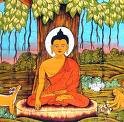
The Originar of Hatha-Yoga
Tree is the highest evolved form in plant kingdom. Man is the highest evolved species in Animal kingdom. Mushrooms are the best fungi visible on this planet. There is commonality of forms among all these highest evolved forms among different type of life-forms -Tree-like structure.Man is a cerebro-spinal being sheathed within a fleshy body. Most evolved form of cell is neuron that mediates consciousness is Tree-like structure. Surprisingly, most powerful thing that mankind achieved viz. atom bomb , produce Tree-like clouds after exploding on the surface.
Tree-like structure in Nature!
One can find out where else do Tree-like structure in nature exist. Pliny, the Younger linked the eruption of Vesuvius eruption in 79 A.D. with Italian umbrella pine. It is now an established scientific fact that the most powerfur process within earth, volcanic plumes that move inside earth is umbrella-shaped with a column & umbrella spinning about vertical axis( Tree-like). The most terrible force on the surface of the earth are the Tornados which are again Tree-like shapes with a column & an umbrella. Tree-like shape is found in other very powerful phenomena like lightening flashes, electric sparks, river delta, snowflakes, coral .
Tree-like structure is characteristics of every visceral system. Biologists trace this form in the mosses, lichens, shrubs, root system, mammalian lung bronchioles, cells of nervous system, veins & arteries forming cardio-vascular system. Wheresoever there are branching system, that invariably culminate in a Tree-like structure.
Tree & Fractal Geometry
In last fortnight, a brilliant paper was published in ‚Advances in Soft Computing“, under the title“Algorithms for Tree-like Structure Generation“ by Anna Romanowska, a neuro-anatomist et al. The team characterised Tree-like structure as that form which bifurcates but do not form any cycles. The team picked up the concepts of fractal geometry & fused with algorithms to create a Recurrent Algorithm. Self-similarity and repetition of sequence( iteration) is generated by a bifurcating cascade. The team concluded that if living system are generated recurrently, complex organic structures like roots, bronchial system in lungs emerge.
Now that an algorithm for Tree-like structure has been generated, it will be feasible in a decade to manufacture on mass scale silicon bronchial/ cardio-vascular/ neural system .
Before the advent of Fractal geometry by Benoit Mandelbrot during 1970s, the question of Tree-like structure had perturbed many a great minds. Hisao Honda of University of Kyoto published a paper on “ Description of the Form of Trees by the parameters of the Tree-like body“ in the Journal of Theoretical Biology, May, 1971. Honda concluded that Tree architecture maximizes flow access. He found stastitical similarity in living & non-living world, among branching in living system & geological & geophysical system.
- Meet Swami SIVANANDA friends, yoga, studies, at facebook <
- Meet Bhagavad Gita friends, yoga, studies at facebook <
- Meet Patanajali friends, yoga, studies at facebook <
- Meet Buddhism, friends, studies, Medicine at facebook <
- Meet Paramahansa Yogananda friends, groups, studies at fb <
- Meet Raja Yoga, Friends, Group, studies at facebook <
- Meet IYENGAR (B.K.S.), Yoga, Friends, Studies, Groups at fb<
- Meet Swami Vivekananda, Yoga, Studies, Friends, Groups at fb<
- Meet Bhagavad Gita, Yoga, Studies, Friends, Groups at fb <
- Meet Ramana Maharshi Groups, Friends, Studies, Fans at fb<
- Meet Hinduism, Groups, Friends at facebook <
- Meet Kashmir Hinduism, Studies, Friends at facebook <
- Meet Shaktism and Devi the Godess at facebook <
- Meet Saundaryalahari: Wave of Bliss by Shankaracharya at fb <
- Meet Arsha Vidya Gurukulam, Studies, Friends, Fans, at fb <
- Meet Advaita Vedanta,Groups,Studies, Vivekananda at fb <
- Meet Yogi Yogendra Nath, Studies about Goraksha at fb <
- Meet Jaya Kula and the three ways of Practicing tantra at fb <
- Meet VASTU, Friends, and Study Groups at facebook <
- Meet Jyotish, Friends, and Study Groups at facebook <
- Meet Sacred Geometry at facebook <
- READ MORE HERE:
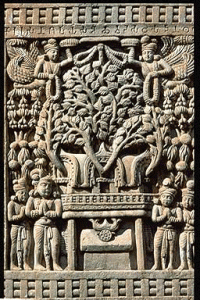
Morphic field & Morphic Resonance!
Tree-form is found in lower kingdom of Animal as well as Fungi. Jelly fishes or the polyp, these are invariably shaped like Trees. The colonies of proliferating marine organism replicate this form. It is interesting that jellyfishes which have no neurons & man with maximum neurons are essentially same in shape. Great Scottish biologist, Sir D’Arcy Thompson wrote in 1917 „On Growth and Form“, to analyse patterns & shapes in nature. His erudite tradition sd being carried by Rupert Sheldrake, a British biologist. He has done extensive work on the concept of morphic field & morphic resonance. By morphic resonance, he explains the influence of Like upon Like by which a connection among similar fields is established. He has shown in his work example of crystallization. It is very difficult to crystallize a new compound for the first time. Once it is done, a morphic field emerge. It is easier next time if someone does elsewhere in the world. There is a cumulative influence & it gets easier & easier to crystallize the compound. There is an accelerated rate of crystallization . Similarly, in learning among rats, this phenomena has been experimentally confirmed. It is difficult for a rat to pass through a maze for the first time. But, once a rat does this, another rat elsewhere does it much easily. And with each learning , there is spontaneous spread of new habits. For Sheldrake, evolutionary spread of new habit is not genetic but depends on a kind of collective memory due to morphic resonance.
This can be easily comprehended in case of human. It was very tough to manufacture clock or VCD or computer. More people are manufacturing, easier it is getting to manufacture. Watches, transistora & VCDs are now cottage industry. Who knows in future, robotics will emerge as similar kind of easily handled industry and there will be garages in every nook & corner of city to repair robots or even remodell robots by neighbourhood mechanic.
Sheldrake further proposes the concept of the „Memory of Nature“. Habits of nature depend on non-local similarity reinforcement. Through morphic resonance, the pattern of activity in self-organizing system are influenced by similar patterns in the past. He brings back the idea of Carl Jung‘ collective unconscious.
Examining Growth of Tree-Form!
I find the concept of morphic resonance appealing. That can explain this frequent recurrnce of similar pattern in nature. If we ponder over the shape of DNA & its future. The fluid around earth’s inner core creates a helical movement and generates magnetic field. The geodynamo of the earth is a self-replicating system that help explain the continuity of magnetism in earth’s core , otherwise it would have dissipated within 20,000 years. Now, the transformatory biological molecule,DNA, is helical as well as self-replicating. Within geo-physical processes, we know that Tree-like plumes are created. Now, this geophysical structure resonates throughout future evolution of biological world. For every plume within, there is a tornado on the surface. This first form of powerful process recurs at the level of the most developed categories at various levels, may it be fungi, or plants or animals or cells. And, that form recurs in even man-made powerful processes like atomic explosions.Upon visualizing this sequence, I can very well predict that the most successful biological robots or most efficient spaceship for planetary travels would have Tree-like architecture. Our Discovery spaceship is a poor materialization of that critical architecture.
Tree & bifurcation!
This Tree-like structure itself is generated by recurrent self-similarity which results due to behaviour of a dynamic system. Now, the chaos theorists have worked out very well that how in a dynamic system , a stage of crisis is set in and at the point , there are two possibilities for the system to transform. Sometimes, the system oscillates between two possibilities as found in certain chemical clocks extensively investigated by Nobal laureate Ilya Prigogine.Most of the times, the branches grow further and then bifurcate. This is iteration of self-similarity that later results into Tree-like structures.
If this kind of bifurcaing iteration is fundamental to our changing Reality which is dynamic, and there is morphic resonance, one can draw the contours of this phenomena of emergence of Tree-like structure at a higher level.
End of biological evolution!
The bifurcation, that determines DNA-replication to cell-division, has finally achieved its destiny in the biological world in the form of Human beings. We are the highest biological form and the biological evolution has now concluded. There is no further scope of biological evolution beyond us.Perfect biological bifurcating branching system has been achieved. Our lungs, our cardio-vascular system, neural system .. everything has emerged as mere consequence of cascading bifurcation. Surprisingly, we have greater number of most evolved cells viz. neurons (200 billions) which themselves replicate own form at macrolevel. The cerebro-spinal system is a magnified neuron. We are the only animal to walk on 2 legs. Penguins do perform but lack other binarities. We have two legs, two hands, two nostrils, two ears, two testicles, two mammary glands, two eyes, two kidneys, two hemispheres in brain, two atrium, two ventricles in heart, two excretory points, two lips, two jaws. Our thinking pattern is also binary. Our categories are in twos- good/bad, high/low,sacred/profasne, self/other… We donot yet understand that this duality in thought is rooted in hemispheric brain or in fractal geometry. There is no more bifurcation & branching possible in bodily architecture of human beings. This is the end-point of biological evolution. Now, mankind is on verge of developing biological robots & higher order machine consciousness therby imbuing consciousness to physical world bypassing the biological evolution. We are becoming the co-creator of the Universe as well as agent to accelerate self-consciousness of physical matter in the universe.
Trees are our cousin!
Now, the issue of Tree-like structure resonates into our collective psyche. Tree is the source of wisdom, healing, nourishment, power. Bible myth has Tree . Newton discovered moodern science sitting under an apple Tree. Buddha discovered non-theistic self-awareness sitting under a peepul Tree. In Tibetan tradition, powerful meditation requires visualizing Tree of lineage with various Gurus on different branches. These kind of visualization has transformative effect on our consciousness. In every culture, Tree occupies a significant position in rituals & mythology. We feel special feeling with Tree. Our romantic mood, our wisdom, contemplative mood, aesthetic mood.. orbit around physical & metaphoric Tree. Tree have power to transmit some kind of healing power to us. Tree are the source of healing body through fruits & herbal medicine . Tree heals our body, mind as well as soul, if any. The processes involved may be a kind of morphic reonance that vitalizes self-similar cardio-vascular, respiratory & neural system.Trees are our morphic cousins. We feel guilty & hurt when trees are cut or when those are under environmental threat.
Future?
One thing is certain. Future robots & spaceships which would be most efficient to survive would have Tree-like architecture. We would have very little to do with blooming of age of nanotechnology, biotechnology & Artificial intelligence. Successful creation of algorithm for Tree-like structure has made it more likely that artificial human organs can be manufactured at industrial level. When death will be conquered after successful download of Memories & large scale diffusion of bionics, We would have enough time to resonate with biological Trees in solitude & steer mankind towards a spiritual evolution as biological evolution from DNA-pathway has reached a dead end!
(Niraj,1.11.2009)
VEDA, TREE´s AND THE HOLY SCRIPTURES
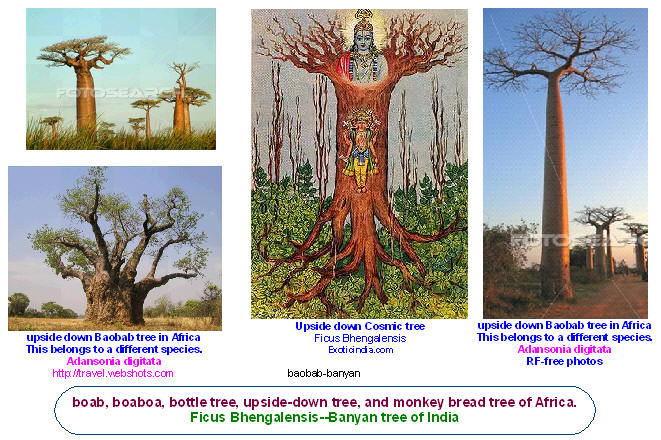
> Sanskrit Web / Yayurveda, Taithreeya Aryanka <
> BIHAR SCHOOL OF YOGA, SRI SIVANANDA MATH <
The Aranyakas/Wald Texte der Veden, (Sanskrit आरण्यक Ä�raṇyaka) are part of the Hindu śruti, the four Vedas; these religious texts were composed in Late Vedic Sanskrit typical of the Brahmanas and early Upanishads; indeed, they frequently form part of either the Brahmanas or the Upanishads. „Aranyaka“ (Ä�raṇyaka) means „belonging to the wilderness“ (araṇya), that is, as Taitt.Ar.2 says, „from where one cannot see the roofs of the settlement“. They contain Brahmana-style discussion of especially dangerous rituals such as the Mahavrata and Pravargya, and therefore had to be learned in the wilderness. They have also served as receptacles of later additions to the Vedic corpus. However, they have nothing to do, as later tradition has it, with Sannyasins or Vanaprasthas and they are not of „mystical“ nature but very close to the Brahmanas proper. Read More: > HERE <
The Taittiriya Upanishad is one of the older, „primary“ Upanishads commented upon by SHANKARA. It is associated with the Taittiriya school of the Yajurveda. It figures as number 7 in the Muktika canon of 108 Upanishads. It belongs to the Taittiriya recension of the Yajurveda and is constituted by the seventh, eighth and ninth chapters of Taittiriya Aranyaka.
The tenth chapter of the same Aranyaka is the Mahanarayana Upanishad. The Taittiriya Upanishad describes the various degrees of HAPPINESS enjoyed by the different beings in creation. Read More: > HERE <
Real Identity of Asvattham tree. It is called “Arasa Maram”
There is some confusion in books about the identity of Asvattham tree. It is called “Arasa Maram” (Ficus religiosa) in Tamil Nadu, Ravi-manu in Telugu, Aruli-mara in Canarese. One calls it a Palm tree; another calls it Pipal (Ficus religiosa-pagoda fig-tree); and yet another calls it Banyan Tree (Ficus Bhengalensis) with the adventitious aerial roots. Both (the latter two) are related to each other. It is a humongous tree with bright green leaves chatting with each other with a pat on the back as they rustle in the gush of wind. It is music to the ears. The breeze sets the leaves dancing in the wind and doing partial pirouette on their spindly petioles. When the wind quiets down, the song and dance stop suddenly.
One thing we know is that it is a cosmic tree. The berry of the Pipal is sweet, and Soma (intoxicant) is prepared from its juice according to some accounts. (There is another claim that says the soma juice comes from a mushroom.) Images of Pipal tree appear on the Harrapan seals. Asvattham is said to be a “body-tree.” “A” is no; “THA” is existence; “Shva” means “after tomorrow:” No existence after tomorrow. It tells us that life is precarious. The body tree itself is imperishable (HAM), because God pervades it.
The tree is rooted in heaven and since its aerial adventitious roots go down to anchor to the earth and Prakrti (matter), we are susceptible to the temptations of evil. The middle branches are the men and the sap that keeps flowing inside and sustaining the branches are the Gunas (modes). Cutting the branches and the aerial roots figuratively depicts transcending the gunas and a move to a higher plane― that of SannyÄ�si.
In Chinese lore, the body is compared to the Bodhi tree (Tree of Wisdom). Katha Upanishad 2.3.1: With the root above and branches below the fig tree stands: That is pure, That is Brahman, That is immortal. In It the world rests and no one goes beyond it. The upside down Tree of Life has roots in Brahman: The tree, the roots, the trunk, and the branches represent Manifest Brahman or the phenomenal world of Isvara, matter and beings.
Katha Upanishad describes Manifest Brahman as follows: He is self-born and first-born from the waters (Mula Prakrti, root cause or matter) by an act of meditation. He resides in the cave of the heart of beings and is immanent in all causes and effects. He who knows this knows the Absolute in Him. Verse 2.1.6
It goes on to describe the Mother Goddess. She is Aditi, the Boundless. She is born as Prana (Breath or life) from the Absolute genderless Brahman, the nameless, and the formless. She is the Devatamayi (Mother of gods) and the soul of all beings. She stands in the inner recess of the heart. Verse 2.1.7
The Buddha attained enlightenment under the Bo tree; Bo is short for bo-gaha, tree of wisdom; Bo tree is Pipal or Banyan tree; Bo is wisdom, Bodhi is enlightenment, Buddhi is knowledge and the Buddha is he who attained enlightenment. Bodhisattva is potential Buddha meaning that the aspirant has wisdom (enlightenment) and virtue (Bodhi + Sattva).
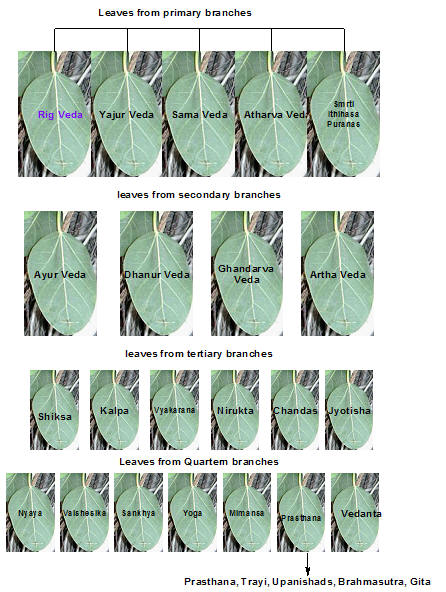
Krishna states that He is Asvattha tree among trees. Jesus Christ says that he is the true vine. It appears the trees have souls from what Lord Krishna and Jesus Christ say. Why are we cutting them indiscriminately and depleting our forests?
Sage Narada cursed the two sons of Kubera to become trees for knowingly playing naked in the shoal of a river with Ghandarva women. (You thought that having a shower mate is a modern phenomenon: not so from what you read here.) The young women in a turn of modesty put on their clothes while the Kubera’s sons ignored the sage, who cursed them to become trees for their feral nature, arrogance, insolence, and ignorance; Krishna released their souls and bodies after one hundred divine years by uprooting the trees.
Krishna drank water from River Sarasvati, sat, and meditated under Asvattha (Pipal) tree in a reclining position, before his departure to Goloka, Bhagavata Purana 3.4.3 and 8. River Sarasvati went dry before 1900 B.C. At present Sarasvati River features as a pentimento from satellite earth images.
Mantra Pushpam – Vedic Hymns
This mantra is from Taithreeya Aranyakam of Yajur Veda
Asva, meaning horse, is the root word for Asvattha, the tree; Asvamedha, horse sacrifice; Asvatthaman, he who cried like a horse at birth; Asvatthaman, the elephant; Asvini, the wife of Asvins, who took the form of a mare; and Asvinikumaras, the sons of Asvini-the sons of a mare. Asvattha tree gained such name because people used the tree’s shade as shelter for horses. Professor Bokonyi of Hungary an expert in the anatomy of horses tells that the true horses were present in Kutch area during the late Harappan period. The Aryans migrated from India in several waves to Iran to Caucasus riding on the horses as early as 4000 B.C. Rg Vedic civilization was before 5000 B.C. Indo-European languages have loan words like Aspa, Aihva, aszva, aspa, asa, iss, issi, issia, assa, sisu, equus. Where did they originate from? Yes, from Sanskrit. Let us look at another view. Domestication of horse: the credit goes to Akkadians; that is one view. The majority opinion is that the Indo-Aryan was the first domesticator of the horses. They wrote the first manuals for horse training.
Between 2000 B.C. and 1700 B.C. the Aryans (the late comers) in Babylon domesticated the horses which were then called the ass of the East. The horse was later introduced in Egypt before 1580 B.C. The Aryan victory march was attributed to tamed fast horses and chariots.
Sri Swami Satyananda Saraswati calls this tree The Mystical Tree. He says that this imperishable tree has roots above and branches below. The human body, according to him, resembles the upside-down tree in that the brain forms the root structure; the spinal column, the tree trunk; and the leaves, the thoughts, emotions and distractions. The occult truth and the secret knowledge of the Mystical Tree cannot be understood until the aspirant gets spiritual awakening.
Let me touch upon the significance of tree in Christianity. As you see Krishna’s image on the cosmic tree, it reminds us of Jesus Christ on Holy Rood, the tree of immortal life, and he is himself the fruit of the tree. Jesus on the cross, the Buddha under the tree, and Krishna on the cosmic tree–my interpolation, are the same figures. Page 107 The Power of Myth, by Joseph Campbell. Joseph Campbell, the universal man, sees oneness in Jesus Christ and the Buddha. Campbell is one among the rarest of breeds who knows the essence of (a generic) religion. He can see through the apparent differences among the religions and find the common Truth.
15.2: Its branches extend downwards and upwards nourished by Gunas, with sense objects as shoots or sprouts; and its roots extend downwards to the world of men, bound to karma.
The tree has many adventitious roots, coming down from the tree branches; the wider the tree grows the more adventitious roots there are. These adventitious roots, compared to ego, ignorance and vasanas supporting the heavy branches grow down, while the cosmic roots of the tree trunk grow towards heaven and anchor in Brahman. The lower branches are synonymous with human beings, animals, birds, reptiles, worms, insects, and insentient and immovable matter. The upper branches are comparable to Ghandarvas, yaksas, gods, and goddesses.
The sap of Gunas nourishes the branches, the product of Prakrti; the sap flowing through the upper branches contains Sattva (goodness and virtue), while that of the lower branches comparable to animals, contains Tamas (ignorance and delusion). The middle branches are the men with varying combinations of the Gunas and thrive by the sap of Sattva, Rajas, and Tamas in varying combinations. The adventitious roots of the middle and lower branches represent bondage of the human beings and animals. The lateral branches are the sense objects, namely sound, vision, smell, taste, and touch; the growing ends of lateral branches are the ears, eyes, nose, mouth, and skin; the leaves representing the Vedas reach for the sun and illumination from God.
The adventitious roots originate from branches, which draw nourishment from Gunas: they are extensions of these branches and therefore of the gunas, which are responsible for the way men behave. The adventitious roots or the gunas anchor to Prakrti and bind the jivatma to karma and therefore to Sams�ra. In this world of beings, man has the most opportunity to advance to a higher state, fall to lower state, or remain in the same state. The animals are born in the lower state because they have to resolve the pr�rabda (past) karma inherited from the past life; they do not accumulate new karma in the present life because their acts are commensurate with their animal traits; and they are incapable of making informed choice from Sattva, Rajas, or Tamas. But, man on the other hand can accumulate new karma because he can choose his (thought), word, and deed.
Krishna in his discourse in The Uddhava Gita, Dialogue 7.21-7.24 describes the Tree of Life. (based on translation by Swami Saraswati.)
The tree of Samsara bears flowers and fruits; good and bad deeds are its seeds; desires are its deep roots; Sattva, Rajas, and Tamas are its support; earth, water, fire, air, and ether are its five secondary branches through which five kinds of sap (smell, taste, sight, touch and hearing) flow. The five branches fork into ten branches: five motor organs, five sensory organs plus the mind. Two birds (The Supreme One and Ahamkara) live in their nests in the branches. The bark has three layers, the three humors of the body: wind, bile and phlegm. The tree bears two fruits: joy and sorrow. Some eat the fruit of sorrow; some on right path eat the fruit of joy. Krishna tells Uddhava to cut down the tree and free the Self, identifying himself with the Self.
15.3: Neither its form nor its end nor its beginning nor its support is seen. Having cut this firm-rooted Asvattham tree by the strong weapon of detachment…
15.4: Thereafter, seek out that goal, attaining which one does not return again. Surrender to the (first and) Primal Person from whom the ancient manifestation comes forth.
We have to cut the adventitious roots to prevent lowermost branches from getting the sap of Tamas (darkness and delusion); then we have to cut the adventitious roots, which supply the Rajas sap (motion and passion) to the middle branches; now we are left with the upper branches (and their adventitious roots), whose sap is Sattva (goodness, virtue, and calmness). To attain to Brahman, we have to transcend all three Gunas and therefore have to cut the tree, roots, and all. The tree represents the nonself or Prakrti, and we have to separate the Jiv�tman from Prakrti, so it merges with the Higher Self.
Let me explain what attaining to Brahman means. It points to a certain quality of life and behavior. It is simply not having the didactic knowledge of the Holy Scriptures; it is not simply the rituals alone. Dharma, duty; sama, equanimity; dama, self-control; vairÄ�gya, indifference to worldly objects; uparati, desisting from sensual enjoyment; sraddhÄ�, faithfulness; and atha, “much more or more over,” (auspiciousness, authority, flair and divine grace) are the preconditions for reaching Brahman. The fit person is the one who knows his Vedas, has the attributes (described above), and is devoted to the Lord only and detached from the world.
- Dharma
- Sama
- Dama
- Vair�gya
- Uparati
- Sraddh�
- Atha
- Duty
- Equanimity
- Self-control
- Desirelessness
- Abstinence
- Faithfulness
SraddhÄ� is implicit faith in Hindu Holy Scriptures. “Atha” has no English equivalent and means “much more” or “more over” meaning auspiciousness, authority, flair, and divine grace.
15.5: The wise ones, without false pride and delusion, having vanquished the evil of attachment, eternally devoted to the Supreme Self, divorced from passion (KÄ�mÄ�h), free from dualities of HAPPINESS and distress, and delusion, reach the eternal state. ( Suka and Dukha = þýÀõ (Inbam) and ÐýÀõ (Thunbham) = HAPPINESS and distress.)
- FULL ARTICLE with reference to horses, veda <
- Bhagavad Gita & the President’s remarks at the Nobel Peace Prize ceremony Oslo.
- ARTICLES, DEIN AYURVEDA NET:
- The Holy Bodhi Tree
- The mystical tree – In the Bhagavad Gita
- The Baobab Tree, Africa´s Medicine, Social Project
- Brihad Aryanka Upanishad and Stars
- Brihad Aryanka Upanishad and Trees
- Yoga, Ayurveda und Siddha Medizin
- Ashtanga Yoga and the Tanthram Tree
- Veda, Smriti and Sruti
- Gunas im Ayurveda und Yoga, Grundprinzipien
- Adi Shankara, Books, Arts, Studies
- YOGA LITERATUR ÜBERSICHT
Shivaratri, most significant of all Festivals
> Int. Interreligiöser Kalender <
> 12 Jyotir Lingas, Seats of Lord Siva <
> OMKARESHWAR ASHRAM, SCHOOL PROJECT <
> SRI RAMANA SEVA ASHRAM – Message No. 132.<
On 12th febrauary 2010, Maharshivaratri(lord Shiva’s Birthday) is celebrated all over the world. Maha Shivratri or Maha Sivaratri or Shivaratri or Sivaratri (Night of Shiva or „Great Night of Shiva“) is a festival celebrated every year on the 13th night/14th day in the Krishna Paksha (waning moon) of the month of Maagha (as per Shalivahana or Gujarati Vikrama) or Phalguna (as per Vikrama) in the Hindu Calendar (that is, the night before and day of the new moon). The festival is principally celebrated by offerings of Bael (Bilva) leaves to the Lord Shiva, all day fasting and an all night long vigil. Ganja is traditionally used as an offering for Lord Shiva and his followers. Read More: > HERE <
Shivaratri — The most significant of all festivals
Shivaratri is celebrated every year with a lot of religious fervour and devotion. Devotees keep fast, make offerings on Shivaling and stay awake all night (jagarari) to get the blessings of God Shiva. Unknown to most of the devotees the festival of Shivaratri holds the mystery to something most crucial namely, how God liberates the entire humanity from sorrow and suffering.
Till this mystery is solved by God himself, Shivaratri is celebrated merely as an annual ritual sans its original significance and purpose. To truly celebrate Shivaratri it is vital to know as to who Shiva is and what the word ‘Ratri’ which means night has to do with Shiva. The Supreme Soul is one and souls are many. The Supreme Soul is the Creator and Director of the eternal World Drama and souls are the actors in it. By becoming pure souls can become a great soul (mahatma), religious soul (dharamatma) and a divine or deity soul (devatmd) but they cannot become Supreme Soul i.e. paramatma. Souls are the progeny and not a part of the Supreme Soul. God Shiva is the creator of all deities even Brahma, Vishnu and Shankar.
Devotees worship them as devtaya namaha (salutations to the lords or deities). In comparison, Shiva is always worshipped as Shiva Paramatmay Namaha (Salutations to God Shiva) and Om Namaha Shivay (I salute Shiva). Lord Rama and Lord Krishna are shown as worshipping God Shiva at Rameshwar and Gopeshwar respectively.
The light form of God Shiva has been idolized as jyotirlingam (pillar of light) in 12 famous jyotirlingam Shiva temples in India viz. in Kedarnath, Somnath and Mahakaleswar etc. The light form of God is worshipped in most of the faiths in the world. Interestingly, Shivaratri does not mean Shiva’s night. The festival commemorates God’s descent on earth to end the unlimited Ratri (night) of ignorance and suffering and to usher in the golden dawn of peace, harmony and happiness.
“ Feste und Fastentage im Hinduismus „
von SWAMI SIVANANDA, 25. Kapitel – Shivaratri
siehe: > www.yoga-vidya.de <
>„1-Woche-vor-Shivaratri-Vortrag-mit-Sukadev“ <
Here Ratri connotes that critical juncture in eternal world drama cycle when unrighteousness reaches its extreme and all human efforts to redeem the situation fail. It’s a period of extreme sorrow and suffering when the vices (bad habbits) of ego, lust, anger and attachment rule human thoughts and actions.
In Hindu scriptures there is mention of the night of Brahma and also the night of the shaktis or goddesses (Navratris). The night of Brahma signifies the age of ignorance and unrighteousness in which God’s first and purest creation, Brahma and the Brahmins, are clouded by ignorance and vices. When God Shiva comes and opens their third eye of wisdom by bestowing divine intellect, they are able to forge a mental link with Him and draw His power. They thus become Shiva Shaktis who destroy ignorance and vices in the world with the help of Shiva. The Navratri (festival of nine nights) is a memorial of the end of the unlimited ratri in which devotees invoke the blessings of Shiva Shaktis and sing praise of their divine actions. It is at such a time when God intervenes to perform the divine acts of re-creating the new world order of purity, peace and prosperity and destroying the old worldorder of viciousness, violence and deprivation, as described in the Bhagavad Gita.
Just as night ends and day dawns when the sun rises, in the same way to end the night of ignorance God Shiva, the Sun of Knowledge (Gyan Surya) incarnates at the fag end of Kaliyuga, in Bharat.
This period of spiritual enlightenment is sailed Sangamyuga (Confluence Age) in which the most auspicious confluence of the Supreme Soul Shiva and human souls takes place. This is the most elevated period in human world when God incarnates in an ordinary man’s body and names him Prajapita Brahma through whom He reveals the most profound cnowledge about the Creator and His Creation. He reveals the supreme wisdom of Rajyoga which helps human beings absolve their sins and attain their original purity and perfection. That s why God Shiva is knowledgefull and patitpavan (purifier).
He is also the liberator and guide whose incarnation sets in process the destruction of the unrighteous iron-aged world – the present Kaliyuga – and consequently the liberation of ill souls from sin and suffering. God Shiva guides all souls to the land of liberation – the souls world where freed from their bondages they live in peace and silence. Thus He is also called Mahakaal (the great death or the eternal time) whose advent signals the return of everything in Creation to its original state.
This purification leads to the creation of a new pure world order Satyuga. It is the time on the world drama cycle (Srishti Chakra) which is remembered as Paradise, Heaven, Vaikunth, or Swarg where complete purity, peace and prosperity prevailed.
That is why the supreme Father of all souls is called the Creator and Shiva, which means the benefactor of all, who does good to every soul by incarnating in this world.
And the happiest news is that this golden key which opens the gates of the Golden age, Satyuga or Paradise is being given right now by Supreme Soul God Shiva himself to His spiritual children who have recognized His incognito incarnation in the human medium of Adi Dev Prajapita Brahma.
It is now that we have to awaken the soul (jagarari) and stay in the remembrance of God Shiva (up-vas means to stay close) take the oath of celibacy, sacrifice the bitterness of vices (bad habbits) on Shiva, and let the divine knowledge of Shiva flow drop by drop to all souls.
By adopting this true method of celebrating Shivaratri we should claim the greatest blessing mukthi , liberation in life, from God Shiva in this birth.
Gross Elements in Ayurveda, Yoga, Buddhism
> Principle of Tridoshain Ayurveda <
MahÄ�bhūta is Sanskrit and PÄ�li for „great element.“In Hinduism, the five „great“ or „gross“ elements are ether, air, fire, water and earth. In Buddhism, the „four great elements“ (Pali: cattÄ�ro mahÄ�bhūtÄ�ni) are earth, water, fire and air. Read more: > HERE <
The Principle of Vata, Pitta and Kapha
The Physiology of Âyurveda is the physiology of the all-important trio, Vâta, Pitha and Kapha or Tridosha as they are generally called. Anybody, even faintly acquainted with Ayurveda, must have frequently come across the terms Vâyu, Pitha and Kapha. But very few have any clear idea of what is really meant by the terms. Every grown-up Indian has some vague idea about Vayu, Pitta and Kapha, and the terms are also used in common parlance. But in the majority of instances, the popular conception is quite different from the medical one. We have ample reference in Ayurvedic literature to the properties and different functions of Vatu, Pitta and Kapha, both in their normal and abnormal conditions. But we have no direct evidence by which we can come to a definite conclusion regarding the ultimate nature of these three substances. All that we can do is to make some inference based on reason, by a comparison of the original texts of Charaka, Sushruta and others and supplemented by such evidence as we can get from non-medical sources.
Yet Vâtha, Pitha and Kapha are the three entities on which stands the whole foundation of Ayurveda; we have to deal with them from the beginning to the end. Without their proper knowledge, successful treatment of diseases according to the Ayurvedic System is quite impossible. Before proceeding further, it is necessary that we should know something of the conception of the ancient Hindus regarding the physical world. Charaka and Sushrutha have mainly followed the Nyâya-Vaisheshikha and Sâmkhya-Yoga systems of Philosophy and occasionally the Vedanta view of the five Bhuta.
The nature and Physical Properties of the Tridosha.
The fundamental principle underlying the Ayurvedic System of Medicine is that of the Tridosha. In a nutshell, this Principle may be stated as follows:
There are three Dosha, Vâyu, Pitta and Kapha, which when in equilibrium keep the body sound, but which when vitiated, either singly or in combination, bring about diseases. The method of treatment would therefore be to bring the vitiated Dosha back to normal state, so that the three Dosha are again in equilibrium. We have seen that Âyurveda developed from the four Vedas; it is also regarded as a supplement of the Atharva Veda. But nowhere in the four Vedas can we find any specific mention of these substances.
It is in the Rig Veda only (1.3.6) that we find what may be regarded as the root idea of Vâyu, Pitta and Kapha :
“Tri-no asvinÄ� divyÄ�ni bhesajÄ� trih pÄ�rthivÄ�ni trirudattamadvyaha;
Om�nam samyor-manma k�yasunave tridh�tu sarma vahatam subhaspatī.
Here “tridhÄ�du sarma vahatam” has been explained thus by the commentator SÄ�yana: That is to say that when the three Dhâtu – Vâyu, Pitta and Kapha – remain normal and undisturbed, the body is at ease and there is no disease.
With the advancement of the knowledge, when the science of medicine was systematically studied, Âyurveda as a separate and special subject evolved out of the Vedas. The Principle of Vâyu Pttha and Kapha, was then fully developed and so we find copious reference to these terms in the Mahâ Bhârata and Upanishads.
Draya explained:
Dravya is defined as „that which contains in it action and quality and is a co-existent cause“. (C. S. I. 1.50 ; V. S. I. 1. 15). Substances exist and have qualities. We have two kinds of qualities, those which reside in a plurality of objects and those which are confined to individuals. The former are the general qualities (sâmânya), while the latter are distinguished as permanent (guna) and transitory (karma). Inherence is a special kind of relation. Relations are of two kinds. external like, conjunction (samyoga), or internal like inherence (samavâya). The first is regarded as a quality and the second is made a separate category.
The Vaisheshika believes that a substance is something over, and above the qualities. It is anxious to assert the existence of something which has qualities without being itself a quality, for we predicate qualities of substances and not qualities of qualities. Nor can it be said that we predicate one quality of a group of qualities. But since a substance cannot be conceived apart from qualities, it is defined as possessing qualities.
Qualities and action exist by combination with substance. Without substance, there were no qualities or action. Similarly, genus and species are correlative and are not absolute, except in the case of the highest genus which is Existence (bhâva) and the lowest species which is vishesha or individual characteristics appertaining to and inhering in the external substances. Genus and species, therefore, exist by combination with substances. Without substances, there were no genus and species. Similarly Samavâya or combination is “the intimate connection in the inseparably connected things“, e.g. parts and wholes of substances and their qualities, of action and the seat of action of genus and species and substances in which they reside, and of external substances and their ultimate differences. Without substance, then, there were no combination. Substance or dravya, therefore, is the fundamental reality.
Dravyas are nine in number, viz. the five Bhutas,
- 1. Prthivi (Earth)
- 2. Apah (Water)
- 3. Tejas (Fire)
- 4. Vâyu (Air)
- 5. Âkâsha (Ether
and
- 6. âtman (Soul)
- 7. Manas (Mind)
- 8. Dish or dik (Space) and
- 9. Kâla (Time).
These nine substances are intended to comprise all corporeal (murta) and incorporeal (a-murta) things. Ether, time and space are all-pervading, have the largest dimensions and are the common receptacles of all corporeal things. Soul and mind, Ether, time and space, Air and the ultimate atoms are not ordinarily perceptible, (V. S. VIII. 1.2).
[It must be clearly understood here that whenever we use the terms Earth, Water, Fire, Air and Ether, we use them only to denote the five bhutas and not in the sense of ordinary earth, water, air, fire or ether]
Charaka says that dravyas are of two varieties, – animate and inanimate. Those endowed with the senses are called animate; those devoid of senses are inanimate, (Sendriyam cetanam dravyam, nirindriyam acetanam, C. S. I. 1. 47.)
The Nature Of Citta According To The Yogasutras Of Patanjali
The five Mahâbhutas
The five Mahâbhuta originate from the five Tanmâtra. Of these, the Prthivi helps the other four by being their support. Ap helps the other four by moistening. Tejas helps the others by ripening. Marut helps by drying and Akâsha helps the other four by giving space. Prthivi is possessed of five qualities, – sound, touch, colour, taste and smell. Ap is possessed of four qualities,- sound, touch, colour and taste. Tejas is possessed of three qualities, sound; touch and colour. Vâyu is possessed of two qualities, – sound and touch. Akâsha has only one quality, sound.
We thus get :
Âkâsha/ Aether – (Sound-essence)
Vâyu/ Air – (Sound + touch)
Tejas/ Fire – (Sound + touch + colour)
Ap/ Water – (Sound + touch + colour + taste)
Prthivi/ Earth – (Sound + touch + colour + taste + smell).
Though Earth contains a number of qualities; we yet say that it has smell, on account of the predominance of this quality. If water and other substances besides earth possess smell, it is because particles of Earth are mixed up with them. We cannot think of Earth without smell, though we can so think of air and water. The special quality of Water is taste. Fire has for its special quality luminosity. Air is invisible, though limited in extent and made up of parts. The discrete nature of Air is inferred from the movements in the air, which would not be possible were Air an absolute continuum devoid of parts (V. S. II.1.14). Its existence is inferred from its special quality of touch and it is said to be a substance, since it possesses quality and action.
According to the Vaisheshika, the ultimate constituents of the concrete things of earth, air, fire and water are called paramânu or atoms.
Charaka has pointed out the primary qualities or special physical characters, of the five Bhuta in a different way. He says, „The characteristic of Earth is roughness, that of Water liquidity, of Air expansion, of Fire heat and that of Ether non-resistance. All these qualities are perceived through the sense of touch,“ -„Sparshendriya gocharam“, (C. S, IV. 1,27 ).
Bhutas are not elements
The Bhuta has been translated as ‚element‘. This is misleading. Bhutas are not elements and paramânus are not atoms or molecules in the modern sense of the terms. Modern writers laugh at the idea of calling the earth, water, fire, air and ether elements, ignoring the fact that a Bhuta is just an element, in the chemical sense of a substance that cannot be further analysed. „On referring to any Vaisheshika manual, it will be clear that what is ordinarily known as ‚earth‘, is not regarded by the Vaisheshika to be an ‚element‘ – in the technical sense; if it were so regarded, then alone could the Vaisheshika view be stigmatised as primitive and unscientific. The touch of ‚Earth‘ in its pure state is said to be ’neither hot nor cold’ so also the touch of ‚Air‘ and when asked why the ordinary earth and ordinary air are found to be very far from ’neither hot nor cold‘, the Vaisheshika explains that this is due to earth and air being mixed up with particles of Fire or Water, which make them hot or cold. From this, it is clear that what is regarded as ‚element‘ is not the earth etc., as we know and see them, but as they exist in their pristine and pure state, unmixed with any other substances“. Just as an atom of a chemical element has no free and independent existence, so also the five Bhutas in their pure state are never found in nature. What we find are compounds of the five Bhutas, mixed together in different proportions; that is to say, all gross matter is penta-bhautika.
Psychological explanation of the five Bhutas
The question may be asked, why were only five Bhutas postulated? Now, God has endowed us with only five senses, neither more nor less. The external world can only be apprehended by us through these five senses or Indriya. There is no other source which can give any information about matter which constitutes the physical world. For one particular lndriya, there is only one particular sense-object. The srotarerdriya or the sense of hearing can appreciate only the quality of sound. Sound, touch, colour, taste and smell are the five sense-objects corresponding to the five senses. These are gunas, and as such cannot exist independently by themselves, but must have some receptacle. In this way, we get five receptacles,- the five Bhutas.
What, for example, is the ‚atom‘ of Earth, but an ultimate material substratum of odour. On the other hand, let us take the case of the coloured gas Chlorine. It can be felt, smelt, tasted and seen. We are cognizant of its existence by at least four different sensory impressions; therefore it is not an element in the Vaisheshika sense of the term; it must be composed of at least four different Bhuta. The Hindu classification of matter into five Bhuta is, therefore, not at all absurd, as is supposed by many scientists who have an altogether different viewpoint.
According to Dr. Ganganath Jha, what the Vaisheshika means by saying that there are five Bhuta, is that there are five states of matter, viz., solid (Earth), liquid (Water), gaseous (Air), luminous (Fire) and etheric (Akâsha). It is better, however, to regard them as the Ashrayas or repositories of the five qualities,. viz. of smell, etc.
The confusion has been introduced by denoting the Bkutas by terms which are also used with reference to external objects of matter, such as earth, etc. But, as Hoffding says, „because language was developed under the influence of attention directed to the external world, we find that expressions for mental phenomena were originally taken from the material world. The inner „World behind is denoted by symbols borrowed from the „outer world of space“.
Contemplation of the elements (dhatu, mahabhuta) as a meditation method taught by the Buddha.
Hindu Medicine and the Vedas:
There is no doubt that the germ of Hindu medicine was laid in the Vedas. Because in all the four Vedas, – Rig, Yajur, Sâma and Athravana, – we find ample reference to medicine, drugs, methods of treatment and descriptions of the different parts and organs of the human body.
For example, reference is made to Dhanvantari in R.V IX. 112. In R.V. 1.117. 13 and V.74.5, we find that Chyavana was rejuvenated by the Ashvini Kumâras. ln 1. 23. 19, the medicinal properties of water are described. Reference is made to phthisis in R. V. X. 163 and to the organs of the body in R. V. III. 36.8, III. 50. 6, VI. 53. 8, VIII. 1. 26, X. 1. 84, X. 163 and X. 186. Similarly in the Sâma Veda II. 10. 70. 184 and in the White Yajur Veda XII.74. 75 and the 16 hymns that follow, we have reference to the medicinal properties of drugs.
But it is the Atharvana Veda which deals more fully with medicine. Here we have reference not only to mineral and vegetable drugs but also the causes of diseases (A. V. I. 23, 24, 36 ). „This work in its tenth book contains“, as Dr. Hroernle notes, „a hymn (the second) on the creation of man, in which the several parts of the skeleton are carefully and orderly enumerated in, striking agreement more specially with the system of Atreya as contained in Charaka’s Compendium“.
It is for this reason that the Ayurveda is generally included in the Atharvana Veda. This is also distinctly indicated by both Charaka and Sushruta. Sushruta (1. 1) calls it the Upânga of Atharvana Veda; and in Charaka Samhiaf (1. 30), we find that Atreya’s advice to his pupils was to have faith in the Atharvana Veda, because the latter deals with the treatment of diseases in the form of religious rites, sacrifices, oblations, expiation, fasts, the chanting of hymns, etc.
If we take the time of the Vedas to be 2000 B. C., we see that as early as this, the practice of medicine was in a very crude form. Nowhere in the four Vedas, can we find any mention of the term ‚Ayurveda‘. So we may take it that when later on the medical side of the Vedas was more fully and systematically developed, it formed a separate subject by itself and came to be known as Ayurveda.
- Dein Ayurveda Net:
- Samkhya Philosophie im Yoga
- Tattvas im Ayurveda und Yoga
- Die Veden, ein Überblick, Overview
- Arthavaveda
- Yoga in Buddhism
- Krishnamachar B.K.S. Iyengar, Bellur School, Patanjali Temple
- www.patanjaliyogafoundation.com
- yogena chittasya padena vacham malam sarirasya cha vaidyakena | yopakaroti tam pravaram muninam patanjalim pranajaliranato’smi || Let us bow the noblest of sages Patanjali, who gave Yoga for serenity of the mind, Sanskrit grammar for purity of speech and Ayurvedic medicine for the perfection of health.
- Meet all Ayurveda Groups, Friends, Studies at facebook <
- Meet Lord Dhanvantri at facebook <
