SPIRITUAL JOURNEYS, NEWS

UN – Access to water is a human right, not charity

http://plattformbelomonte.blogspot.com
International Day of Action for Rivers
We are already gearing up for March 14th 2012, which will mark the 15th annual International Day of Action for Rivers.
Last year saw the largest celebration of our world’s rivers by thousands of us who fight to keep them healthy and free flowing. Events took place in 36 countries – the broadest geographical participation in the last 14 years.
The theme of creativity shone through last year’s events. Around the world, from mountaintops to ocean shores, on many rivers and city streets in between, March 14th was filled with music, artwork, dancing and prayer. With such incredible momentum from last year, we wanted to start thinking about goals, ideas and possible themes for the 2012 International Day of Action for Rivers.
We would love to hear from you. Please post your ideas, possible themes, events that you are already planning, or anything you have to say! If you have any questions, please post them on Facebook or email dayofaction@internationalrivers.org.
http://www.facebook.com/DayofActionforRivers
P.S. To get you inspired take a look back at the last few years of the International Day of Action for Rivers, in pictures.
Greenwashing dams is high on the agenda
– Activists Take on Greenwashing at the 6th World Water Forum
One corporate „solution“ on the agenda at this year’s meeting is the Hydropower Sustainability Assessment Protocol (HSAP), a voluntary, non-binding scorecard that allows dam builders to greenwash the social and environmental performance of each other’s projects. HSAP is more about protecting the right to build large dams than protecting the rights of the millions of people who depend on rivers for their daily needs. HSAP does nothing to require developers to follow high social and environmental standards.
- Read Zach’s most recent blog from Marseille: „Civil Society Rejects Greenwashing of Dams at World Water Forum„
Stay tuned for more direct updates from Marseille and news about the many different events surrounding the 6th World Water Forum. https://twitter.com/worldwaterforum
Water is a human right
Press Statement UN Resolution 64/292 The Right to Water and Sanitation
UN united to make the right to water and sanitation legally binding
“I wholeheartedly welcome this resolution from the Human Rights Council, which signals a global agreement that access to water and sanitation are no longer matters of charity,” Ms. de Albuquerque said. “The right to water and sanitation is a human right, equal to all other human rights, which implies that it is justiciable and enforceable. Hence from today onwards we have an even greater responsibility to concentrate all our efforts in the implementation and full realisation of this essential right.”
The Right to Water is the Right to Life
When the United Nations’ Universal Declaration of Human Rights was drafted over 50 years ago, water was not included in the list of protected rights. The rationale was simple. Water, like air, was considered so fundamental to life that naming a right to it would have been redundant.
Times have changed.
Despite the everyday dependence we have on water, access to fresh water is far from equal or guaranteed. Of the world’s population of 6 billion, at least 1.5 billion people do not have access to clean drinking water and another 4 billion lack adequate sanitation services. In parts of the developing world, a child dies every 15 seconds due to easily preventable water-related diseases.
Global water corporations, international financial institutions, trade agreements, governments and even parts of the United Nations have been promoting privatization and commodification of water as a way to deal with this crisis.
But the evidence shows that privatization leads to rising water rates, unclean water – and of course, soaring corporate profits. Water should be safe, affordable, and accessible to everyone – not just those who can afford to pay.
Time for Action
Without action, inequality and human suffering will only worsen. The UN predicts that by 2025, the number of people deprived of water will climb to over 3 billion. Such disparity is an affront to the world’s shared humanity and threatens our future security. Water scarcity is a common source of conflict in this new century and promises to become more so. And for many developing nations, the lack of proper infrastructure to deliver clean water only perpetuates and worsens poverty.
The only way to solve this crisis is to ensure that water remains under public control. Governments must enshrine the human right to water and protect the eco-systems that people and nature rely upon.
Friends of the Right to Water
In recognition that water is the essence of life, a group known as “The Friends of the Right to Water” (FRW) has begun an international campaign seeking to affirm the universal right to water. Building upon General Comment No. 15 (GC 15) adopted in November 2002 by the UNCommittee on Economic, Social and Cultural Rights, the FRW is inviting organizations to join in the effort to secure the right to water.
General Comment 15 notes that the right to water has already been established in a wide range of international documents and underscores the fundamental importance that water plays in the realization of all other human rights.
As it stands, all 144 signatories to the UN Covenant on Economic, Social and Cultural rights are bound by the pronouncements of GC 15. The problem is that countries can ignore their responsibilities because there is no effective means of holding them to account. The campaign proposed by the Friends of the Right to Water is working to create a binding means to hold these states accountable.
Water belongs to the earth and all species andis an inalienable human right that must not be appropriated for profit.
— Maude Barlow,
National Chairperson of The Council of Canadians and co-founder of The Blue Planet project.
http://www.foodandwaterwatch.org/water
http://www.blueplanetproject.net/RightToWater/human_right.html
http://farmlandgrab.org Governments and corporations are buying up farmland in other countries to grow their own food – or simply to make money.
Increasing demand and climate change threaten global water supplies: At the moment, 70 per cent of freshwater is already being used for agricultural purposes. – UN report http://shar.espaEZB
‘Obesogenic’ food systems & Right to food in emerging countries
OLIVIER DE SCHUTTER
U.N. SPECIAL RAPPORTEUR
ON THE RIGHT TO FOOD
Newsletter 12 March 2012
Here is the latest news from the United Nations Special Rapporteur on the Right to Food, Olivier De Schutter. You will find more information on our website.
In the spotlight
‘Obesogenic’ food systems must be reformed
“The West is exporting diabetes and heart disease to developing countries, along with the processed foods that line the shelves of global supermarkets,” warned the Special Rapporteur, calling for an urgent response to the public health disaster of poor nutrition.
On March 6th the UN expert presented an official report, entitled ‘The right to an adequate diet: the agriculture-food-health nexus’ to the UN Human Rights Council.
Instead of medicalizing diets, we must tackle the systemic problems that generate poor nutrition in all its forms, he urged, calling for the taxation of unhealthy products, regulation of foods high in saturated fats, salt and sugar and the way they are marketed, reform of wrong-headed agricultural subsidies, and support for local food systems.
Read the press release or the report and recommendations.
“Unfinished progress”
– UN expert examines food systems in emerging countries
[8 March 2012] GENEVA – “The food systems of emerging countries are at a major crossroads. Millions of people have been lifted out of poverty, yet whole communities have been left behind,” warned Olivier De Schutter, the United Nations Special Rapporteur on the right to food, after presenting his reports* on China, Mexico and South Africa to the Human Rights Council.
“As many as 19 million Mexicans and 12 million South Africans remain food insecure, and China’s rural dwellers are up to six times poorer than urban populations,” the expert said, calling on emerging countries to act now to lay the foundations for fair and sustainable food systems by implementing the following actions:
Mr. De Schutter urged emerging economies to protect the rights of land users, especially minority and vulnerable groups, and to establish in law the right to food, so it can be rapidly translated it into national strategies and institutions. He also advised supporting smallholder agriculture in the face of mega-development projects, and stopping soil and water degradation through a massive shift to agroecological practices. Likewise, the UN expert suggested the adoption of a strategy to tackle rising obesity.
| Read more… |
“Emerging countries face the huge task of feeding fast-growing populations whose increasing wealth is exerting new pressures on scant resources. They must secure and strengthen their food production bases as a matter of urgency; and they will only do so by working with farmers and their organizations, rather than against them,” he urged.
END
(*)Check the reports: China, Mexico and South Africa.
Women’s Voices, Women’s Choices – 100 years of international Women’s Day

http://www.gwi-boell.de/democracy-womens-day-international-womens-voices-womens-choices
International Women’s Day (IWD), originally called International Working Women’s Day, is marked on March 8 every year.[1] In different regions the focus of the celebrations ranges from general celebration of respect, appreciation and love towards women to a celebration for women’s economic, political and social achievements. Started as a Socialist political event, the holiday blended in the culture of many countries, primarily Eastern Europe, Russia, and the former Soviet bloc. In many regions, the day lost its political flavour, and became simply an occasion for men to express their love for women in a way somewhat similar to a mixture of Mother’s Day and St Valentine’s Day. In other regions, however, the original political and human rights theme designated by the United Nations runs strong, and political and social awareness of the struggles of women worldwide are brought out and examined in a hopeful manner. http://en.wikipedia.org/wiki/International_Womens_Day
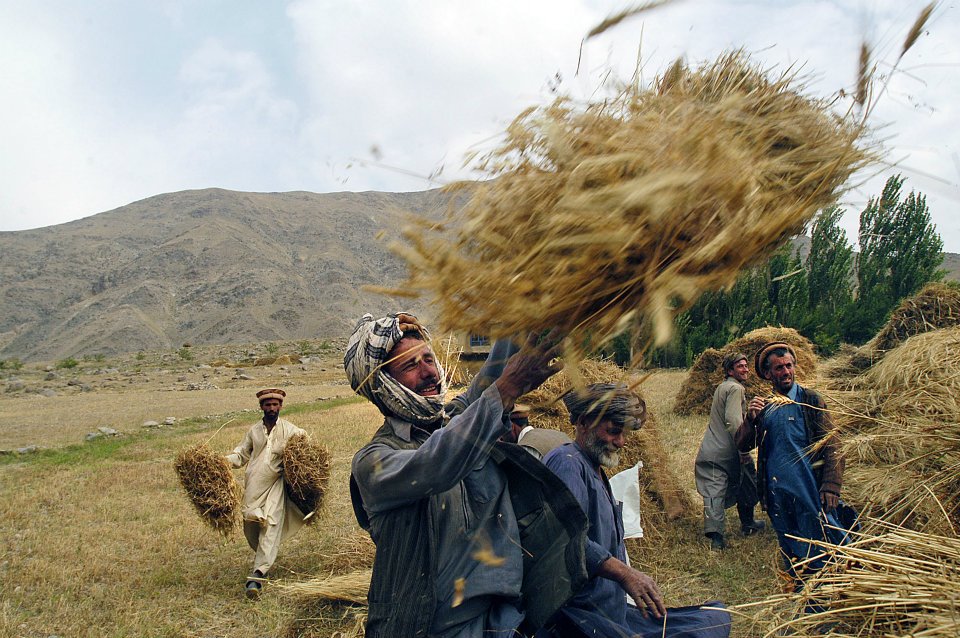
“Our food systems create sick people” – UN rights expert
“Our food systems create sick people” – UN rights expert
Do you agree? Like and share
Five ways to tackle the public health disaster of bad diets– UN expert on the right to food
GENEVA (6 March 2012) – “Our food systems create sick people,” warned today United Nations Special Rapporteur on the right to food, Olivier De Schutter. “One in seven people globally are undernourished, but many more suffer from the ‚hidden hunger‘ of micronutrient deficiency, while 1.3 billion are overweight or obese.”
“Faced with this nutritional crisis, we need to tackle the systemic problems which generate poor nutrition,” the independent expert said as he presented his report* on the agriculture-food-health nexus to the UN Human Rights Council. “However, we continue to prescribe remedies like a doctor: nutrition pills and early-life nutrition strategies for those lacking in calories; slimming pills, lifestyle advice and calorie counting for the overweight.”
In his report, Mr. De Schutter identifies five priority actions for putting nutrition at the heart of food systems in the developed and developing world:
- taxing unhealthy products;
- regulating foods high in saturated fats, salt and sugar;
- cracking down on junk food advertising;
- overhauling wrong-headed agricultural subsidies which make certain ingredients cheaper than others;
- and supporting local food production so that consumers have access to healthy, fresh and nutritious foods.
“Urbanization, supermarketization and the global spread of Western lifestyles have shaken up traditional food habits. The result is a public health disaster,” the Special Rapporteur said. “Governments have been focusing on increasing calorie availability, but they have often been indifferent to what kind of calories are on offer, at what price, to whom they are accessible, and how they are marketed.”
“We have deferred to food companies the responsibility for ensuring that a good nutritional balance emerges. Voluntary guidelines and piecemeal nutrition initiatives have failed to create a system with the right signals, and the odds remain stacked against the achievement of a healthy, balanced diet,” he said.
“The right to food means not only access to an adequate quantity of food, but also the ability to have a balanced and nutritious diet,” Mr. De Schutter noted. “Governments must not abstain from the responsibility to secure this right.”
The Special Rapporteur also identified the abundance of processed food as a major threat to improving nutrition. “Heavy processing thrives in our global food system, and is a win-win for multinational agri-food companies. Processed items can be produced and distributed on a huge scale, thanks to cheap subsidized ingredients and their increased shelf life.”
“But for the people, it is a lose-lose,” he stressed. “Heavily processed foods lead to diets richer in saturated and trans-fatty acids, salt, and sugars. Children become hooked on the junk foods targeted at them. In better-off countries, the poorest population groups are most affected, because foods high in fats, sugar and salt are often cheaper than healthy diets, as a result of wrong-headed subsidies whose health impacts have been wholly ignored.”
The UN expert noted that the West is now exporting diabetes and heart disease in developing countries, along with the processed foods which line the shelves of global supermarkets. By 2030, more than 5 million people will die each year before the age of 60 from non-communicable diseases linked to diets.
“We should not simply invest our hopes in medicalizing our diets with enriched products, or changing people’s choices through health warnings. Ambitious, targeted nutrition strategies can work, but only if the food systems underpinning them are put right,” the Special Rapporteur said.
Olivier De Schutter was appointed the Special Rapporteur on the right to food in May 2008 by the UN Human Rights Council. He is independent from any government or organization.
http://www.ohchr.org/Documents/HRBodies/HRCouncil/RegularSession/Session19/A-HRC-19-59_en.pdf
For the full briefing note entitled The World Trade Organization and the Post-Global Food Crisis Agenda: Putting Food Security First in the International Food System, visit: http://www.ohchr.org/Documents/Issues/Food/BN4_SRRTF_WTO_EN.pdf or http://www.srfood.org/images/stories/pdf/otherdocuments/20111116_briefing_note_05_en.pdf
For more information on the mandate and work of the Special Rapporteur, visit: http://www2.ohchr.org/english/issues/food/index.htm or www.srfood.org
Press contacts:
Yoonie Kim or Ulrik Halsteen (OHCHR): +41 22 917 9643 / 9323 / srfood@ohchr.org
UN Human Rights, follow us on social media:
Facebook: https://www.facebook.com/unitednationshumanrights
Twitter: http://twitter.com/UNrightswire
YouTube: http://www.youtube.com/UNOHCHR
Check the Universal Human Rights Index: http://uhri.ohchr.org/en
http://www.facebook.com/ANHInternational
http://www.facebook.com/organicconsumers
http://www.facebook.com/FoodandWaterWatch US , http://foodwatch.de/
http://bikyamasr.com/60747/un-expert-calls-for-junk-food-tax
http://www.foodsovereignty.org http://www.foodsov.org
http://en.wikipedia.org/wiki/Fat_tax
http://en.wikipedia.org/wiki/Right_to_food
http://en.wikipedia.org/wiki/Food_security
http://en.wikipedia.org/wiki/Agricultural_subsidy
Who Will be The Biggest Farm Bill Loser?
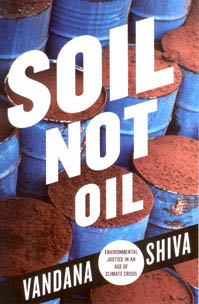
Soil Association annual conference 2012
Soil Association annual conference 2012
Facing the future: Innovation in food and farming
Royal Horticultural Halls, London
02 March 2012 http://www.soilassociation.org/conference
The Soil Association’s Conference 2012 will celebrate innovation in food and farming today. We will explore this through the two major themes of our strategy: Facing the Future, which explores the exciting scientific and technical progress being made in organic and low-input farming systems; and Good Food for All, which contributes to the important debate about food, public health and social justice.
The future of our food is in flux. According to the United Nation’s Food and Agriculture (UNFAO) special Rapporteur, Olivier de Schutter http://www.srfood.org/, ‘keeping blindly on the track of industrial agriculture is clearly unsustainable.’ If this is the case, then we need to galvanize the finest thinkers, technologists, scientists, farmers, entrepreneurs and teachers to develop new and sustainable ways of feeding a growing world population now and in the future.
In addition, the growing challenge of diet-related ill-health, in the UK and internationally, means that we need to explore the relationship between food production and its consumption. With a world that has approximately 1 billion people malnourished and 1 billion obese, there is a powerful case for bringing public health and nutritional expertise to the farming and food production table, to innovate joined-up solutions for our food future.
Navdanya
http://www.navdanya.org/campaigns
Navdanya means “nine seeds” (symbolizing protection of biological and cultural diversity) and also the “new gift” (for seed as commons, based on the right to save and share seeds In today’s context of biological and ecological destruction, seed savers are the true givers of seed. This gift or “dana” of Navadhanyas (nine seeds) is the ultimate gift – it is a gift of life, of heritage and continuity. Conserving seed is conserving biodiversity, conserving knowledge of the seed and its utilization, conserving culture, conserving sustainability.
Navdanya is a network of seed keepers and organic producers spread across 16 states in India.
Navdanya has helped set up 65 community seed banks across the country, trained over 5,00,000 farmers in seed sovereignty, food sovereignty and sustainable agriculture over the past two decades, and helped setup the largest direct marketing, fair trade organic network in the country.
Navdanya has also set up a learning center, Bija Vidyapeeth (School of the Seed) on its biodiversity conservation and organic farm in Doon Valley, Uttarakhand, North India.
2011 marked Earth University/Bija Vidyapeeth’s 10 year anniversary. Located on Navdanya’s Biodiversity and Conservation Farm, Navdanya offers celebrated courses for students to partake in from all over the world.
Our Vision
Vision Statement
“Navdanya’s vision is to accomplish such a development that all beings have a healthy environment to live, should have enough healthy food to eat and also have equal right to live, grow and evolve to their full potential through their self organisation”.
…………………………………………………………………………………………………
http://www.un.org/en/documents/udhr/index.shtml
Article 25 of United Nations Universal Declaration of Human Rights –
Everyone has the right to a standard of living adequate for the health and well-being of themselves and their family, including food, clothing, housing and medical care and necessary social services, and the right to security in the event of unemployment, sickness, disability, widowhood, old age or other lack of livelihood in circumstances beyond their control.
http://www.facebook.com/soilassociation
http://www.facebook.com/pages/Navdanya
Was wären die Schwaben ohne ihre Linsen?
>>> Traditional Food, Medicine & Biodiversity
>>> The Coming Famine: The Global Food Crisis and What We Can Do to Avoid It
Previous #articles #videos on #foodsecurity #agriculture #biodiversity
http://www.scidev.net/en/science-and-innovation-policy/science-at-rio-20
World Youth Congress Rio 2012
About WYC http://wycrio2012.org
The World Youth Congress series was born in 1997 following the frustrations of the Rio+5 Earth Summit conference which highlighted the fact that, far from increasing as the original Rio 1992 Earth Summit had proposed, Overseas Development Aid had, in fact dropped by 17% since 1992.
So the 1st World Youth Congress was conceived as a kind of Young People’s Earth Summit. However by the time it was finally held, in Hawaii in October 1999, it had developed into a much broader process of identifying priorities for the new Millennium. Entitled, the Millennium Young People’s Congress.
It got millions of young people around the world to identify ten key priorities for the new millennium and it turned out that eight of these closely mirrored the UN’s Millennium Development Goals, agreed a year later at the UN Millennium Summit.
In 2012 the United Nations will convene the United Nations Conference on Sustainable Development, also known as Rio 2012 or Rio+20, hosted by Brazil in Rio de Janeiro, as a 20-year follow-up to the historic 1992 United Nations Conference on Environment and Development (UNCED) that was held in the same city. The conference is organized by the United Nations Department of Economic and Social Affairs.
http://en.wikipedia.org/wiki/United_Nations_Conference_on_Sustainable_Development
http://www.amnesty.org/en/economic-social-and-cultural-rights
What is Rio+20?
Simply put:-
20 years after the original Earth Summit, Heads of State will meet again in Rio de Janeiro in May 2012 for the UN Conference on Sustainable Development. . The issues to be discussed are the building of a green economy and a institutional framework for sustainable development.
 –
– 
1992 Earth Summit logo 2012 Rio+20 logo
Detail:-:
The 1992 meeting came about due to a report from the the 1980′s defining sustainable development as
“Development that meets the needs of the present without compromising the ability of future generations to meet their own needs”. Bruntland Report 1987
However after 20 years, many of the issues discussed in 1992 still persist today and need urgent action.
As well as there being increased interest in issues of environmental, social and economical issues via scientific findings, governmental concern, media attention and NGO’s (non-governmental organisations) campaigns.
Videos explain what happened at the Earth Summit concerning the world leaders and the NGO’s activities.
From this Earth Summit came documents concerning
- Agenda 21
- Convention on Biological Diversity
- Framework on Climate Change
- Forest Principles
- Deceleration on Environment and Development
Since then other UN meetings have taken place concern sustainable development and climate change.
Of note: 1997 Kyoto COP3, 2002 World Summit on Sustainable Development (Rio+10) & COP15
However after 20 years, many of the issues discussed in 1992 still persist today and need urgent action.
Rio+20 will focus on 2 themes
Green Economy
By focusing the world economy on poverty eradication and sustainable development it is hoped in one case to increase the move from Victorian fossil fuel technologies, to alternative renewable energy resources.
Institutional Framework for Sustainable Development
This is to make governments have a greater focus on Sustainable Development.
In turn these will fulfill the Rio+20 objectives of
- Securing political commitment to Sustainable Development
- Assessing progress towards international agreed commitments
- Pinpointing new and emerging challenges
As well as put us on a path to a more sustainable future that us youth will grow into.
However, pressure is still needed to make this so….
http://www.scidev.net/en/science-and-innovation-policy/science-at-rio-20/
Get active, get involved and join us on the Road to Rio+20

Links:-
http://www.facebook.com/joinundesa
Previous #articles #videos #sources > #sustainable #development
Previous #articles #videos #sources > #millenium #development goals
http://www.facebook.com/WYC2012

Sivaratri Celebration and Sri Ramakrishna’s Brithday Celebration :
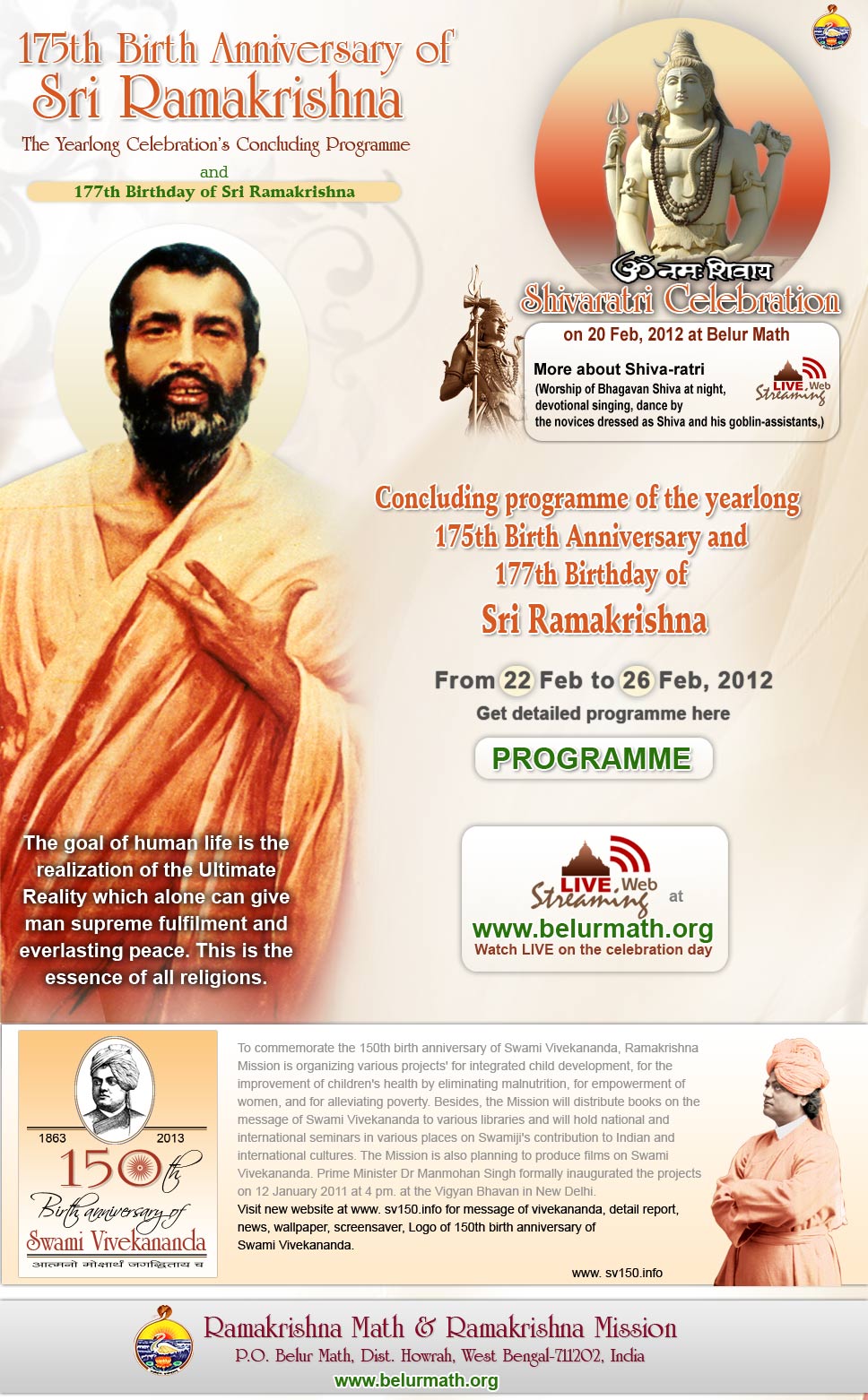
Sri Ramakrishna’s 175th Birth Anniversary : The Yearlong Celebration’s Concluding Programme and Sri Ramakrishna’s 177th Birthday Celebration : Watch LIVE from 22. Feb to 26. Feb 2012
Maha Shivratri ( Sanskrit:महा शिवरात्रि, Tamil:மகா சிவராத்திரி, Hindi:महाशिवरात्रि Nepali: महाशिवरात्रि) or Maha Sivaratri or Shivaratri or Sivarathri (Great Night of Shiva or Night of Shiva) is a Hindu festival celebrated every year on the 13th night/14th day in the Krishna Paksha (waning moon) of the month of Maagha (as per Shalivahana or Gujarati Vikrama) or Phalguna (as per Vikrama) in the Hindu Calendar (that is, the night before and day of the new moon). The festival is principally celebrated by offerings of Bael (Bilva) leaves to the Lord Shiva, all day fasting and an all night long vigil. Per scriptural and discipleship traditions, the penances are performed in order to gain boons in the practice of Yoga and meditation, in order to reach life’s summum bonum steadily and swiftly. International Mandi Shivratri Fair is held every year.
Shiva-ratri (Magha-krishna-chaturdashi) :
Shiva-ratri is observed on the 14th lunar day of the dark fortnight of the month of Magha (February-March). Watch LIVE Feb. 20. 2012 http://www.belurmath.org/siva_ratri.htm
Mahashivaratri is on February 19th in Entire North America, Canada, and United Kingdom. For Middle East, India, Srilanka, Malaysia, China, Japan, Singapore, Australia, Newzeland and Fiji Mahashivaratri is on Feburary 20th 2012. Please remember there is no Chaturdashi during 20th February’s midnight in America, Canada and United Kingdom. Hence If you are observing Mahashivaratri on February 20th in America, Canada, and United Kingdom you are observing amavasya not mahashivaratri. However in Middle East, India, Srilanka, Malaysia, China, Japan, Singapore, Australia, Newzeland and Fiji Mahashivaratri is on Feburary 20th 2012.
http://www.belurmath.org/siva_ratri.htm
http://en.wikipedia.org/wiki/Sivarathri
Hindu Festivals 2012 Time Table:
http://www.mypanchang.com/hindufestivals2012.php
OHCHR´s Management Plan 2012-2013

United Nations Human Rights
“[W]e are aware of the many challenges we face. As daunting as the road ahead may be, my Office will steadfastly pursue our goals and stay the course. The focus of this report is “Working for Results” and this is precisely what we intend to achieve in this biennium.” – UN High Commissioner for Human rights Navi Pillay’s foreward to her Office’s management plan 2012-13: http://bit.ly/zy5yVh
Like, share and give us feedback!
The “OHCHR Management Plan 2012-2013 ” articulates OHCHR’s priorities, expected accomplishments and strategies for the biennium. The Plan introduces OHCHR’s programme of work, both at Headquarters and in the field and presents OHCHR’s total budget and funding requirements for 2012-2013.
International human rights law refers to the body of international law designed to promote and protect human rights at the international, regional and domestic levels. As a form of international law, international human rights law is primarily made up of treaties, agreements between states intended to have binding legal effect between the parties that have agreed to them; and customary international law, rules of law derived from the consistent conduct of states acting out of the belief that the law required them to act that way. http://en.wikipedia.org/International_human_rights_law
The Guiding Principles provide a solid foundation for the implementation of those elements in the standards and practices which govern the full range of business activities and which ultimately lead to a socially sustainable globalization.
Reflecting on the rapid development of the relationship between business and human rights, the Chair of the Working Group, Margaret Jungk said it was not long ago that the prevailing view in the business community was that “human rights is not our concern”. Jungk paid tribute to the work of the former Special Representative of the Secretary-General on business and human rights, John Ruggie, saying it had taken great commitment to achieve the “traction which led to the first generation of progress and achievements in the field of human rights and business.”
“The second-generation challenge,” Jungk said, “is to have the Guiding Principles implemented.” Moving from agreement to implementation will be challenging, she predicted, because “99.9 per cent of the world have not yet heard of the Principles”.
Welcome to the portal about http://www.business-humanrights.org/SpecialRepPortal/Home
the work of the Special Repre- sentative of the United Nations Secretary-General on business & human rights, John Ruggie.
http://www.un.org/en/documents/udhr/index.shtml
http://www.minesandcommunities.org/
http://www.illegal-logging.info/
http://farmlandgrab.org/
http://www.ohchr.org
http://twitter.com/unrightswire
http://www.youtube.com/user/UNOHCHR
http://www.facebook.com/unitednationshumanrights
http://www.ohchr.org/EN/NewsEvents/Pages/InternetMustBeFree.aspx
Previous #Articles > #Human Rights #Human Rights Day 2011
Live Webcast: Public Welcome Ceremony for Archbishop Desmond Tutu

http://www.tutu.org The Desmond Tutu Peace Centre
We are having technical problems with the broadcast, we apologize for any inconvenience. The video will be available on www.dalailama.com after the event.
There will be a live webcast of the public ceremony welcoming Archbishop Desmond Tutu on his visit to meet with His Holiness the Dalai Lama in Dharamsala, India, on February 10th at 10:30-11:30 am Indian Standard Time.
The ceremony will be available for viewing and download after the event on http://www.dalailama.com (Russian translation available at http://dalailama.ru/top/974-dalai-lama.html)
For times in your region, 10:30am February 10th in Dharamsala, India, is the same as 9:00 pm February 9th in Los Angeles, California, USA.
Desmond Mpilo Tutu (born 7 October 1931) is a South African activist and retired Anglican bishop who rose to worldwide fame during the 1980s as an opponent of apartheid. He was the first black South African Archbishop of Cape Town, South Africa and primate of the Church of the Province of Southern Africa (now the Anglican Church of Southern Africa).
Tutu has been active in the defence of human rights and uses his high profile to campaign for the oppressed. He has campaigned to fight AIDS, tuberculosis, homophobia, transphobia, poverty and racism. Tutu received the Nobel Peace Prize in 1984, the Albert Schweitzer Prize for Humanitarianism in 1986, the Pacem in Terris Award in 1987, the Sydney Peace Prize in 1999, the Gandhi Peace Prize in 2005 and the Presidential Medal of Freedom in 2009. Tutu has also compiled several books of his speeches and sayings.
http://en.wikipedia.org/Desmond_Tutu
http://www.nobelprize.org/nobel_prizes/peace/laureates/1984/tutu-lecture.html
Previous #articles #news #social issues #humanrights > desmond tutu

EU Pledges Strong Support for Earth Summit

Through coverage of issues like food security, extractive industries, biodiversity and climate change, IPS aims to give a voice to people whose stories are seldom heard. IPS also hopes to highlight the various challenges they face in this globalised world: health and food insecurity, environment degradation, and poverty.
Hello,
While I’m always passionate about the work I do here at IPS, there’s something else that I’m excited about: Support Your Media Day.
On February 15, 2012, thousands of people are going to put their support behind non-profit, independent media in an unprecedented, 24-hour virtual donation drive. And on that day, every donation and donor IPS gets will help us claim our share of more than $10,000 in grants.
These contributions will fund the critical work we do every day and our unique brand of international reporting. They’ll support our writers, photographers, editors and media trainers throughout the world — from the streets of Damascus to the Dadaab refugee camps, from the Amazon basin to the Mekong Delta — wherever citizens are acting for change.
Support Your Media Day is going to be a big event, and everyone will be talking about it. Please join us. This is your opportunity to sustain reporting and analysis that is especially critical in this time of global upheaval.
We need you to help us with these three things:
- 1) Mark Wednesday Feb. 15 on your calendar, bookmark this giving link #video http://www.razoo.com/story/ipsnews/ and make a donation to IPS on Support Your Media Day.
- 2) Share this event on Facebook and Twitter and help build the buzz. You can tweet about this day using #supportyrmedia.
- 3) Spread the word! Forward this email to your family and friends along with a personal note explaining why you believe in our work, and why they should give on Feb. 15.
Support your media. Support IPS. We can’t wait to celebrate the difference your generosity will make.
 Sincerely,
Mario Lubetkin
Director-General, IPS
Some stories in this selection were produced by Tierramérica, a specialised information service on environment and development created by IPS in Latin America and sponsored by UNEP, UNDP and the World Bank. This newsletter includes independent IPS news coverage financed by the Finnish Ministry of Foreign Affairs.

These newsletter includes news coverage which is part of a project funded by the European Union
The contents of this news coverage, including any funded by the European Union, are the sole responsibility of IPS and can in no way be taken to reflect the views of the European Union.
2012/2/2 From the Frontline of Environment
Through coverage of issues like food security, extractive industries, biodiversity and climate change, IPS aims to give a voice to people whose stories are seldom heard. IPS also hopes to highlight the various challenges they face in this globalised world: health and food insecurity, environment degradation, and poverty.
2011 – A Year of Weather Extremes, with More to Come
Analysis by Janet Larsen and Sara Rasmussen*
WASHINGTON, Feb 1 – The global average temperature in 2011 was 14.52 degrees Celsius (58.14 degrees Fahrenheit). According to NASA scientists, this was the ninth warmest year in 132 years of recordkeeping, despite the cooling influence of the La Niña atmospheric and oceanic circulation pattern and relatively low solar irradiance.
MORE >> http://ipsnews.net/news.106616
OP-ED: After Durban, Latin America Looks Towards Rio+20
Ede Ijjasz-Vásquez*
WASHINGTON, Jan 31 (Tierramérica) – After the climate change negotiations in Durban, South Africa in December, there is space to continue advancing in the short and medium term. Now the attention of Latin America and the rest of the world is turned towards the United Nations Conference on Sustainable Development taking place this June in Rio de Janeiro.
In Durban, delegates from 194 countries agreed to develop a new global climate pact by 2015, which would enter into force in 2020. MORE >> http://ipsnews.net/106606
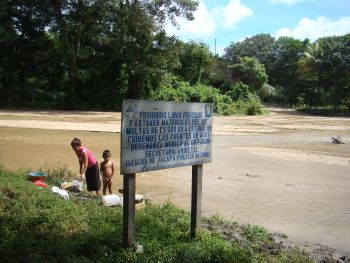
Local residents continue to use water from the depleted Coco River, despite the signs prohibiting it.
http://en.wikipedia.org/Right_to_water This article is about a right to water as a human right under international law. For a discussion of water usage laws in common law, see Water right.
NICARAGUA-HONDURAS: Re-Greening the Border
José Adán Silva*
MANAGUA, Jan 31 (Tierramérica) – Ignacia Matute looks back nostalgically on the days when the hills around her home in northwestern Nicaragua were blanketed in green, and she woke every morning to the sounds of birds singing in the treetops and the rushing waters of the nearly Coco River.
MORE >> http://ipsnews.net/news.106604
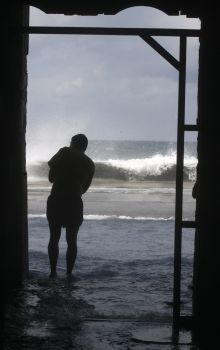 CUBA: Adapting to Climate Change Proves a Complex Challenge
Patricia Grogg
SURGIDERO DE BATABANO, Jan 30 – No one who lives in this fishing village on the south coast, 70 km from the Cuban capital, can forget the devastation wrought by hurricanes in 2008.
Official estimates indicate that 2.32 percent of Cuban territory may be permanently under water by 2050. If the necessary adaptation measures are not taken, as many as 79 coastal settlements will be affected and 15 will completely disappear.
 People living in low-lying coastal areas are most exposed to sea-level change.
She hopes and believes the water won’t reach her new house.
In the wake of a hurricane in Surgidero de Batabanó.
Risk evaluation is a first step towards a climate change adaptation plan. Credit: Jorge Luis Baños/IPS
MORE >> http://ipsnews.net/106593
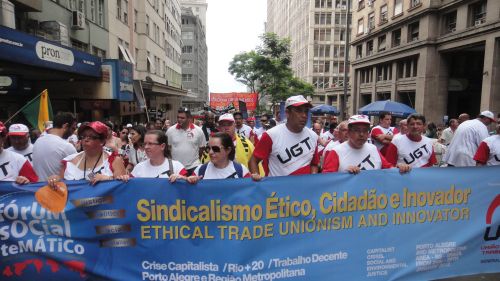
Labour and other activists flood the streets of Porto Alegre in environmental protest.
Thematic Social Forum Awash with Criticism for Green Economy
Clarinha Glock*
PORTO ALEGRE, Brazil, Jan 30 (Tierramérica) – Critical voices raised against what was dubbed „the gospel of green capitalism“ resonated in every discussion and street march held during the Thematic Social Forum, which brought thousands of activists to the capital city of the state of Rio Grande do Sul, in southern Brazil.
Spurred by the global economic and financial crisis, participants at this year’s thematic edition of the World Social Forum, which ran from Jan. 24th through the 29th, called on governments to implement changes in production and consumption, even as they were sceptical that a commitment along those lines could be secured at the United Nations Conference on Sustainable Development (Rio+20), scheduled for June in Rio de Janeiro.
Professor Edgardo Lander, of the Central University of Venezuela and a member of that country’s Social Forum, said there was „an attempt to rebuild capitalism with a new, green face.“
„Rio+20 comes at a time when capitalism faces a profound crisis and when the severe problems arising from the limitations of growth and the destruction of the conditions that make life on the planet possible are more evident,“ he told Tierramérica.
In this context, „green capitalism“ offers a solution to the severe crisis, primarily of the financial sector, through the increasing commodification of everything from education and healthcare to the traditional knowledge of indigenous peoples, he said.
MORE >> http://ipsnews.net/news.106591
U.N. Panel Launches Blueprint for Sustainable Development
Thalif Deen
UNITED NATIONS, Jan 30 – A long-awaited report by a U.N. high-level panel on global sustainability recommends several far-reaching proposals, including the establishment of new institutions and the creation of global indicators, aimed at protecting the world’s environment and strengthening the U.N.’s sustainable development strategy.
MORE >> http://ipsnews.net/news.106590
THEMATIC SOCIAL FORUM: Working Towards a Never-Ending Democracy
Antonio Martins
PORTO ALEGRE, Jan 27 – For five centuries, Europe has taken it upon itself to enlighten the world, teaching it ways to address and overcome crises, from ideas and wars to missionary work and genocides.
MORE >> http://ipsnews.net/news.106576
Some stories in this selection were produced by Tierramérica, a specialised information service on environment and development created by IPS in Latin America and sponsored by UNEP, UNDP and the World Bank. This newsletter includes independent IPS news coverage financed by the Finnish Ministry of Foreign Affairs.
These newsletter includes news coverage which is part of a project funded by the European Union
The contents of this news coverage, including any funded by the European Union, are the sole responsibility of IPS and can in no way be taken to reflect the views of the European Union.
Read more IPS reporting of environment news at: http://www.ipsnews.net/environment.asp
http://www.stwr.org/imf-world-bank-trade
http://www.facebook.com/UN Department-of-Economic-and-Social-Affairs DESA
http://www.amnesty.org/en/economic-social-and-cultural-rights
http://www.facebook.com/ipsenvironment
http://twitter.com/ipsenvironment
http://www.facebook.com/road2rio20
http://www.scidev.net/en/science-and-innovation-policy/science-at-rio-20
Rio+20: Is science getting a say? There’s quite a bit about science in the first draft of the Rio+20 negotiations http://www.facebook.com/scidevnet http://twitter.com/scidevnet

FOOD: WTO „must address“ food security
UPDATE 30.01.2012 Haircut Negotiations – Hedge Funds Bet on Profits from Greek Debt Talks SPIEGEL ONLINE – http://www.spiegel.de/international/topic/debt_crisis
The negotiations over the Greek debt haircut are becoming increasingly suspenseful, with euro-zone finance ministers and the IMF pushing investors to accept greater losses. Hedge funds, more than any others, stand to profit, and are betting that the voluntary debt rescheduling will fail. By Stefan Kaiser http://www.facebook.com/spiegelinternational
Coming Events:
7 February 2012: European Economic and Social Committee sustainability conference
Olivier De Schutter will address Workshop 1, entitled „food, water and energy for everyone“, held between 4.30 and 6.00 pm, of the Conference of the European Economic and Social Committee (EESC) Go sustainable, be responsible! European civil society on the road to Rio+20.
30 January 2012: No enough food, energy for World as population increases: U.N. report | Morocco World News http://moroccoworldnews.com
30 January 2012: With new blueprint in hand, Ban calls for action to chart more sustainable future http://www.un.org/apps/news/sustainable development

http://www.irinnews.org/Report WTO
http://www.ourworldisnotforsale.org/
“ Trade and food security is in effect a WTO issue, and so there is great frustration within the UN that this enormously restricts the role of, for example, the Food and Agriculture Organization-based Committee on Food Security „
Olivier de Schutter, UN Human Rights Council’s Special Rapporteur on the Right to Food, says: “Food security is the elephant in the room, which WTO [the World Trade Organization] must address”, pointing out that food import bills had soared by a third for poor countries this year.
WTO defending an outdated vision of food security [16 December 2011] Geneva – „Globalization creates big winners and big losers. But where food systems are concerned, losing out means sinking into poverty and hunger. A vision of food security that deepens the divide between food-surplus and food-deficit regions, between exporters and importers, and between winners and losers, simply cannot be accepted.
Food security hostage to trade in WTO negotiations: UN right to food expert [16 November 2011] Geneva – „The world is in the midst of a food crisis which requires a rapid policy response. But the World Trade Organisation (WTO) agenda has failed to adapt, and developing countries are rightly concerned that their hands will be tied by trade rules.”
Is the Doha round delivering on poverty?
Food aid on the back burner as WTO talks collapse
Some issues WTO needs to address in agriculture:
Ceilings on subsidies: Current ceilings on how much the US and the EU can spend on subsidies that distort trade are still rather high
Cotton subsidies: The US has still not fully complied with a WTO ruling in 2009 to remove subsidies for its cotton producers. African farmers could have gained from a 3.5 percent average increase in world cotton prices, if the US had cut subsidies.
Biofuel Subsidies : Not covered yet. A new study found that US ethanol subsidies may have artificially inflated maize prices by as much as 17 percent in 2011. Source: ICTSD
Some Further Sources such as http://www.un.org/en/documents/udhr/index.shtml
Read http://www.srfood.org/ Press release, „Eco-Farming Can Double Food Production in 10 Years, says UN Report“, 8 March 2011.
FARMAfrica FARM-Africa http://www.farmafrica.org.uk
Research by American Prof of International Development shows that small farms in Africa could be the solution to hunger http://www.stanforddaily.com/2012/01/13/
http://www.righttofood.org/ http://en.wikipedia.org/Right_to_food
http://cesr.org/index.php Center for Economic and Social Rights
http://www.facebook.com/World Fair Trade Organization (WFTO)
The G20 & Food Security – missing the big picture? World Trade
https://www.facebook.com/boellstiftung
http://www.business-humanrights.org/Categories/Issues/Other/Righttofood
http://www.stwr.org/imf-world-bank-trade/
http://en.wikipedia.org/wiki/Millennium_Development_Goals
http://donttradeourlivesaway.wordpress.com/
http://www.oaklandinstitute.org/issues
http://farmlandgrab.org/Olivier De Schutter: “Principles for responsible investment in agriculture”
http://www.ourworldisnotforsale.org/en/signon/stop-wto-s-doha-development-round-and-other-FTAs
The right to food, and its variations, is a human right derived from the International Covenant on Economic, Social and Cultural Rights (ICESCR). The UN Special Rapporteur on the right to food in 2002 defined it as follows: http://en.wikipedia.org/wiki/Right_to_food
http://www.amnesty.org/en/economic-social-and-cultural-rights
Join the energy [r]evolution! http://www.energyblueprint.info/ The report: ‘Energy [R]evolution: A Sustainable World Energy Outlook’, provides a detailed practical blueprint for cutting carbon emissions while achieving economic growth by replacing fossil fuels with renewable energy and energy efficiency. This phase-out of fossil fuels offers substantial benefits such as energy security, independence from world market fuel prices as well as the creation of millions of new green jobs.

Celebrate the 2012 Sundance Film Festival From Anywhere

http://www.sundance.org/festival
http://www.sundance.org/stories/blog
http://www.sundance.org/programs/native-film
“Storytellers broaden our minds: engage, provoke, inspire, and ultimately, connect us.”
—Robert Redford, President and Founder
The Sundance Film Festival is a film festival that takes place annually in Utah, in the United States. It is the largest independent cinema festival in the United States. HERE
Charity biography #433 Robert Redford has addressed environmental issues in documentaries and film for over 30 years. Read more: http://www.looktothestars.org/celebrity/443-robert-redford
Sundance Institute is a nonprofit organization dedicated to the discovery and development of independent artists and audiences. Through its programs, the Institute seeks to discover, support, and inspire independent film and theatre artists from the United States and around the world, and to introduce audiences to their new work.
Since 1981, Sundance Institute has evolved to become an internationally-recognized nonprofit organization that actively advances the work of risk-taking storytellers worldwide. Originally founded by Robert Redford in the mountains of Sundance, Utah, Sundance Institute has always provided a space for independent artists to explore their stories free from commercial and political pressures. By providing year-round creative and financial support for the development of original stories for the screen and stage, Sundance Institute remains committed to its mission to discover and develop independent artists and audiences across the globe.
#VIDEO 2012 Festival Kickoff http://www.youtube.com/sff
Sundance Film Festival Director John Cooper, and Director of Programming Trevor Groth, share some of the great things about to happen at the 2012 Sundance Film Festival.
Artist Programs
http://www.sundance.org/programs/
Through year-round support, including a series of Labs and Fellowships for screenwriters, directors, documentarians, producers, composers, and theatre artists, the Institute’s artist programs have supported more than 5,000 artists and their films.
Feature Film
The longest-running of Sundance Institute’s artist development programs, the Feature Film Program (FFP) was founded in 1981 and has since supported more than 500 independent filmmakers whose distinctive, singular films have engaged audiences worldwide. We hope to embrace the unique vision of each filmmaker we support and encourage a rigorous creative process with a focus on original storytelling. Led by Michelle Satter, each year the Program advances the work of as many as 65 emerging filmmakers from the U.S. and around the world through a year-round continuum of support from development, to production and postproduction, all the way through to festival strategy and creative marketing/distribution.
#video http://www.aiweiweineversorry.com
http://filmguide.sundance.org/ai_weiwei_never_sorry
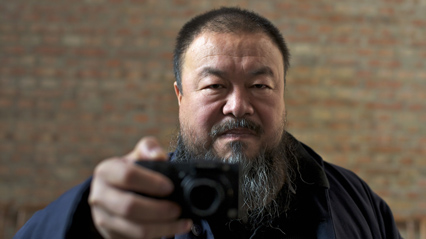
Ai Weiwei is China’s most famous international artist, and its most outspoken domestic critic. Against a backdrop of strict censorship and an unresponsive legal system, Ai expresses himself and organizes people through art and social media. In response, Chinese authorities have shut down his blog, beat him up, bulldozed his newly built studio, and held him in secret detention.
AI WEIWEI: NEVER SORRY is the inside story of a dissident for the digital age who inspires global audiences and blurs the boundaries of art and politics. First-time director Alison Klayman gained unprecedented access to Ai while working as a journalist in China. Her detailed portrait provides a nuanced exploration of contemporary China and one of its most compelling public figures.
http://www.financialtaskforce.org/2011/12/07/an-artists-stand
Ai Weiwei is known for many things—great architecture, subversive in-your-face art, and political activism. He has also called for greater transparency on the part of the Chinese state. Director Alison Klayman chronicles the complexities of Ai’s life for three years, beginning with his rise to public prominence via blog and Twitter after he questioned the deaths of more than 5,000 students in the 2008 Sichuan earthquake. The record continues through his widely publicized arrest in Beijing in April of 2011. As Ai prepares various works of art for major international exhibitions, his activism heats up, and his run-ins with China’s authorities become more and more frequent.
In this unprecedented look at Ai and those close to him, Klayman’s camera captures his forthrightness and unequivocal stance. She gives a larger picture of the artist as an individual, a symbol of China’s oppression, and a powerful voice against a country that still denies its citizens many basic freedoms. – K.Y.
http://www.sundance.org/filmforward/destinations
http://www.sundance.org/filmforward/destination/china-2012/
Sundance Spotlights Spacey’s Wall Street Boss,
Al Pacino’s Cop
http://www.bloomberg.com/news/2012-01-17/austerity-wrong-way-to-fight-eu-crisis-stiglitz.html
Two movies about the *financial crisis — a drama starring Kevin Spacey and a documentary featuring Nobel Prize-winner Joseph Stiglitz — will be showcased at the Sundance Film Festival opening today in Utah.
On China, Stiglitz said an easing in its economic expansion to 7 percent to 8 percent is in some sense probably a “good thing.” He later told reporters at a Hong Kong briefing growth in the world’s second-largest economy is now more “sustainable.”
http://genevalunch.com/blog/2011/11/29/swiss-chinese-free-trade-good-progress-made
http://en.wikipedia.org/wiki/List_of_bilateral_free_trade_agreements
Not to be confused with Free market or Fair Trade. http://en.wikipedia.org/wiki/Free_trade
In “Margin Call,” Spacey plays an executive at a troubled Wall Street investment firm during the early days of the economic meltdown. “The Flaw,” directed by British filmmaker David Sington, explores the causes of the crisis through interviews with leading economists, Wall Street insiders and victims of the Great Recession.
Celebrate the 2012 Sundance Film Festival From Anywhere
Digital Initiatives Bring the Festival to You!
Livestream Events │ Exclusive Online Content │Social Media
We’re working to improve your experience on our site. Please click to offer your feedback.
http://www.sundance.org/video/live/ LIVE Streaming
http://www.facebook.com/sundance
http://twitter.com/sundancefest
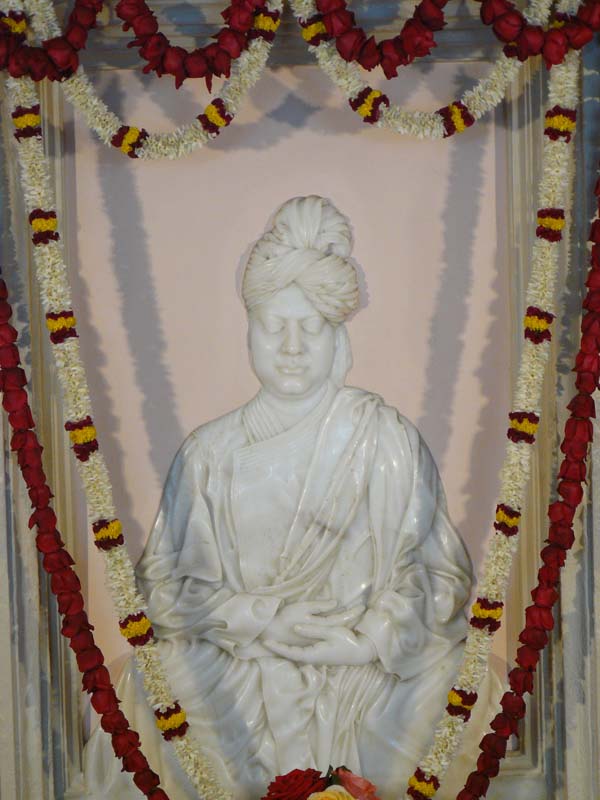
SWAMI VIVEKANANDA’S BIRTHDAY CELEBRATION : Live Webcast
http://www.belurmath.org/news_archives/swami-vivekanandas-birthday-celebration-live-webcast/
http://www.belurmath.org/news_archives/2012/01/10/national-youth-day-12-january-2/
Previous #articles #videos # development #reliefwork
http://ramakrishna.org Ramakrishna – Vivekananda Center of New York
http://en.wikipedia.org/wiki/Vedanta
Live Webcasts from the Kalachakra Teaching
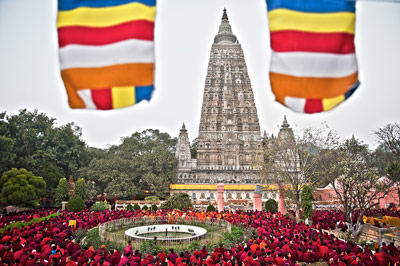
There will be live webcasts from the Kalachakra Teaching in Bodh Gaya, Bihar, India, from January 1-10, 2012. His Holiness the Dalai Lama will be teaching in Tibetan and there will be live webcasts in English, Chinese, Russian and Tibetan languages.
All times Indian Standard Time (GMT+5.30)
January 1: Short Teaching
His Holiness will give a short teaching.
Time: 1:00pm – 3:00pm
January 4-6: Preliminary Teachings
His Holiness will give preliminary teachings on Kamalashila’s „The Middling States of Meditation (gomrim barpa)“, Gyalsey Thokme Sangpo’s „37 Practices of A Bodhisattva (laklen sodunma)“, Geshe Langri Thangpa’s „Eight Verses of Training the Mind (lojong tsik gyema)“, Nagarjuna’s „The Praise to the World Transcendent (jigten ley deypar toepa)“ and Khunu Lama Tenzin Gyaltsen’s „The Precious Lamp in Praise of Bodhicitta (jangchup sem kyi toepa rinchen drolma)“.
Times: 1:00pm – 3:30pm each day
January 10: Long life empowerment and offering
A long life empowerment (tsewang) and a ceremony offering prayers for the long life of His Holiness the Dalai Lama will be performed.
Time: 9:00am – 11:00am (approximate time)
January 10: Ceremony honoring His Holiness the Dalai Lama
There will be a public felicitation ceremony for His Holiness.
Time: 1:30pm – 3:00pm
Live English language webcast can be viewed here.
Live Chinese language webcast can be viewed here.
Live Russian language webcast can be viewed here.
Live Tibetan language webcast can be viewed here.
More information and a full schedule of events at:
http://www.kalachakra2012.org/
http://www.facebook.com/DalaiLama
For times in your region 1:00pm Indian Standard Time (IST) on January 1st in India is the same as 7:30am on January 1st in London, England.
http://tibetanyouthcongress.org
http://wiki/List_of_organizations_of_Tibetans_in_exile
http://www.studentsforafreetibet.org
http://www.tchrd.org/ Human Rights Situation in Tibet
https://www.facebook.com/tibetnewsonline
http://www.facebook.com/Tibet Sites
Further Sources #articles #videos #social projects #buddhism:
