Posts by admin
Human Rights Watch Annual Dinner 2011
http://www.un.org/human rights
http://www.uyghurcongress.org/
Human Rights Watch Annual Dinner 2011
Honoring those who speak out where there is silence
Each year Human Rights Watch honors individuals who have put their lives and safety at risk in the name of defending human rights. Join us at the Voices for Justice Annual Dinner where we will present these human rights defenders strong with The Alison Des Forges Award for Extraordinary Activism, our highest honor.
Meet the 2011 Defenders – This year’s Voices for Justice Annual Dinners will be held in Amsterdam, Beirut, Chicago, Geneva, Hamburg, London, Los Angeles, Munich, New York, Oslo, Paris, San Francisco, Santa Barbara, Toronto, and Zurich throughout November and early December. We hope you will come celebrate these remarkable individuals and support the important global work of Human Rights Watch.
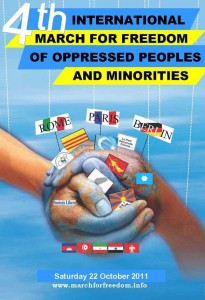
http://www.marchforfreedom.info
http://www.facebook.com/HumanRightsWatch
http://www.facebook.com/amnestyusa
http://www.facebook.com/unitednationshumanrights
San Francisco World Music Festival
http://portal.unesco.org/intangible
http://www.sfworldmusicfestival.org
http://www.uyghurensemble.co.uk
www.rferl.org/Radio Free Europe/Kyrgyz
Kyrgyzstan (English pronunciation: /ˈkɜrɡɪstɑːn/; KUR-gi-stahn; Kyrgyz: Кыргызстан IPA: [qɯrʁɯzstɑ́n]; Russian: Кыргызстан [kɨrɡɨsˈtan]), officially the Kyrgyz Republic, is a country in Central Asia. Landlocked and mountainous, it is bordered by Kazakhstan to the north, Uzbekistan to the west, Tajikistan to the southwest and People’s Republic of China to the east. Its capital and largest city is Bishkek. The ethnonym „Kyrgyz“, after which the country is named, is thought to originally mean „forty tribes“, presumably referring to the epic hero Manas who, as legend has it, unified forty tribes against the Khitans. The 40-ray sun on the flag of Kyrgyzstan symbolizes the forty tribes of Manas. It might also refer to “red”, the colour of the “south country” of the original Turkic nations. More
Uzbekistan, officially the Republic of Uzbekistan (Uzbek: O‘zbekiston Respublikasi or Ўзбекистон Республикаси);(Urdu: ازبکستان), is a doubly landlocked country in Central Asia, formerly part of the Soviet Union. It shares borders with Kazakhstan to the west and to the north, Kyrgyzstan and Tajikistan to the east, and Afghanistan and Turkmenistan to the south. Once part of the Persian Samanid and later Timurid empires, the region was conquered in the early 16th century by Uzbek nomads, who spoke an Eastern Turkic language. Most of Uzbekistan’s population today belong to the Uzbek ethnic group and speak the Uzbek language, one of the family of Turkic languages. Uzbekistan was incorporated into the Russian Empire in the 19th century and in 1924 became a constituent republic of the Soviet Union, known as the Uzbek Soviet Socialist Republic (Uzbek SSR). It has been an independent republic since December 1991. Uzbekistan’s economy relies mainly on commodity production, including cotton, gold, uranium, potassium, and natural gas. Despite the declared objective of transition to a market economy, Uzbekistan continues to maintain rigid economic controls, which often repel foreign investors. The policy of gradual, strictly controlled transition has nevertheless produced beneficial results in the form of economic recovery after 1995. Uzbekistan’s domestic policies on human rights and individual freedoms are often criticised by international organizations. More
Dear Friends, The 34th annual Mill Valley Film Festival will present a special evening of music on Saturday October 15th celebrating the life and work of the great master Indian musician and teacher, Ali Akbar Khan. The screening of the U.S. premiere of the documentary film Play Like a Lion: The Legacy of Maestro Ali Akbar Khan is one of the highlights of the 10-day film festival.
This concert will bring together award-winning world music artists who have been inspired and influenced by the „maestro“ and whose music spans classical Indian to African and western fusion.
Musicians for the evening include:
- Saturday, October 15th 9pm (doors 8pm) at 142
- Ali Akbar Khan’s son Alam Khan on sarod accompanied by Salar Nader on tabla and Manik Khan on tampura
- Grammy-winning bassist Rob Wasserman & Friends
- Grammy-nominated jazz saxophonist John Handy, who is featured in the film
- Master African drummer Kwaku Daddy accompanied by 10 drummers
- Grammy nominated singer and composer Sukhawat Ali Khan and Riffat Sultana (featured vocalist with Quincy Jones at the May 2011 Mawazine Festival, Morocco)
- And….special surprise local music legends who join the festival every year.
- Video greetings from Derek Trucks and Zakir Hussain
Throckmorton Theatre in Mill Valley – Play Like a Lion: A Concert Honoring Ali Akbar Khan. Tickets are $50 and are available online at mvff.com or by phone at 877-874-6833 or at the Rafael Film Center box office, 1118 4th St. San Rafael, the Mill Valley Chamber of Commerce, 85 Thockmorton Ave., and at 142 Throckmorton Theater day of show.
PLAY LIKE A LION: THE LEGACY OF MAESTRO ALI AKBAR KHAN
When a young Alam Khan asks about his family’s religion, his father, master North Indian musician Ali Akbar Khan, tells him, „Music is our religion.“ Play Like a Lion explores the deep musical lineage of the Khan family -a tradition in which the lines between father and teacher are blurred and the intervals between duty, love and music become a devotional song. Alam, a prodigious musician, taught at his father’s feet, is our guide for a rich, soulful journey into the legacy of the late maestro. Entrancing musical virtuosity and moving homage on display in footage featuring concerts, class time at the famed Ali Akbar School of Music and tribute performances by musical luminaries like Carlos Santana, Ustad Zakir Hussain and Mickey Hart.
Sun. October 9, 8:00PM, Christopher B. Smith Rafael Film Center, San Rafael
Wed. October 12, 9:15PM, CinéArts @ Sequoia, Mill Valley Tickets: mvff.com, Tel: 1-877-874-MVFF (6833)
Akyns are virtuoso performers: they are Kazakh poets and bards of improvisation. The Akyn improvises with lyrics while playing the dömbra to a set traditional rhythm. The Akyn must not only be a master dömbra player, but also an expert story-teller, with a good wit and a great sense of timing. Akyn competitions are exciting and humorous, full of theatre and soul. They bring life to a party, helping to strengthen the sense of community among villagers.
The Art of Akyns, Kyrgyz Epic Tellers UNESCO: Representative List of the Intangible Cultural Heritage of Humanity – 2008 URL: http://www.unesco.org/culture/ich/RL/00049
Description: The predominant form of cultural expression among the Kyrgyz nomads is the narration of epics. The art of the Akyns, the Kyrgyz epic tellers, combines singing, improvisation and musical composition. The epics are performed at religious and private festivities, seasonal ceremonies and national holidays and have survived over the centuries by oral transmission.
The value of the Kyrgyz epics lies largely in their dramatic plots and philosophical underpinnings. They represent an oral encyclopaedia of Kyrgyz social values, cultural knowledge and history. The pre-eminent Kyrgyz epic is the 1000-year-old Manas trilogy, which is noteworthy not only for its great length (sixteen times longer than Homers Iliad and Odyssey), but also for its rich content. Blending fact and legend, the Manas immortalizes important events in Kyrgyzs history since the ninth century. The Kyrgyzs have also preserved over forty smaller epics. While the Manas is a solo narration, these shorter works are generally performed to the accompaniment of the komuz, the three-stringed Kyrgyz lute. Each epic possesses a distinctive theme, melody and narrative style. Akyns were once highly respected figures who toured from region to region and frequently participated in storytelling contests. They were appreciated for their proficiency in narration, expressive gestures, intonation and lively mimicry, so well suited to the epics emotionally charged content.
During the 1920s, the first part of the Manas trilogy was recorded in written form based on the oral interpretation of the great epic singer, Sagynbay. The epics remain an essential component of Kyrgyz identity and continue to inspire contemporary writers, poets, and composers; even today, the traditional performances are still linked to sacred cultural spaces. Although there are fewer practitioners nowadays, master akyns continue to train young apprentices and are helped by recent revitalization initiatives supported by the Kyrgyz government. Country(ies): Kyrgyzstan
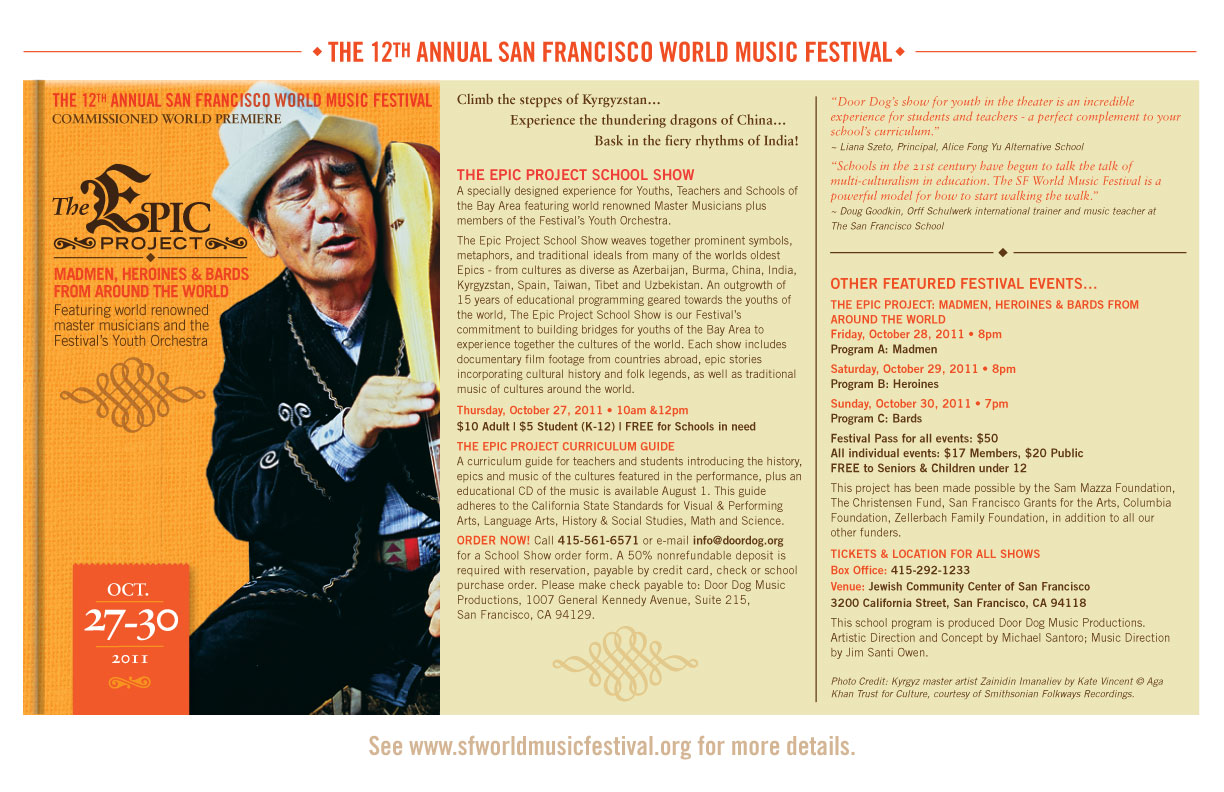
SF WORLD MUSIC FESTIVAL – AACM’s beloved tabla master, Pandit Swapan Chaudhuri, will be honored for his 30 years of performing and teaching in the U.S. at this year’s San Francisco World Music Festival – The Epic Project: Madmen, Heroines, and Bards From Around the World (http://www.sfworldmusicfestival.org/) – The Epic Project: Madmen, Heroines, and Bards From Around the World. October 27-30 www.sfworldmusicfestival.org
Swapanji will be performing on the opening night of the festival, Friday, October 28th, in a world premiere commissioned composition which he has composed for an array of musicians including AACM’s Youth Tabla ensemble and musicians from Kyrgyzstan, Azerbaijan, and South India.
The San Francisco World Music Festival, under the musical direction of AACM faculty member Jim Santi Owen, will be presenting world class musicians from Burkina Faso, India, Tibet, China, Azerbaijan, Taiwan, Kyrgyzstan performing repertoire from their countries‘ epic stories in both traditional settings and cross-cultural collaborations.
This is the third consecutive year that AACM is proud to be a co-sponsor of The San Francisco World Music Festival. Tickets are sure to sell out so purchase yours soon!
MUSICIANS UNITED FOR SAFE ENERGY
http://musiciansunited4safeenergy.com/
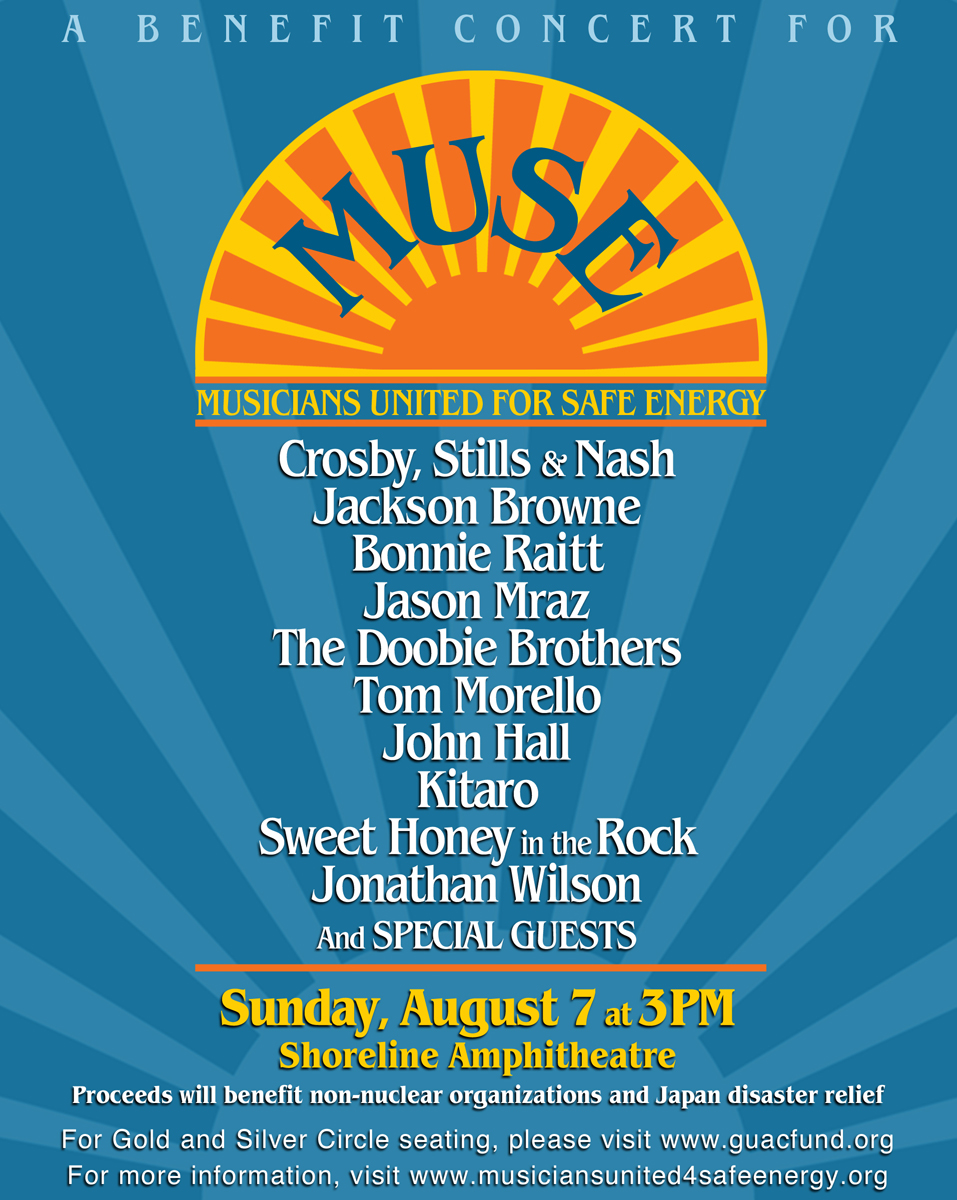
WATCH THE M.U.S.E CONCERT LIVE ONLINE – AUGUST 7TH
© 2011. MUSE. Please visit: www.NukeFree.org and www.GuacFund.org
MUSE press release, June 20, 2011. MUSE website PDF
If you can’t make it to the M.U.S.E. concert on August 7th don’t worry. You can watch the whole show live thanks to StageIt. For a $5 minimum donation you can pre-register at http:/musebenefit to watch the concert. Livestreaming of concert begins at 2 pm Pacific time, August 7, Shoreline Amphitheatre, Mountain View, California.
Your donations make our monitoring of the situation in Japan and our work for a nuclear-free carbon-free future possible. http://www.nirs.org/fukushima/crisis.htm Nuclear Information & Resource Center.
www.looktothestars.org/ – 2653 celebrities and the 1722 charities/causes they support, including Annie Lennox, Elton John, Bono, and Brad Pitt.
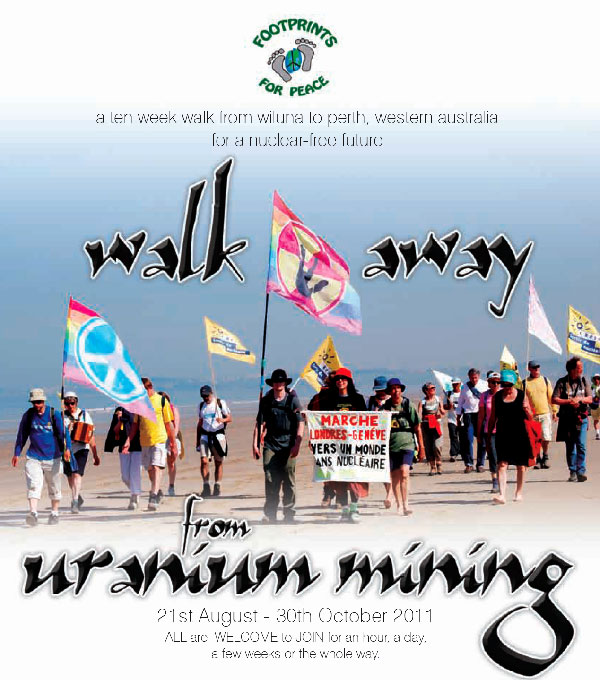
Welcome to our Walk for a Nuclear Free Future http://www.nuclearfreefuture.com/ Campaign.
Footprints for Peace – August 21st – October 30th 2011 – Join us on an amazing journey to create a Nuclear Free Future. A ten week walk from Wiluna to Perth, Western Australia for a Nuclear-Free Future. Footprints for Peace has recently launched an exciting new campaign that will join together with people and organizations from around the world to build and strengthen the global movement for a nuclear free future.
The campaign – Walk for a Nuclear Free Future – is an awareness raising and non-violent action based campaign involving a series of walks throughout Australia, Canada, United States & Japan. The walks will follow the deadly nuclear fuel path from uranium mines to nuclear reactors, waste dumps and nuclear weapons sites.
Walk for a Nuclear Free Future aims to bring people together to walk from community to community as an effective way to educate our selves and the public about the danger, destruction and waste that is threatening all life at every stage of the nuclear process. Our purpose is to inspire, empower and mobilise people to take action not only through walking but also through creative campaigning in street theatre, music, art, public meetings, petitioning, letter writing and non-violent direct actions.
The Walk for a Nuclear Free Future will promote positive social, environmental and economical solutions for the development of renewable energy technologies including solar, wind, wave and geothermal to create a sustainable future.
Walk for a Nuclear Free Future calls for:
- respect and solidarity for Indigenous Peoples Rights
- a global ban on uranium mining
- phase out of nuclear power
- complete nuclear weapons disarmament
- ban on the use of depleted uranium weapons
- responsible solutions to nuclear waste
- full rehabilitation of abandoned uranium mines and all nuclear facilities
- development and use of renewable energy technologies
- http://www.uranium-network.org/Nuclear Free Future Walk.PDF
Please join us on this walk in Western Australia to STOP Uranium Mining and create a nuclear free future.

Gegenrede: Offener Brief von Jean Ziegler
Festspielrede 2011 Part 1/2. Rede in zwei Teilen ist auf Youtube.com zu sehen und zu hören.
Nachdem Jean Ziegler http://www.righttofood.org/ als Festredner der Salzburger Festspiele ausgeladen wurde, begründete er am Donnerstag seine Entscheidung, am Eröffnungstag der Festspiele doch keine Gegenrede in Salzburg halten zu wollen, in einem offenen Brief. http://t.co/xsRjOnr via @salzburg_com
„Ziegler hätte in seiner Rede den Welthunger thematisiert. Er wollte in Salzburg gerade diese Leute treffen, die verantwortlich für das Elend dieser Welt sind“, sagte eine Aktivistin.
… Ich komme gerade von einer mehrwöchigen UNO-Mission in Nordafrika zurück, die mich tief bewegt hat. Im Maghreb und im Majrekh stehen ganze Völker auf. Mit oft leeren Händen kämpfen sie todesmutig gegen Tyrannei, Korruption und über Generationen erlittene Erniedrigung. In Ras el-Jdir und Zaouïa (Westlibyen), in den Berber-Gebirgen von Djebel Gharbi, sterben Männer und Frauen für unsere und ihre ureigensten Träume: für Demokratie und Freiheit.
Die zerrissenen, blutüberströmten Körper junger Menschen, die auf Tragbahren bei Dhiba über die südtunesische Grenze in die Hilfslazarette von Gabès kommen, wollen mir nicht aus dem Sinn. Von Syrien bis Bahrein und Jemen hoffen die aufständischen, todesmutigen Menschen bisher umsonst auf die konkrete Hilfe der internationalen Gemeinschaft, denn die UNO ist gespalten…
Jean-Paul Sartre schreibt: „Wer die Menschen lieben will, muss sehr stark hassen, was sie unterdrückt“. Vergangenes Jahr haben die 500 weltgrössten Privatkonzerne 52,8 % des Welt-Brutto-Sozialproduktes kontrolliert.
Derweil steigen in der südlichen Hemisphäre, wo 4,8 der 6,7 Milliarden Menschen der Erde leben, die Leichenberge. Alle fünf Sekunden verhungert ein Kind unter zehn Jahren – auf einem Planeten, der problemlos 12 Milliarden Menschen ernähren könnte.
Ich bewundere Ihren geduldigen, mutigen Kampf gegen die kannibalische Weltordnung. Die Aufklärung ist ein langer, mühsamer Prozess. Unsere Gegner erscheinen zur Zeit übermächtig. Aber Che Guevara sagt: „Auch die stärksten Mauern fallen durch Risse“…
Jean Zieglers „Gegenrede“ bei den Festspielen verteilt: http://www.nachrichten.at/nachrichten/ticker Aktivisten haben vor der Eröffnung der Salzburger Festspiele die nicht gehaltene Rede von Jean Ziegler an Festspiel- und Zaungäste vor den Festspielhäusern verteilt. Auf Youtube ist die Rede zu sehen und zu hören.
Aktivisten der „Plattform Zivilgesellschaft“ und der Salzburger „Grünen“ haben vor der Eröffnung der 91. Salzburger Festspiele am Mittwoch Vormittag die nicht gehaltene Rede von Jean Ziegler vor den Festspielhäusern in der Hofstallgasse verteilt. Es handelte sich dabei um eine 16-seitige Broschüre des „Ecowin“-Verlages mit dem Titel „Aufstand des Gewissens“.
“In a world overflowing with riches,
it is an outrageous scandal that more than 1 billion people suffer from hunger and malnutrition and that every year over 6 million children die of starvation and related causes. We must take urgent action now.”
Jean Ziegler, January 2010
Global funding for agricultural research, public and private, is estimated to total around $40 billion. There is a stark contrast with the $1500 billion the world now spends on weapons.
- The coming famine: risks and solutions for global food security (Science Alert):
- http://sciencealert.com/coming famine
- Petition: Dakar Appeal Social Forum against Farmlandgrab
- http://www.grain.org/farmlandgrab
- Somalia: the Real Causes of Famine www.globalresearch.ca Far beneath the surface of the tragic drama of Somalia, four major U.S. oil companies are quietly sitting on a prospective fortune in exclusive concessions to explore and exploit tens of millions of acres of the Somali countryside. http://www.oilwatchafrica.org/
- News & Media http://www.business-humanrights.org/ UN HUMAN RIGHTS COUNCIL ENDORSES NEW GUIDING PRINCIPLES ON BUSINESS AND HUMAN RIGHTS http://www.unog.ch/unog/OpenDocument

The Woodrow Wilson Int. Center for Scholars

www.world-economy-and-development.org
http://physiciansforhumanrights.org/persecution health workers
The Woodrow Wilson International Center for Scholars (or Wilson Center), located in Washington, D.C., is a United States Presidential Memorial that was established as part of the Smithsonian Institution by an act of Congress in 1968. Named in honor of President Woodrow Wilson (the only President of the United States with a Ph.D.), its mission is:
“to commemorate the ideals and concerns of Woodrow Wilson by: providing a link between the world of ideas and the world of policy; and fostering research, study, discussion, and collaboration among a full spectrum of individuals concerned with policy and scholarship in national and world affairs.”
Purpose: The Center serves as a national memorial to President Wilson established by Congress in 1968 and headquartered in Washington, D.C. It is a nonpartisan institution supported by public and private funds, engaged in the study of national and world affairs. HERE
Having surged to the center of the world’s political and economic stage, China is plagued by contradictions. On the one hand, Maoism is enjoying a comeback: the CCP ax-sickle flag is flying everywhere, “red songs” are back in fashion, loud calls for another “Cultural Revolution” are heard, and jobs in the government and at the state enterprises are once again favored by the young generation.
On the other hand, however, the movement to defend people’s legal rights and interests is stronger than ever, calls for political reform proliferate, and many foreign enterprises are still eager to invest in China. The challenge is to penetrate this confusion and try to divine where China will go in the future. Through an in-depth analysis of China’s actual conditions–the “crossroads” it faces–this presentation will seek to suggest ways to make sense of China’s uncertain future.
Kissinger Institute on China and the United States
Events: China at a Crossroads:
Distress Over Democratization or an Omen of Collapse?
August 04, 2011 // 10:00am — 11:30am
CLICK – THERE WILL BE A LIVE WEBCAST OF THE EVENT
Dateline SBS – “ Chinas Economic Growth looks not so rosy as it seems „
The Woodrow Wilson International Center for Scholars is the national, living memorial honouring President Woodrow Wilson. In providing an essential link between the worlds of ideas and public policy, the Center addresses current and emerging challenges confronting the United States and the world. The Center promotes policy-relevant research and dialogue to increase understanding and enhance the capabilities and knowledge of leaders, citizens, and institutions worldwide. Created by an Act of Congress in 1968, the Center is a nonpartisan institution headquartered in Washington, D.C., and supported by both public and private funds.
NEWS – Bahraini Human Rights Activist Nabeel Rajab to Receive 2011 Ion Ratiu Democracy Award Jul 29, 2011
Nabeel Rajab, a leading human rights activist and president of the Bahrain Center for Human Rights, will receive the 2011 Ion Ratiu Democracy Award, presented annually by the Woodrow Wilson International Center for Scholars.
One of the founders of the human rights movement in Bahrain, Nabeel Rajab is president of the Bahrain Center for Human Rights. Rajab also has been active internationally as deputy secretary general for the International Federation for Human Rights and as the chairperson of CARAM-Asia, a regional network that addresses migration and health issues. He is also a member of the Board of Advisors for the Middle East and North Africa division of Human Rights Watch and a member of an Arab media monitoring group.
The Ion Ratiu Democracy Award aims to bring international recognition to the ideas and accomplishments of individuals around the world who are working on behalf of democracy.
“In such a tumultuous year, Nabeel Rajab’s efforts to peacefully advance democratic freedoms for Bahraini citizens, even in the face of considerable personal peril, are truly exemplary,” said Jane Harman, director, president & CEO of the Woodrow Wilson Center. “He is an exceptional choice to receive the Ion Ratiu Award and I extend my sincerest congratulations.”
http://www.facebook.com/KissingerInstitute
http://www.facebook.com/chinadialogue
http://twitter.com/nabeelrajab
http://www.facebook.com/Bahrain Center for Human Rights
http://en.wikipedia.org/wiki/Bahrain United States Free Trade Agreement
http://en.wikipedia.org/wiki/Foreign relations of the Peoples Republic of China
* Infographic: Map of Pollution Levels in China’s Major River Basins @circleofblue, Great Lakes
* Climate Crisis at the Third Pole, China’s disappearing rivers and lakes @ecobuddhism
ECONOMY OF CHINA CHOKE POINTS: www.hrw.org/asia/CHINA
http://www.greenpeace.org/eastasia/
http://www.srfood.org/country-missions/CHINA PDF
Analysis: What is Plan B if China dumps its U.S. debt? | Reuters
US labour group urges end to Bahrain free trade pact – Arabian Business.com
http://www.business-humanrights.org/CHINA
http://www.minesandcommunities.org/CHINA
http://www.circleofblue.org/waternews/Choke Points/CHINA/US
http://www.internationalrivers.org/CHINA
http://www.laborrights.org/CHINA
http://www.nkeconwatch.com/ NORTH KOREA ECONOMY
Chinese Sea, Arctic, Climate Change, Deep Sea Mining http://www.blacksands.org.nz/
http://en.wikipedia.org/UN Convention on the Law of the Sea
http://en.wikipedia.org/Asian_Dust CHINA GLOBAL
India Institute for Defence Studies and Analyses (IDSA)- CHINA
http://www.india-defence.com/reports
http://www.defenceweb.co.za/CHINA
http://en.wikipedia.org/wiki/China space program
NASA’s Mars Exploration Rover Mission (MER)
http://costofwar.com/en/ #debtceiling http://www.ifamericansknew.org/
Water Wars in the Making: http://en.wikipedia.org/wiki/South North Water TransferProject
http://www.greengrowth.org/rethink.asp UN
http://www.facebook.com/mcampaign
http://en.wikipedia.org/Millennium Development Goals
16th Protecting Mother Earth Gathering
“Energy, Climate, Water and the Importance of Health and Culture.”
July 28 – 31, 2011
Four Bears Park/Little Shell Powwow Grounds
New Town, North Dakota
Hosted by Mandan, Hidatsa, Arikara Nations Community Members
Click here to learn more and register online.
The Indigenous Environmental Network (IEN), a Native national environmental justice advocacy organization, is sponsoring the gathering where educators, indigenous peoples, local community members, youth and elders, and other interested individuals camp outdoors together for four days to collectively discourse and strategize on the resolution of local, national, and international environmental justice and indigenous rights issues through forums of plenary and concurrent workshop sessions.
The theme for the July gathering is “Water, Energy, Climate, and the Importance of Health & and Culture,” which is fitting for the indigenous community hosting PME.

Listen to Crow Voices 87.9 Live Stream. Native Youth explore Radio / Center Pole Web Cast
The new Crow Voices radio http://www.crowvoices.blogspot.com/ will broadcast the upcoming conference of the Indigenous Environmental Network, with Earthcycles and Censored News assisting, from the campground near New Town, ND, July 28–31, 2011.
UN High-Level Meeting on Youth 2011

http://www.un.org/millenniumgoals
http://social.un.org/youthyear
www.world-economy-and-development.org
In December 2009, the United Nations General Assembly adopted resolution 64/134 proclaiming the year commencing 12 August 2010 as the International Year of Youth. The resolution calls upon governments, civil society, individuals and communities worldwide to support activities at local and international levels to mark the event. The International Year of Youth can generate much needed attention for youth participation and youth development and can provide an impetus to partnerships among youth organizations around the world. Youth organizations, governments, and civil society are encouraged to organize activities that promote an increased understanding of the importance and benefits of youth participation in all aspects of society, as well as those that support youth to devote their energy, enthusiasm and creativity to development and the promotion of mutual understanding.
It encourages young people to dedicate themselves to fostering progress, including the attainment of the UN Millennium Development Goals (MDGs), which seek to slash a host of social ills, ranging from extreme poverty and hunger to maternal and infant mortality to lack of access to education and health care, all by 2015. HERE
As part of the International Year of Youth, the General Assembly will hold a high-level meeting on youth on 25 and 26 July 2011. The High Level Meeting will have as its overarching theme “Youth: Dialogue and Mutual Understanding”.
The High Level Meeting on Youth is scheduled to take place from 25 to 26 July 2011 at the General Assembly, United Nations Headquarters in New York.
The high-level meeting will comprise two consecutive informal interactive thematic panel discussions on 25 July 2011 and two plenary meetings on 26 July 2011. The thematic panel discussions will be chaired by Member States at the invitation of the President of the General Assembly and will address the following themes:
Thematic panel discussion 1: Strengthening international cooperation regarding youth and enhancing dialogue, mutual understanding and active youth participation as indispensable elements towards achieving social integration, full employment and the eradication of poverty;
Thematic panel discussion 2: Challenges to youth development and opportunities for poverty eradication, employment and sustainable development.
„Youth should be given a chance to take an active part in the decision-making of local, national and global levels.“ – United Nations Secretary-General Ban Ki-moon.
http://www.youtube.com/unyouthyear2010 Dialogue for Peace: The Impact of Youth
If you are holding an event in celebration of the International Year of Youth (IYY) and would like to register it on our calendar of events, please visit this link: http://social.un.org/iyyevents.
CHANGE YOUR WORLD 2011 If you are holding an event in celebration of the International Year of Youth (IYY) and would like to register it on the calendar of events, please follow these steps:
Step 1. Pledge your commitment on the UN International Year of Youth Calendar of Events page: http://social.un.org/IYYevents/ Don’t forget to title your event “Change Your World + (the name of your event)” .
Step 2. After sending your Waiver of Liability Form to youth@un.org (subject heading: „Change Your World“), you will receive an email with the International Year of Youth logo to use for your event.
Step 3. After this, immediately navigate to our Facebook page. You can upload photos, videos, and a brief description of your initiative.
Make sure to cross-link this FB page with your online accounts and websites to maximize your project’s exposure. Keep in mind, the five projects with the most likes will be presented at the next Global Changemakers Youth Summit and will receive an International Year of Youth poster signed by Monique Coleman, Hollywood star and UN Youth Champion.
http://www.facebook.com/UNyouthyear
http://www.facebook.com/UN Millenium Campaign
http://www.facebook.com/Earth Summit 2012
http://www.facebook.com/road2rio20
http://www.youthforhumanrights.org/
http://www.un.org/documents/udhr/index.shtml
http://en.wikipedia.org/Universal Declaration of Human Rights
Sufi Music Of Kashmir (Sufiyana Mousiqui)Part 1
Ghulam Mohamad Saznawaz is the only existing master of Kashmiri Sufiyana Music in the world. The most tragic part of Kashmiri sufiyana music is that with the Maestro Ghulam Mohamad Saznawaz the art will be lost to posterity, now very old with his age the mastero has opened a school to teach Kashmiri Sufiyana Music free of charge but this school does not attract many students from Kashmir because of the religious and social prejudice among the majority of Kashmiris. This is sad but its true that still musicians are considered as of a lower class or of low moral and as if they can not do something useful thats why they chose to be musician.
http://saznawazgharana.blogspot.com/
http://www.facebook.com/SuFiYaNa MuSiQuI Of KaShMiR
With the goal of uniting conservation, communities and sustainable travel, TIES is committed to promoting the principles of ecotourism and responsible travel around the world.
http:// www.disappearancesinkashmir.com/
http://www.hrw.org/legacy/reports/1999/kashmir/
West Papua refugees in Papua New Guinea

European Maccabi Games: Vienna 2011
http://occupiedpalestine.wordpress.com
The Maccabi World Union is an international Jewish sports organisation spanning 5 continents and more than 50 countries, and boasting some 400,000 members. Maccabi World Union organises the Maccabiah Games, a prominent international Jewish athletics event. The organisation comprises six confederations: Maccabi Israel, European Maccabi confederation, confederation Maccabi North America, confederation Maccabi Latin America, Maccabi South Africa and Maccabi Australia.
The origin of the word is not clear but the common opinion is that the word „Maccabi“ (מכבי) is an acronym of the biblical sentence: „Who is like unto Thee, O LORD, among the mighty?“ (Exodus 15:11), in Hebrew: „‚מי כמוך באלים י“, „Mi kamocha ba’elim YHWH“. Read More: > HERE <
YHWH – Yahweh is the personal name of God in the Hebrew Bible. This form is a modern scholarly convention: Hebrew scripts write it as four consonants, rendered in Roman letters as YHWH, due to the fact that most alphabets, prior the Greek alphabet, did not display vowels, and required that vowels be mentally pronounced in the proper places. The most likely meaning of the name may be “He Brings Into Existence Whatever Exists,“ but there are many theories and none is regarded as conclusive by scholars. Read more: > HERE <
Mission statement – European Maccabi Games – Vienna 2011 – The Maccabi Games are the biggest Jewish sports events and are organized in a similar way to the Olympic Games. The Games are one of the five biggest international sporting events worldwide.
The Israel Maccabiah is organized by the Maccabi World Union (MWU), which is the umbrella organization overseeing all regional Maccabi unions. Although the history of the Maccabi Games is not as old as the Olympic Games the first Maccabiah did take place in Tel Aviv as far back as 1932. Meanwhile the Maccabiah has become a sporting anchor event which takes place regularly every four years in Israel.
The European Maccabi Games – Exciting and in our case very interesting are the European Maccabi Games. They also take place every four years, however always two years after the Maccabiah in Israel.
The participating European Delegations send their best Jewish athletes to this event. The organization of the Games is carried out in very close cooperation with the European Maccabi Confederation (which currently has 36 member nations) and the national Maccabi Confederation (in Austria the Jewish Sport Union, to which the Unions of the Hakoah Vienna and Maccabi Vienna belong).
17th Maccabiah Games To Love To Live To Win – — Go to www.maccabiusa.com to learn how you can compete in the 18th Maccabiah Games in July 2009.
The “White Horse Olympics” – It was in 1932 that the first Maccabiah was held in Mandate-era Palestine. Meir Dizengoff, the first mayor of Tel Aviv, decided to lead a parade in honour of the Games riding his notorious white horse, and that is why the event is remembered as the ”White Horse Olympics”. In order to spread the news of the first Maccabiah to the world, 120 pigeons, ten for each of the twelve tribes of Israel, were released.
Maccabi and Politics – Due to the rise of Nazism, World War II and the Holocaust, the Maccabi movement suffered a setback. A large group of Young Maccabi members decided to join the British Army during the Second World War. Many served in the Underground Movement and subsequently were active in the establishment of the new State of Israel.
In the early nineties, after the fall of the Iron Curtain, Maccabi has played an important role in ending the isolation of Jews in Eastern Europe and given fresh impetus in the former Soviet republics.
The Jewish Museum Vienna www.jmw.at will organize an exhibition dedicated to the subject of sport from July to September 2011 on the occasion of the 13th European Maccabi Games that will take place in Vienna from 5th to 13th July 2011.
- www.lettertothestars.at
- http://occupiedpalestine.wordpress.com/
- Isralestinian Ghandis – Meditation for Peace
- Israeli-Palestinian “COMET-ME” Project
- “Hoppauf Hakoah” Jewish Sports Club in Vienna, 1909-1995
- http://en.wikipedia.org/wiki/Hakoah_Vienna
- Meet Israel S Upports Tibet (Ist ישראלים למען טיבט, friends at fb
- Meet European Maccabi Games – Vienna 2011, friends, fans at fb
- Council for a Parliament of the World’s Religions (CPWR)at fb
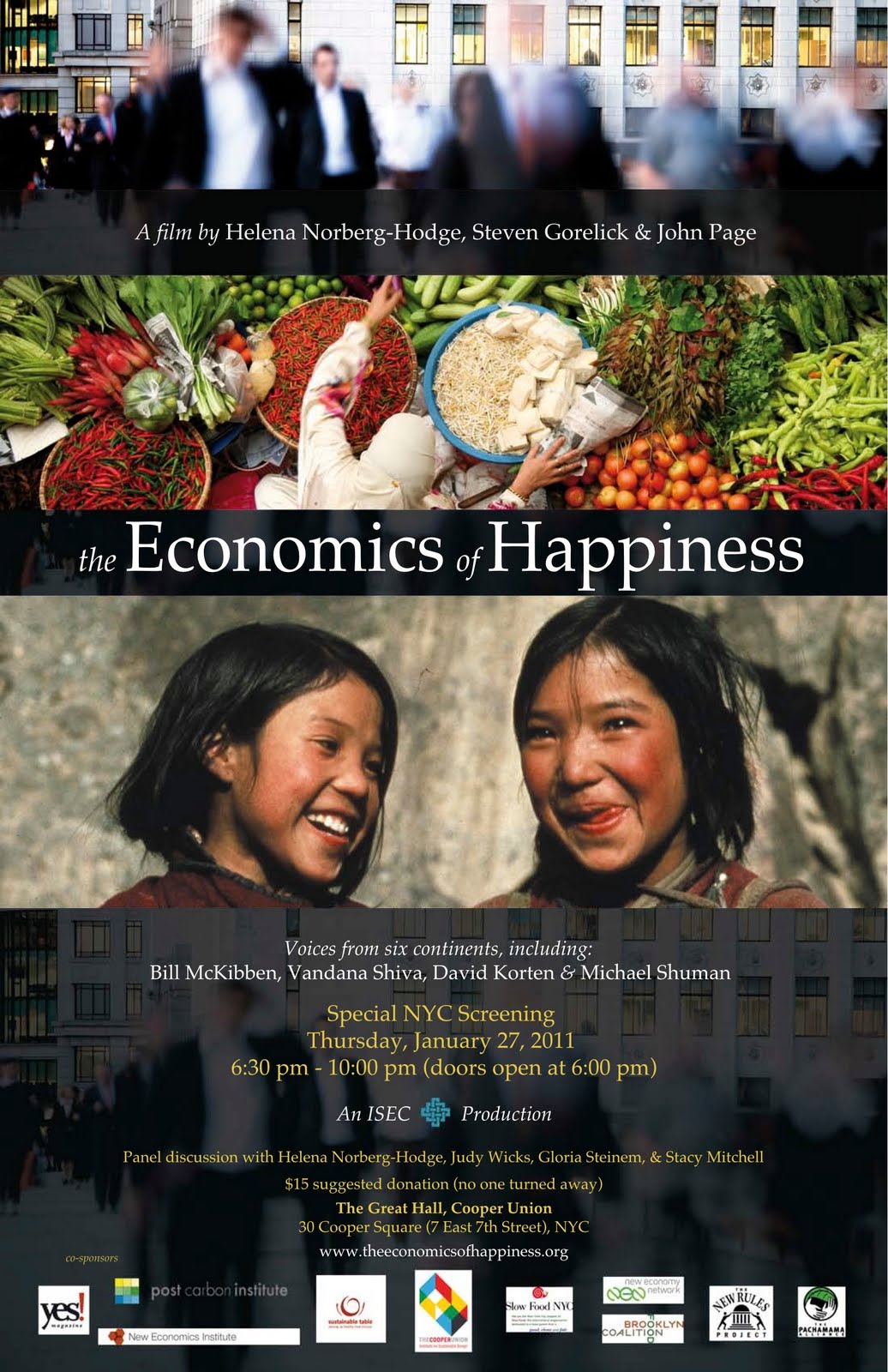
The Economics of Happiness
www.theeconomicsofhappiness.org
www.otherworldsarepossible.org
Fair trade is an organized social movement and market-based approach that aims to help producers in developing countries make better trading conditions and promote sustainability. The movement advocates the payment of a higher price to producers as well as higher social and environmental standards. More
‚Going local‘ is a powerful strategy to help repair our fractured world – our ecosystems, our societies and our selves. Far from the old institutions of power, people are starting to forge a very different future…
Economic globalization has led to a massive expansion in the scale and power of big business and banking. It has also worsened nearly every problem we face: fundamentalism and ethnic conflict; climate chaos and species extinction; financial instability and unemployment. There are personal costs too. For the majority of people on the planet, life is becoming increasingly stressful. We have less time for friends and family and we face mounting pressures at work.
The Economics of Happiness describes a world moving simultaneously in two opposing directions. On the one hand, an unholy alliance of governments and big business continues to promote globalization and the consolidation of corporate power. At the same time, people all over the world are resisting those policies, demanding a re-regulation of trade and finance—and, far from the old institutions of power, they’re starting to forge a very different future. Communities are coming together to re-build more human scale, ecological economies based on a new paradigm – an economics of localization.
www.energyblueprint.info The report: ‘Energy [R]evolution: A Sustainable World Energy Outlook’, provides a detailed practical blueprint for cutting carbon emissions while achieving economic growth by replacing fossil fuels with renewable energy and energy efficiency. This phase-out of fossil fuels offers substantial benefits such as energy security, independence from world market fuel prices as well as the creation of millions of new green jobs.
The film shows how globalization breeds cultural self-rejection, competition and divisiveness; how it structurally promotes the growth of slums and urban sprawl; how it is decimating democracy.
We learn about the obscene waste that results from trade for the sake of trade: apples sent from the UK to South Africa to be washed and waxed, then shipped back to British supermarkets; tuna caught off the coast of America, flown to Japan to be processed, then flown back to the US. We hear about the suicides of Indian farmers; about the demise of land-based cultures in every corner of the world.
The second half of The Economics of Happiness provides not only inspiration, but practical solutions. Arguing that economic localization is a strategic solution multiplier that can solve our most serious problems, the film spells out the policy changes needed to enable local businesses to survive and prosper. We are introduced to community initiatives that are moving the localization agenda forward, including urban gardens in Detroit, Michigan and the Transition Town movement in Totnes, UK. We see the benefits of an expanding local food movement that is restoring biological diversity, communities and local economies worldwide. And we are introduced to Via Campesina, the largest social movement in the world, with more than 400 million members.
We hear from a chorus of voices from six continents, including Vandana Shiva, Bill McKibben, David Korten, Samdhong Rinpoche, Helena Norberg-Hodge, Michael Shuman, Zac Goldsmith and Keibo Oiwa. They tell us that climate change and peak oil give us little choice: we need to localize, to bring the economy home. The good news is that as we move in this direction we will begin not only to heal the earth but also to restore our own sense of well-being. The Economics of Happiness challenges us to restore our faith in humanity, challenges us to believe that it is possible to build a better world.
Casino of Hunger: How Wall Street Speculators Fueled the Global Food Crisis
The global food crisis is an overlooked symptom of the broader global economic crisis. The food crisis shares many characteristics of the financial meltdown ‚ it was exacerbated by the deregulation of the commodity markets (including agriculture) that encouraged a tidal wave of Wall Street speculation‚ leading to further increases in already rising food and energy prices.
Over the past two decades, the safeguards that prevented excessive speculation from distorting the futures markets were eroded or eliminated.
http://www.foodandwaterwatch.org/reports/casino-of-hunger
www.oaklandinstitute.org/trade watch
www.ifg.org Int. Forum on Globalization
http://donttradeourlivesaway.wordpress.com
www.attac.org International Movement
Meet Economy of Happiness at fb
Meet Gross National Happiness American Project at fb
MeetUnited for a Fair Economy at fb
Eradicating Ecocide – Rights for the Planet
www.world-economy-and-development.org
www.environmentallawresource.com
www.stwr.org/climate-change-environment
The neologism ecocide can be used to refer to any large-scale destruction of the natural environment or over-consumption of critical non-renewable resources. An early reference in 1969 described it as „Ecocide – the murder of the environment – is everybody’s business.“ Ecocide is also a term for a substance that kills enough species in an ecosystem to disrupt its structure and function. Another example would be a high concentration of pesticide due to a spillage. U.S. environmental theorist and activist Patrick Hossay argues that the human species is committing ecocide, via industrial civilization’s effects on the global environment. Much of the modern environmental movement stems from this belief as a precept.
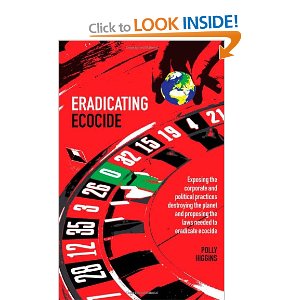
In April 2010 UK Lawyer Polly Higgins proposed to the United Nations that ecocide be recognised as an international Crime Against Peace alongside Genocide, Crimes of Humanity, War Crimes and Crimes of Aggression, triable at the International Criminal Court. More
Polly Higgins is an international environmental lawyer. She believes that change can happen very quickly. She understands how law can act as a catalyst for global change.
Did you know that every government can implement laws overnight? George Bush used emergency laws to shore up Wall Street at the 11th hour and the UK have used them to pass laws on terrorism. It all depends on whether there is a national emergency. Well, now we have an international emergency. So we can do the same worldwide, and put in place an international law of Ecocide. In truth, it’s not that difficult. All that is required is for every nation to agree to vote on it, and then put it to the vote. It’s that simple. Really.
Proposed definition: Ecocide is the extensive destruction, damage to or loss of ecosystem(s) of a given territory, whether by human agency or by other causes, to such an extent that peaceful enjoyment by the inhabitants of that territory has been severely diminished.
In April 2010 a second international legislative proposal was submitted to the United Nations: for the crime of Ecocide to be implemented as a 5th Crime Against Peace under the Rome Statute.
The proposal of Ecocide as a crime of strict liability would impose a prohibition of environmental damage or destruction over a certain size, duration and severity to apply during peace time. To read more about the proposal, see thisisecocide.com
http://www2.ohchr.org/english/issues/environment
„ERADICATING ECOCIDE“ by Polly Higgins: www.amazon.co.uk/Eradicating-Ecocide-Polly-Higgins
The Millennium Development Goals (MDGs) are eight international development goals that all 192 United Nations member states and at least 23 international organizations have agreed to achieve by the year 2015. They include eradicating extreme poverty, reducing child mortality rates, fighting disease epidemics such as AIDS, and developing a global partnership for development. More
Goal 7: Ensure environmental sustainability
Target 7A: Integrate the principles of sustainable development into country policies and programs; reverse loss of environmental resources
Target 7B: Reduce biodiversity loss, achieving, by 2010, a significant reduction in the rate of loss
The Convention on Biological Diversity (CBD), known informally as the Biodiversity Convention, is an international legally binding treaty. The Convention has three main goals:
1. conservation of biological diversity (or biodiversity);
2. sustainable use of its components; and
3. fair and equitable sharing of benefits arising from genetic resources
In other words, its objective is to develop national strategies for the conservation and sustainable use of biological diversity. It is often seen as the key document regarding sustainable development.
The Convention was opened for signature at the Earth Summit in Rio de Janeiro on 5 June 1992 and entered into force on 29 December 1993.
2010 was the International Year of Biodiversity. The Secretariat of the Convention on Biological Diversity is the focal point for the International Year of Biodiversity. At the 2010 10th Conference of Parties (COP) to the Convention on Biological Diversity in October in Nagoya, Japan, the Nagoya Protocol was adopted.
On 22 December 2010, the UN declared the period from 2011 to 2020 as the UN-Decade on Biodiversity. They, hence, followed a recommendation of the CBD signatories during COP10 at Nagoya in October 2010. More
- http://en.wikipedia.org/Equator_Principles
- www.globalwitness.org www.biodiversityhotspots.org
- www.worldviewofglobalwarming.org
- www.endpoverty2015.org UN Millenium Campaign
- http://farmlandgrab.orgwww.biofuelwatch.org.uk
- Meet Ecocide is a Crime, studies at fb
- Meet United Nations Millennium Campaign, friends, fans
(mehr …)
Climate Change, Food Sovereignty & Security
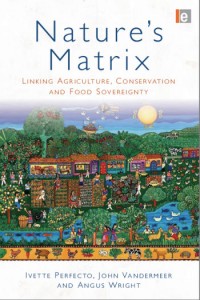
www.oneclimate.net Food security refers to the availability of food and one’s access to it. A household is considered food-secure when its occupants do not live in hunger or fear of starvation. According to the World Resources Institute, global per capita food production has been increasing substantially for the past several decades. In 2006, MSNBC reported that globally, the number of people who are overweight has surpassed the number who are undernourished – the world had more than one billion people who were overweight, and an estimated 800 million who were undernourished. According to a 2004 article from the BBC, China, the world’s most populous country, is suffering from an obesity epidemic. In India, the second-most populous country in the world, 30 million people have been added to the ranks of the hungry since the mid-1990s and 46% of children are underweight.
www.1billionhungry.org Worldwide around 852 million people are chronically hungry due to extreme poverty, while up to 2 billion people lack food security intermittently due to varying degrees of poverty (source: FAO, 2003). Six million children die of hunger every year – 17,000 every day. As of late 2007, export restrictions and panic buying, US Dollar Depreciation,increased farming for use in biofuelsworld oil prices at more than $100 a barrel, global population growth,climate change,loss of agricultural land to residential and industrial development,and growing consumer demand in China and Indiaare claimed to have pushed up the price of grain. However, Nonetheless, food riots have recently taken place in many countries across the world. Read More: > HERE <
As the Nobel Prize-winning economist Amartya Sen has observed that „there is no such thing as an apolitical food problem.“ While drought and other naturally occurring events may trigger famine conditions, it is government action or inaction that determines its severity, and often even whether or not a famine will occur. The 20th century is full of examples of governments undermining the food security of their own nations–sometimes intentionally.
There are many economic approaches advocated to improve food security in developing countries. Three typical approaches are listed below, click here . The first is typical of what is advocated by most governments and international agencies. The other two are more common to non-governmental organizations (NGO’s).
The third approach is known as food sovereignty; though it overlaps with food justice on several points, the two are not identical. It views the business practices of multinational corporations as a form of neocolonialism click here.
It contends that multinational corporations have the financial resources available to buy up the agricultural resources of impoverished nations, particularly in the tropics. They also have the political clout to convert these resources to the exclusive production of cash crops click here ,for sale to industrialized nations outside of the tropics, and in the process to squeeze the poor off of the more productive lands. Under this view subsistence farmers are left to cultivate only lands that are so marginal in terms of productivity as to be of no interest to the multinational corporations. Likewise, food sovereignty holds it to be true that communities should be able to define their own means of production and that food is a basic human right.
With several multinational corporations now pushing agricultural technologies on developing countries, technologies that include improved seeds, chemical fertilizers, and pesticides, crop production has become an increasingly analyzed and debated issue. Many communities calling for food sovereignty are protesting the imposition of Western technologies on to their indigenous systems and agency.
Those who hold a „food sovereignty“ position advocate banning the production of most cash crops in developing nations, thereby leaving the local farmers to concentrate on subsistence agriculture. In addition, they oppose allowing low-cost subsidized food from industrialized nations into developing countries, what is referred to as „import dumping“. Import dumping also happens by way of food aid distribution through programs like the USA’s „Food for Peace“ initiative.
www.fao.org , www.vandanashiva.org Vandana Shiva (Hindi: वन्दना शिवा; b. November 5, 1952, Dehra Dun, Uttarakhand, India), is a philosopher, environmental activist, eco feminist and author of several books. Shiva, currently based in Delhi, is author of over 300 papers in leading scientific and technical journals. She received her Ph.D. in philosophy from the University of Western Ontario, Canada, in 1978 with the doctoral dissertation:“Hidden variables and locality in quantum theory. Read More: > HERE < , Food Commodities Speculation and Food Price Crises http://www.srfood.org
Food Security Guide – Over one billion people experience the hardship that hunger imposes, a figure which continues to rise even amidst the riches of the 21st century. Engulfed within a vortex of population growth, economic instability and climate change, food security has become an urgent challenge for national and global governance. However, the feeble outcome of the 2009 World Summit on Food Security suggests that the richer countries are not yet ready to reorganise their dysfunctional priorities. http://uk.oneworld.net/guides/food
WASHINGTON (MarketWatch) — Those of us who believe that the economy should serve us instead of the other way around are conflicted. We know that the only way to end unemployment at home and poverty around the world is to make the economy grow faster. But we also know that nothing can grow forever, that the faster the global economy grows, the sooner we’ll run out of essential resources, including fossil fuels, water, arable land, healthy ecosystems and moderate climate. Economists and politicians can’t admit it, but the laws of physics apply, no matter what the latest polls tell us. The Earth has finite resources that will someday limit our economic growth.
The Earth cannot forever support 7 billion people consuming as much as Americans consume. And yet we’ve staked our future — individually, nationally, and maybe even as a species — on that impossible dream.
SOLUTIONS – Prosperity Without Growth, Professor Tim Jackson: Growth has delivered its benefits, at best, unequally. A fifth of the world’s population earns just 2% of global income. Inequality is higher in the OECD nations than it was 20 years ago. And while the rich got richer, middle-class incomes in Western countries were stagnant in real terms long before the recession. Far from raising the living standard for those who most needed it, growth let much of the world’s population down. Wealth trickled up to the lucky few.
Accordingly, this report sets out a critical examination of the relationship between prosperity and growth. It acknowledges at the outset that poorer nations stand in urgent need of economic development. But it also questions whether ever-rising incomes for the already-rich are an appropriate goal for policy in a world constrained by ecological limits. Its aim is not just to analyse the dynamics of an emerging ecological crisis that is likely to dwarf the existing economic crisis. But also to put forward coherent policy proposals that will facilitate the transition to a sustainable economy. In short, this report challenges the assumption of continued economic expansion in rich countries and asks: is it possible to achieve prosperity without growth?
In short, a ‘green stimulus’ is an eminently sensible response to the economic crisis. It offers jobs and economic recovery in the short term, energy security and technological innovation in the medium term, and a sustainable future for our children in the long term. Nonetheless, the default assumption of even the ‘greenest’ Keynesian stimulus is to return the economy to a condition of continuing consumption growth. Since this condition is unsustainable, it is difficult to escape the conclusion that in the longer term something more is needed. A different kind of macro-economic structure is essential for an ecologically-constrained world.
The above is an excerpt www.ecobuddhism.org : The full report can be downloaded here .
Available in PDF: New briefing: Food safety for whom? Corporate wealth versus people’s health by GRAIN, May 2011, further informations: www.corpwatch.org
A new briefing by GRAIN examines how „food safety“ is being used as a tool to increase corporate control over food and agriculture, and discusses what people can do and are doing about it. Below is a snapshot of what’s inside. The full briefing is available here.
View some additional photos here.
Relay Hunger Strike to Kirti Gompa
Kirti Gompa (Tibetan: ཀིརྟི་དགོན་པ།), (sometimes referred to as Ge’erdengsi or Gerdeng Monastery), properly known as Kirti Kalari Gon Tashi Lhundrub, is a Gelugpa monastery on the northwestern edge of Ngawa City, the main city in Ngawa County, within the Ngawa Tibetan and Qiang Autonomous Prefecture in northwestern Sichuan, China. It is located on the Tibetan plateau at an elevation of 3,200 metres (10,499 ft.) Read More: > HERE <
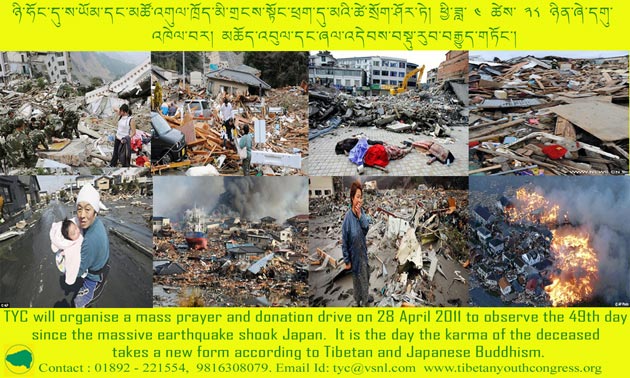
The Fukushima I nuclear accidents (福島第一原子力発電所事故, Fukushima Dai-ichi are a series of ongoing equipment failures and releases of radioactive materials at the Fukushima I Nuclear Power Plant, following the 9.0 magnitude Tōhoku earthquake and tsunami on 11 March 2011.The plant comprises six separate boiling water reactors maintained by the Tokyo Electric Power Company (TEPCO). This accident is the largest of the 2011 Japanese nuclear accidents arising from the Tōhoku earthquake and tsunami, and experts consider it to be the second largest nuclear accident after the Chernobyl disaster, but more complex as all reactors are involved. Read more: > HERE <
TYC will organise a mass prayer and donation drive on 28th April 2011 to observe the 49th day since the massive earthquake shook Japan.
Relay Hunger Strike to demand immediate withdrawal of Chinese troops from Kirti Monastery in Tibet – TYC launched today indefinite Relay Hunger Strike near Main Temple (Tsuklagkhang) to protest against the critical situation in and around Kirti Monastery in Ngaba, Tibet. 15 monks from Institute of Buddhist Dialectics today participated in the first batch of hunger strike. We are also collecting signatures at the site on the petition demanding immediate withdrawal of Chinese troops. All Regional chapters of TYC has also been instructed to launch relay hunger strike. Please see the statement on this campaign.
www.studentsforafreetibet.org against Chinas „Re – Education Programme“ and for Human Rights 4 All
- www.tibetoralhistory.org
- Save Mountain Minorities, Tibetan Nomads, Indigenous People <
- www.uranium-network.org www.minesandcommunities.org
- http://stopminingtibet.com www.meltdownintibet.com
- Nuclear Safety: http://www.barentsobserver.com/index.php?cat=156838
- IPPNW Int. Physicans to prevent Nuclear War at fb <
- Meet International friends of Tibetan Youth Congress at fb <
- Meet Students for a free Tibet at fb <
- http://www.amnesty.org/en/economic-social-and-cultural-rights <
- Meet Human Rights Watch International at fb <
Saving the Bedouin Heritage and Biodiversity

Libyan Bedouin Camp, Dubai Heritage Village
http://portal.unesco.org/intangible
The Bedouin are a part of the predominantly desert-dwelling Arab ethnic group. Specifically the term refers only to the „camel-raising“ tribes, but due to economic changes many are now settled or raising sheep. Also due to linguistic and cultural changes the term is now often applied in many ways either to Arabs in general or to desert dwellers or nomads.
Bedouins are traditionally divided into tribes or clans, known in Arabic as ʿašÄ�ʾir (عَشَائِر). A widely quoted Bedouin saying is „I against my brother, my brothers and me against my cousins, then my cousins and I against strangers„. This saying signifies a hierarchy of loyalties based on closeness of kinship that runs from the nuclear family through the lineage, the tribe, and even, in principle at least, to an entire ethnic or linguistic group (which is perceived to have a kinship basis). Read more: > HERE <
The Negev Bedouin (Arabic: بدو النقب, Badū an-Naqab) are traditionally pastoral semi-nomadic Arab tribes indigenous to the Negev region in Israel, who hold close ties to the Bedouin of the Sinai Peninsula. The forced alteration of their traditional lifestyle has led to sedentarization. Estimated to number some 160,000,they comprise 12% of the Arab citizenry of Israel.Of Israel’s total population, 12% live in the Negev,and Negev Bedouin constitute approximately 25% percent of the total population therein. Read More: > HERE <
The Bedouin heritage Project was founded to help safeguard the unique cultural heritage of Bedouin communities around the globe. Founded on the principles of the UNESCO Intangible Cultural Heritage.
The Non Profit Association will foster projects to help safeguard the intangible cultural heritage of Bedouin communities throughout the Middle East following the basic principles:
- The collection and intergenerational transmission of oral heritage; and
- The transmission and adaptation of knowledge and know-how.
The Wadi Rum project in Jordan is promoted by the Bedouin Heritage Project. The principal goal of the project is to safeguard the main features of the lifestyle and oral history of the Bedu that have developed in Wadi Rum region over the course of millennia and that are being lost due to inevitable societal changes.
The BHP’s Wadi Rum project goal is to participate, record, represent and ultimately safeguard the many facets of the Bedouin lifestyle, social system, traditions, medicine and oral history. This two year project will incorporate the best practices of cultural and media anthropology including video, photography, audio, figurative art, journalism, academic research, sensory memory and genealogy.
While the initial project is local in nature, the best practices established should serve as a model for future projects throughout Jordan and the middle east. In order to achieve the project’s goals and deliver a living memory to the Bedu themselves, new methodologies for authenticate representation of intangible heritage and oral traditions will be required and, ideally, will be transfered to similar projects around the world.
“If we begin to see each other as we are…brothers, all striving for the same things and with the same problems…then maybe we can begin to put an end to this madness. We are fathers, mothers, sisters, brothers, bosses, employees, emigrants, lovers and, most of all, children.
As long as we highlight differences in our cultures, traditions and lives, then a true dialogue can never begin. However, once we show respect for the traditions, history and lifestyle of other peoples, then we can truly begin to talk about the numerous problems we all face.”
Sabah and Salem Ali lafi explain the harvesting and application of common desert plant medicines. The Bedouin heritage Project offers a unique insight into the medicinal plants the bedouin of Wadi Rum, Jordan, have used for centuries. Sabbah ali Lafi and his brother Salem share their traditions in words and images.
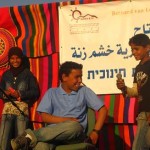
NISPED-AJEEC is dedicated to offering educational programs for children of all ages that meet the needs and traditions of the Arab-Bedouin community. Our staff and volunteers work together with community educators, parents and residents in the planning and running of these programs. NISPED-AJEEC’s initiatives include early childhood day-care centers – Bet El-Umm Wal-Tifil (The House of the Mother and the Child) – educational activity centers in unrecognized villages for children of all ages and special summer camps and activities.
This innovative pilot project, initiated in April 2006, provides an enriching, stimulating, accessible and safe after-school environment for children ages 4 to 8 in two unrecognized Arab Bedouin villages, Hashem Zane and Qassar el Sar, where no such services existed.
The playgrounds are located in a readily accessible public space in the village, selected for this purpose by the communities. Each playground consists of a large fenced-in play area and a small playing field. The play areas are equipped with safe playground equipment – swings, see-saws, slides, jungle gyms, sandbox, utilizing recycled materials such as tires, cable spools, and more. Adjacent to the playgrounds are tents that provide sheltered area for indoor play and enrichment activities.
The playgrounds are open daily after school hours, on weekends and during school breaks. Responsibility for operation of the program and care and maintenance of playgrounds are in the hands of a staff of specially trained men and women employed on a part-time basis, assisted by high school students from the community who are trained as junior counselors. During the academic year (November-June) AJEEC’s Bedouin Volunteer Center deploys student volunteers to provide educational enrichment, tutoring and help with homework for children in need of assistance and coaching, while parents and other members of the community will be encouraged to volunteer their services to help in running the program.
The playgrounds and educational activity centers are designed and equipped to provide a wide range of activities suitable for both girls and boys of different ages and interests, both outdoor and indoor, within an area sufficiently large to provide ample room for free and easy movement.